


G GCSE Apps

GCSE Science

P7 Magnetism and electromagnetism

4 subtopics in this section

Magnets and magnetic fields

Definition

A magnet has a north (north-seeking) and a south (south-seeking) pole, where its force is strongest.

A permanent magnet has its own magnetic field all the time. An induced magnet is a magnetic material that becomes a magnet only while it is in a magnetic field, and quickly loses its magnetism when removed.

The magnetic field is the region around a magnet where another magnet or a magnetic material (iron, steel, cobalt, nickel) feels a force.

Method

Like poles repel and unlike poles attract. These are non-contact forces.

The field direction at a point is the direction of the force on a north pole placed there, so field lines run from N to S outside the magnet.

To plot a field, mark where a plotting compass points, move the compass so its tail is on the mark, and repeat from N to S. Join the marks and add arrows.

Diagram
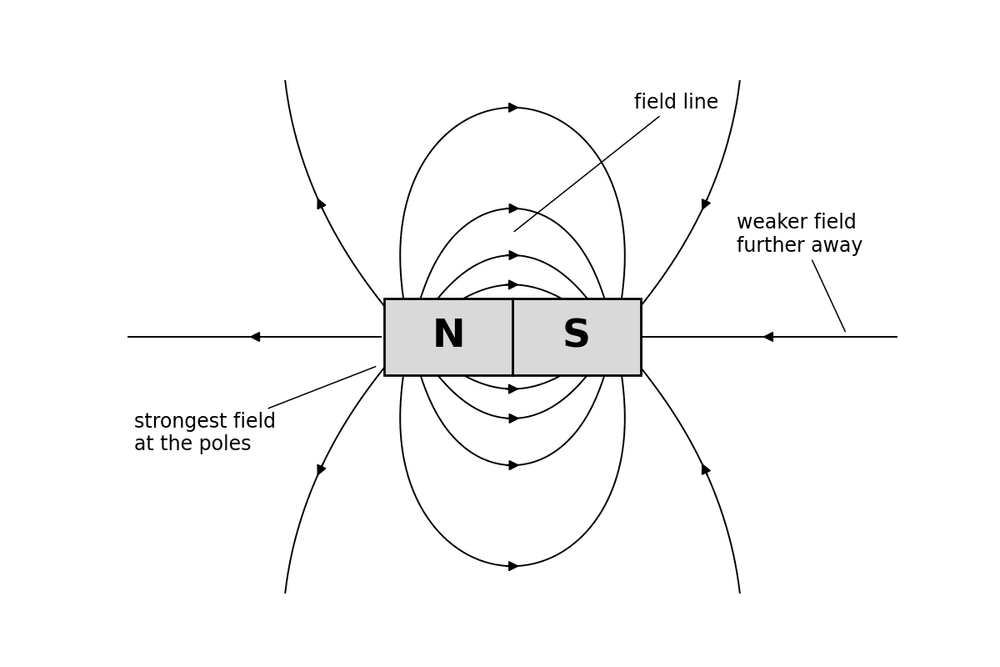
phys bar magnet field

Note

Field lines leave the N pole and enter the S pole. They are closest together at the poles, where the field is strongest.

Example

The north pole of a bar magnet is held near one end of a small iron bolt. Why is the bolt attracted, and what happens if the magnet is turned round?

Solution

The field makes the bolt an induced magnet with a south pole nearest the magnet's north pole, and unlike poles attract.

Turned round, the magnet induces a north pole in the near end of the bolt, so it is still attracted.

Tips/hints

Not all metals are magnetic: copper, aluminium and brass are not.

A compass needle is a small bar magnet. Away from magnets it lines up with Earth's field, which shows that Earth's core is magnetic. Its north pole points north, so the magnetic pole near geographic north is a south pole.
Electromagnetism

Definition

A current in a wire produces a magnetic field around the wire. The field is stronger when the current is larger and weaker further from the wire.

A solenoid is a wire wound into a long coil. An electromagnet is a solenoid with an iron core.

Method

To show the field, pass a vertical wire through a card and place plotting compasses around it. With a current, the compasses line up in circles; reversing the current reverses them all.

Right-hand grip rule: grip the wire with your right hand, thumb along the current (+ to −). Your fingers curl in the direction of the field.

In a solenoid the fields of the turns add up. Inside, the field is strong and uniform; outside, it has the shape of a bar magnet's field. Looking at an end, an anticlockwise current makes a north pole and a clockwise current a south pole.

An electromagnet is made stronger by a bigger current, more turns or an iron core.

Diagram

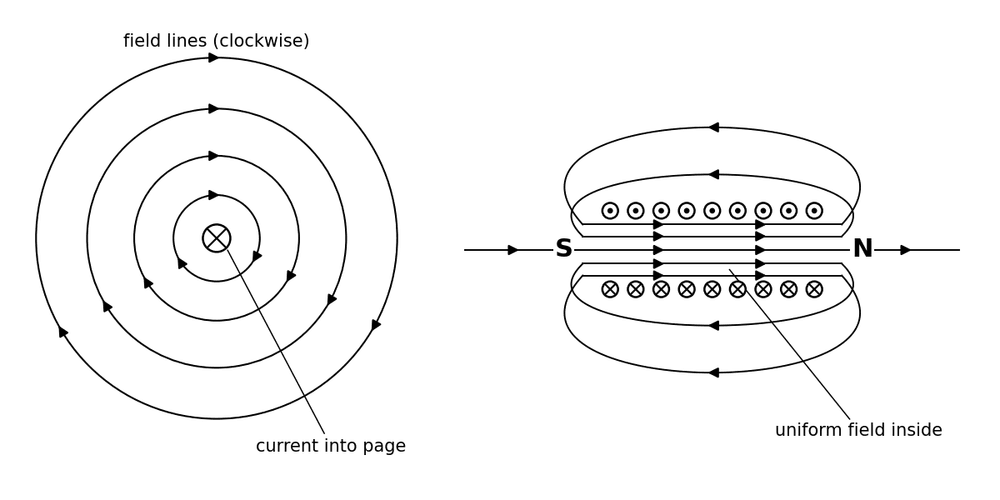
phys wire and solenoid fields

Note

Left: current into the page gives clockwise circles, spaced further apart where the field is weaker. Right: the solenoid's field is uniform inside and leaves the N end, looping round to the S end.

Example

A wire is drawn end-on with its current coming out of the page. Which way does its magnetic field circle?

Solution

Point the right thumb out of the page, towards you.

The fingers curl anticlockwise, so the field lines are anticlockwise circles centred on the wire.

Tips/hints

Reversing the current reverses the field's direction, not its shape or strength.

Soft iron is used for the core because it loses its magnetism when the current stops, so the electromagnet can be switched off. Steel would stay magnetised.

Fleming's left-hand rule (Higher)

Definition

When a wire carrying a current is placed in a magnetic field, the field of the current and the field of the magnet interact, so the wire feels a force. The magnet feels an equal and opposite force. This is the motor effect.

The force is greatest when the wire is at right angles to the field. A wire lying parallel to the field feels no force.

Method

Fleming's left-hand rule: hold the thumb, first finger and second finger of your LEFT hand at right angles. First finger = Field (north to south), seCond finger = Current (+ to −), thuMb = Motion (force).

Reversing either the current or the field reverses the force. Reversing both leaves it unchanged.

F = B I l, so force = magnetic flux density × current × length. F is in newtons (N), B in tesla (T), I in amps (A) and l in metres (m).

Diagram

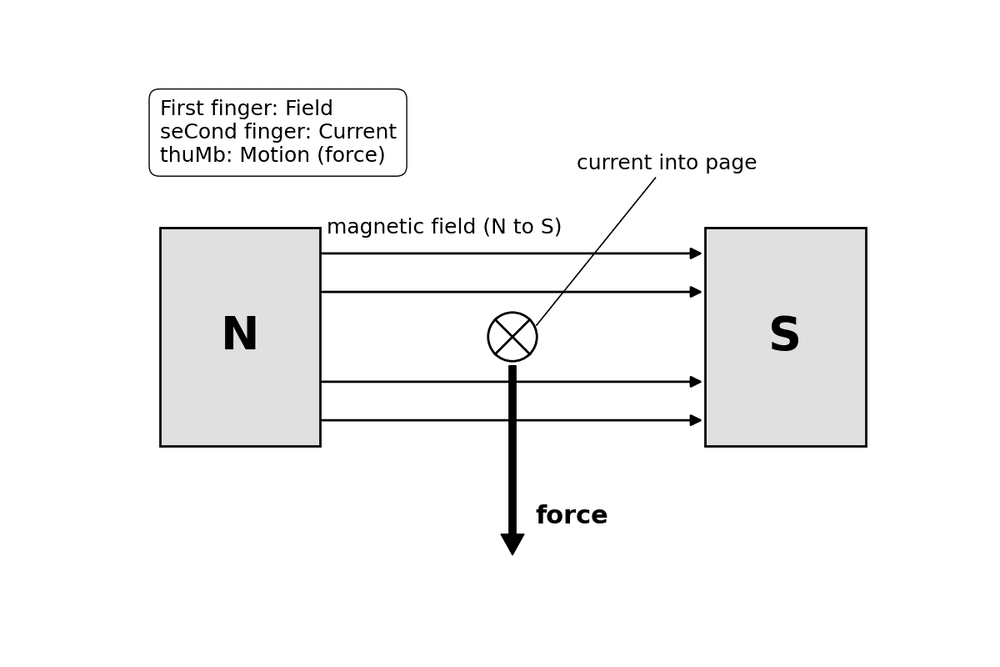
phys motor effect wire

Note

The field points from N to S and the current flows into the page. With the first finger pointing to the right and the second finger into the page, the thumb points down, so the force on the wire is downwards.

Example

A wire at right angles to a 0.25 T field carries a current of 4.0 A. 30 cm of the wire is inside the field. What is the force on it?

Solution

Convert the length: 30 cm = 0.30 m.

F = B I l = 0.25 × 4.0 × 0.30 = 0.30 N.

Tips/hints

Convert cm to m (÷ 100), mA to A and mT to T (÷ 1000) before using the equation.

Use only the length of wire that is inside the field, not the whole wire.

Use your left hand: the right hand gives the opposite force.

Electric motors (Higher)

Definition

A coil of wire carrying a current in a magnetic field tends to rotate. This is how a simple electric motor works.

Method

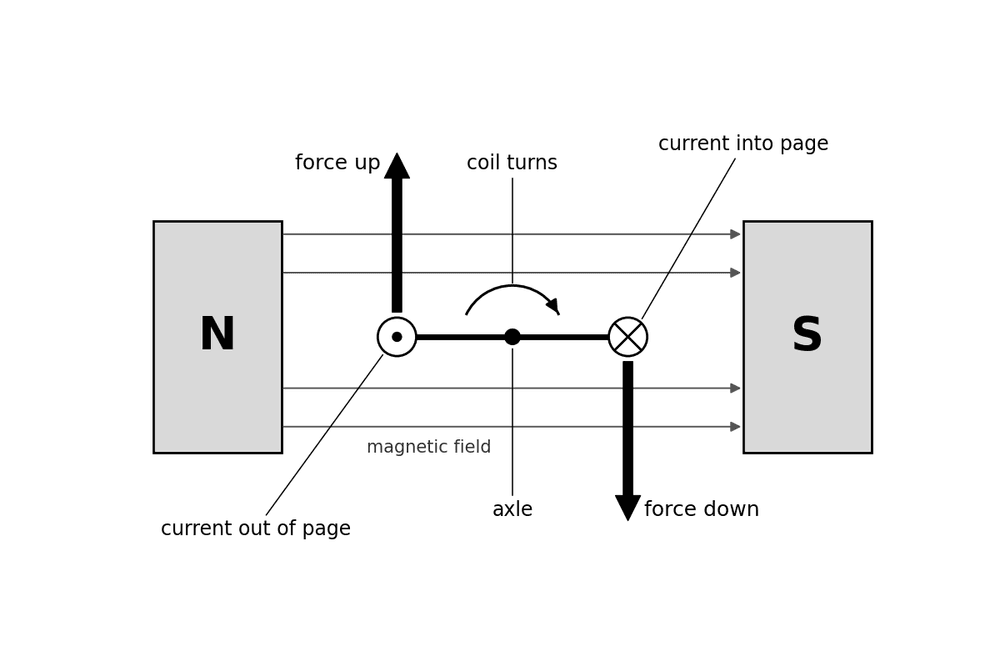
The two sides of the coil at right angles to the field carry current in opposite directions. By Fleming's left-hand rule they feel forces in opposite directions, one up and one down, so the coil turns about its axle.

The turning effect is greatest when the coil is parallel to the field. When the coil is at right angles to the field, the forces just pull the sides apart and there is no turning effect.

A split-ring commutator reverses the current in the coil every half turn, so the coil keeps turning the same way.

Faster motor: bigger current, stronger magnet or more turns. Opposite rotation: reverse the current or swap the poles, not both.

Diagram

phys dc motor end view

Note

End view along the axle. The side carrying current out of the page is pushed up and the side carrying current into the page is pushed down, so the coil turns clockwise.

Example

Each side of a motor coil has 8.0 cm inside a 0.50 T field, at right angles to it, and carries 1.5 A. What force acts on each side?

Solution

Convert the length: 8.0 cm = 0.080 m.

F = B I l = 0.50 × 1.5 × 0.080 = 0.060 N (force = magnetic flux density × current × length).

The two forces are equal in size but opposite in direction, so together they turn the coil.

Tips/hints

The commutator keeps the motor turning one way; it does not increase the current or the speed.

Explain rotation step by step: current in each side, opposite forces, turning effect.

Test yourself on this topic

Try the free quiz with worked solutions.

Start quiz →

Get GCSE Science

Full notes, full question bank, offline.