





G GCSE Apps

GCSE Science

C9 Chemistry of the atmosphere

5 subtopics in this section

The atmosphere now and in the past

Definition

For about 200 million years, the proportions of gases in the atmosphere have been much the same as today. Dry air is about 78% nitrogen (roughly four-fifths) and about 21% oxygen (roughly one-fifth).

Small amounts of other gases make up the remaining 1%, including argon and carbon dioxide (about 0.04%).

The Earth is about 4.6 billion years old. Scientists think that during the first billion years, intense volcanic activity released gases that formed the early atmosphere. It was mostly carbon dioxide with little or no oxygen, similar to Mars and Venus today.

Method

Volcanoes also released water vapour. As the Earth cooled, this water vapour condensed to form the oceans.

When the oceans formed, carbon dioxide dissolved in the water. Carbonates precipitated as sediments, reducing the amount of carbon dioxide in the atmosphere. Nitrogen was also released by volcanoes and gradually built up, along with small amounts of methane and ammonia.

Diagram
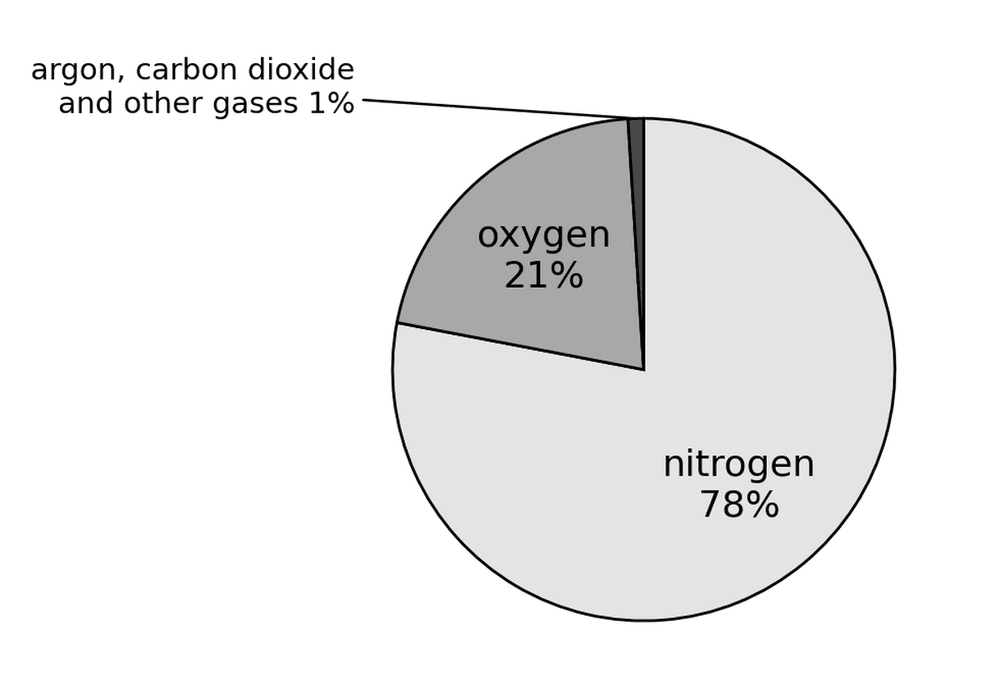
chem atmosphere composition pie

Note

A pie chart showing the composition of today's atmosphere. The small 1% slice includes argon, carbon dioxide and other gases.

Example

A balloon holds 3.0 dm3 of air. Estimate the volumes of nitrogen and oxygen in it.

Solution

Nitrogen is about four-fifths: 3.0 × 4 ÷ 5 = 2.4 dm3.

Oxygen is about one-fifth: 3.0 ÷ 5 = 0.6 dm3.

Tips/hints

Evidence for the early atmosphere is limited because it existed 4.6 billion years ago. Theories change as new evidence is found.

Do not confuse today's atmosphere with the early atmosphere: today there is mostly nitrogen, but the early atmosphere was mostly carbon dioxide.

Air is not mostly oxygen, and carbon dioxide is only a tiny fraction (0.04%) today.

In calculations, use four-fifths (80%) for nitrogen and one-fifth (20%) for oxygen unless the question gives other values.
How oxygen increased and carbon dioxide decreased

Definition

The Earth's early atmosphere was mostly carbon dioxide. Over billions of years, the percentage of carbon dioxide decreased and the percentage of oxygen increased. Today's atmosphere is about 78% nitrogen, 21% oxygen, and only 0.04% carbon dioxide.

Method

Oxygen increased because algae and plants carried out photosynthesis: carbon dioxide + water → glucose + oxygen (6CO2 + 6H2O → C6H12O6 + 6O2). Algae began producing oxygen about 2.7 billion years ago.

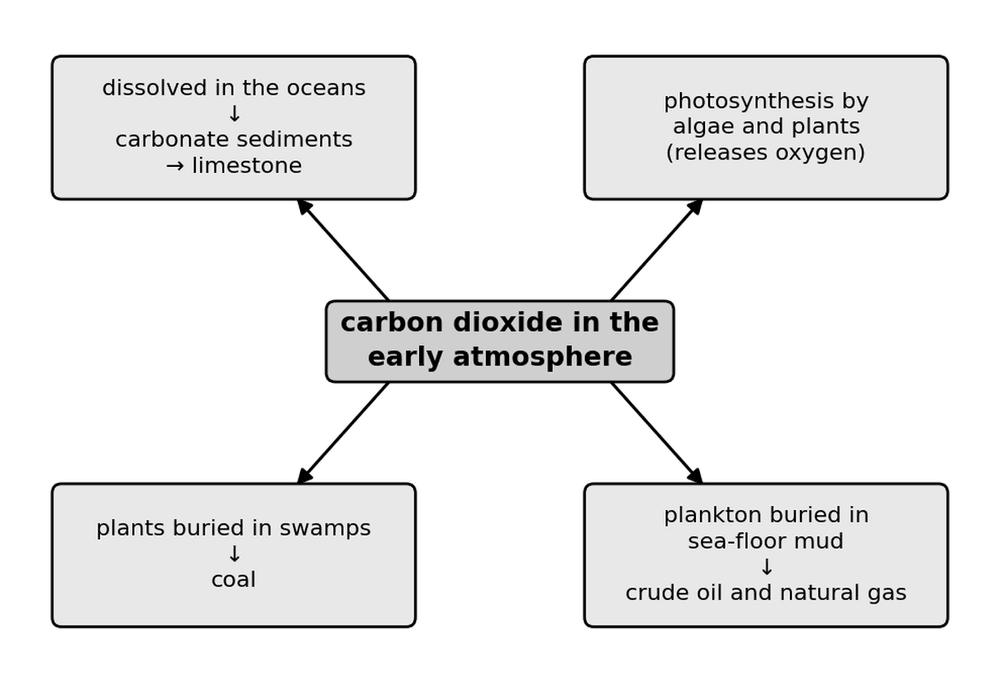
Carbon dioxide decreased because it dissolved in the oceans, where carbonates precipitated as sediments. Plants and algae also absorbed it for photosynthesis. Over millions of years, carbon became locked up in sedimentary rocks like limestone (calcium carbonate from marine shells) and fossil fuels.

Coal formed from thick plant deposits in swamps. Crude oil and natural gas formed from tiny plankton buried in sea-floor mud.

Diagram

chem carbon dioxide removal

Note

Carbon dioxide was removed from the early atmosphere by dissolving in the oceans, photosynthesis by algae and plants, and forming fossil fuels such as coal, crude oil and natural gas.

Example

A limestone cliff is made of the shells of sea creatures that lived millions of years ago. Explain how the cliff stores carbon that was once in the atmosphere.

Solution

Carbon dioxide from the air dissolved in the oceans.

Sea creatures used the dissolved carbonate to build shells of calcium carbonate.

When they died, the shells settled as sediment and were compressed over millions of years into limestone, locking the carbon away.

Tips/hints

Remember that animals do not remove carbon dioxide; they release it by respiration.

Do not mix up the fossil fuels: coal comes from plants, while crude oil and natural gas come from plankton.

Limestone was formed from marine shells and skeletons, not from plants.

Greenhouse gases and human activity

Definition

Greenhouse gases in the atmosphere maintain temperatures on Earth high enough to support life. Water vapour, carbon dioxide and methane are greenhouse gases.

Without the greenhouse effect, the Earth's average surface temperature would be much colder (about −18 °C instead of 15 °C).

Method

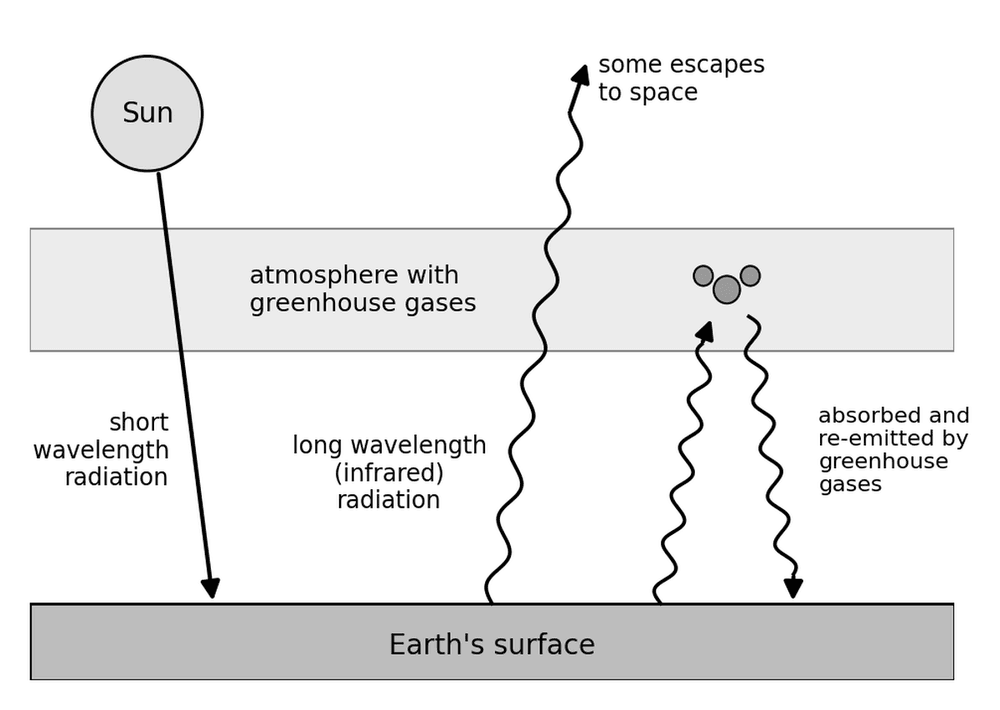
The greenhouse effect: Short wavelength radiation (such as visible light) from the Sun passes through the atmosphere and warms the Earth's surface. The surface emits long wavelength (infrared) radiation. Greenhouse gases absorb some of this long wavelength radiation and re-emit it in all directions, warming the lower atmosphere.

Human activities: burning fossil fuels, deforestation and making cement increase carbon dioxide. Cattle farming, rice fields, landfill sites and leaks from natural gas extraction increase methane.

Evidence: Based on peer-reviewed evidence, many scientists believe human activities will cause global climate change. However, climate is complex and hard to model, which can lead to simplified models, speculation and biased media reports.

Diagram

chem greenhouse effect

Note

Short wavelength radiation from the Sun passes through the atmosphere. The surface emits long wavelength (infrared) radiation: some escapes to space, and some is absorbed and re-emitted by greenhouse gases.

Example

A newspaper claims a single cold winter proves global warming has stopped. Why is this reasoning flawed?

Solution

A single cold winter is a short-term variation in local weather, whereas climate change is based on long-term, global trends over many years.

The newspaper may be presenting a biased or oversimplified view, ignoring peer-reviewed evidence that shows a long-term increase in average global temperatures.

Tips/hints

Greenhouse gases do not trap incoming sunlight. They absorb the outgoing long wavelength radiation emitted by the Earth.

Nitrogen and oxygen make up 99% of the atmosphere but they are not greenhouse gases.

Peer review means other scientists check the research before it is published to ensure it is valid.

Climate change and carbon footprint

Definition

Climate is the long-term average weather of a region; weather is the day-to-day conditions. A rise in the average global temperature is a major cause of climate change.

Possible effects: sea levels rise (ice on land melts and warmer sea water expands), causing flooding and coastal erosion; storms become more frequent and severe; the amount, timing and pattern of rainfall change; people and wildlife face heat and water stress; some regions can produce less food.

The carbon footprint is the total carbon dioxide and other greenhouse gases emitted over the full life cycle of a product, service or event: raw materials, manufacture, transport, use and disposal.

Method

Reduce carbon dioxide: use renewable or nuclear energy instead of fossil fuels, use less energy (insulation, efficient appliances, public transport), carbon capture and storage, carbon taxes and licences, and carbon offsetting such as planting trees.

Reduce methane: send less waste to landfill and burn landfill gas as a fuel.

Actions may be limited by disagreement about causes, lack of information, people unwilling to change lifestyles, cost, and lack of international cooperation.

Diagram

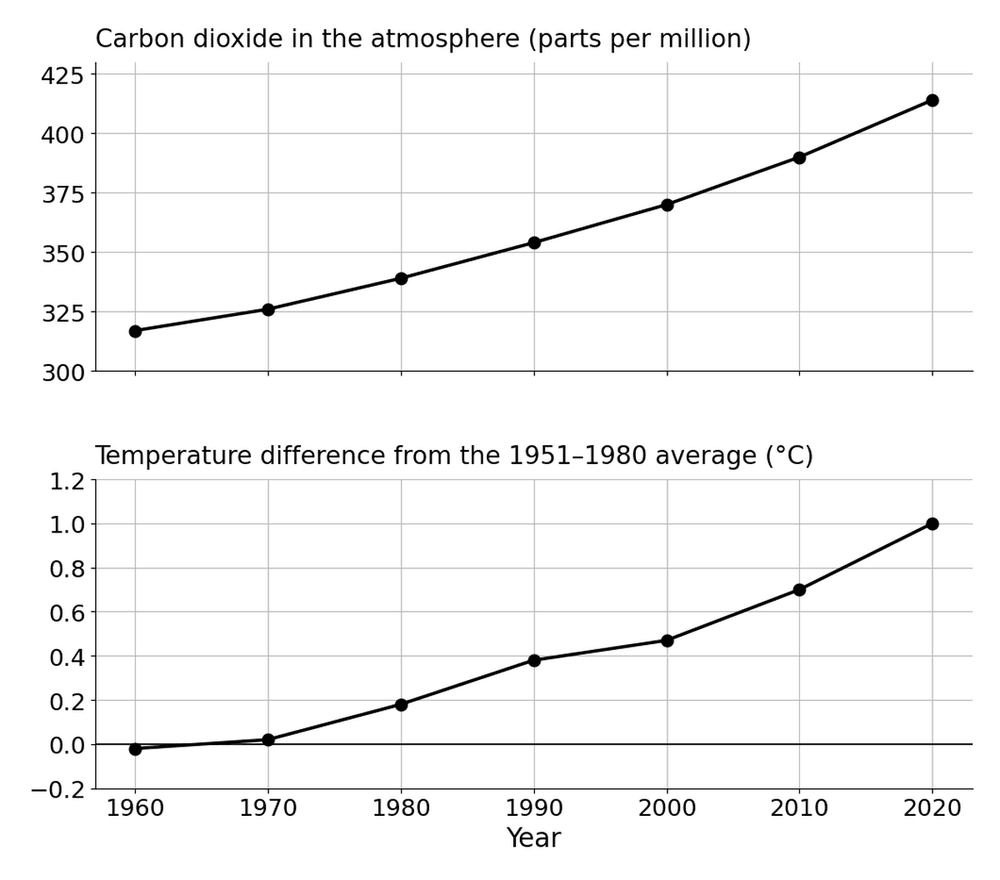
chem co2 temperature graph

Note

Carbon dioxide and the global temperature difference from the 1951–1980 average both rise from 1960 to 2020: a correlation.

Example

A school concert has a carbon footprint of 600 kg of carbon dioxide (travel 450 kg, electricity 90 kg, food 60 kg). Which stage should be cut first?

Solution

Travel gives 450 ÷ 600 × 100 = 75% of the footprint, so encouraging shared lifts, buses or walking would make the biggest reduction.

Tips/hints

A correlation does not prove cause on its own; the cause is supported by how greenhouse gases absorb radiation and by peer-reviewed models.

One cold winter is weather, not evidence about climate.

Include every life-cycle stage in a footprint, not just making or using the product.

Atmospheric pollutants

Definition

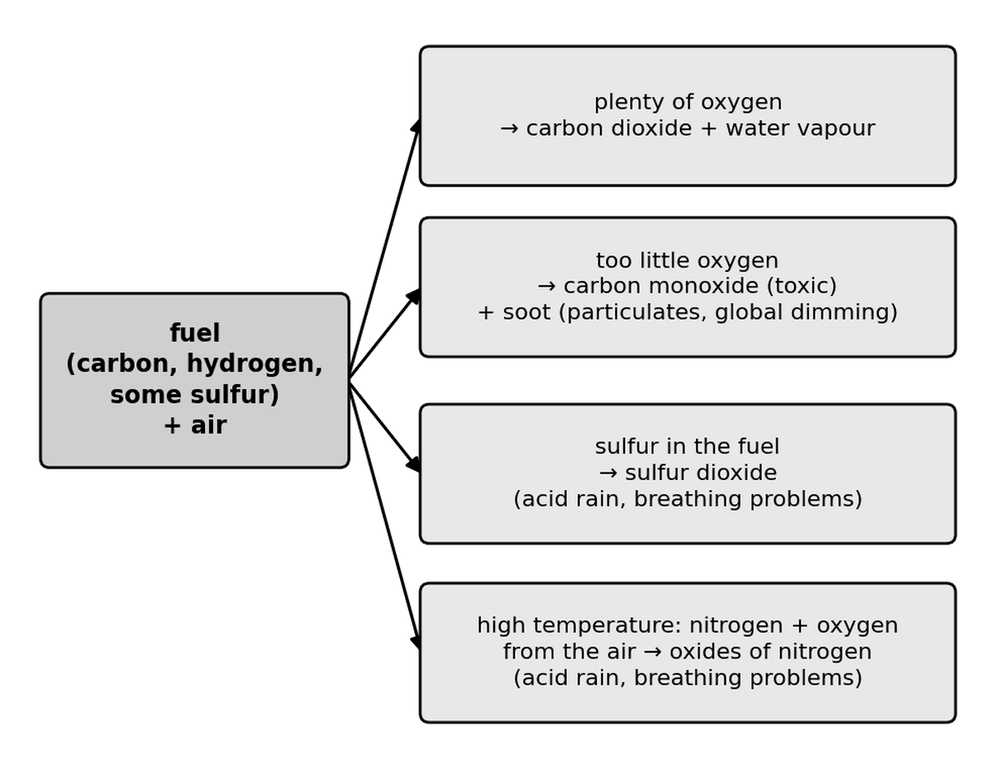
Most fuels, including coal, petrol and natural gas, contain carbon and hydrogen. Some fuels also contain small amounts of sulfur.

When burned in plenty of oxygen (complete combustion), the carbon and hydrogen react to form carbon dioxide and water vapour.

If there is not enough oxygen (incomplete combustion), toxic carbon monoxide and soot (solid carbon particulates) are produced instead.

Method

Other pollutants form depending on the fuel's impurities and how it is burned:

Sulfur dioxide (SO2): Forms when sulfur impurities in the fuel react with oxygen from the air (S + O2 → SO2). It causes acid rain and breathing problems.

Oxides of nitrogen (e.g. NO, NO2): Form when the high temperatures in car engines cause nitrogen and oxygen from the air to react together. They also cause acid rain and breathing problems.

Diagram

chem pollutants from fuels

Note

What forms when a fuel burns depends on the oxygen supply, the impurities in the fuel and the temperature. Each box shows the pollutant and its effects.

Example

Petrol contains carbon and hydrogen but no sulfur. Predict the pollutants a car engine releases when the petrol burns in limited air at a high temperature.

Solution

Carbon with too little oxygen: carbon monoxide and soot (as well as some carbon dioxide).

Hydrogen: water vapour.

High temperature: nitrogen and oxygen from the air form oxides of nitrogen.

No sulfur in the fuel, so no sulfur dioxide.

Tips/hints

Remember that the nitrogen in oxides of nitrogen comes from the air, not from the fuel itself.

Carbon monoxide is dangerous because it is colourless, odourless, and reduces the amount of oxygen your blood can carry.

Do not confuse global warming (caused by greenhouse gases like carbon dioxide) with global dimming (caused by particulates blocking sunlight).

Test yourself on this topic

Try the free quiz with worked solutions.

Start quiz →

Get GCSE Science

Full notes, full question bank, offline.