


G GCSE Apps

GCSE Science

C8 Chemical analysis

4 subtopics in this section

Pure substances and formulations

Definition

In chemistry, a pure substance is a single element or compound with nothing else mixed in.

A formulation is a mixture designed as a useful product. Each component is added in a measured amount so the product has the exact properties needed.

Fuels, paints, medicines, alloys and fertilisers are formulations.

Method

Test if a sample is pure by measuring its melting or boiling point and comparing it with data-book values.

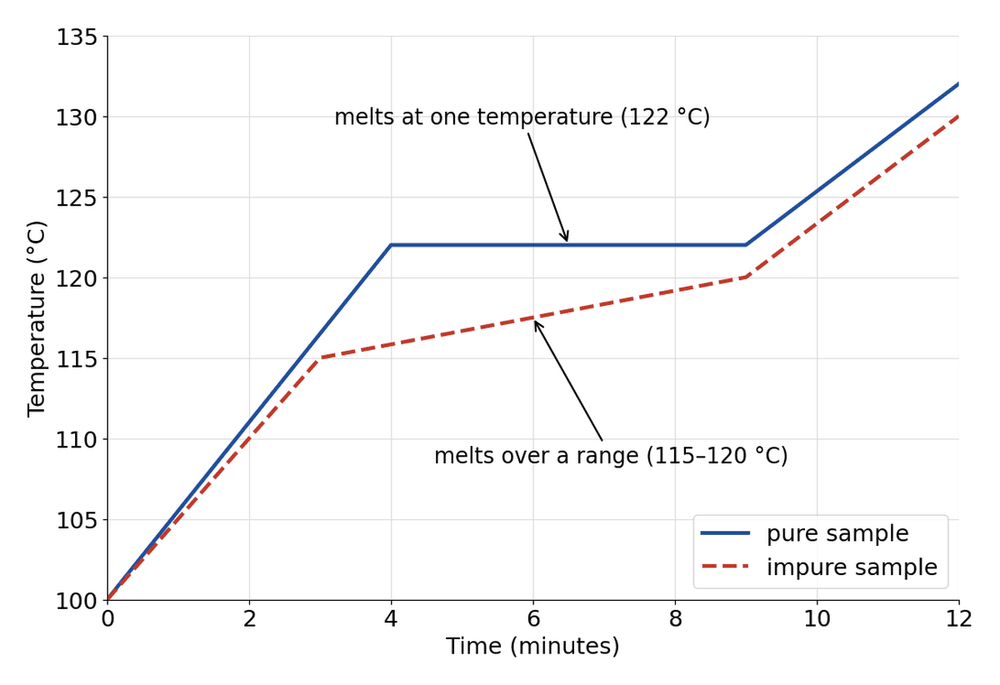
A pure substance melts and boils at exact temperatures.

A mixture melts over a range of temperatures (usually lower than the pure substance). It boils over a range (usually higher).

Diagram
chem melting pure impure

Note

A pure sample melts at one temperature (122 °C). An impure sample melts over a range (115–120 °C).

Example

A data-book boiling point for a pure liquid is 65 °C. A student's sample boils from 67 °C to 71 °C. Is the sample pure?

Solution

No, it is a mixture (impure). It boils over a range of temperatures (67 °C to 71 °C) rather than at a single temperature, and the boiling point is higher than 65 °C.

Tips/hints

In everyday language, "pure" means nothing artificial is added (e.g. pure orange juice). In chemistry, these are mixtures.

Impurities usually lower the melting point but raise the boiling point.

A formulation is a designed mixture; its ingredients are not chemically bonded together.
Chromatography

Definition

Chromatography separates the substances in a mixture and helps identify them.

There are two phases: the stationary phase (the paper, which does not move) and the mobile phase (the solvent, which moves up the paper).

A substance that is more soluble in the solvent, or less attracted to the paper, travels further. An insoluble substance stays on the start line.

Method

Rf = distance moved by substance ÷ distance moved by solvent

Measure both distances from the start line: to the centre of the spot and to the solvent front. Rf has no units and is always less than 1.

Diagram

chem chromatogram rf values

Note

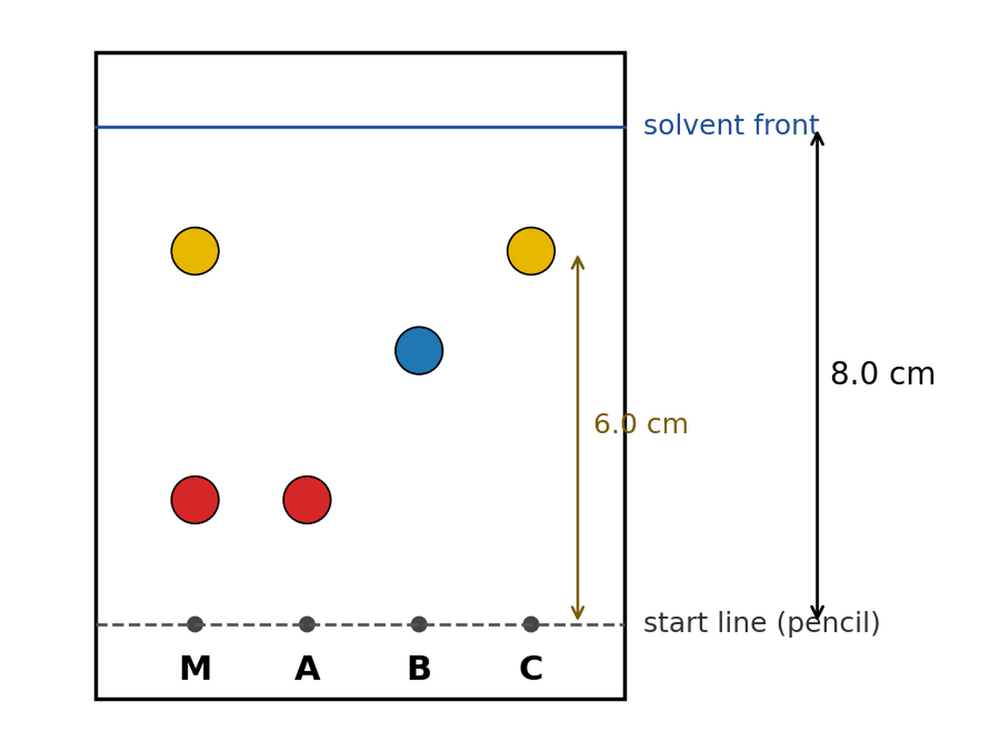
A chromatogram of mixture M and reference substances A, B and C. Mixture M contains A and C, but not B. The Rf values are: A = 0.25, B = 0.55, C = 0.75.

Example

Using the diagram, calculate the Rf value for substance C.

Solution

Distance moved by substance C from the start line = 6.0 cm.

Distance moved by the solvent from the start line = 8.0 cm.

Rf = 6.0 ÷ 8.0 = 0.75.

Tips/hints

A pure compound gives one spot in every solvent. Two substances can travel together as one spot in some solvents, so one spot in one solvent does not prove purity.

A substance has a fixed Rf in a given solvent, but a different Rf in a different solvent. Compare unknowns with references run in the same solvent.

An Rf greater than 1 means you divided the wrong way round.

Tests for gases

Definition

Four common gases each have their own test: hydrogen, oxygen, carbon dioxide and chlorine.

Method

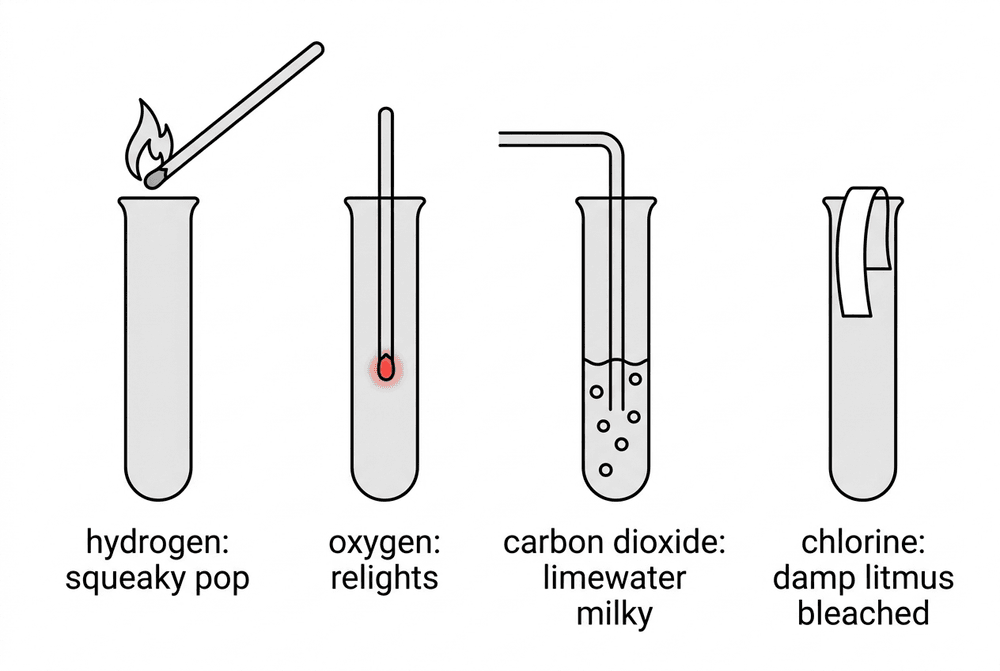
Hydrogen: Hold a burning splint at the open mouth of a test tube of the gas. If hydrogen is present, it burns rapidly with a squeaky pop.

Oxygen: Put a glowing splint (one that has been lit and blown out so it just glows) into a test tube of the gas. If oxygen is present, the splint relights.

Carbon dioxide: Bubble the gas through limewater (calcium hydroxide solution), or shake the gas with limewater. If carbon dioxide is present, the limewater turns milky (cloudy).

Chlorine: Put damp litmus paper into the gas. If chlorine is present, the paper is bleached white (blue litmus may turn red first). Chlorine is toxic, so this should be done in a fume cupboard.

Diagram

chem four gas tests

Note

Left to right: a burning splint at the mouth of the tube (hydrogen: squeaky pop), a glowing splint inside the tube (oxygen: relights), gas bubbled through limewater (carbon dioxide: limewater milky) and damp litmus paper in the tube (chlorine: damp litmus bleached).

Example

A gas is given off when a white solid is heated. A glowing splint put into the gas goes out. What should be done next to find out whether the gas is carbon dioxide?

Solution

The glowing splint going out only shows the gas is not oxygen.

Bubble the gas through limewater. If the limewater turns milky (cloudy), the gas is carbon dioxide.

If the limewater stays clear, the gas is not carbon dioxide and another test is needed.

Tips/hints

Do not mix up the splints: a burning splint for hydrogen, a glowing splint for oxygen.

The litmus paper for chlorine must be damp.

A negative result only rules a gas out; it does not tell you what the gas is.

Required practical: Chromatography

Overview

Use paper chromatography to separate coloured substances, such as inks, and identify them from their Rf values.

Method

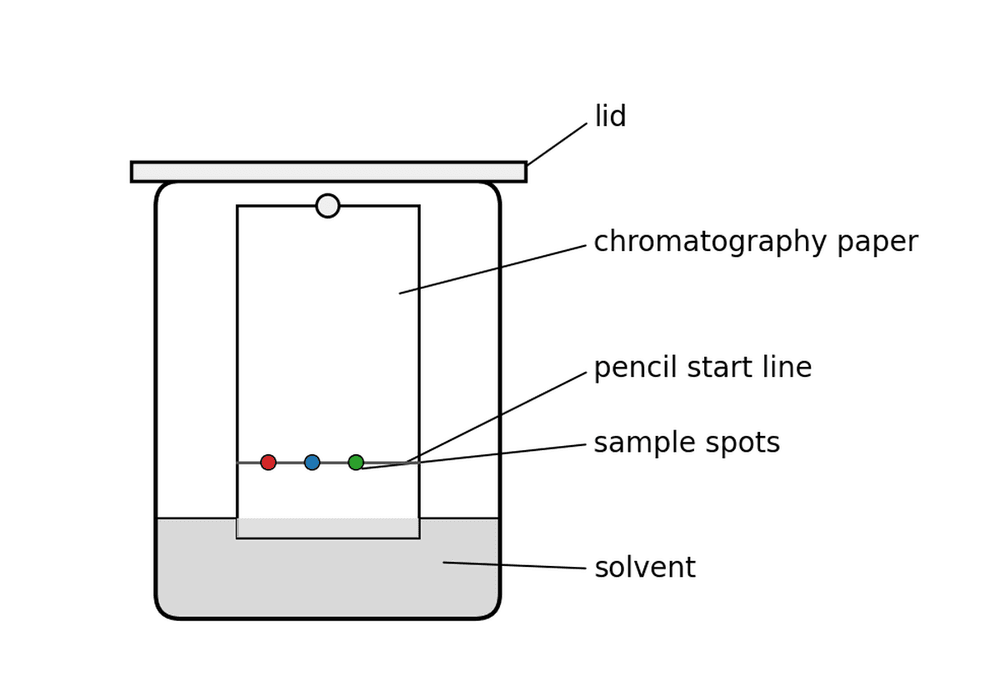
1. Draw a start line in pencil 1–2 cm from the bottom of the chromatography paper.

2. Put small, concentrated spots of each sample on the line with a capillary tube, letting each dry.

3. Pour a shallow layer of solvent into a beaker.

4. Hang the paper in the beaker. The solvent must be below the start line.

5. Cover the beaker with a lid to stop the solvent evaporating.

6. Remove the paper before the solvent reaches the top.

7. Immediately mark the solvent front in pencil before it dries.

8. Let the paper dry. Measure from the start line to the centre of each spot and to the solvent front, calculate each Rf value and compare it with known substances.

Knowledge Required

Variables: The independent variable is the substance tested. The dependent variable is the distance moved by the substance (or its Rf value). Control variables include the solvent, paper, and temperature.

Calculation: Rf = distance moved by substance ÷ distance moved by solvent.

Apparatus: chromatography paper, pencil, ruler (read to the nearest mm), capillary tube, beaker and lid.

Note

Hazards: ethanol is flammable, so keep it away from naked flames. Wear eye protection and avoid getting inks or dyes on your skin.

Diagram

chem paper chromatography setup

Note

The paper dips into the solvent, but the pencil start line and the sample spots stay above the solvent surface. The lid stops the solvent evaporating.

Tips/hints

Use pencil for the start line: graphite is insoluble, but ink would dissolve and separate.

If the paper touches the beaker sides, the solvent front rises unevenly.

Large spots smudge and overlap; keep spots small.

Rf has no units and is always less than 1.

Test yourself on this topic

Try the free quiz with worked solutions.

Start quiz →

Get GCSE Science

Full notes, full question bank, offline.