





G GCSE Apps

GCSE Science

C10 Using resources

7 subtopics in this section

Using the Earth's resources sustainably

Definition

We rely on the Earth's resources for food, warmth, shelter and transport. Farming adds to what nature provides, giving us food, timber, fibres for clothing and fuels.

A finite resource is used up faster than it forms, so it will run out. Examples: crude oil, metal ores, limestone and sand, which are processed to make materials and fuels.

A renewable resource is replaced at least as fast as we use it. Examples: timber from managed forests, cotton and wool.

Method

Sustainable development meets the needs of people today without stopping future generations from meeting their own needs. Chemists help by designing processes that use less energy, fewer finite raw materials and make less waste, and by finding renewable alternatives.

Many natural products are now supplemented or replaced by farmed or synthetic ones: wool and cotton by polyester and nylon; natural rubber by synthetic rubber from crude oil; timber and stone by bricks, concrete and plastics; wild food by farmed crops.

To estimate how long a reserve will last: years remaining = reserve ÷ yearly use.

Example

A reserve of a mineral is 1.2 × 10⁹ tonnes and 3.0 × 10⁶ tonnes are used each year. How long will the reserve last if use stays the same?

Solution

Years remaining = (1.2 × 10⁹) ÷ (3.0 × 10⁶)

= 0.4 × 103 = 400 years.

Tips/hints

Classify a resource from data: compare how fast it forms or regrows with how fast it is used. Don't just learn lists.

Renewable does not mean recyclable, and finite does not mean it has already run out.

Divide the reserve by the yearly use, not the other way round. Check powers of ten: subtract the indices when you divide.
Potable water

Definition

Potable water is safe to drink. To be potable, it must have low enough levels of dissolved salts and microbes.

Potable water is not pure water. In chemistry, pure water contains only H2O molecules, but potable water always contains some dissolved substances.

Method

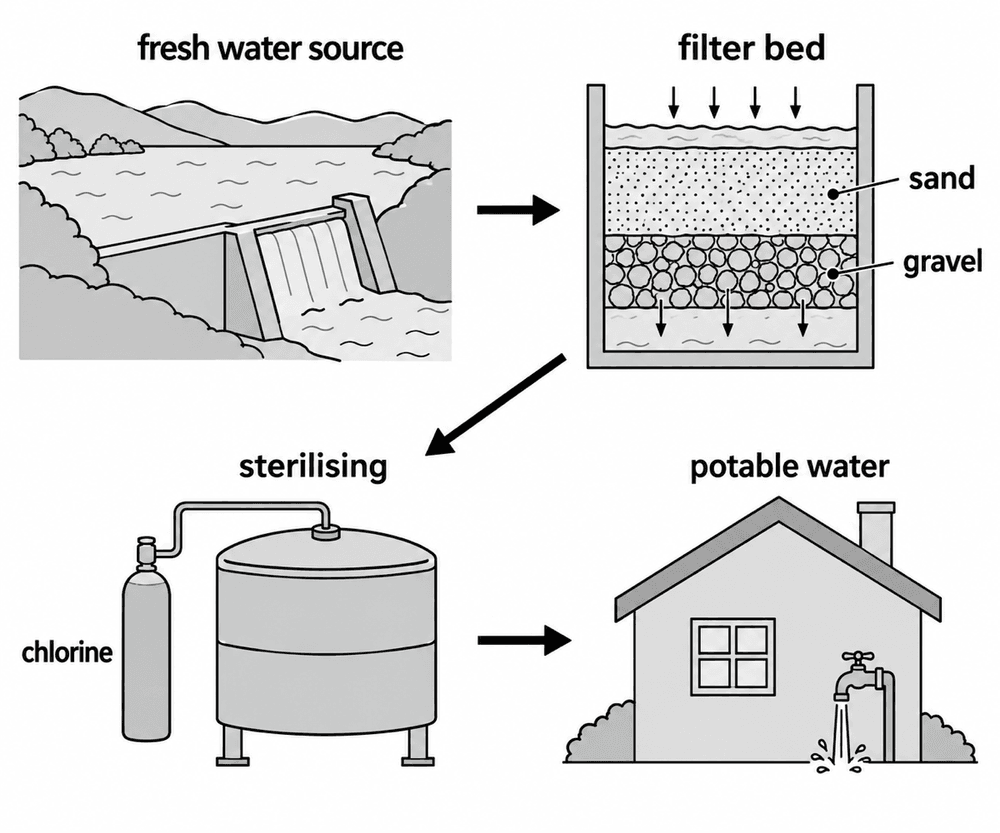
Most potable water in the UK comes from rain that collects in the ground, lakes and rivers (fresh water). It is produced by:

1. Choosing an appropriate fresh water source.

2. Passing the water through filter beds (sand and gravel) to remove solid particles.

3. Sterilising to kill harmful microbes, using chlorine, ozone or ultraviolet light.

If fresh water is limited (e.g. in hot, dry coastal countries), sea water must be desalinated (have its salts removed). This is done by distillation or by membrane processes like reverse osmosis. Desalination requires a lot of energy, making it expensive.

Diagram

chem potable water treatment

Note

Water from a fresh water source passes through a filter bed of sand and gravel to remove solids, then is sterilised with chlorine to kill microbes before it reaches homes as potable water.

Example

Explain why water from an underground aquifer in the UK needs fewer treatment steps than sea water in a hot, dry coastal country.

Solution

Aquifer water comes from rain, so it is fresh water with low levels of dissolved salts.

It only needs filtering (to remove solids) and sterilising (to kill microbes).

Sea water contains a lot of dissolved salt, which filtering and sterilising cannot remove.

So it must also be desalinated by distillation or reverse osmosis, which needs much more energy.

Tips/hints

Potable and pure do not mean the same thing in science.

Filtering only removes solid particles. It does not remove dissolved salts or kill microbes.

Sterilising kills microbes, but does not remove dissolved salts.

Waste water treatment

Definition

Waste water from towns, homes and agriculture contains high levels of organic matter and harmful microbes. It must be treated before it can be safely released.

Industrial waste water may also contain harmful chemicals, requiring extra treatment stages to remove them.

Method

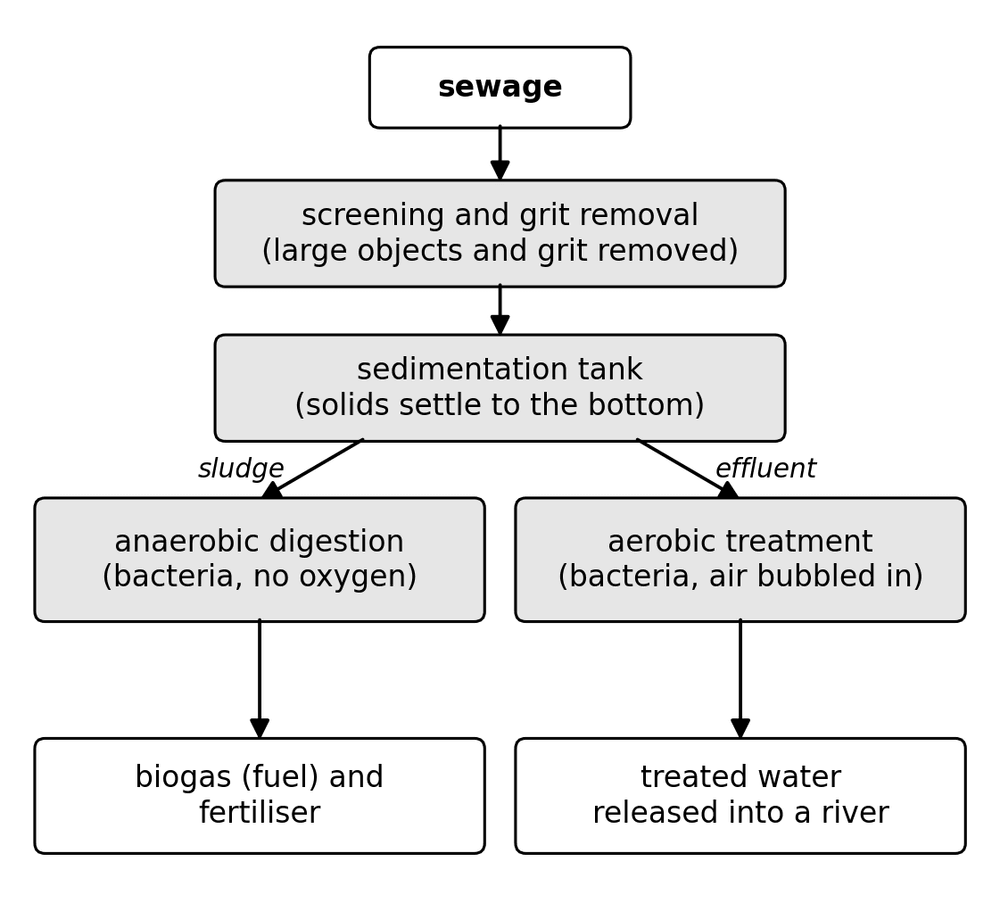
Sewage treatment happens in four stages:

1. Screening and grit removal: Waste water passes through screens to remove large solid objects and grit.

2. Sedimentation: The water sits in settlement tanks. Heavier solids sink to form sewage sludge; the lighter liquid above is the effluent.

3. Anaerobic digestion: Bacteria break down the sludge without oxygen. This produces biogas (burned for electricity) and digested waste for fertiliser.

4. Aerobic biological treatment: Air is bubbled through the effluent. Aerobic bacteria use the oxygen to break down remaining organic matter and harmful microbes before release.

Diagram

chem sewage treatment stages

Note

Sewage is screened, then left to settle. The sludge is digested by anaerobic bacteria, giving biogas, while the effluent is treated by aerobic bacteria before it is released into a river.

Example

A food factory's waste water contains a lot of organic matter and also a toxic metal compound. What treatment does it need before it can be released into a river?

Solution

The organic matter is removed in the normal way: screening, sedimentation, anaerobic digestion of the sludge and aerobic treatment of the effluent.

The toxic metal compound is a harmful chemical, so an extra treatment stage is needed to remove it before the water is released.

Tips/hints

Bacteria in sewage treatment are useful! Anaerobic bacteria digest the sludge; aerobic bacteria treat the effluent.

Screening removes large solids, not dissolved substances or microbes.

Getting potable water from waste water needs many more stages than from ground water, but much less energy than desalinating sea water.

Life cycle assessment

Definition

A life cycle assessment (LCA) judges the environmental impact of a product at each stage of its life.

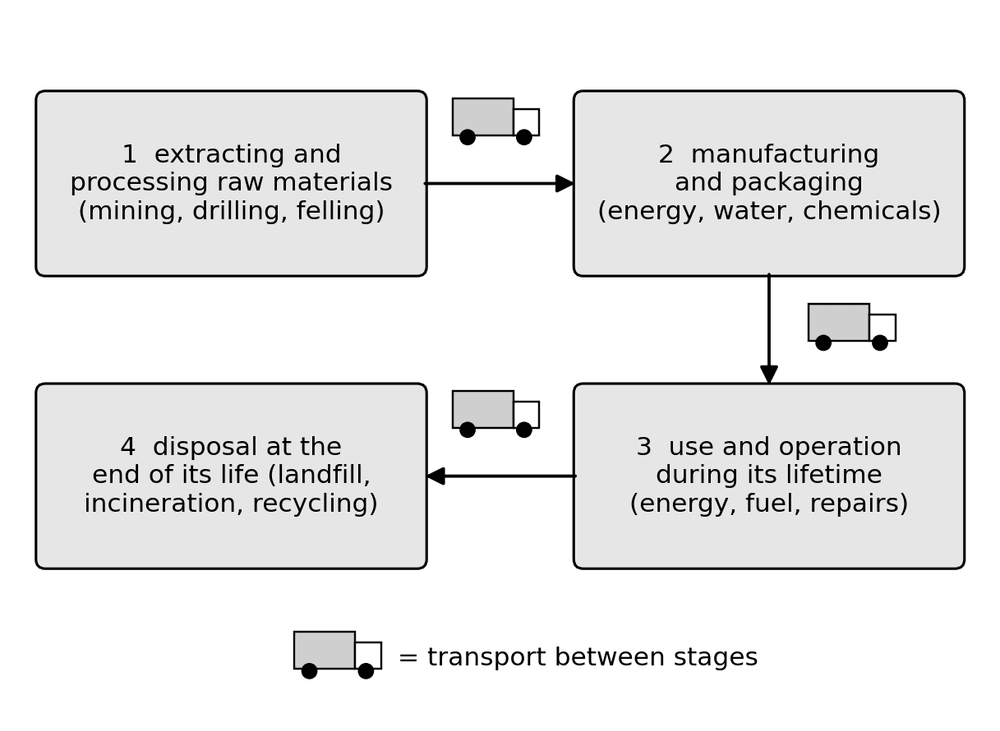
The four stages are: extracting and processing the raw materials; manufacturing and packaging; use and operation during its lifetime; and disposal at the end of its useful life (such as landfill, incineration or recycling). Transport and distribution at each stage are also included.

Measuring the use of water, raw materials and energy is fairly easy, but giving numbers to the effects of pollutants is harder and requires value judgements. This means an LCA is not purely objective.

Method

To compare two products, such as paper and plastic bags, look at the data for every stage of the life cycle, not just the raw materials.

To find the environmental impact per use, divide the total impact by the number of times the product is reused.

Diagram

chem lca stages

Note

The four stages assessed in a life cycle assessment. Transport between the stages is included too.

Example

Making a paper bag uses 3.0 dm3 of water and it is used twice. Making a plastic bag uses 0.8 dm3 of water and it is used 4 times. Which bag uses less water per use?

Solution

Paper bag: 3.0 ÷ 2 = 1.5 dm3 per use.

Plastic bag: 0.8 ÷ 4 = 0.2 dm3 per use.

The plastic bag uses less water per use. A full LCA would also compare energy, raw materials and waste at every stage.

Tips/hints

Do not assume that natural materials like paper always have a lower environmental impact. They often require much more water and energy to manufacture.

Companies can misuse a selective or shortened LCA (which leaves out some stages) to support an advertising claim.

Remember to read questions carefully to see if they are asking for the total impact or the impact per use.

Reducing the use of resources

Definition

Using less, reusing and recycling all mean we take fewer finite raw materials from the Earth, burn less fuel, throw away less and do less damage to the environment.

Most everyday materials, including metals, glass, plastics, bricks, pottery and other building materials, are made from raw materials that will run out. Making them also uses a lot of energy, mostly from fossil fuels.

Mining and quarrying for raw materials destroy habitats and scar the landscape, leave heaps of waste rock, and cause noise, dust and heavy traffic.

Method

Reuse: a product is cleaned and used again for the same job, e.g. a washed glass milk bottle.

Recycle: the material is processed into something new. Glass is crushed and melted into new glass items; metals are melted and cast or shaped into new products.

Recycling a metal needs far less energy than extracting it from ore (aluminium: about 5% of the energy). Scrap steel added to iron from the blast furnace means less iron has to be extracted from ore.

Example

Washing a glass bottle so it can be reused needs 0.4 MJ of energy. Crushing and melting the bottle to make a new one needs 2.0 MJ. Which option is better for saving energy, and by how much?

Solution

Energy saved by reusing = 2.0 − 0.4 = 1.6 MJ per bottle.

Reuse needs (0.4 ÷ 2.0) × 100 = 20% of the energy needed for recycling.

Reusing is better here because the glass does not have to be melted again.

Tips/hints

Recycling still needs energy (collecting, transporting, sorting, melting) and costs money.

Different metals are sorted (e.g. steel cans with a magnet) because a mixture usually has poorer properties.

If recycling uses 5% of the energy, it saves 95%: read whether a question asks for energy used or energy saved.

Alternative methods of extracting metals (Higher)

Definition

High-grade copper ores are running out. To avoid depletion, copper is extracted from low-grade ores using biological methods: phytomining and bioleaching.

These methods avoid the traditional mining approach of digging up and dumping huge amounts of rock, reducing damage to landscapes.

Method

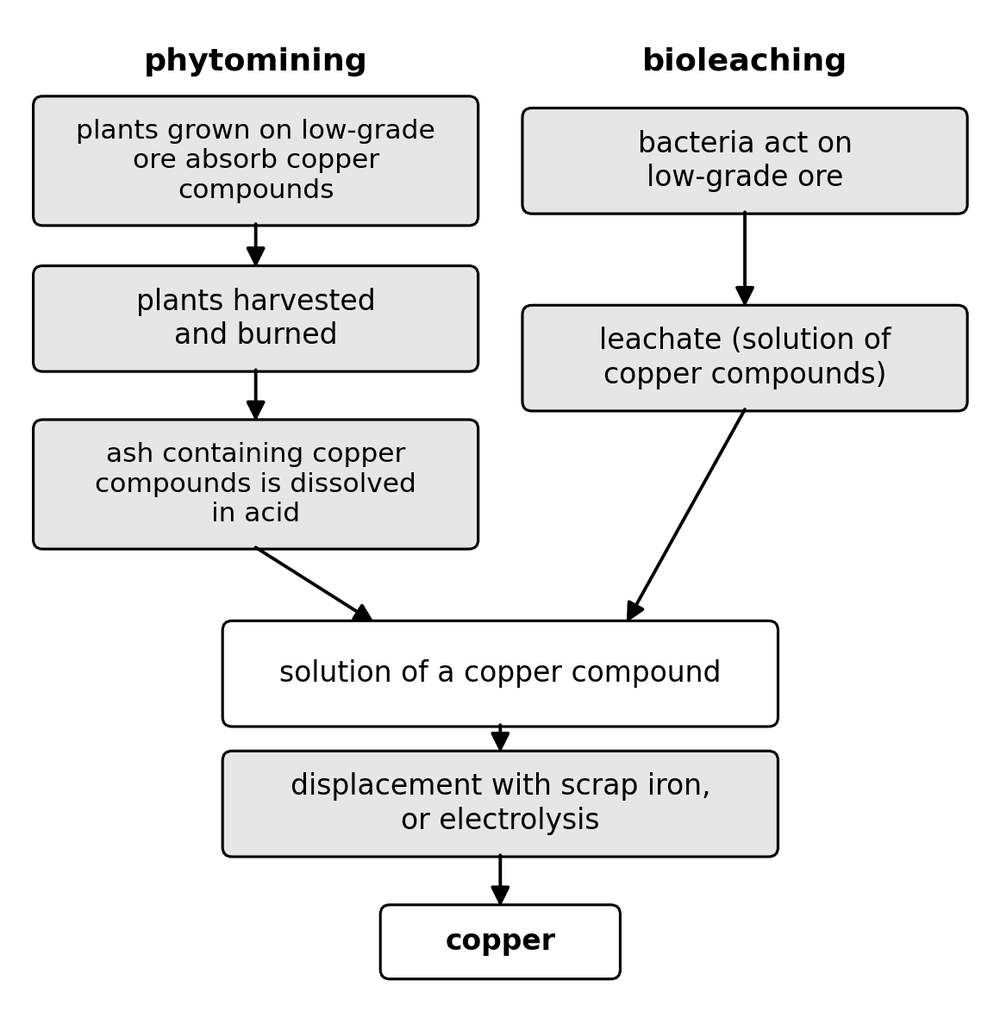
Phytomining uses plants grown on waste tips containing low-grade ore. They absorb copper compounds into their tissues. The plants are harvested and burned; the ash contains the copper compounds, which are dissolved in acid to make a solution.

Bioleaching uses bacteria on low-grade ore to produce a solution of copper compounds, called a leachate.

Solid copper is extracted from these solutions by displacement using scrap iron (iron is more reactive) or by electrolysis (copper forms at the negative electrode, the cathode).

Diagram

chem phytomining bioleaching

Note

Phytomining and bioleaching turn a low-grade ore into a copper compound solution. Copper is obtained using scrap iron or electrolysis.

Example

A company can either dig a new open-pit mine for high-grade copper ore or bioleach the low-grade ore in an old waste tip. Evaluate the bioleaching option.

Solution

Advantages: no new pit has to be dug, so far less rock is moved and dumped and less habitat is destroyed; it uses less energy than smelting; the waste tip is put to use.

Disadvantages: bioleaching is slow and gives only a small amount of copper; the leachate can be toxic and acidic, so it must be kept out of rivers.

Conclusion: bioleaching is better for the environment, but the mine gives copper faster.

Tips/hints

Plants and bacteria do not make copper; they extract existing compounds.

Both methods are very slow and have small yields, but use less energy than smelting, reduce rock waste, and make waste tips viable.

Scrap iron is cheap and more reactive than copper.

Required practical: Water purification

Overview

Analyse water samples from different sources and purify one by distillation. It tests pH, dissolved solids and purity.

Method

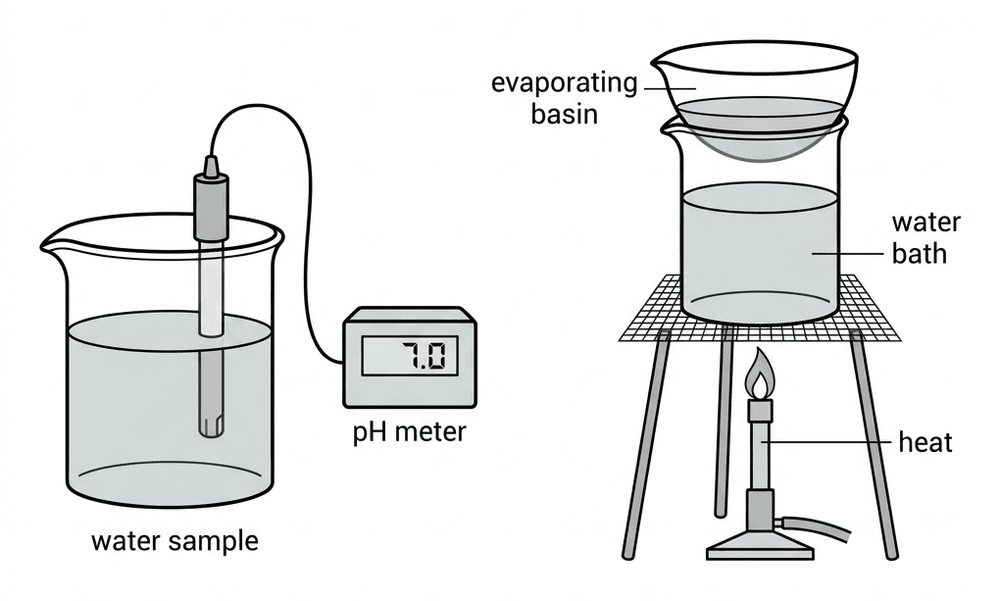
1. Test sample pH using a calibrated pH meter or universal indicator.

2. Weigh a clean, dry evaporating basin.

3. Add a measured volume of the sample.

4. Heat gently over a water bath until water evaporates.

5. Cool and reweigh.

6. Repeat heating, cooling and weighing until mass stays constant.

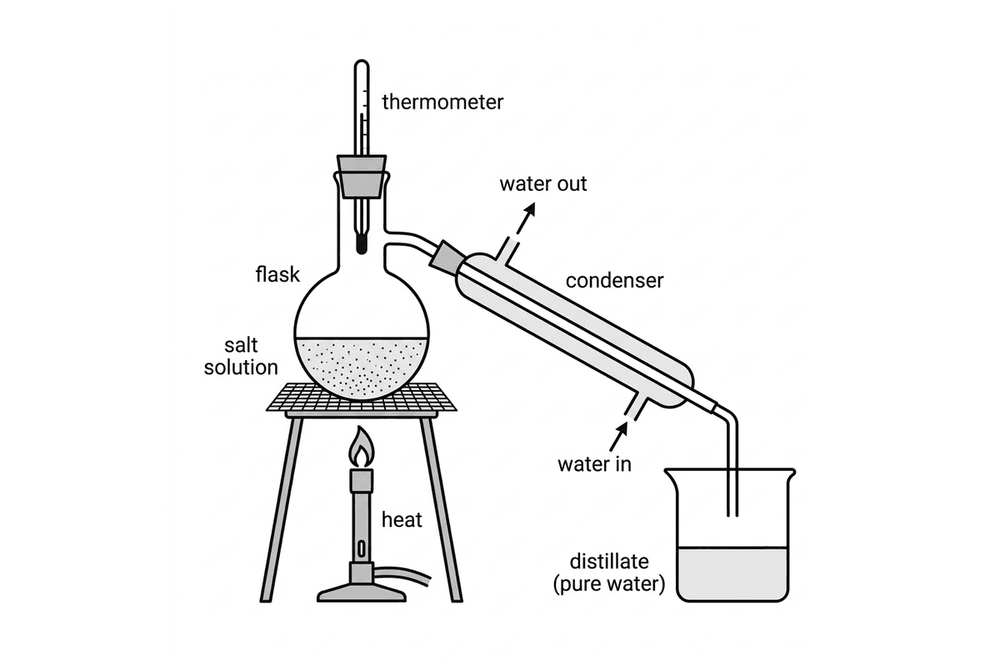
7. Distillation: heat the salt solution in a flask. Vapour passes into a condenser and collects as liquid distillate.

8. Check distillate: it should boil at exactly 100 °C, have pH 7, and leave no residue.

Knowledge Required

Variables: Independent = source of the sample. Dependent = pH and mass of dissolved solids. Control = sample volume and heating method.

Processing: Mass of dissolved solids = (basin + residue) − empty basin. To find concentration in g/dm3, divide mass by volume in dm3 (divide cm3 by 1000).

Note

Hazards: hot apparatus and steam (let cool, use tongs), spitting when evaporating, and microbes in pond water (wash hands). Never taste samples.

Diagram

chem water sample tests

Note

Measuring pH with a meter, and evaporating a sample to find dissolved solids.

Diagram

chem simple distillation

Note

Distilling a salt solution. Vapour cools in the condenser (cold water in at bottom, out at top) to form liquid distillate (pure water).

Tips/hints

Not heating to constant mass is a common error; it makes the calculated mass of dissolved solids too high because water remains.

Spitting loses solid, making the mass too low. Use a water bath for gentle heating.

Take several samples from the same source to be representative, then calculate a mean (excluding anomalies).

Pure water boils at exactly 100 °C. A pH of 7 does not guarantee purity.

Test yourself on this topic

Try the free quiz with worked solutions.

Start quiz →

Get GCSE Science

Full notes, full question bank, offline.