





G GCSE Apps

GCSE Science

B7 Ecology

10 subtopics in this section

Communities and interdependence

Definition

An ecosystem has different levels of organisation. An individual organism is one living thing. A population is all the organisms of one species living in an area. A community is made up of the populations of all the different species living in the same habitat. The ecosystem is the community interacting with the non-living parts of its environment.

A habitat is the place where an organism lives.

Method

Organisms need materials from their surroundings and from other organisms, so they compete. Plants compete for light, space, water and mineral ions. Animals compete for food, mates and territory.

Interdependence: each species depends on others for food, shelter, pollination or seed dispersal, so removing one species can affect the whole community.

In a stable community, the species and environmental factors are in balance, so population sizes stay roughly constant (they still rise and fall a little).

Diagram
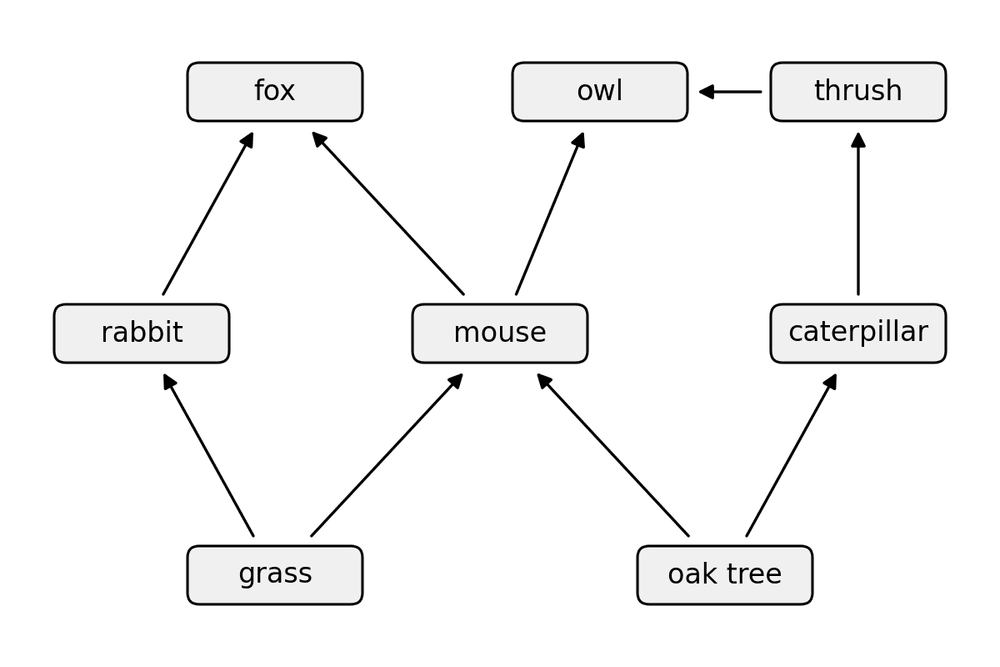
bio woodland food web

Note

A food web shows interdependence. Each arrow points from the food to the feeder.

Example

Using the woodland food web, what would happen to the thrushes and the mice if most of the caterpillars died?

Solution

Thrushes eat caterpillars, so the thrushes have less food and their number falls.

Owls eat both thrushes and mice. With fewer thrushes to eat, the owls eat more mice, so the number of mice is likely to fall too.

The caterpillars and mice never meet, yet a change in one affects the other: this is interdependence.

Tips/hints

Plants do not compete for food: they make their own. They compete for light, water, space and mineral ions.

A community is only the living things. Add the non-living parts and it becomes an ecosystem.

Interdependence is not just feeding: pollination, seed dispersal and shelter count too.

Removing a predator does not help every species: its prey may increase and overgraze the plants.
Abiotic and biotic factors

Definition

Abiotic factors are the non-living parts of an environment that can affect a community. These include light intensity, temperature, moisture levels, soil pH and mineral content, wind intensity and direction, carbon dioxide levels for plants, and oxygen levels for aquatic animals.

Biotic factors are the living parts of an environment that affect a community. These include the availability of food, the arrival of new predators, new pathogens, and one species outcompeting another so that the numbers left are too few to breed successfully.

Example

During a long, hot summer the water in a shallow pond warms up and holds less dissolved oxygen. Herons feed on the fish in the pond. Explain how the change could affect the community.

Solution

Oxygen level is an abiotic factor for aquatic animals. With less dissolved oxygen, fewer fish can survive in the pond.

Fewer fish means less food for the herons, a biotic factor, so they catch less and may feed elsewhere or raise fewer young.

Tips/hints

Remember that "amount of food" is a biotic factor because food consists of other organisms.

Do not confuse carbon dioxide and oxygen levels with biotic factors; although organisms use or produce them, the gases themselves are non-living (abiotic).

A pathogen is a biotic factor. Even though viruses and bacteria are very small, they are treated as living parts of the environment.

When an abiotic factor changes, it often has a knock-on effect on biotic factors. For example, less light reduces plant growth, which leaves less food for the animals that eat them.

Adaptations

Definition

Adaptations are inherited features that help an organism survive in the conditions where it normally lives. These features can be structural, behavioural or functional.

Extremophiles are organisms that live in extreme environments, such as very high temperature, high pressure or high salt concentration (for example, bacteria living around deep-sea hydrothermal vents).

Method

Structural adaptations are physical features of the organism's body shape or structure. Examples include thick fur, camouflage colouring, small ears, or a thick layer of fat.

Behavioural adaptations are things the organism does to survive. Examples include migrating, hibernating, huddling for warmth, or being active only at night.

Functional adaptations are processes happening inside the organism's body. Examples include producing very concentrated urine to save water, or producing antifreeze-like chemicals.

Diagram

bio cactus adaptations

Note

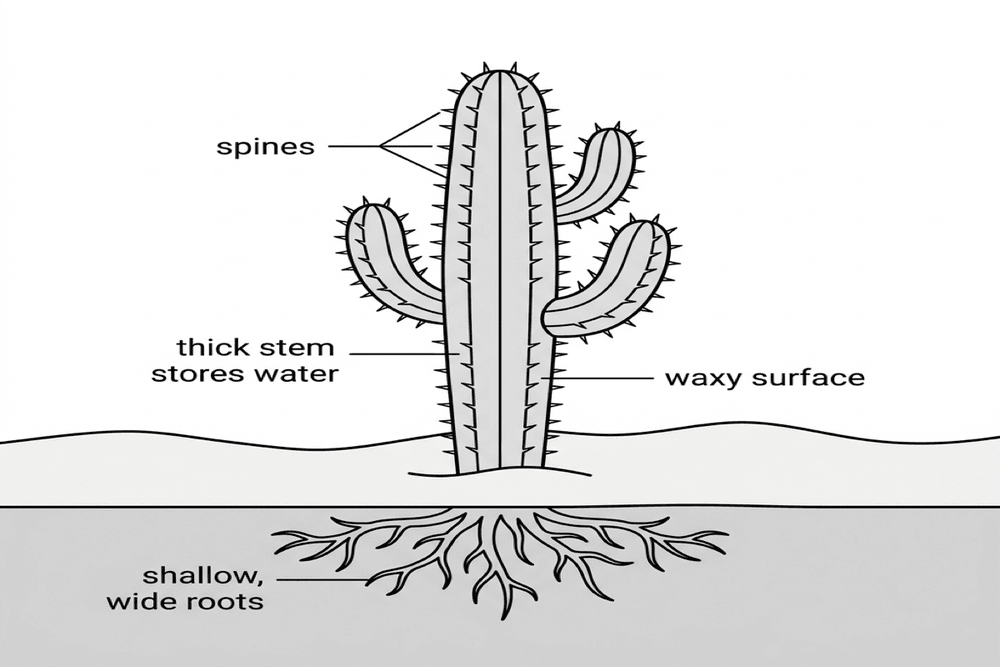
Spines instead of leaves and a waxy surface reduce water loss, the thick stem stores water, and shallow, wide roots take up rain water quickly before it drains away.

Example

A grey seal has a thick layer of blubber under its skin. When it dives, its heart rate slows down so that it uses its oxygen more slowly. Classify each adaptation and explain how it helps.

Solution

Blubber is part of the seal's body, so it is a structural adaptation. It insulates the seal and reduces heat loss to the cold sea.

Slowing the heart rate is a process inside the body, so it is a functional adaptation. It lets the seal stay under water for longer to catch food.

Tips/hints

Adaptations are inherited traits; an organism cannot choose to adapt during its lifetime just because it needs to.

Cactus spines do not store water. They reduce water loss; the thick stem stores the water.

Extremophiles are not just bacteria in hot places; they can be different types of organisms living in various extreme conditions.

Food chains and levels of organisation

Definition

A food chain shows feeding relationships in a community. Every chain starts with a producer: a green plant or alga that makes glucose by photosynthesis. Producers make the biomass that all life on Earth depends on.

Predators are consumers that kill and eat other animals; the animals they eat are their prey.

Method

Producers are eaten by primary consumers, which are eaten by secondary consumers, which may be eaten by tertiary consumers.

Each arrow points from the food to the feeder, showing the direction energy is transferred.

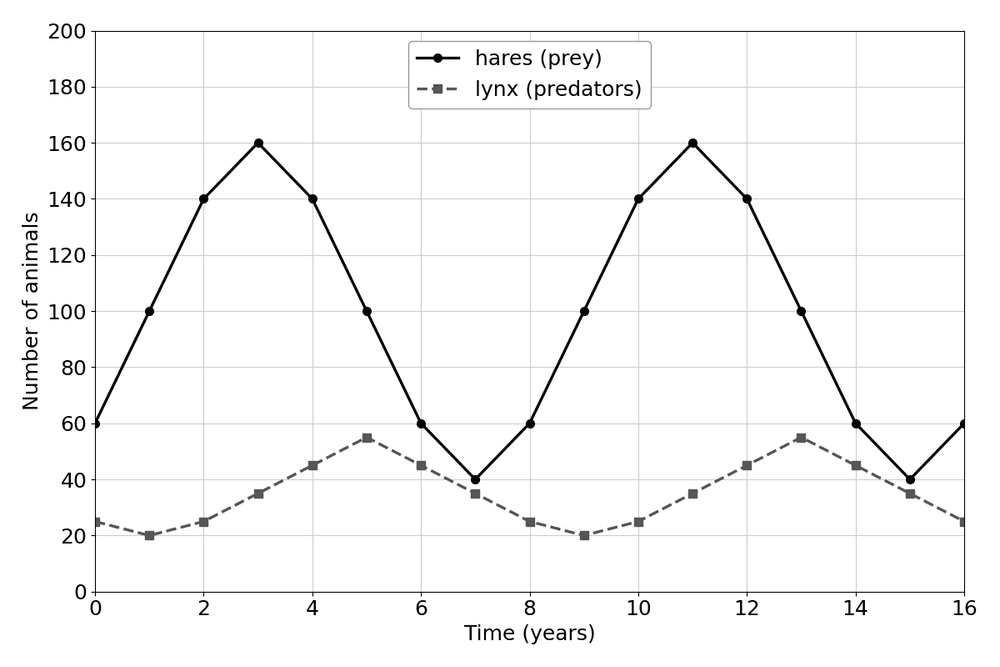
In a stable community, predator and prey numbers rise and fall in cycles: more prey → more food, so more predators survive and breed → more prey eaten, so prey fall → predators go short of food and fall → prey recover. The predator peak comes after the prey peak because breeding takes time.

Diagram

bio predator prey graph

Note

The hares peak at years 3 and 11; the lynx peak 2 years later, at years 5 and 13. One full cycle lasts 8 years.

Example

In the chain grass → grasshopper → frog → grass snake, name the role of each organism and one predator–prey pair.

Solution

Grass is the producer, the grasshopper is the primary consumer, the frog is the secondary consumer and the grass snake is the tertiary consumer.

The frog kills and eats grasshoppers, so the frog is a predator and the grasshopper is its prey. (The snake and the frog are another pair.)

Tips/hints

Arrows mean "is eaten by", not "eats": the producer is always at the tail of the first arrow.

The Sun is not a producer; it supplies the light energy producers use.

A cycle length is measured from one peak to the next, not from the first peak to the last.

How materials are cycled

Definition

Materials such as carbon, water and mineral ions cycle between the living and non-living parts of an ecosystem, so they can be used again to build future organisms.

Method

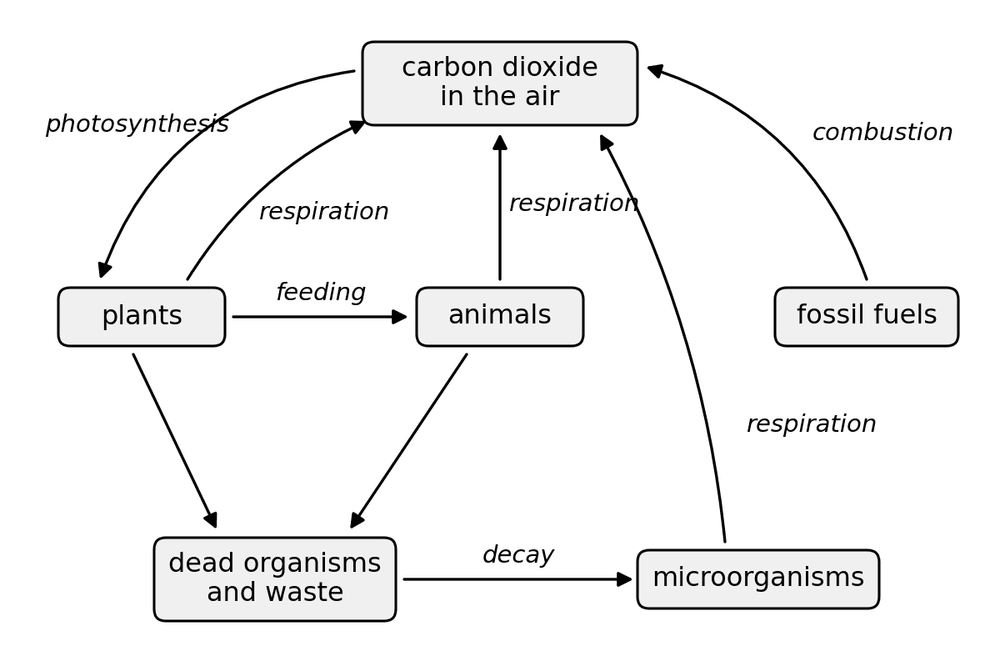
Carbon cycle: plants and algae take in carbon dioxide for photosynthesis and make carbon compounds such as glucose. Animals get carbon compounds by eating plants or other animals.

Carbon dioxide returns to the air by respiration of plants, animals and microorganisms, and by combustion of wood and fossil fuels.

Microorganisms (decomposers) break down dead organisms and waste, releasing carbon dioxide by respiration and returning mineral ions to the soil.

Water cycle: energy from the Sun evaporates water from seas and lakes, and plants lose water vapour by transpiration. The vapour cools and condenses into clouds, then falls as precipitation (rain or snow), giving fresh water on land before draining back to the sea.

Diagram

bio carbon cycle

Note

Photosynthesis is the only process here that removes carbon dioxide from the air. Respiration by plants, animals and microorganisms, and combustion of fossil fuels, return it.

Example

Describe how a carbon atom in carbon dioxide in the air can pass into a rabbit and then return to the air.

Solution

1. Grass takes in the carbon dioxide for photosynthesis and uses it to make glucose and other carbon compounds.

2. A rabbit eats the grass, so the carbon compounds become part of the rabbit.

3. The carbon returns to the air as carbon dioxide when the rabbit respires, or when it dies and microorganisms decompose its body and respire.

Tips/hints

Plants respire all the time, not just at night. Both plants and animals release carbon dioxide.

Decomposers do not just 'eat' waste; they respire while breaking it down, which releases carbon dioxide.

Condensation does not make new water, it just changes water vapour back into liquid.

Biodiversity and waste management

Definition

Biodiversity is the variety of all the different species of organisms on Earth, or within an ecosystem.

A high biodiversity ensures the stability of ecosystems by reducing the dependence of one species on another for food, shelter and the maintenance of the physical environment.

Humanity's future depends on keeping biodiversity high to provide food, medicines, materials and ecosystem services.

Method

Rapid human population growth and rising standards of living mean that more resources are used and more waste is produced.

If waste and chemical materials are not handled properly, they cause pollution. Pollution kills plants and animals, which reduces biodiversity.

Pollution occurs in water (from sewage, fertiliser and toxic chemicals), in air (from smoke and acidic gases like sulfur dioxide, which causes acid rain), and on land (from landfill and toxic chemicals).

Example

Toxic chemicals leak from a landfill site into a stream. Explain how this could reduce biodiversity in and around the stream.

Solution

1. The toxic chemicals kill sensitive invertebrates and fish, and damage plants along the banks.

2. Animals that feed on them, such as kingfishers, lose their food and leave or die.

3. Fewer different species survive, so the variety of species (biodiversity) falls, and the community becomes less stable.

Tips/hints

Biodiversity means the variety of species, not the number of individuals of one species.

An ecosystem with low biodiversity is less stable, because each species relies on very few others.

Fertiliser in a lake does not help life thrive: algae grow and block light, plants die, decomposers use up the oxygen and fish die.

For a percentage change, divide the change by the original value, not the new value.

Land use and deforestation

Definition

Humans reduce the land available for other animals and plants by building, quarrying, farming and dumping waste in landfill.

Peat bogs are waterlogged, acidic areas where partly decayed plants slowly form peat. This stores a lot of carbon.

Deforestation is the large-scale clearing of trees, often in tropical areas, to provide land for cattle, rice fields and biofuel crops.

Method

Destroying peat bogs for garden compost reduces habitat area and biodiversity. When the peat is drained, it decays and releases carbon dioxide.

Using peat-free compost helps to conserve these habitats and keeps the carbon locked away.

Deforestation also destroys habitats and lowers biodiversity. It releases carbon dioxide when the trees are burned or decay, and leaves fewer trees to remove carbon dioxide by photosynthesis.

Example

A council plans to drain a small lowland peat bog to sell the peat as compost and use the land for new houses. Give one argument for and two environmental arguments against the plan.

Solution

For: cheap compost helps people grow food and plants, and the land meets a need for housing.

Against: the bog's habitat is lost, so the variety of plants, animals and microorganisms that live there falls.

Against: drained peat decays (or is burned), releasing carbon dioxide that adds to global warming.

Tips/hints

A common mistake is thinking deforestation reduces oxygen — the main problem is the release of carbon dioxide and loss of biodiversity.

Remember that peat takes a very long time to form, so it is not a renewable resource.

Biofuel crops grown on cleared forest still have an environmental cost because of the habitats destroyed to make space for them.

Cattle and rice fields both release methane, which contributes to global warming.

Global warming

Definition

Levels of carbon dioxide and methane in the atmosphere are increasing, and these gases contribute to global warming.

Carbon dioxide is released mainly from burning fossil fuels and deforestation. Methane is released from agriculture, such as cattle farming and rice fields, and from landfill sites.

Method

Global warming has many biological consequences.

Species distributions change: animals and plants adapted to cooler climates may move further north or up mountains to higher altitudes. Some may lose their habitats completely, such as polar bears losing Arctic sea ice.

Migration patterns can change, with birds altering the timing and routes of their journeys.

Biodiversity is often reduced due to habitat loss and changing conditions. Meanwhile, disease-carrying insects like mosquitoes may spread to new, warmer areas.

The timing of natural events can get out of step, such as plants flowering before the insects that pollinate them emerge.

Example

Records show that a woodland plant first flowered, on average, on 20 April in 1990 but on 8 April in 2020. By how many days per decade has flowering moved earlier, and why could this matter?

Solution

Change = 20 − 8 = 12 days earlier. Time = 2020 − 1990 = 30 years = 3 decades.

Rate = 12 ÷ 3 = 4 days earlier per decade.

If the insects that pollinate the plant do not emerge earlier too, fewer flowers are pollinated and fewer seeds form.

Tips/hints

The scientific consensus comes from systematic reviews of thousands of peer-reviewed publications, not from one study.

Predictions are uncertain because the climate is complex, with many variables and natural variation.

Global warming is not caused by the hole in the ozone layer.

Not every species benefits from warmer weather, and not every place gets hotter every year.

Maintaining biodiversity

Definition

Biodiversity is the variety of all the different species of organisms on Earth, or within an ecosystem. Human interactions with ecosystems can be positive (increasing biodiversity) or negative (decreasing biodiversity).

Method

Scientists and concerned citizens have set up programmes to reduce the negative effects of humans on ecosystems and biodiversity:

Breeding programmes: Endangered species are bred in captivity (like zoos) and then released into the wild to stop them becoming extinct.

Habitat protection: Rare habitats like wetlands, heathland and coral reefs are protected and regenerated.

Field margins and hedgerows: These are planted around fields where farmers grow a single crop (a monoculture). They provide food, shelter and corridors for insects, birds and small mammals.

Government policies: Some governments introduce laws to reduce deforestation and carbon dioxide emissions.

Recycling: Recycling resources means less waste is dumped in landfill, so fewer habitats are destroyed.

Example

A company wants to build a warehouse on a rare chalk grassland, bringing 200 jobs to a town. Evaluate the plan in terms of biodiversity.

Solution

Against: building destroys a rare habitat, so the plants and insects that live only in chalk grassland are lost and biodiversity falls.

For: the jobs bring income to local people.

A balanced judgement: build on land that is already developed, or protect the grassland and regenerate a similar habitat nearby. The conflict is between economic needs and conserving biodiversity.

Tips/hints

Breeding programmes only work if the animal's natural habitat is protected; there is no point breeding animals if they have nowhere to live when released.

A monoculture (a large field of a single crop) has very low biodiversity.

Conservation programmes often face conflicting pressures, such as the need for housing or agricultural land versus the need to protect natural habitats.

Required practical: Field investigations

Overview

Estimate population size using random sampling. Use a transect to see how an abiotic factor (like light) affects a species' distribution.

Method

Random sampling: Mark out the area with tape measures. Use random numbers as coordinates to place a quadrat. Count the plants. Repeat to take many samples (e.g. 10+), then find the mean per quadrat.

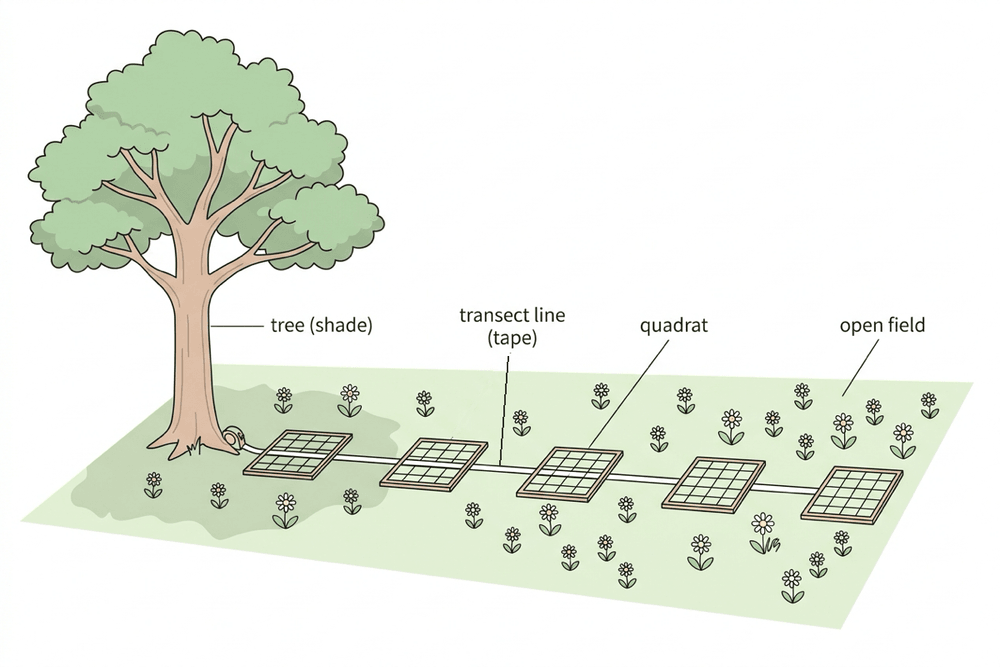
Transect: Lay a tape measure across the change in conditions (e.g. into shade). Place quadrats at regular intervals. Count plants and measure the abiotic factor at each point.

Knowledge Required

Variables (transect): Independent = distance along transect. Dependent = number of species per quadrat. Control = quadrat size.

Equation: estimated population = mean per m2 × total area in m2.

Note

Hazards: uneven ground, plants that sting, animal waste. Manage by washing hands after the practical.

Diagram

bio quadrat transect

Note

Quadrats are placed at regular intervals along a tape measure running from the shade under the tree into open grass. A light meter records the light intensity at each quadrat.

Example

A student counts daisies in ten 0.5 m × 0.5 m quadrats. Total count is 40. The field is 60 m by 40 m. Estimate the total population.

Solution

Mean per quadrat = 40 ÷ 10 = 4 daisies.

Quadrat area = 0.5 × 0.5 = 0.25 m2.

Mean per m2 = 4 ÷ 0.25 = 16 daisies.

Total area = 60 × 40 = 2400 m2.

Estimate = 16 × 2400 = 38 400 daisies.

Tips/hints

More quadrats give a more representative result. Random placement avoids bias.

Mean is total ÷ count. Median is middle value. Mode is most frequent.

Use percentage cover for plants hard to count (like grass).

Plot a scatter graph of the abiotic factor against the number of plants.

Test yourself on this topic

Try the free quiz with worked solutions.

Start quiz →

Get GCSE Science

Full notes, full question bank, offline.