


G GCSE Apps

GCSE Science

B5 Homeostasis and response

10 subtopics in this section

Homeostasis

Definition

Homeostasis means keeping the internal conditions of a cell or of the whole body within narrow limits, so that conditions stay at the optimum level for the body to work.

It happens automatically. It matters because cells and enzymes only work well within narrow limits of temperature, pH, water and glucose.

Method

In humans, homeostasis controls blood glucose concentration, body temperature and water levels. Control can use nerves (fast electrical responses), hormones (chemical responses) or both.

Every control system has three parts:

Receptors are cells that detect a stimulus, which is a change in the internal or external environment.

Coordination centres (like the brain, spinal cord or pancreas) receive and process the information from the receptors.

Effectors carry out a response to bring the condition back to its optimum. They are always muscles (which respond by contracting) or glands (which respond by secreting chemicals like hormones).

Diagram
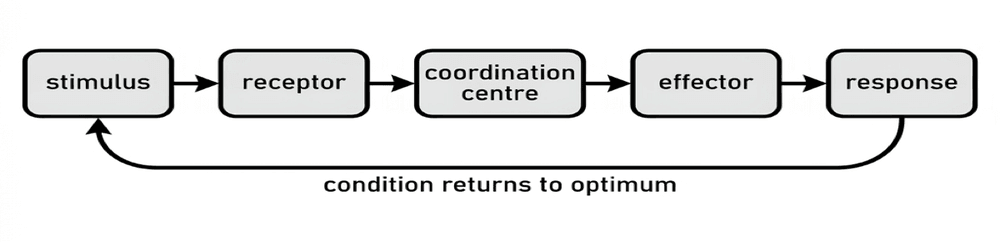
bio control system

Note

Every control system follows this pathway: a receptor detects the stimulus, the coordination centre processes it, and an effector brings about a response that returns the condition to its optimum.

Example

During hard exercise, extra carbon dioxide makes the blood slightly more acidic. Receptors in blood vessels detect this. The brain processes the information and sends impulses to the breathing muscles, which contract faster, so more carbon dioxide is breathed out. Identify the stimulus, receptor, coordination centre, effector and response.

Solution

Stimulus: the fall in blood pH.

Receptor: the receptor cells in the blood vessels.

Coordination centre: the brain.

Effector: the breathing muscles.

Response: faster breathing, which returns the blood pH to its optimum.

Tips/hints

Homeostasis keeps conditions within limits; it does not keep them exactly constant.

Do not confuse receptors and effectors: receptors detect the change, while effectors carry out the response.

Remember that hormones are chemical messengers, not effectors themselves.
The nervous system and reflexes

Definition

The nervous system lets us respond quickly to changes around us. Receptors detect a stimulus, and nerve cells (neurones) carry the information as electrical impulses to the central nervous system (CNS): the brain and spinal cord.

The CNS sends impulses to effectors. Muscles respond by contracting; glands respond by releasing chemicals. Pathway: stimulus → receptor → coordinator → effector → response.

Method

Reflex actions are automatic and rapid. They do not involve the conscious part of the brain, and they protect the body from harm.

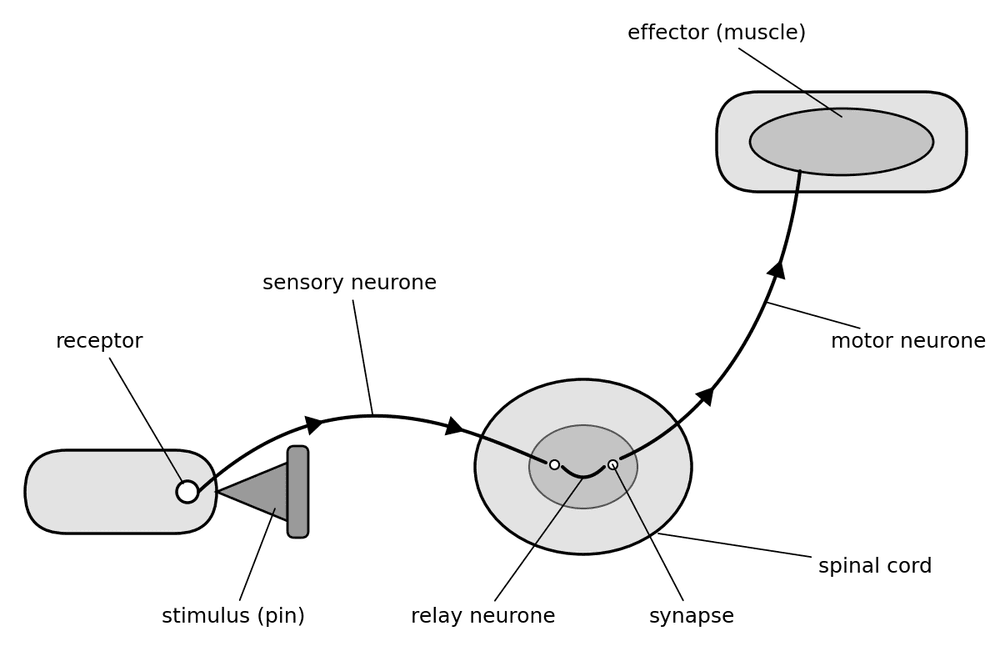
The pathway is: stimulus → receptor → sensory neurone → relay neurone (in the CNS) → motor neurone → effector → response.

Where two neurones meet there is a small gap called a synapse. The impulse triggers the release of a chemical that diffuses across the gap and starts an impulse in the next neurone, so impulses travel one way.

Diagram

bio reflex arc

Note

The pin presses on a receptor in the fingertip. The impulse travels along the sensory neurone to the spinal cord, crosses synapses to the relay and motor neurones, and reaches the muscle, which contracts.

Example

You step on a sharp stone and lift your foot before you feel pain. Describe the reflex arc.

Solution

Pain receptors in the skin of the foot detect the stimulus (the sharp stone).

Impulses pass along a sensory neurone to the spinal cord, then across synapses through a relay neurone to a motor neurone.

The motor neurone carries impulses to leg muscles (effectors), which contract and lift the foot. The conscious brain is not involved, so it is very fast.

Tips/hints

The spinal cord is part of the CNS; relay neurones in reflex arcs are found there.

Impulses are electrical along neurones but chemical across a synapse.

Sensory neurones carry impulses to the CNS; motor neurones carry them to effectors.

The endocrine system

Definition

The endocrine system is a set of glands that release chemical messengers called hormones straight into the blood.

Hormones are carried all round the body in the blood, but they only change the activity of their target organs, which have receptors for that hormone.

Method

Hormones vs nerves: hormones are chemicals carried in the blood, so their effects start more slowly but last longer. Nerves carry electrical impulses along neurones, giving fast, short-lived responses in one place.

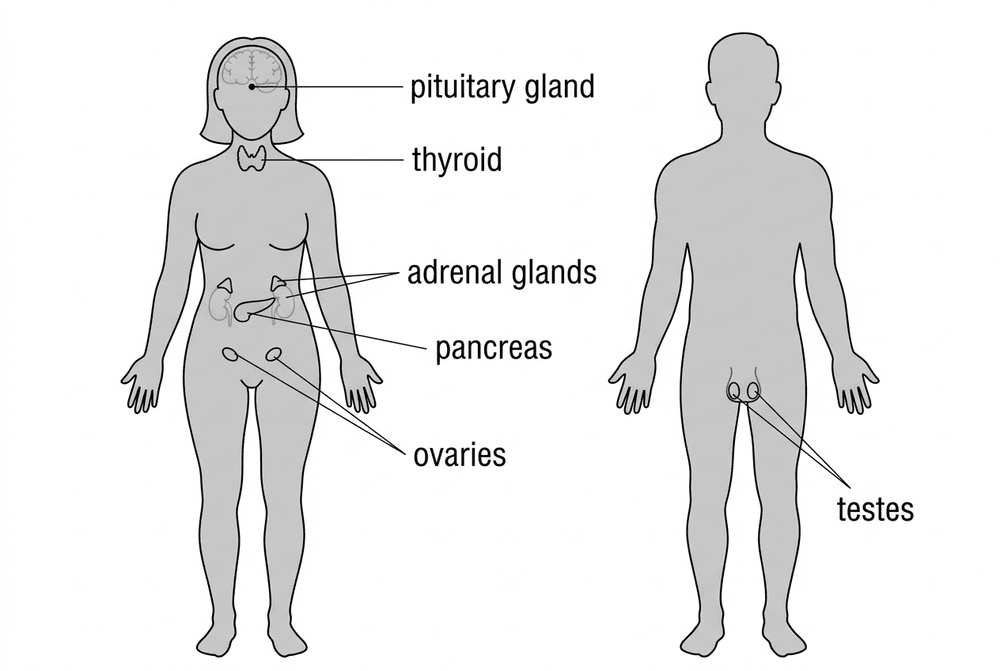
The master gland: the pituitary gland, at the base of the brain, releases several hormones that switch on other glands. For example, its hormones FSH and LH act on the ovaries.

Diagram

bio endocrine glands

Note

The pituitary gland, thyroid, adrenal glands, pancreas and ovaries are labelled on the female figure, and the testes on the male figure. The adrenal glands sit on top of the kidneys.

Example

Explain why the changes of puberty are controlled by hormones rather than by nerves.

Solution

Puberty changes happen over several years and involve many parts of the body.

Hormones in the blood reach target organs all over the body, and their effects last a long time. Nerve impulses are fast but short-lived, so they suit quick responses instead.

Tips/hints

Hormones travel in the blood, not along nerves and not through ducts.

Learn the six glands with their places: pituitary (base of brain), thyroid (neck), adrenal glands (on the kidneys), pancreas (below the stomach), ovaries and testes.

Pancreas → insulin; ovaries → oestrogen; testes → testosterone.

Control of blood glucose

Definition

The pancreas monitors and controls blood glucose. If it gets too high, the pancreas releases the hormone insulin into the blood.

Insulin causes glucose to enter body cells. In liver and muscle cells, extra glucose is turned into glycogen and stored. Glycogen is a storage carbohydrate, not a hormone.

Type 1 diabetes: the pancreas does not make enough insulin, so blood glucose rises uncontrollably. Usually starting in childhood, it is treated by injecting insulin matched to meals and activity.

Type 2 diabetes: the pancreas still makes insulin, but cells no longer respond properly. It is treated with a carbohydrate-controlled diet and regular exercise (medication may be added). Obesity is a risk factor.

Diagram

bio blood glucose graph

Note

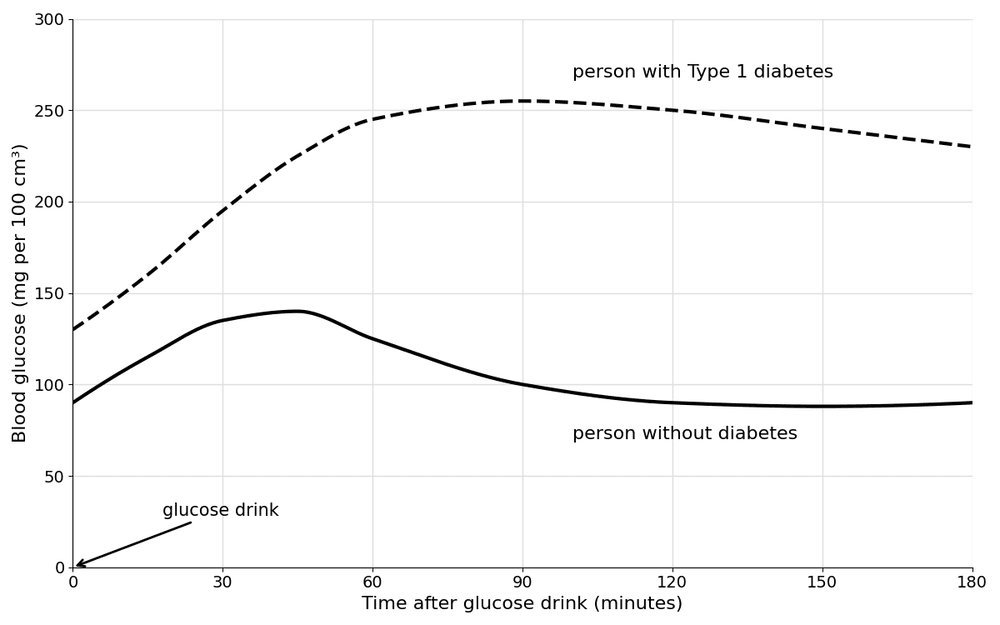
The graph shows blood glucose after a glucose drink. The person without diabetes rises from 90 to peak at about 140 at 45 minutes, returning to 90 by 120 minutes. The person with Type 1 diabetes rises from 130 to about 255 at 90 minutes, and is still about 230 at 180 minutes.

Example

Calculate the percentage increase in blood glucose for the person without diabetes from their starting value to their peak.

Solution

Start = 90 mg per 100 cm3. Peak = 140 mg per 100 cm3.

Increase = 140 − 90 = 50 mg per 100 cm3.

Percentage increase = (50 ÷ 90) × 100 = 55.6%.

Tips/hints

Insulin is a hormone; glycogen is a storage carbohydrate.

Type 1 diabetes is treated by insulin injections. Type 2 diabetes is treated by a carbohydrate-controlled diet and exercise.

When calculating a percentage increase, always divide the increase by the starting value, not the peak.

Hormones in human reproduction

Definition

During puberty, reproductive hormones cause secondary sex characteristics to develop. In males, the voice deepens and facial hair grows; in females, breasts develop and periods start.

Testosterone is the main male reproductive hormone. It is produced in the testes and stimulates sperm production.

Oestrogen is the main female reproductive hormone and is produced in the ovaries.

Method

The menstrual cycle lasts about 28 days. From puberty, eggs begin to mature and one is released about every 28 days (ovulation).

Four hormones control the cycle: FSH (from the pituitary gland) causes an egg to mature in an ovary. LH (from the pituitary gland) stimulates the release of the egg. Oestrogen and progesterone are involved in building up and maintaining the lining of the uterus.

If no fertilised egg implants, the level of progesterone falls and the lining breaks down. This is the period (day 1 of the cycle).

Diagram

bio menstrual cycle timeline

Note

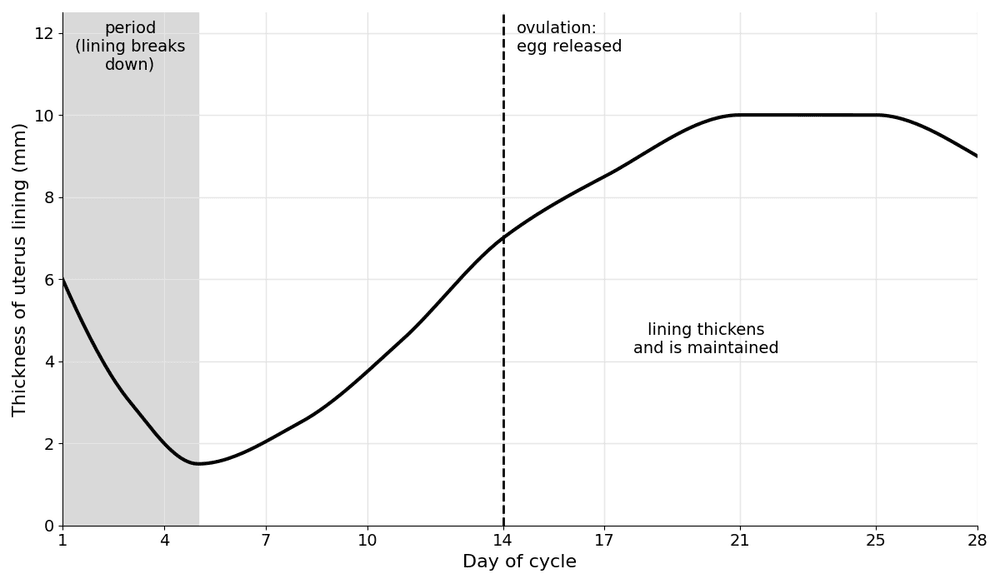
Day 1 is the start of the period, when the uterus lining breaks down. The lining then thickens again, an egg is released around day 14, and the thick lining is maintained in the second half of the cycle.

Example

Use the graph to describe what happens to the uterus lining between day 5 and day 25, and name the hormones that control it.

Solution

The lining thickens from about 1.5 mm on day 5 to about 10 mm by day 21, then stays at about 10 mm until day 25.

Oestrogen and progesterone build up and maintain the lining. Around day 14, LH causes an egg to be released.

Tips/hints

FSH matures the egg, LH releases it. Do not mix them up.

Testosterone is made in the testes, not the pituitary gland.

Ovulation is the release of the egg (around day 14), not the period (days 1 to 5).

Contraception

Definition

Fertility can be controlled by hormonal and non-hormonal methods of contraception. Each method has advantages and disadvantages based on its effectiveness, side effects and how it is used.

Decisions about contraception cannot be made by science alone. Science can explain how well a method works and its side effects, but choosing a method involves personal, ethical, religious and social views.

Method

Hormonal methods: The oral contraceptive pill contains hormones that inhibit FSH production so no eggs mature. It must be taken regularly. The injection, implant or skin patch slowly release progesterone to stop eggs maturing and being released. They last for months or years.

Non-hormonal methods: Barrier methods like condoms and diaphragms physically stop sperm reaching an egg. Condoms are the only method here that reduces the spread of sexually transmitted infections (STIs).

Other methods: Intrauterine devices (IUDs) are fitted in the uterus to prevent an embryo implanting, or release a hormone. Spermicidal agents disable or kill sperm. Surgical sterilisation involves cutting the sperm ducts or oviducts and is usually permanent.

Example

A person wants a method of contraception that is reversible and does not use hormones. Suggest suitable methods and explain why two others are not suitable.

Solution

Suitable: a barrier method such as a condom or a diaphragm, which stops sperm reaching an egg; an IUD that does not release a hormone also fits.

Not suitable: the implant, because it releases progesterone; sterilisation, because it is usually permanent.

Tips/hints

Hormonal methods do not protect against STIs; only condoms do.

The pill does not kill sperm, and condoms do not use hormones.

An IUD is not a physical barrier to sperm; it stops an embryo implanting.

Spermicide used on its own is less effective than other methods.

Glucagon and the menstrual cycle (Higher)

Definition

Blood glucose concentration is controlled by two hormones from the pancreas: insulin (which lowers it) and glucagon (which raises it). They act in a negative feedback cycle.

The menstrual cycle is controlled by four interacting hormones: FSH and LH from the pituitary gland, and oestrogen and progesterone from the ovaries.

Method

If blood glucose falls too low (e.g. after a long run), the pancreas releases glucagon. Glucagon makes the liver convert stored glycogen back into glucose, which is released into the blood.

In the menstrual cycle, FSH causes an egg to mature and stimulates the ovaries to make oestrogen. Oestrogen builds the uterus lining, inhibits FSH, and stimulates a surge of LH. LH causes ovulation. Progesterone from the empty follicle maintains the lining and inhibits FSH and LH. If there is no pregnancy, progesterone falls and the lining breaks down.

Diagram

bio menstrual hormone graph

Note

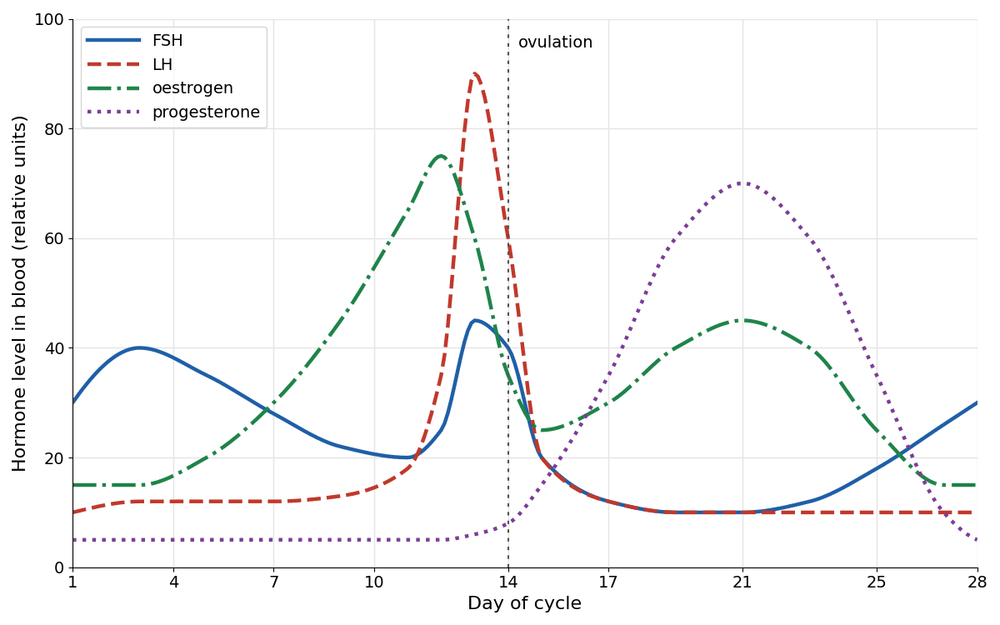
Notice that the oestrogen peak stimulates the LH surge, which causes ovulation. High progesterone in the second half of the cycle keeps FSH and LH low.

Example

A blood test shows high levels of progesterone but very low FSH and LH. Which part of the menstrual cycle is this?

Solution

The high level of progesterone and low levels of FSH and LH mean this is the second half of the menstrual cycle, after ovulation. The empty follicle produces progesterone, which maintains the lining and inhibits FSH and LH.

Tips/hints

Spell the G-words carefully. Glucose is the sugar in the blood, glycogen is the storage molecule in the liver, and glucagon is the hormone.

Negative feedback means a fall in glucose triggers a rise, bringing it back to normal.

Progesterone maintains the uterus lining. It is the fall in progesterone that causes the lining to break down.

Treating infertility (Higher)

Definition

Infertility means being unable to have a baby naturally. Hormones can be used to help, giving a woman or couple the chance to have a baby of their own.

If a woman's own FSH and LH levels are too low to cause eggs to mature, she can be given a fertility drug containing FSH and LH. This stimulates eggs to mature and be released, meaning she may then become pregnant in the normal way.

Method

In vitro fertilisation (IVF) is another treatment. The steps are:

1. The woman is given FSH and LH to stimulate the maturation of several eggs.

2. These eggs are collected from her ovaries.

3. The eggs are fertilised by sperm from the father in a laboratory dish (in vitro means outside the body).

4. The fertilised eggs develop into embryos.

5. When they are tiny balls of cells, one or two embryos are inserted into the woman's uterus.

Example

At one clinic, the live-birth rate per IVF cycle is 32% for women under 35 and 12% for women aged 40 to 42. How many times greater is the success rate for the younger group, and what does this suggest?

Solution

32 ÷ 12 = 2.7 times greater (to 2 significant figures).

Success rates fall as a woman gets older, so older patients usually need more cycles, which adds to the stress and cost.

Tips/hints

IVF disadvantages: it is physically and emotionally stressful, success rates are not high, and it is expensive.

It can lead to multiple births (twins or triplets), which are a risk to the mother and to the babies (who may be born early or small).

Ethical issues: some people object because unused embryos may be destroyed.

Developments in microscopy made it possible to see and handle eggs, sperm and early embryos.

Negative feedback: adrenaline and thyroxine (Higher)

Definition

Adrenaline is produced by the adrenal glands (above the kidneys) during fear or stress. It prepares the body for "fight or flight" by increasing heart rate and boosting oxygen and glucose delivery to the brain and muscles.

Thyroxine is produced by the thyroid gland (in the neck). It stimulates the basal metabolic rate (the speed of chemical reactions at rest) and promotes growth.

Method

A negative feedback system reverses any change from the normal level to maintain a steady state.

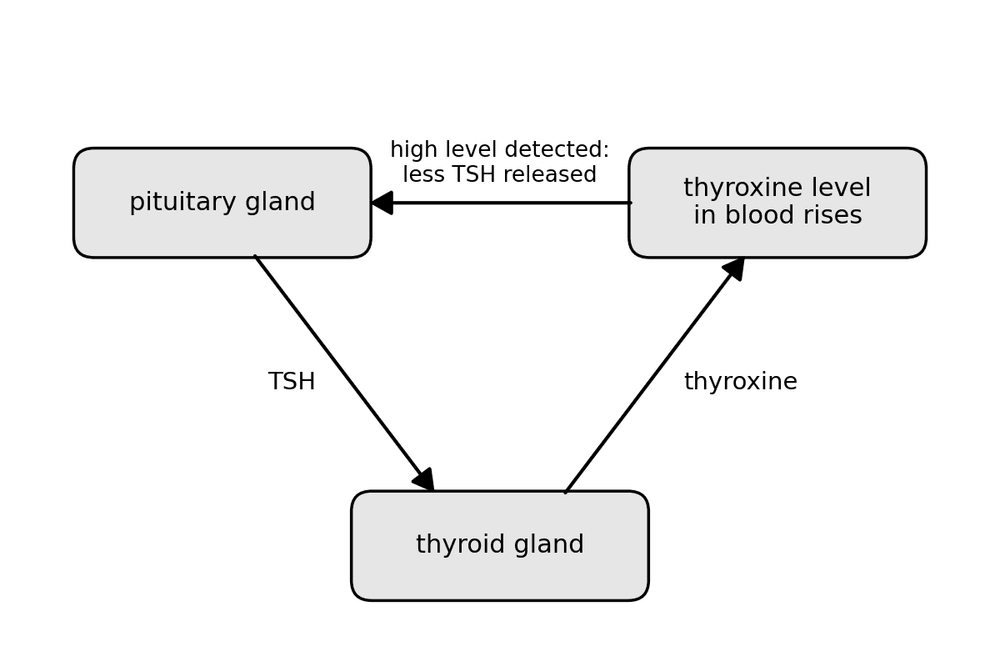
Thyroxine is controlled by negative feedback. If thyroxine is low, the pituitary gland releases more TSH, stimulating the thyroid to release more thyroxine. If thyroxine is high, the pituitary releases less TSH, so the thyroid releases less thyroxine.

Adrenaline is a short-term response and is NOT controlled by negative feedback.

Diagram

bio thyroxine feedback

Note

TSH from the pituitary gland stimulates the thyroid gland to release thyroxine. When the thyroxine level rises, the pituitary releases less TSH, so the level falls back to normal.

Example

A person is given thyroxine tablets, which raise the thyroxine level in their blood above normal. Predict how their pituitary gland and thyroid gland respond.

Solution

The pituitary gland detects the high thyroxine level and releases less TSH.

With less TSH reaching it, the person's own thyroid gland releases less thyroxine. This is negative feedback: the response opposes the rise.

Tips/hints

Adrenaline is made in the adrenal glands, not the brain or kidneys.

Thyroxine controls metabolic rate, not blood glucose (insulin and glucagon do that).

The pituitary controls the thyroid using TSH, not the reverse.

For percentage increase, divide the difference by the original value.

Required practical: Reaction time

Overview

This practical measures how a factor affects human reaction time. Suitable factors include practice, the hand used, or distractions (like music).

Method

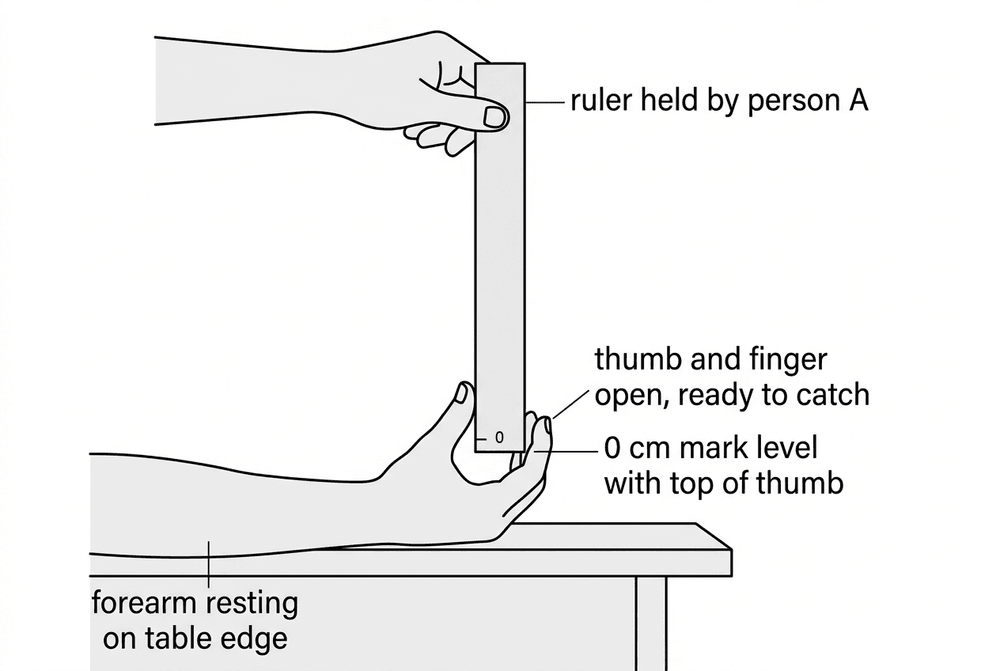
1. Person A holds a 30 cm ruler vertically by the top.

2. Person B rests their forearm on a table, holding thumb and finger open without touching the ruler.

3. The 0 cm mark must be level with the top of B's thumb.

4. Person A drops the ruler without warning.

5. Person B catches it as quickly as possible.

6. Record the reading at the top of B's thumb.

7. Repeat several times and calculate a mean.

8. Use a conversion table to change distance into time.

Knowledge Required

Independent variable: the factor changed (e.g. hand used, practice, a distraction).

Dependent variable: the reaction time (from the distance the ruler falls).

Control variables: same catcher, same ruler, same starting position of the hand, 0 cm mark at the same height, same conditions.

Apparatus: a 30 cm ruler marked in mm, a table, and a distance-to-time conversion table.

Note

When investigating caffeine, participants must be willing volunteers. Use small amounts and exclude anyone with a condition affected by caffeine.

Diagram

bio ruler drop test

Note

Person A holds the ruler at the top. Person B rests their forearm on the table with thumb and finger open, and the 0 cm mark level with the top of the thumb, so the hand cannot move up or down.

Tips/hints

Person A must wait a random delay before dropping to stop person B anticipating it.

Always read the ruler at the top of the thumb.

A computer test (e.g. clicking when the screen changes) gives a more precise time and removes human reading error.

Do not include anomalous results in the mean.

Test yourself on this topic

Try the free quiz with worked solutions.

Start quiz →

Get GCSE Science

Full notes, full question bank, offline.