









Solving Simultaneous Equations by Substitution: A Step-by-Step GCSE Guide
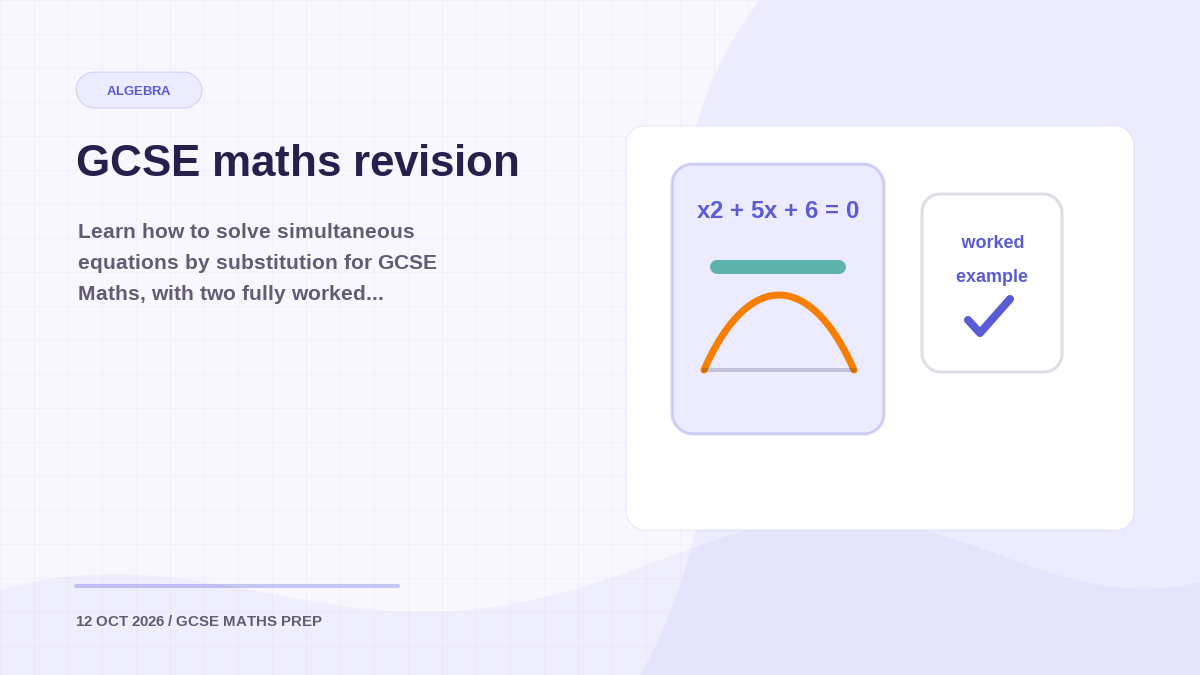
Learn how to solve simultaneous equations by substitution for GCSE Maths, with two fully worked examples, common mistakes and exam tips.
12 October 2026 · Webrich Software
Simultaneous equations are one of those topics that come up on GCSE Maths papers year after year, and they’re worth 3–4 reliable marks once you know the method. In an earlier guide we covered elimination. Here we look at the other main method, substitution. When one of the equations already has a letter on its own, substitution is often the quicker route.
What does “substitution” actually mean?
The idea is simple. You have two equations and two unknowns, usually x and y. You:
- Rearrange one equation so that one letter is on its own (for example, x = something with y in it).
- Substitute that expression into the other equation, which leaves an equation with only one letter in it.
- Solve that equation.
- Substitute back to find the second letter.
That’s the full method. The skill is in choosing which equation and which letter to rearrange.
Tip: Look for a letter with a coefficient of 1, such as a plain x or y with no number in front of it. Rearranging for that letter avoids fractions completely.
Substitution vs elimination at a glance
| Substitution | Elimination | |
|---|---|---|
| Best when… | A letter already has a coefficient of 1 | Coefficients match or are easy to match |
| Main step | Rearrange, then replace a letter with an expression | Multiply, then add or subtract the equations |
| Common pitfall | Forgetting brackets | Subtracting negatives incorrectly |
| Works for linear + quadratic? | Yes | No |
If you’d like a refresher on where simultaneous equations sit within the wider topic, our guide to all of GCSE Algebra in one place walks through everything from number lines up to this point.
Worked example 1: rearranging for x
Solve:
- (1) x + 3y = 11
- (2) 4x − 7y = 6
Step 1: Choose what to rearrange. In equation (1), x has a coefficient of 1, so rearrange that one for x:
x = 11 − 3y (3)
Labelling the new equation (3) helps both you and the examiner follow your working.
Step 2: Substitute (3) into (2). Wherever you see x in equation (2), write (11 − 3y), in brackets:
4(11 − 3y) − 7y = 6
There is now only one letter in the equation, because x has been eliminated.
Step 3: Expand and simplify.
44 − 12y − 7y = 6
44 − 19y = 6
Add 19y to both sides and take 6 from both sides:
38 = 19y
Step 4: Solve.
y = 38 ÷ 19 = 2
Step 5: Substitute back to find x. You could use any of the equations, but (3) already has x on its own, so it’s the easiest:
x = 11 − 3(2) = 11 − 6 = 5
Solution: x = 5, y = 2
Check in equation (2): 4(5) − 7(2) = 20 − 14 = 6 ✓
Remember: Once you’ve found the first value, substitute it into the equation where the other letter is already on its own. There’s less algebra to do and fewer places for a mistake to creep in.
Worked example 2: rearranging for y, with negatives
Solve:
- (1) 3x − y = 7
- (2) 10x + 3y = −2
Step 1: Choose what to rearrange. This time it’s y in equation (1) that has a coefficient of 1 (strictly −1). Move y to the other side to make it positive:
3x − 7 = y, so y = 3x − 7 (3)
Step 2: Substitute (3) into (2).
10x + 3(3x − 7) = −2
Step 3: Expand and simplify. Take care with the sign: 3 × −7 = −21.
10x + 9x − 21 = −2
19x − 21 = −2
19x = 19
Step 4: Solve.
x = 1
Step 5: Substitute back into (3).
y = 3(1) − 7 = 3 − 7 = −4
Solution: x = 1, y = −4
Check in equation (2): 10(1) + 3(−4) = 10 − 12 = −2 ✓
Common mistakes (and how to avoid them)
- Missing brackets. 4x with x = 11 − 3y must become 4(11 − 3y). Without brackets you get 44 − 3y, which is wrong.
- Sign errors when expanding. A negative number multiplied by a bracket changes the sign of every term inside it. Write each multiplication out if you need to.
- Substituting back into the same equation you rearranged and calling it a check. It isn’t a real check. Use the equation you didn’t rearrange.
- Stopping after one value. The question asks for both x and y. Finding only one gets you partial marks at best.
- Rearranging the awkward equation. Rearranging 4x − 7y = 6 for x gives x = (6 + 7y) ÷ 4, which brings fractions in. Always look for the coefficient of 1 first.
Did you know? On the Higher tier, substitution is the only standard method for a linear equation paired with a quadratic, such as y = 2x + 1 and x² + y² = 10. Learning it properly now pays off later, and you’ll need your factorising skills for quadratic equations to finish those questions.
How to set out your answer in the exam
Examiners award method marks, so set your working out clearly:
- Number your equations (1), (2), and label any rearranged equation (3).
- Write a short note such as “Sub (3) into (2)” so your method is visible.
- Show the expanded line before simplifying.
- Write the final answer clearly on its own line: x = 1, y = −4.
- If you have time, write a one-line check.
On the non-calculator paper the numbers are usually chosen to divide neatly, like 38 ÷ 19 and 19 ÷ 19 above. If you end up with a messy fraction, go back and check your signs. For more tips like this, see our guide to non-calculator paper tactics.
Practise until it’s automatic
Simultaneous equations reward repetition. After 10–15 practice questions, you’ll start to see which method to use as soon as you read the question. A good routine is:
- Day 1: 5 questions where one letter already has a coefficient of 1 (substitution).
- Day 2: 5 questions where you need to multiply first (elimination).
- Day 3: 5 mixed questions where you pick the method yourself.
If you’re building this into a longer revision timetable, our 12-week GCSE Maths revision plan shows where algebra topics like this fit in.
Revise simultaneous equations with our apps
The GCSE Algebra app is built for exactly this kind of topic. It covers expressions, equations, inequalities, sequences and graphs for both Foundation and Higher tier, so you can drill simultaneous equations alongside the rearranging and expanding skills they depend on.
If you’d rather revise every area of the course in one place, the GCSE Maths app brings Number, Algebra, Geometry and Statistics together in a single bundle. Across the four subject apps there are 6900+ questions, so you can switch from simultaneous equations to Pythagoras or probability without changing app.
Learn the four steps (rearrange, substitute, solve, substitute back), keep your brackets, and always check your answer.
Frequently asked questions
When should I use substitution instead of elimination for simultaneous equations?
Use substitution when one of the variables already has a coefficient of 1 (or −1), such as x + 3y = 11 or 3x − y = 7. That makes it quick to rearrange for one letter without creating fractions. If neither equation has a lone x or y, elimination is usually faster.
Is substitution on the Foundation or Higher tier GCSE Maths paper?
Solving linear simultaneous equations appears on both tiers, although it is more common on Higher. Substitution is also essential on Higher tier when one equation is linear and the other is quadratic, such as y = x + 1 and x² + y² = 25, because elimination doesn't work there.
Do I need to check my answer to simultaneous equations?
You don't have to, but you should. Put both values into the original equation you didn't use for the final substitution. If both sides match, your answer is right. It takes about 20 seconds and catches most sign errors.
How many marks are simultaneous equations questions worth in GCSE Maths?
Usually 3 or 4 marks for a linear pair. You can pick up method marks for correctly rearranging and substituting even if you make an arithmetic slip later, so always show every line of working.
What is the most common mistake when solving simultaneous equations by substitution?
Forgetting the brackets when you substitute. If x = 11 − 3y, then 4x has to become 4(11 − 3y), not 4 × 11 − 3y. Leaving the brackets out means only part of the expression gets multiplied, and the answer will be wrong.
Related apps
Put it into practice
Free quizzes for every topic, or download the apps for the full experience.