

GCSE Circle Theorems: 7 Rules, Examples & Exam Tips
Learn the seven GCSE Higher circle theorems with clear rules, worked angle examples, worded reasons and tips for spotting each theorem in exam questions.
6 July 2026 · Webrich Software
Circle theorems are one of the highest-value topics on the GCSE Higher Maths paper. A single well-labelled diagram can be worth four or five marks, and the theorems come up almost every year. The good news? There are only seven of them, and once you can recognise each one in a diagram, the questions become a satisfying puzzle rather than a guessing game.
This guide walks through every theorem you need, then shows you how examiners expect you to lay out your working — including when to write down worded reasons.
First, the vocabulary
Before the theorems, you need the language. Get these terms wrong in an exam and you can lose marks even when your maths is right.
| Term | What it means |
|---|---|
| Chord | A straight line joining two points on the circumference |
| Segment | The region a chord cuts the circle into (major and minor) |
| Diameter | A chord that passes through the centre |
| Radius | A line from the centre to the circumference |
| Tangent | A straight line that touches the circle at exactly one point |
| Cyclic quadrilateral | A four-sided shape with all four corners on the circumference |
Tip: A shape is only a cyclic quadrilateral if every corner sits on the circumference. If even one vertex is inside or outside the circle, the cyclic quadrilateral theorem does not apply.
The seven circle theorems
Here is the full set at a glance, then we’ll unpack the ones students trip over.
| # | Theorem | Quick reason to quote |
|---|---|---|
| 1 | Angles in the same segment are equal | ”Angles in the same segment are equal” |
| 2 | The angle in a semicircle is 90° | “Angle in a semicircle is 90°“ |
| 3 | The angle at the centre is twice the angle at the circumference | ”Angle at centre is twice the angle at circumference” |
| 4 | Opposite angles in a cyclic quadrilateral sum to 180° | “Opposite angles in a cyclic quadrilateral add to 180°“ |
| 5 | A tangent meets a radius at 90° | “A tangent meets a radius at 90°“ |
| 6 | Tangents from the same point are equal in length | ”Tangents from a point are equal” |
| 7 | The alternate segment theorem | ”Alternate segment theorem” |
1. Angles in the same segment. Draw a chord, then draw two or three angles from that chord that all sit in the same segment. They will all be equal. Because the finished diagram looks a bit like a bow tie, students often call this the “bow tie theorem” — but avoid that phrase in the exam and write the proper reason instead.
2. The angle in a semicircle. This is a special case of theorem 1. If the chord happens to be a diameter (so it passes through the centre), any angle drawn from it to the circumference is a right angle. The diameter splits the circle into two semicircles, hence the name.
3. The angle at the centre. Draw a chord, then draw one angle at the circumference and one at the centre using the same chord. The angle at the centre is exactly twice the angle at the circumference. So if the angle at the circumference is 50°, the angle at the centre is 100°.
4. Cyclic quadrilaterals. Opposite angles add to 180°. If one angle is 86°, the angle opposite it is 94°. If another is 110°, its opposite is 70°.
5, 6 and the tangent family. A tangent always meets a radius at 90° at the point of contact. If you draw two tangents from the same external point, they are equal in length — and the line from that point to the centre bisects the angle between them. So a 30° angle between two tangents splits into 15° and 15°.
7. The alternate segment theorem. This is the one to master. Where a tangent meets a chord, the angle between them equals the angle the chord makes at the circumference in the other segment. It is easy to miss because the two equal angles sit on opposite sides of the diagram.
Remember: Theorems 1, 2 and 3 are all about angles from a chord. If you can see a chord in the diagram, one of those three is usually the key.
Worked example: finding an angle with reasons
Suppose you’re asked to find angle ABD, giving reasons. In a typical diagram you first spot that angle ACD sits on a straight line with a given 105° angle:
- Angles on a straight line add to 180°, so ACD = 180 − 105 = 75°.
- ABD and ACD are angles in the same segment, so ABD = 75° — reason: angles in the same segment are equal.
Notice that every step has a justification. When the question says “give reasons”, each worded reason is an easy mark you should never leave on the table.
Worked example: chaining theorems together
Harder questions stack several theorems. Imagine a diagram with an isosceles triangle inside a circle and a tangent at the bottom. A full solution might run:
- Two sides are equal, so the base angles are equal → one angle is 35° (isosceles triangle).
- Angles in a triangle sum to 180°, so the third angle is 180 − 35 − 35 = 110°.
- The opposite angle in the cyclic quadrilateral is 180 − 110 = 70°.
- A line through the centre is a diameter, so the angle in that semicircle is 90°.
- The remaining angle in that triangle is 180 − 90 − 70 = 20°.
- By the alternate segment theorem, the required angle is also 20°.
Did you know? There is often more than one correct route through a circle theorems question. As long as your method is clear and the answer is right, you’ll earn full marks — so don’t panic if your working looks different from a friend’s.
The habit that separates high scorers from the rest is simple: mark every angle you find directly onto the diagram as you go. It stops you losing track and makes the next step obvious.
How this fits your wider revision
Circle theorems reward the same approach as the rest of Higher geometry — spot the configuration, apply the rule, justify it. If you’re still shaky on the angle facts that feed into these questions, our guide to trigonometry for beginners and our deeper dive into the 8 circle theorems every Higher tier student must know are the natural next reads. And when the theorems appear in a bigger multi-topic question, the tactics in how to get a grade 9 in GCSE Maths will help you keep your working tidy under pressure.
Practise until you can spot them instantly
Reading about circle theorems is the easy part — the exam tests whether you can recognise the right one in an unfamiliar diagram, at speed. That only comes from doing questions.
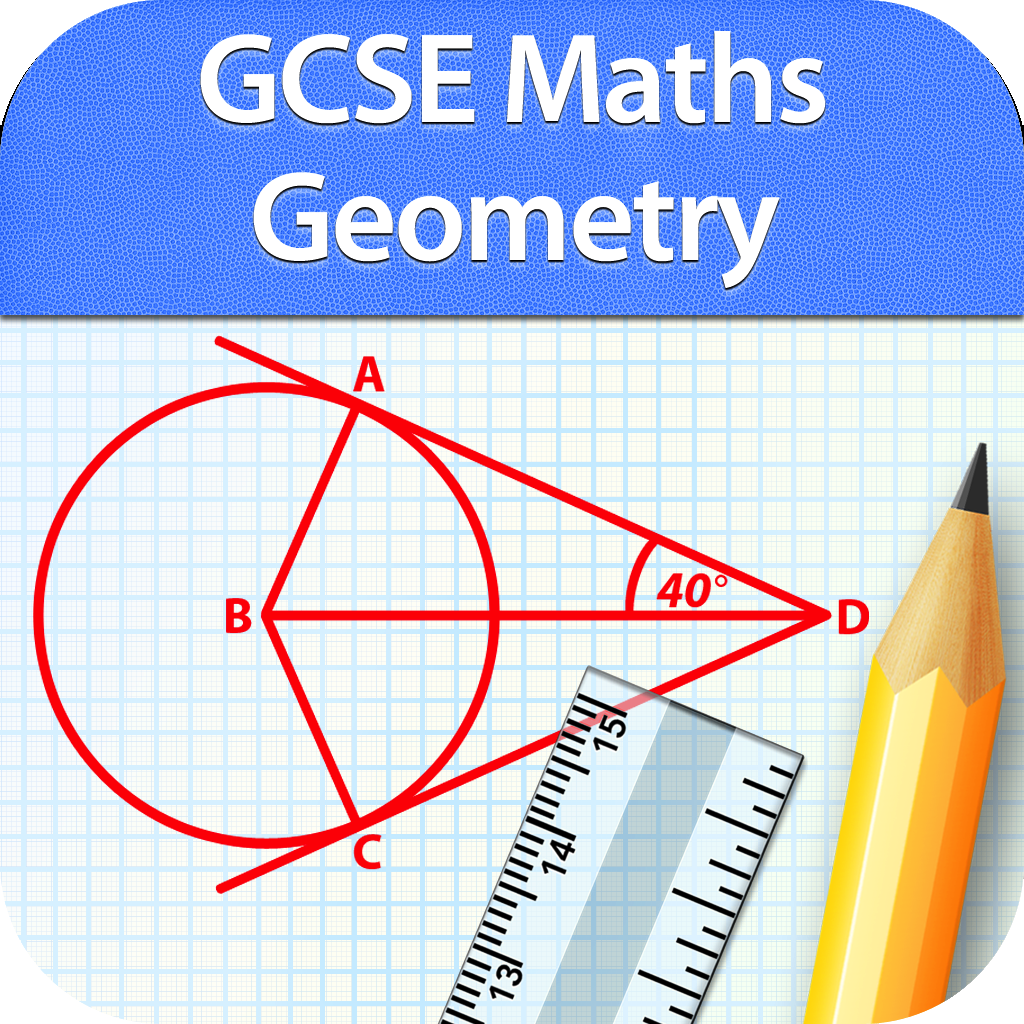
Our GCSE Geometry app gives you focused, visual practice on exactly this: 2D and 3D shapes, angles, trigonometry, transformations and, of course, circle theorems, with worked diagrams that build the pattern-spotting instinct examiners are looking for. If you want circle theorems alongside every other topic in one place, the GCSE Maths all-in-one app bundles Number, Algebra, Geometry and Statistics together so you can move seamlessly between topics — part of a suite of 2900+ questions across the four subject apps.
Draw the theorems out on a single page, keep the reasons in your own words, and put in the timed practice. Circle theorems will go from your least favourite topic to a reliable source of marks.
Frequently asked questions
How many circle theorems do I need to know for GCSE Higher Maths?
There are seven core circle theorems on the Higher tier: angles in the same segment are equal, the angle in a semicircle is 90°, the angle at the centre is twice the angle at the circumference, opposite angles in a cyclic quadrilateral sum to 180°, a tangent meets a radius at 90°, tangents from the same point are equal in length, and the alternate segment theorem. You should be able to name each one, because worded reasons often carry marks.
Are circle theorems on the Foundation tier?
No — circle theorems are a Higher tier topic only. Foundation students still need angles in shapes, area and circumference of circles, and basic angle facts, but the theorems involving chords, tangents and cyclic quadrilaterals appear only on Higher papers.
Do I have to write the reason as well as the answer?
Only when the question asks you to 'give reasons for your answer' — but when it does, the reason is worth marks. Write the theorem in words, for example 'angles in the same segment are equal' or 'the angle in a semicircle is 90°'. Vague phrases like 'the bow tie rule' will not score.
What is the alternate segment theorem in simple terms?
Where a tangent meets a chord, the angle between them equals the angle the chord makes at the circumference in the other (alternate) segment. It is the theorem students forget most often, so it is worth drilling until you can spot it instantly.
How do I remember all the circle theorems?
Draw them. Sketch each theorem on a single revision page, then practise spotting them in mixed diagrams. Recognition — not recitation — is what the exam tests, so timed practice with worked questions beats re-reading notes.
Related apps
Put it into practice
Free quizzes for every topic, or download the apps for the full experience.