

Trigonometry for Beginners: SOH CAH TOA Explained for GCSE
A beginner-friendly guide to right-angled triangle trigonometry: SOH CAH TOA, finding missing sides and angles, and the special triangles for your GCSE exam.
1 June 2026 · Webrich Software
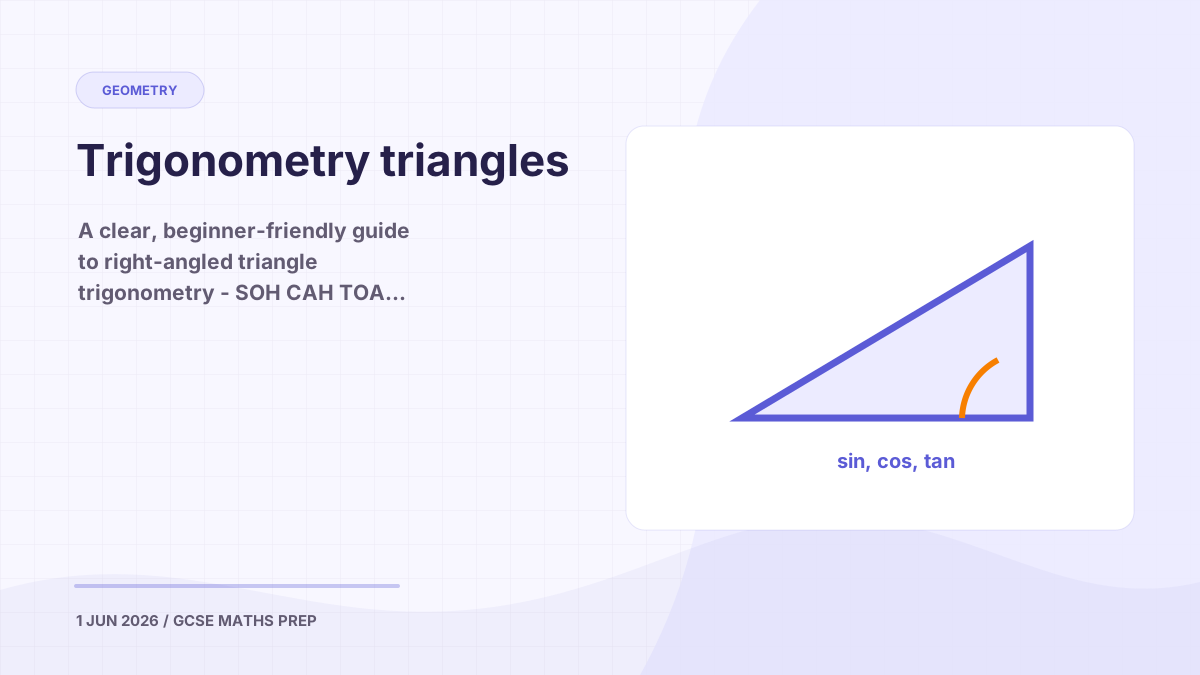
If you’ve ever stared at “SOH CAH TOA” scrawled across a whiteboard and wondered what on earth it meant, you’re in exactly the right place. Trigonometry is one of those GCSE topics that looks intimidating until the moment it clicks — and then it becomes one of the most reliable sources of marks on the Geometry section of the paper. This guide takes you from the very beginning.
The three sides of a right-angled triangle
Before any of the ratios make sense, you need to label the sides correctly. Everything is named relative to the angle you’re working with, usually written as θ (theta).
- Opposite — the side directly across from the angle θ.
- Adjacent — the side next to θ (but not the hypotenuse).
- Hypotenuse — the longest side, always opposite the right angle.
Tip: The hypotenuse never changes — it’s always opposite the little square that marks the right angle. Only “opposite” and “adjacent” swap around depending on which angle you’re looking at. Label them every single time before you do anything else.
You’ll also recognise the Pythagorean theorem here: a² + b² = c², where c is the hypotenuse. You won’t always need it, but it’s your safety net for finding a missing side.
SOH CAH TOA: the three ratios
The whole of beginner trigonometry rests on three ratios, and SOH CAH TOA is how you remember them:
| Mnemonic | Ratio | Formula |
|---|---|---|
| SOH | Sine | sin θ = Opposite ÷ Hypotenuse |
| CAH | Cosine | cos θ = Adjacent ÷ Hypotenuse |
| TOA | Tangent | tan θ = Opposite ÷ Adjacent |
That’s genuinely it for the core content. There are three other functions — cosecant, secant and cotangent — which are simply the reciprocals (flip the fraction) of sine, cosine and tangent. They turn up more in A-level than GCSE, but it’s worth knowing they exist.
A worked example: the 3-4-5 triangle
Suppose a right-angled triangle has sides of 3 and 4, with the angle θ in the corner. First, find the missing side using Pythagoras:
- 3² + 4² = 9 + 16 = 25
- √25 = 5, so the hypotenuse is 5.
Now label relative to θ: opposite = 4, adjacent = 3, hypotenuse = 5. The ratios fall straight out:
- sin θ = 4 ÷ 5
- cos θ = 3 ÷ 5
- tan θ = 4 ÷ 3
Once you have those three, the reciprocals are just flips: cosec θ = 5 ÷ 4, sec θ = 5 ÷ 3, cot θ = 3 ÷ 4.
Special triangles that save you time
Some side combinations appear so often that memorising them lets you skip the Pythagoras step entirely. These are the Pythagorean triples:
- 3, 4, 5
- 5, 12, 13
- 8, 15, 17
- 7, 24, 25
Any whole-number multiple works too. Multiply 3-4-5 by two and you get 6-8-10; by three and you get 9-12-15. Spotting that “25” is 5 × 5 and “15” is 3 × 5 instantly tells you the third side is 4 × 5 = 20. The rarer triples 9-40-41 and 11-60-61 occasionally appear on Higher tier.
Did you know? Recognising a triple in an exam can save you a full minute of working — time you can spend on the harder questions later in the paper. Our guide on the tricks they don’t tell you about getting a grade 9 digs into more shortcuts like this.
Finding a missing side with trigonometry
When you have one side and an angle, you use the ratios to find another side. Say the angle is 38° and the side adjacent to it is 42, and you want the opposite side, x.
Opposite and adjacent means tangent (TOA):
- tan 38° = x ÷ 42
- Multiply both sides by 42: x = 42 × tan 38°
- tan 38° ≈ 0.7813, so x ≈ 42 × 0.7813 ≈ 32.8
If instead you know the hypotenuse, you’d use sin or cos. For an angle of 54° with hypotenuse 26 and an adjacent side x: cos 54° = x ÷ 26, so x = 26 × cos 54° ≈ 15.28.
Remember: Always check your calculator is in degree mode, not radians. A surprising number of marks are lost in exams simply because the calculator was set wrongly. It’s the first thing to verify when an answer looks bizarre.
When the unknown is on the bottom of the fraction — for example sin 32° = 12 ÷ x — rearrange by cross-multiplying: x = 12 ÷ sin 32° ≈ 22.64.
Finding a missing angle
If you know two sides and want the angle, work out the ratio, then apply the inverse function (the little −1, found above sin, cos or tan on your calculator):
| You know | Ratio used | How to find θ |
|---|---|---|
| Opposite & adjacent | tan θ = opp ÷ adj | θ = tan⁻¹(opp ÷ adj) |
| Adjacent & hypotenuse | cos θ = adj ÷ hyp | θ = cos⁻¹(adj ÷ hyp) |
| Opposite & hypotenuse | sin θ = opp ÷ hyp | θ = sin⁻¹(opp ÷ hyp) |
So with opposite 5 and adjacent 4: tan θ = 5 ÷ 4, giving θ = tan⁻¹(1.25) ≈ 51.3°. With adjacent 3 and hypotenuse 7: θ = cos⁻¹(3 ÷ 7) ≈ 64.6°.
Where trigonometry fits in your revision
Trigonometry sits alongside Pythagoras, angles and circle theorems in the Geometry strand. If you’re comfortable with right-angled triangles, the natural next steps are the eight circle theorems every Higher tier student must know and, for the non-calculator paper, knowing which tactics actually save marks when a calculator isn’t allowed.
Tip: Trigonometry is almost always a calculator-paper topic. Drill it with your own calculator in hand so that finding sin, cos, tan and their inverses becomes second nature before you sit the exam.
Practise trigonometry with our GCSE apps
Reading about SOH CAH TOA gets you halfway; the marks come from repetition. Our GCSE Geometry app gives you focused, exam-style practice on right-angled trigonometry, Pythagoras, angles, transformations and circle theorems — all with worked solutions so you can see exactly where a method goes wrong.
If you’d rather revise across the whole specification in one place, the GCSE Maths all-in-one app bundles Number, Algebra, Geometry and Statistics together, so you can move between trigonometry and the topics it connects to without switching apps. Across the four subject apps you’ll find 2900+ questions covering both Foundation and Higher tier — more than enough to turn “I sort of get it” into “I can do this under exam pressure.”
Label your sides, pick your ratio, check your calculator’s in degree mode — and trigonometry becomes one of the most dependable mark-earners on the paper. You’ve got this.
Frequently asked questions
What does SOH CAH TOA mean in GCSE trigonometry?
SOH CAH TOA is a memory aid for the three trig ratios in a right-angled triangle. SOH means Sin = Opposite ÷ Hypotenuse. CAH means Cos = Adjacent ÷ Hypotenuse. TOA means Tan = Opposite ÷ Adjacent. Label your sides relative to the angle first, then pick the ratio that uses the two sides you know or need.
How do I know whether to use sin, cos or tan?
Look at which two sides are involved relative to your angle. If it's opposite and hypotenuse, use sin. Adjacent and hypotenuse, use cos. Opposite and adjacent, use tan. The hypotenuse is always the longest side, opposite the right angle.
How do I find a missing angle in a right-angled triangle?
Work out the relevant ratio from the two sides you know, then apply the inverse function on your calculator. For example, if tan θ = 5 ÷ 4, then θ = tan⁻¹(5 ÷ 4) ≈ 51.3°. Use sin⁻¹, cos⁻¹ or tan⁻¹ depending on which ratio you used. Always check your calculator is in degree mode.
What are the special right-angled triangles I should memorise?
The Pythagorean triples worth knowing are 3-4-5, 5-12-13, 8-15-17 and 7-24-25, plus their multiples (e.g. 6-8-10 or 9-12-15). Spotting them lets you find a missing side instantly without reaching for the Pythagoras calculation.
Is trigonometry on both Foundation and Higher tier GCSE Maths?
Right-angled triangle trigonometry (SOH CAH TOA) appears on both tiers. Higher tier extends this with the sine rule, cosine rule and trigonometry in non-right-angled triangles, so Higher students should treat SOH CAH TOA as the foundation everything else builds on.
Related apps
Put it into practice
Free quizzes for every topic, or download the apps for the full experience.