

The 8 Circle Theorems Every Higher Tier Student Must Know
Visual guide to the 8 circle theorems on the GCSE Maths Higher tier syllabus — what they say, how to spot them, and the mistakes that lose marks.
28 February 2026 · Webrich Software
Circle theorems trip up more Higher-tier students than any other topic — not because they’re hard, but because there are eight of them and they look similar. Spot the configuration, apply the rule, quote the theorem by name. Once you have the visual recognition, the marks are formulaic.
Quick vocabulary
Remember: Examiners use these terms precisely. A chord is not a radius, even when both are inside the circle.
- Radius: centre to circumference.
- Diameter: a chord through the centre.
- Chord: any line segment with both endpoints on the circumference.
- Tangent: a line that touches the circle at exactly one point.
- Arc: a piece of the circumference.
- Segment: the area cut off by a chord.
- Sector: the pie-slice area cut off by two radii.
The 8 theorems at a glance
| # | Theorem | Quick name |
|---|---|---|
| 1 | Angle at the centre = 2 × angle at circumference (same arc) | Angle at centre |
| 2 | Angle in a semicircle = 90° | Semicircle |
| 3 | Angles in the same segment are equal | Same segment |
| 4 | Opposite angles in a cyclic quadrilateral add to 180° | Cyclic quad |
| 5 | Tangent ⟂ radius (at point of contact) | Tangent–radius |
| 6 | Tangents from an external point are equal in length | Two tangents |
| 7 | The perpendicular from the centre to a chord bisects the chord | Perpendicular bisector |
| 8 | Alternate segment theorem | Alternate segment |
1 — Angle at the centre
The angle subtended by an arc at the centre is twice the angle subtended by the same arc at the circumference.
Tip: Two lines from the centre + two lines from a point on the circumference, all meeting at the same two points on the arc → this is your theorem. Look for the “V” inside a wider “V”.
2 — Angle in a semicircle
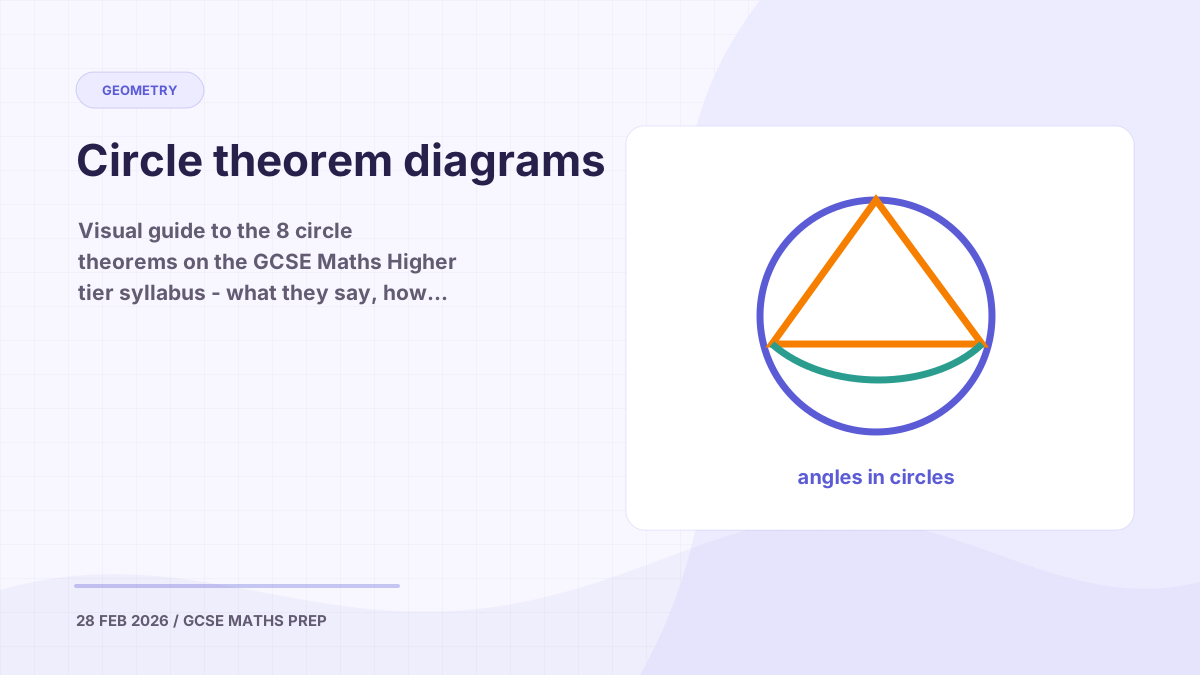
Any triangle inscribed in a circle, with one side being a diameter, has a 90° angle at the opposite vertex.
Tip: Whenever you see a diameter drawn in, scan for triangles with one vertex on the circumference. That right angle is a free mark.
3 — Angles in the same segment
Two points on a chord; two angles subtended from those points to two other points on the same arc → those angles are equal.
This one looks like the angle-at-centre theorem with no centre. The configuration is: a chord plus two more points on the same side of the chord.
4 — Cyclic quadrilateral
A four-sided shape with all four vertices on the circumference. Opposite angles sum to 180°.
Did you know? This is sometimes called the “Ptolemy theorem” in textbooks. Most exams just call it “opposite angles in a cyclic quadrilateral.” Use the second name in your reasoning — it’s clearer.
5 — Tangent–radius
A tangent meets a radius at 90° at the point of contact. Always. No exceptions.
6 — Two tangents from a point
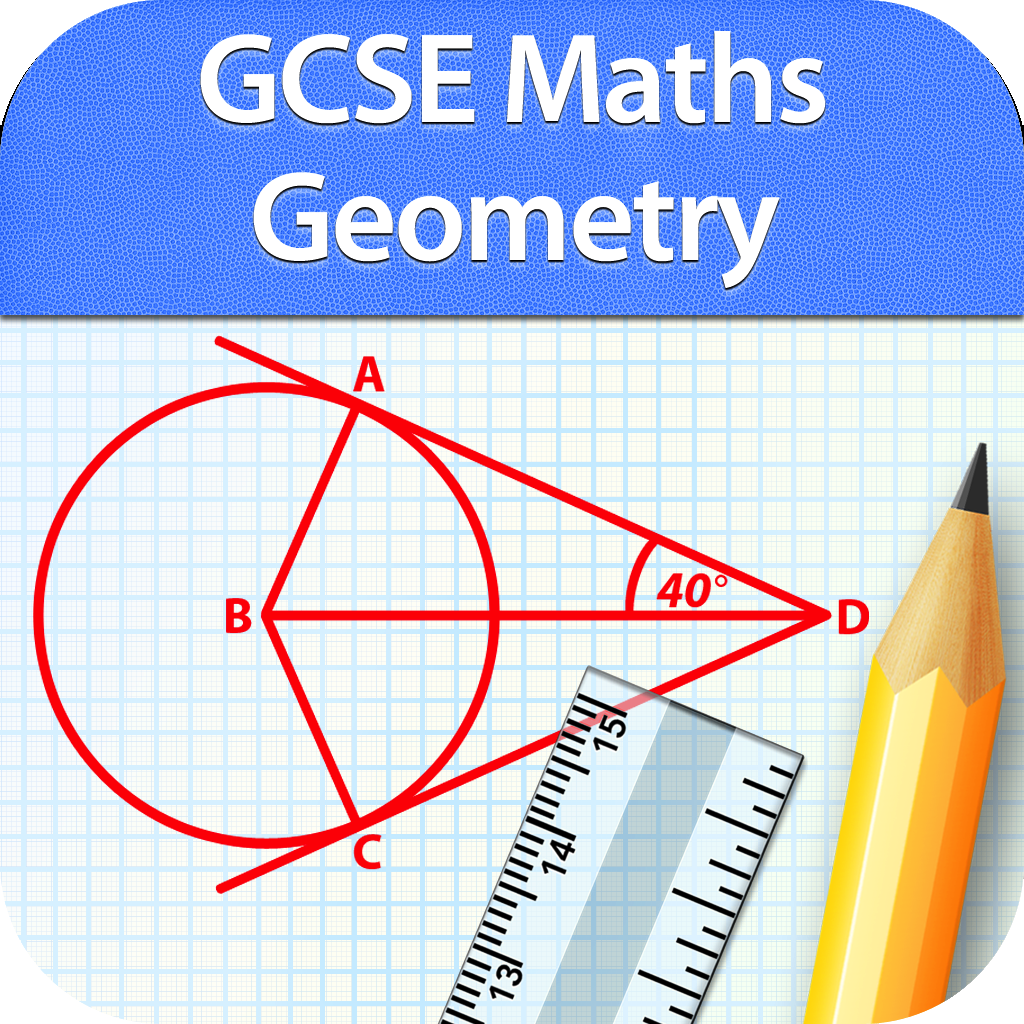
If you draw two tangents from an external point P to a circle, both tangents have the same length. You also get a kite-shaped configuration with two right angles (theorem 5 applied twice).
7 — Perpendicular from centre to chord
Drop a perpendicular from the centre to any chord, and it bisects that chord. This is the basis of most “find the radius” Pythagoras questions.
8 — Alternate segment theorem
The angle between a tangent and a chord at the point of contact equals the angle in the alternate segment (the segment on the other side of the chord).
This is the hardest to spot and the most marked. Practise it in our Geometry quiz — there are dedicated subtopics on every circle theorem.
How to answer in the exam
Remember: Always give a reason. Examiners will dock the second mark if you write only the answer. “Angle ABC = 60°, angles in the same segment” is worth full marks. “Angle ABC = 60°” is worth one.
| What examiners want | Example wording |
|---|---|
| The numerical answer | x = 60° |
| The theorem name | angle at the centre is twice the angle at the circumference |
| Specific to the diagram | (same arc AB) |
Common mistakes
- Calling a chord a diameter. A diameter passes through the centre. If the question doesn’t tell you, don’t assume.
- Using the same-segment theorem on opposite sides. The points must be on the same arc (same side of the chord).
- Forgetting the alternate segment theorem applies even when no second segment is shown. It’s purely a tangent-chord-arc rule.
Drill them visually
The only way circle theorems stick is by recognising the shape of the configuration before reading the question. Try the Circle theorems quiz — 50 questions across the 8 theorems with diagrams for every example.
Frequently asked questions
Do circle theorems appear on Foundation tier?
No. Circle theorems are Higher-tier only. Foundation candidates need to know circle vocabulary (radius, diameter, chord, arc, segment, tangent) and the formulas for circumference and area — but not the theorems.
How are circle theorem questions usually worded?
Almost always 'Find the size of angle X. Give a reason for your answer.' That reason is worth a mark — usually equal to the calculation mark. Always quote the theorem name (e.g. 'angle at centre is twice angle at circumference').
Which theorem appears most often in exams?
Looking at 10 years of papers, the 'angle in a semicircle is 90°' and 'angles in the same segment are equal' theorems appear most often. The 'alternate segment theorem' is the trickiest and is reserved for high-mark questions targeting grade 8/9 candidates.
Related apps
Put it into practice
Free quizzes for every topic, or download the apps for the full experience.