


G GCSE Apps

GCSE Science

P5 Forces

16 subtopics in this section

Scalars, vectors and types of force

Definition

A scalar quantity has a size (magnitude) only. Examples include distance, speed, mass, time, energy and temperature.

A vector quantity has a size and a specific direction. Examples include displacement, velocity, force, acceleration and weight.

A force is a push or a pull on an object caused by an interaction with another object. Forces are vectors and are measured in newtons (N).

Method

Contact forces only act when objects are physically touching. Examples are friction, air resistance, tension and normal contact force.

Non-contact forces can pull or push across an empty space. Examples are gravitational, electrostatic and magnetic forces.

When two objects interact, they both feel a force. These two forces are an interaction pair: they are the exact same type of force, equal in size, opposite in direction, and act on the two different objects.

Diagram
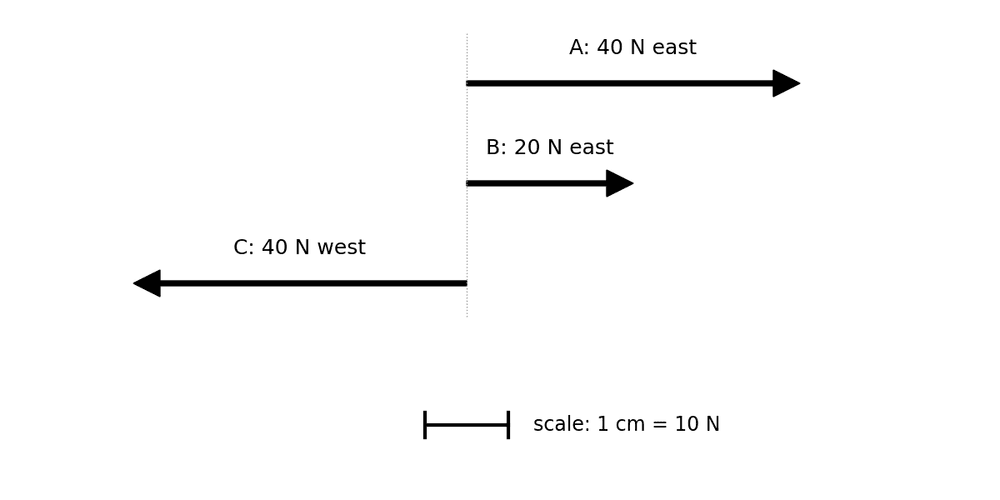
phys vector arrows

Note

A vector can be drawn as an arrow. The arrow's length shows the size to a stated scale, and the arrow points in the direction.

Example

A rubbed balloon pulls a small piece of paper upwards with a force of 0.02 N. What force does the paper exert on the balloon?

Solution

The two forces are an interaction pair, so they have the same size and type.

The paper pulls the balloon with 0.02 N, downwards (towards the paper). It is an electrostatic, non-contact force.

Tips/hints

Weight is a force caused by gravity, so it is a vector. Mass is not a force, so it is a scalar.

Air resistance and friction are contact forces because the object must touch particles or a surface.

In an interaction pair, the forces are always equal in size. Earth pulls the Moon and the Moon pulls Earth back with a force of exactly the same size.
Gravity, weight and mass

Definition

Mass is the amount of matter in an object, measured in kilograms (kg). It does not change.

Weight is the force acting on an object due to gravity. Near Earth, this is caused by its gravitational field. Being a force, it is measured in newtons (N) using a calibrated spring balance (newtonmeter).

Weight acts as if concentrated at a single point, called its centre of mass. For a uniform object like a metre rule, this is exactly in the middle.

Method

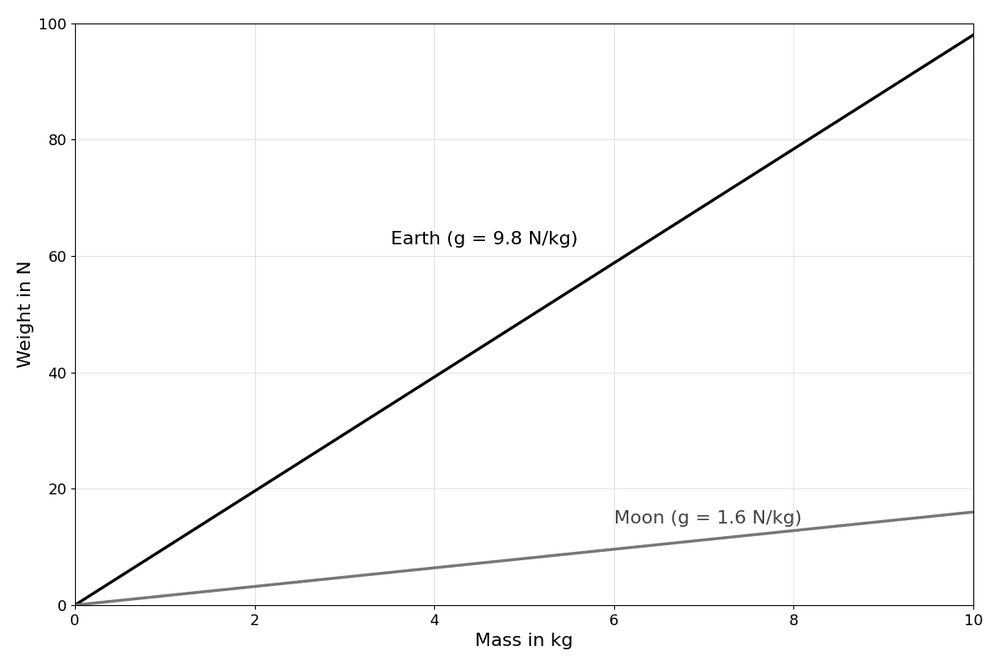
Weight and mass are directly proportional (W ∝ m). If you double the mass, the weight also doubles.

Calculate weight using the equation: W = mg (weight = mass × gravitational field strength).

Mass must be in kilograms (kg). Gravitational field strength is in N/kg and is always given in the question (e.g. 9.8 N/kg on Earth).

Diagram

phys weight mass graph

Note

A graph of weight against mass is a straight line through the origin. The gradient (steepness) of the line tells you the gravitational field strength.

Example

A cat has a mass of 4500 g. The gravitational field strength is 9.8 N/kg. What is the weight of the cat?

Solution

First, convert the mass from grams to kilograms by dividing by 1000: 4500 g = 4.5 kg.

Then use W = mg (weight = mass × gravitational field strength).

W = 4.5 × 9.8 = 44.1 N.

Tips/hints

Mass and weight are not the same thing. In everyday life people talk about 'weighing in kilograms', but in physics, weight is always in newtons.

Remember to convert grams to kilograms before multiplying.

If an object is moved to a different planet or into space, its mass stays exactly the same, but its weight changes depending on the gravitational field strength there.

Resultant forces

Definition

When several forces act on an object, they can be replaced by a single force with the same overall effect, called the resultant force.

A zero resultant force means the forces are balanced. The object's motion does not change: a stationary object stays still, and a moving object keeps its steady speed and direction.

A non-zero resultant force changes the object's motion: it speeds up, slows down or changes direction.

Method

To find the resultant of forces on one straight line, check their directions.

Same direction: add their sizes together.

Opposite directions: subtract the smaller force from the larger one. The resultant acts in the direction of the larger force.

Always give the direction along with the size.

Diagram

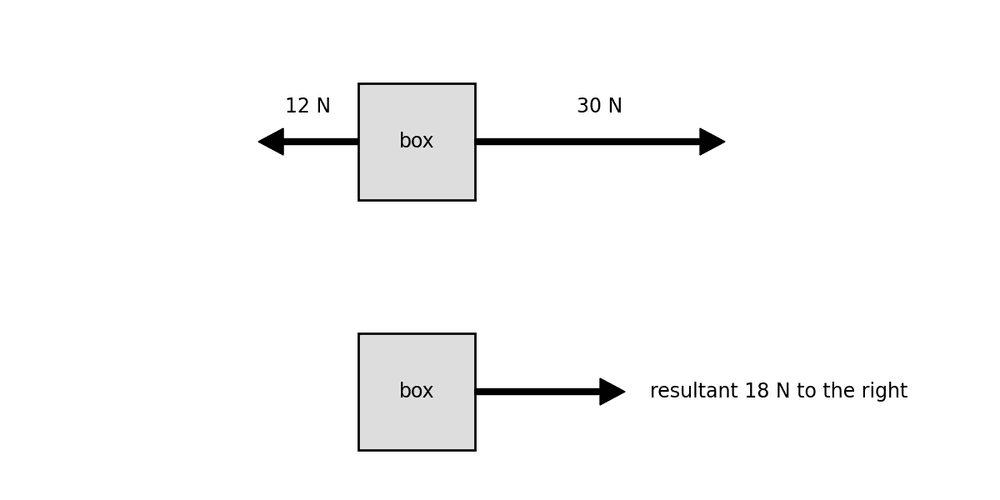
phys resultant force line

Note

A 30 N force right and a 12 N force left can be replaced by a single resultant force of 18 N to the right.

Example

A submarine's propeller gives a forward thrust of 7000 N. Water resistance on the submarine is 5200 N. What is the resultant force?

Solution

The forces act in opposite directions, so subtract: 7000 − 5200 = 1800 N.

The thrust is the larger force, so the resultant acts forwards.

Resultant force: 1800 N forwards, so the submarine speeds up.

Tips/hints

Do not just add the numbers. Always check if forces act in the same or opposite directions.

A moving object does not need a resultant force to keep moving. If it is zero, the object keeps moving at a steady speed.

Never give just a number for the resultant force; always include the direction.

Work done and energy transfer

Definition

Work is done when a force moves an object through a distance along its line of action.

Doing work transfers energy: the work done equals the energy transferred. For example, pushing a box transfers energy to its kinetic store and, due to friction, to thermal stores.

Work done against friction raises the temperature of the objects.

One joule (1 J) of work is done when a 1 N force moves an object 1 m (1 J = 1 N m).

Method

W = Fs, so work done = force × distance.

Work done is in joules (J), force is in newtons (N), and distance is in metres (m). If the distance is in centimetres or kilometres, you must convert it to metres before calculating.

Diagram

phys work done force distance

Note

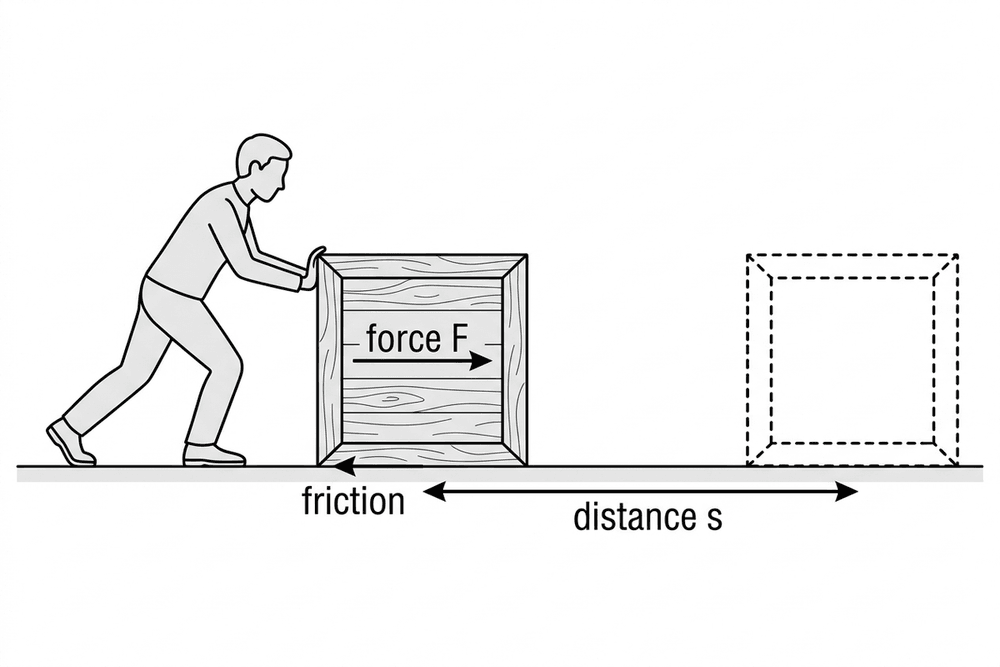
The force F pushes the crate through the distance s along its line of action, so the work done is F × s. Friction acts against the motion and warms the crate and the floor.

Example

A tractor pulls a plough with a force of 1500 N for a distance of 4.5 km. How much work is done?

Solution

First, convert the distance into metres: 4.5 km = 4500 m.

W = Fs = 1500 × 4500 = 6 750 000 J (or 6750 kJ).

Tips/hints

Distance must be in metres. A common mistake is using cm without converting.

Work done and energy transferred are the same thing and both are measured in joules.

Energy is never 'used up'; it is transferred to different stores.

For force, rearrange to F = W ÷ s.

Forces and elasticity

Definition

Changing the shape of a stationary object (stretching, bending or compressing it) requires more than one force. If only one force is applied, the object will just move.

Elastic deformation: the object returns to its original shape and length when the deforming forces are removed.

Inelastic (plastic) deformation: the object does not return to its original shape when the forces are removed.

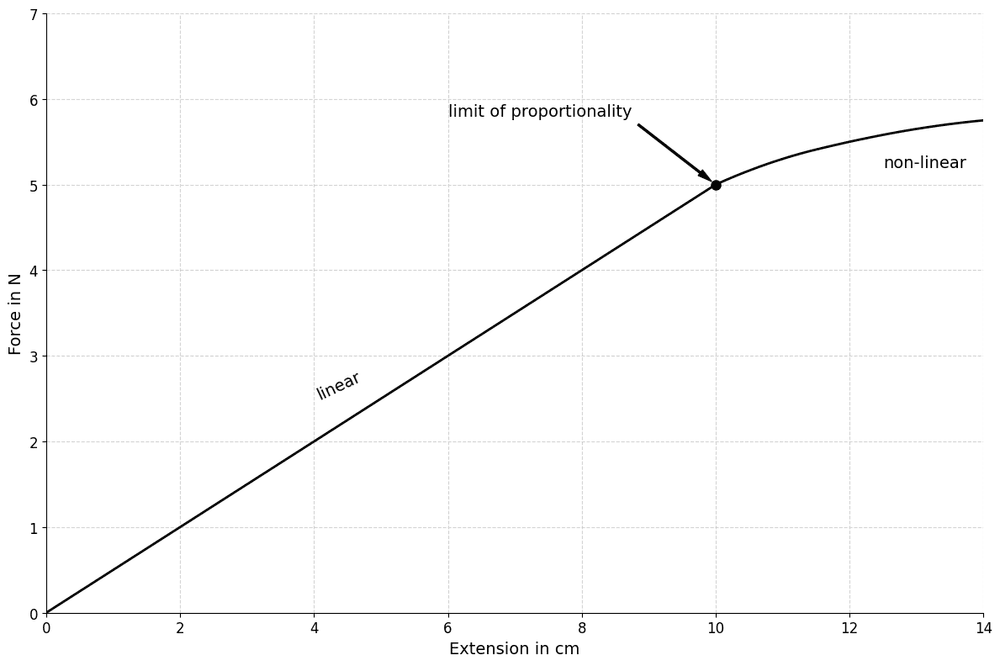
Extension is directly proportional to force up to the limit of proportionality. Beyond this point, the relationship becomes non-linear.

Method

Force and extension: F = ke, so force = spring constant × extension. The force is in newtons (N), the spring constant in N/m, and the extension in metres (m). This equation works for compression too.

Elastic potential energy: Ee = ½ke2, so energy = 0.5 × spring constant × extension². Only the extension is squared. This works up to the limit of proportionality.

A stiffer spring has a larger spring constant.

Diagram

phys force extension graph

Note

The linear part is a straight line through the origin. The spring constant is the gradient of this straight line. The limit of proportionality is the point where the line starts to curve.

Example

On the force–extension graph above, a force of 5.0 N gives an extension of 10 cm at the limit of proportionality. What is the spring constant?

Solution

Convert the extension to metres: 10 cm = 0.10 m

Rearrange F = ke to give k = F ÷ e

k = 5.0 ÷ 0.10 = 50 N/m

Tips/hints

Use extension (new length − original length), not total length.

Convert extensions in centimetres (cm) into metres (m) first.

When calculating energy, square the extension only, not the whole expression.

The limit of proportionality is not the point where a spring breaks — it is the point where extension stops being directly proportional to force.

Distance, displacement, speed and velocity

Definition

Distance is how far an object travels. It is a scalar quantity, so it has no direction.

Displacement is the straight-line distance from a start point to a finish point, together with its direction. It is a vector quantity. If you return to your start point, your displacement is zero.

Speed is a scalar quantity (no direction). Velocity is speed in a given direction, so it is a vector.

Method

Typical speeds: walking ~1.5 m/s, running ~3 m/s, cycling ~6 m/s. A car in a town is ~13 m/s and on a motorway ~30 m/s. A train is ~50 m/s, and a passenger aircraft ~250 m/s. Sound travels in air at ~330 m/s.

For motion at a constant speed, use s = vt (distance = speed × time).

Average speed for a journey is total distance ÷ total time. You must include any time spent stopped.

Diagram

phys distance displacement path

Note

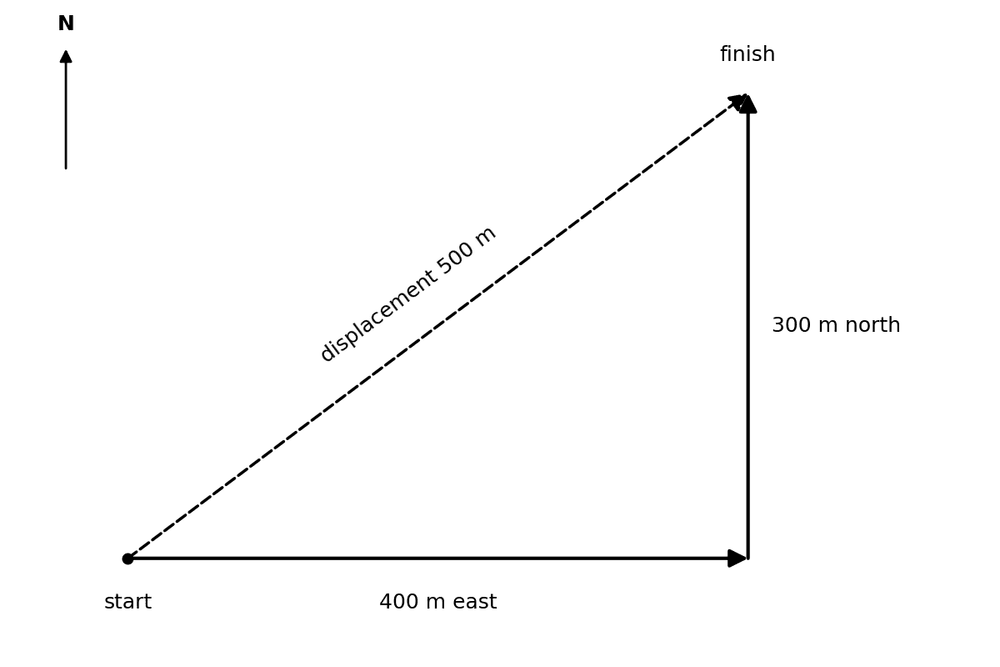
Distance is the total length of the 400 m and 300 m paths added together. Displacement is the straight-line distance from start to finish, including its direction.

Example

A cyclist travels 12 km at a constant speed of 8.0 m/s. How many minutes does the journey take?

Solution

Convert distance to metres: 12 km = 12 000 m

Rearrange s = vt to find time: t = s ÷ v

t = 12 000 ÷ 8.0 = 1500 s

Convert seconds to minutes: 1500 ÷ 60 = 25 minutes

Tips/hints

Always convert times to seconds before calculating.

Speed and velocity are not the same thing. Two cyclists at 6 m/s riding in opposite directions have the same speed but different velocities.

Average speed cannot be found by simply taking the middle value of two speeds; you must divide the total distance by the total time.

Acceleration and motion graphs

Definition

A distance–time graph shows how far an object has moved over time. A velocity–time graph shows how an object's velocity changes over time.

Acceleration is the rate of change of velocity. A negative acceleration means the object is slowing down (decelerating).

Method

Speed from a graph: On a distance–time graph, a straight sloping line means constant speed. The gradient is the speed.

Acceleration: a = Δv ÷ t. Acceleration = change in velocity ÷ time. It is measured in m/s2.

Uniform acceleration: v2 − u2 = 2as (final velocity squared minus initial velocity squared = 2 × acceleration × distance).

Terminal velocity: Near the Earth's surface, an object in free fall accelerates at 9.8 m/s2. As it falls through a fluid, drag increases with speed until it equals the weight. The resultant force becomes zero, so it falls at a constant terminal velocity.

Diagram

phys motion graphs

Note

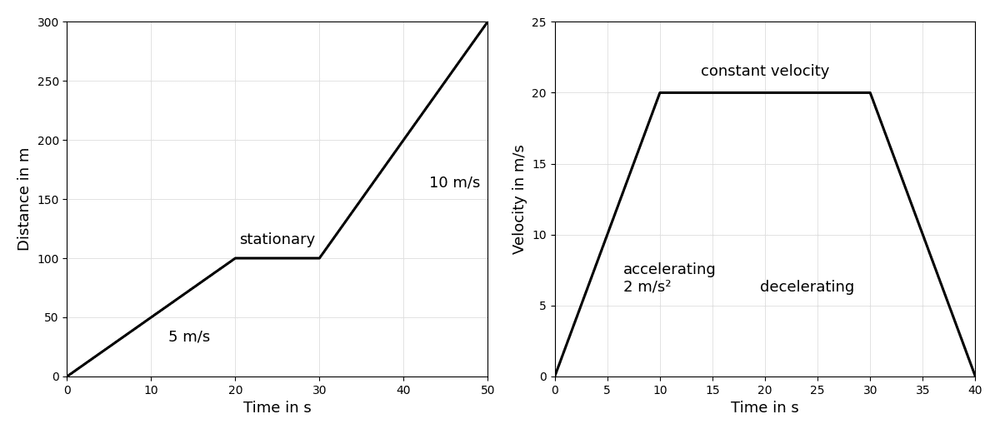
On a distance–time graph, a horizontal line means stationary. On a velocity–time graph, a horizontal line means constant velocity.

Example

On a velocity–time graph, a lorry's line goes straight down from 18 m/s at 0 s to 6.0 m/s at 8.0 s. What is its acceleration?

Solution

The gradient of a velocity–time graph is the acceleration.

Change in velocity = 6.0 − 18 = −12 m/s

a = Δv ÷ t = −12 ÷ 8.0 = −1.5 m/s2

The minus sign shows the lorry is decelerating.

Tips/hints

Do not confuse the graphs: a horizontal line means different things on each.

When using v2 − u2 = 2as, remember to square the speeds before subtracting, and do not forget the 2.

If an object drops from rest, its initial velocity u is 0.

Heavier objects do not fall faster in a vacuum; without air resistance, all objects accelerate at 9.8 m/s2.

Newton's laws of motion

Definition

Newton's first law states that if the resultant force on an object is zero, it stays stationary or keeps moving at a constant velocity (same speed, same direction).

Newton's second law states that acceleration is directly proportional to the resultant force and inversely proportional to mass (a ∝ F, a ∝ 1/m).

Newton's third law states that when two objects interact, they exert equal and opposite forces on each other.

Method

Use F = ma (resultant force = mass × acceleration) to calculate force, mass or acceleration.

The force F must be the resultant force (e.g. driving force minus friction), in newtons (N). Mass must be in kilograms (kg), and acceleration in m/s2.

Diagram

phys driving resistive forces

Note

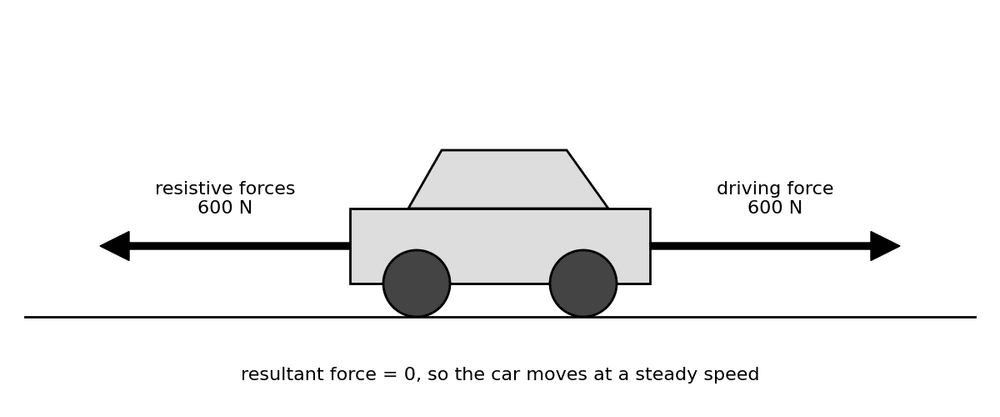
When the driving force equals the resistive forces, the resultant force is zero. The car moves at a steady speed.

Example

A 900 kg speedboat has a forward thrust of 3600 N. The water resistance on it is 900 N. What is its acceleration?

Solution

First, find the resultant force: 3600 − 900 = 2700 N forwards.

Then rearrange F = ma for acceleration: a = F ÷ m.

a = 2700 ÷ 900 = 3.0 m/s2.

Tips/hints

A moving object does not need a resultant force to keep moving. If it is moving at a steady speed, the driving force and friction are exactly equal.

In a third-law pair, the two forces act on different objects. Weight and the normal contact force both act on the same object, so they are not a third-law pair.

Even if one object is much larger (e.g. a lorry and a fly colliding), the forces they exert on each other are exactly equal in size.

Stopping distances

Definition

The stopping distance of a vehicle is the total distance it travels from when the driver first spots a hazard to when it comes to a complete stop. It has two parts:

Stopping distance = thinking distance + braking distance.

Typical reaction times are between 0.2 s and 0.9 s. Distractions (like using a phone), tiredness, drugs and alcohol increase reaction time, which makes the thinking distance longer.

Braking distance is increased by anything that reduces friction: wet or icy roads, worn tyres, and worn brakes.

Method

Thinking distance is the distance travelled during the driver's reaction time. The car is still moving at a constant speed, so thinking distance = speed × reaction time.

Braking distance is the distance travelled while the brakes are actively slowing the car.

Diagram

phys stopping distance chart

Note

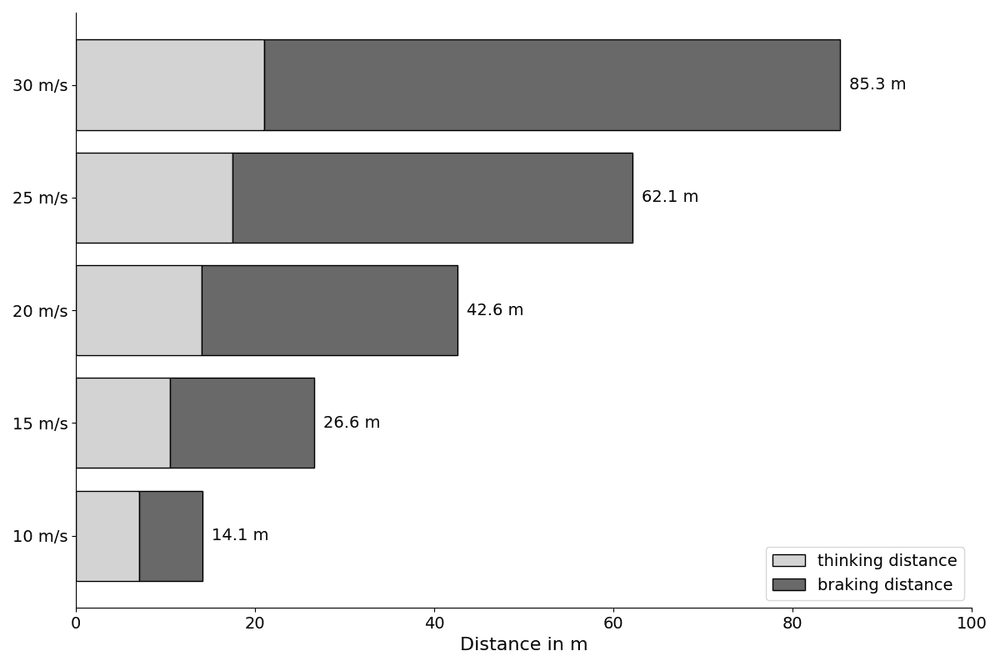
Thinking distance is proportional to speed. Braking distance increases much faster: doubling the speed roughly quadruples the braking distance.

Example

Use the chart: at 20 m/s the thinking distance is 14.0 m (reaction time 0.7 s) and the braking distance is 28.6 m. A driver distracted by a phone call has a reaction time of 1.2 s. What is her stopping distance at 20 m/s?

Solution

New thinking distance = speed × reaction time = 20 × 1.2 = 24 m

Braking distance does not depend on the driver, so it stays 28.6 m.

Stopping distance = 24 + 28.6 = 52.6 m

Tips/hints

A wet road or worn tyres do not affect thinking distance. Tiredness does not affect braking distance.

When a car brakes, friction transfers energy from its kinetic store to the thermal store of the brakes.

A larger braking force produces a larger deceleration. Very large decelerations can cause the brakes to overheat and the car to skid.

Resolving forces (Higher)

Definition

A single force can be resolved (split) into two components acting at right angles. Together, these two perpendicular components have the exact same effect as the original force.

A free body diagram uses arrows to show all the forces acting on an isolated object.

Method

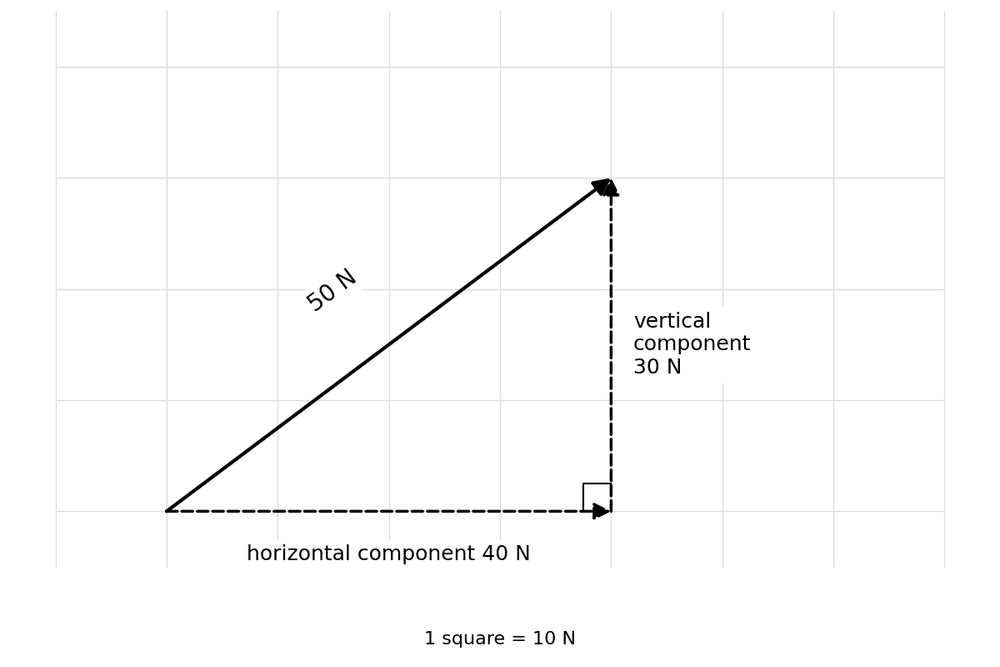
To resolve a force or find a resultant, draw a vector diagram to scale. Draw the perpendicular components tip-to-tail to form a right-angled triangle. The hypotenuse is the single force.

An object is in equilibrium if the resultant force is zero. If you draw all its forces tip-to-tail, they form a closed shape.

Diagram

phys resolving a force

Note

A 50 N force resolved into a horizontal component of 40 N and a vertical component of 30 N.

Example

A suitcase is pulled with a force of 100 N along its handle, at an angle to the floor. Using a scale of 1 cm = 10 N, find the horizontal and vertical components.

Solution

Draw a 10 cm arrow (100 N) at the angle of the handle.

Draw a horizontal line from its tail and a vertical line down from its tip, so the arrow becomes the longest side of a right-angled triangle.

Measure the sides: horizontal 8.0 cm, vertical 6.0 cm.

Use the scale: horizontal component = 8.0 × 10 = 80 N; vertical component = 6.0 × 10 = 60 N.

Tips/hints

State your scale clearly and use it at the end to convert the length back to newtons.

Never just add or subtract forces at an angle. Use a scale drawing.

An object moving at a steady speed in a straight line is in equilibrium (zero resultant force).

Tangents, areas and circular motion (Higher)

Definition

For an accelerating object, the distance–time graph is a curve. The instantaneous speed is the gradient of a tangent drawn at that point.

The distance travelled by an object is the area under its velocity–time graph.

An object moving in a circle at a constant speed has a constantly changing direction. Its velocity changes, so it accelerates. A resultant force acts towards the centre of the circle.

Method

Tangents: Draw a straight line touching the curve at the chosen time. Find its gradient (change in distance ÷ change in time).

Area under graph: Split the area into rectangles (base × height) and triangles (½ × base × height). For curves, estimate by counting squares and multiplying by the distance one square represents. Count part squares of half or more as one.

Diagram

phys tangent and area graphs

Note

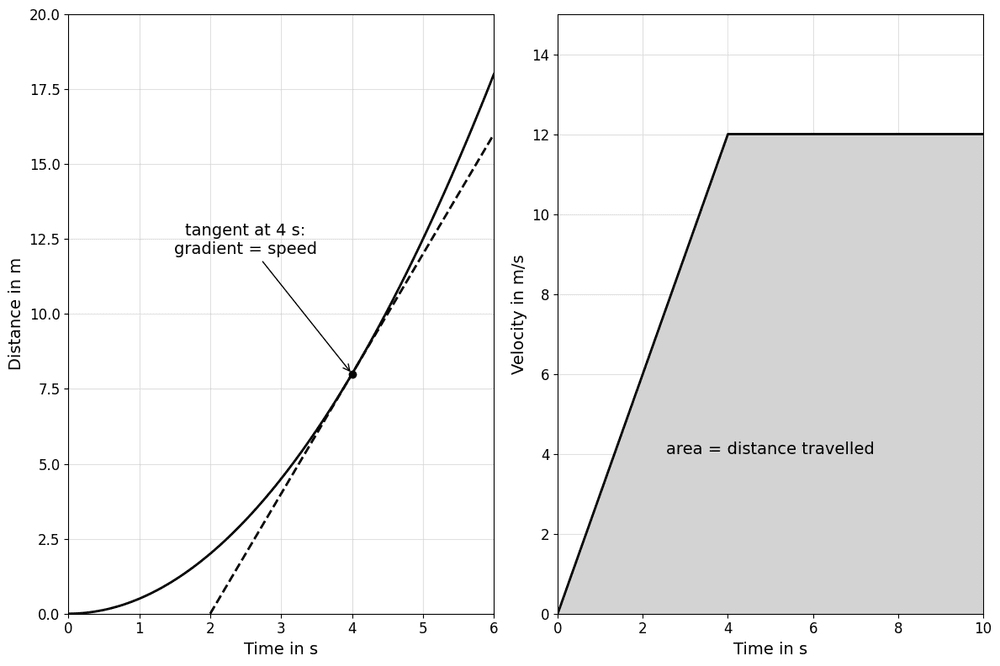
The tangent gives the speed at 4 s. The shaded area gives the total distance travelled.

Example

In the diagram, the tangent drawn at 4 s passes through (2 s, 0 m) and (6 s, 16 m). What is the speed of the object at 4 s?

Solution

The speed at 4 s is the gradient of the tangent.

Change in distance = 16 − 0 = 16 m; change in time = 6 − 2 = 4 s

Speed = 16 ÷ 4 = 4.0 m/s

Tips/hints

When counting squares, always calculate the value of one square first.

Do not divide total distance by total time to find speed on a curve; that gives average speed.

Remember the ½ for triangle areas.

Constant speed in a circle is not constant velocity.

Inertia and braking forces (Higher)

Definition

Inertia is the tendency of an object to stay at rest or keep moving with uniform velocity. This is described by Newton's First Law. For example, when a bus brakes suddenly, passengers lurch forward because their bodies tend to keep moving forwards at their original velocity.

Inertial mass is a measure of how difficult it is to change an object's velocity.

Method

Inertial mass is defined as the ratio of force over acceleration:

m = F ÷ a

inertial mass = force ÷ acceleration

To estimate braking forces, you first need to find the deceleration using either a = Δv ÷ t (acceleration = change in velocity ÷ time) or v2 − u2 = 2as (final velocity squared − initial velocity squared = 2 × acceleration × distance). Then use F = ma to calculate the force.

Example

A car of mass ~1000 kg is travelling at ~20 m/s. It performs an emergency stop over a distance of ~40 m. Approximately what average braking force acts on the car?

Solution

The final speed is 0 m/s, so use v2 − u2 = 2as to find the deceleration.

202 = 2 × a × 40

400 = 80 × a, so a = 400 ÷ 80 = 5.0 m/s2.

Force needed: F = ma = 1000 × 5.0 = 5000 N.

Tips/hints

Inertia is a property, not a force. Objects do not have a 'forward force' keeping them moving.

In a crash, crumple zones and seat belts increase the time and distance over which an object stops. This decreases the deceleration, which heavily reduces the force on the passengers.

When using the equation v2 − u2 = 2as, always remember to square the speed and multiply the distance by 2.

Do not confuse stopping distance with stopping time; they require different equations.

Momentum (Higher)

Definition

Momentum is a property of every moving object. It is a vector quantity, meaning it has both a size and a direction. The momentum of an object acts in the same direction as its velocity.

If two objects are moving in opposite directions, their momenta have opposite signs. A stationary object has a velocity of zero, so its momentum is zero.

Method

To calculate momentum, use the equation: p = mv, so momentum = mass × velocity.

Momentum is measured in kilogram metres per second (kg m/s). Mass must be in kilograms (kg) and velocity in metres per second (m/s) before you calculate.

Example

A rugby player of mass 95 kg is running forwards at a velocity of 8.0 m/s. Calculate the momentum of the player.

Solution

momentum = mass × velocity

p = 95 × 8.0 = 760 kg m/s forwards.

Example

A 0.40 kg ball rolls at 6.0 m/s to the left. Taking motion to the right as positive, what is its momentum?

Solution

The ball moves to the left, so its velocity is −6.0 m/s.

p = mv = 0.40 × (−6.0) = −2.4 kg m/s

The minus sign shows the momentum is to the left.

Tips/hints

A heavy object does not always have more momentum than a lighter one. A slow-moving lorry might have less momentum than a fast-moving motorbike.

Always check that mass is in kilograms. Convert grams to kilograms by dividing by 1000.

When rearranging the equation to find velocity, remember to divide momentum by mass (v = p ÷ m), not the other way around.

Do not confuse momentum with kinetic energy; momentum does not involve squaring the speed, and its unit is kg m/s, not joules (J) or newtons (N).

Conservation of momentum (Higher)

Definition

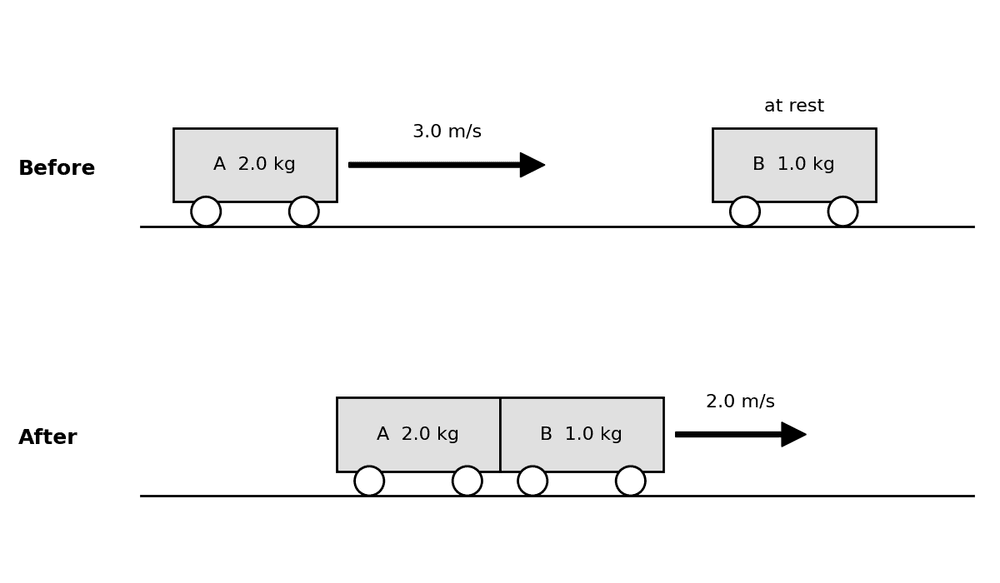
In a closed system, the total momentum before an event is exactly the same as the total momentum after the event. This is called the conservation of momentum.

A closed system is one where no external forces (such as friction or air resistance) act on the objects. Momentum is conserved in collisions and in explosions.

Method

Momentum: p = mv, so momentum = mass × velocity.

For objects that stick together after a collision, calculate the total momentum before, then divide by their total combined mass to find the final velocity.

For an explosion from rest, the total momentum starts at zero. Afterwards, the objects move in opposite directions with equal and opposite momenta, keeping the total at zero.

Diagram

phys momentum trolley collision

Note

Total momentum before (2.0 kg × 3.0 m/s = 6.0 kg m/s) equals total momentum after (3.0 kg × 2.0 m/s = 6.0 kg m/s).

Example

An astronaut of mass 70 kg is floating at rest in space. She throws a 2.0 kg tool away from her at 7.0 m/s. What is her velocity afterwards?

Solution

Total momentum before = 0 kg m/s (both at rest).

Momentum of the tool = 2.0 × 7.0 = 14 kg m/s away from her.

Her momentum must be 14 kg m/s in the opposite direction, so the total stays zero.

Her velocity = p ÷ m = 14 ÷ 70 = 0.20 m/s, in the opposite direction to the tool.

Tips/hints

Velocity has a direction: choose one direction as positive, which makes the opposite direction negative. This is essential for head-on collisions.

Always check that you are using the total combined mass if objects stick together after colliding.

Momentum is never lost in a closed system, even if kinetic energy is transferred to the surroundings.

Required practical: Force and extension

Overview

In this practical you investigate how the extension of a spring depends on the force applied. You do this by hanging masses from a spring and measuring how much it stretches.

Method

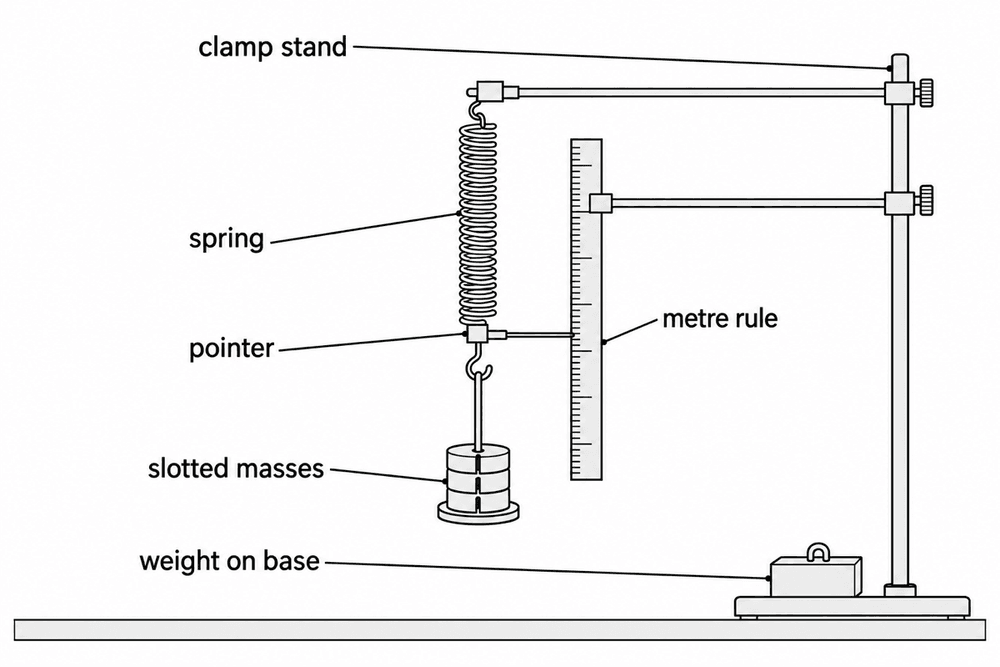
1. Set up a clamp stand with a heavy weight on its base. Clamp a metre rule vertically.

2. Hang a spring from a second clamp. Attach a small horizontal pointer to the bottom of the spring so it touches the rule.

3. Record the pointer reading with no masses attached. This is the unstretched position.

4. Add a 100 g slotted mass to the hanger. Wait for the spring to stop moving, then read the new position at eye level to avoid parallax error.

5. Repeat this for about six different masses.

6. Remove the masses to check the spring returns to its original length. If not, it has been inelastically deformed (overloaded).

Knowledge Required

Independent variable: Force (weight added).

Dependent variable: Extension (new length − original length).

Control variables: Use the same spring, keep temperature the same, and measure the length the same way each time.

Force calculation: W = mg (weight = mass × gravitational field strength). Mass must be in kg.

Spring constant calculation: F = ke. The spring constant k is the gradient of a force–extension graph.

Note

Hazards: Masses could fall and injure feet. Weight the stand and keep feet clear. Wear safety goggles in case the spring snaps.

Diagram

phys spring practical setup

Note

Clamp the metre rule vertically and read at eye level.

Tips/hints

Remember to calculate extension, not total length.

If the ruler's zero is not level with the spring's start, it causes a systematic zero error. The extension is still correct if you subtract the starting reading.

To improve accuracy, repeat readings by loading and unloading the spring, then calculate a mean.

Required practical: Acceleration

Overview

Find how a trolley's acceleration depends on the force (mass constant) and on the mass (force constant).

Method

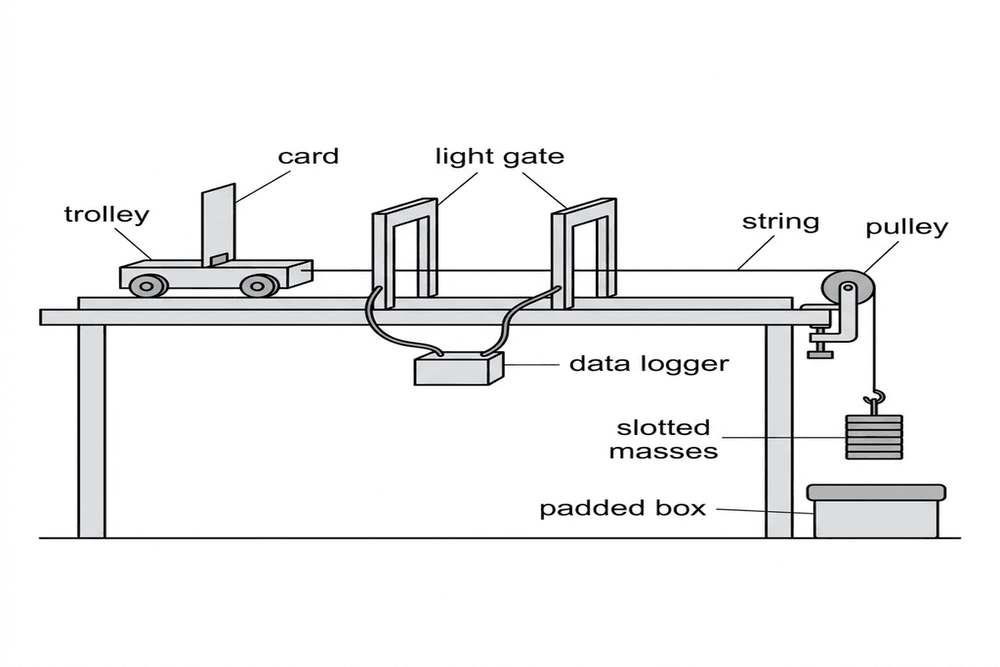
1. Set up the apparatus as shown and tilt the runway slightly to compensate for friction.

2. Part 1 (varying force): put all the slotted masses on the trolley. Release the trolley from the same start line and record its acceleration.

3. Move one mass from the trolley to the hanger, so the force increases but the total mass stays the same. Repeat until all the masses are on the hanger.

4. Part 2 (varying mass): keep the same hanging mass and add masses to the trolley one at a time, recording the acceleration each time.

5. Repeat each run and find a mean.

Knowledge Required

Variables: Part 1 — independent: force; dependent: acceleration; control: total mass. Part 2 — independent: mass; dependent: acceleration; control: force.

Speed at a light gate = card length ÷ time the card blocks it.

Acceleration = (v − u) ÷ t, with t the time between gates.

Accelerating force = weight of the hanging masses, W = mg (mass in kg). The mass in F = ma is the total mass: trolley + hanging masses.

Note

Hazards: falling masses can injure feet — put a padded box under the hanger. A buffer stops the trolley falling off the bench.

Diagram

phys trolley acceleration setup

Note

The falling masses pull the trolley through two light gates; the data logger records the times.

Tips/hints

Tilt the runway until the trolley rolls at constant speed after a gentle push.

A graph of acceleration against force is a straight line through the origin (a ∝ F); if it misses the origin, friction was not fully compensated.

A graph of acceleration against mass is a curve: acceleration is inversely proportional to mass.

Light gates remove human reaction time.

Test yourself on this topic

Try the free quiz with worked solutions.

Start quiz →

Get GCSE Science

Full notes, full question bank, offline.