



The structure of an atom
Definition
Atoms are extremely small, with a radius of about 1 × 10⁻¹⁰ m. An atom has a tiny, positively charged central nucleus surrounded by negatively charged electrons.
The nucleus is very small compared to the whole atom — its radius is less than 1/10 000 of the atom's radius. However, it contains almost all of the atom's mass.
Method
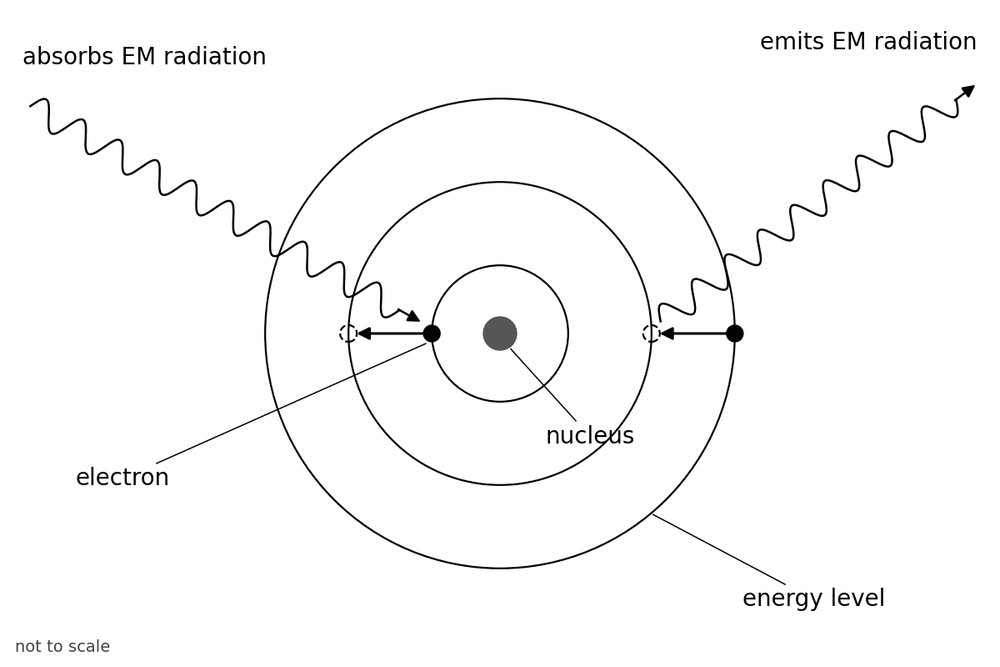
Electrons are arranged at specific distances from the nucleus, in what are called energy levels or shells.
If an electron absorbs electromagnetic radiation, it moves to a higher energy level, which is further away from the nucleus.
If an electron emits electromagnetic radiation, it drops to a lower energy level, which is closer to the nucleus.
Diagram
Note
Left: an electron absorbs EM radiation and moves out to a higher energy level. Right: an electron drops to a lower energy level and emits EM radiation. Dashed circles show where each electron moves to.
Example
The nucleus of an atom has a radius of 3 × 10⁻¹⁵ m. The nucleus radius is less than 1/10 000 of the atom's radius. What is the smallest the atom's radius could be?
Solution
The atom's radius is more than 10 000 (104) times the nucleus radius, so multiply.
Smallest atom radius = 3 × 10−15 × 104 = 3 × 10⁻¹¹ m.
Check: multiplying by 104 makes the power of ten 4 bigger (−15 + 4 = −11).
Tips/hints
A factor of 104 means 10 000 times bigger, not 4 times bigger.
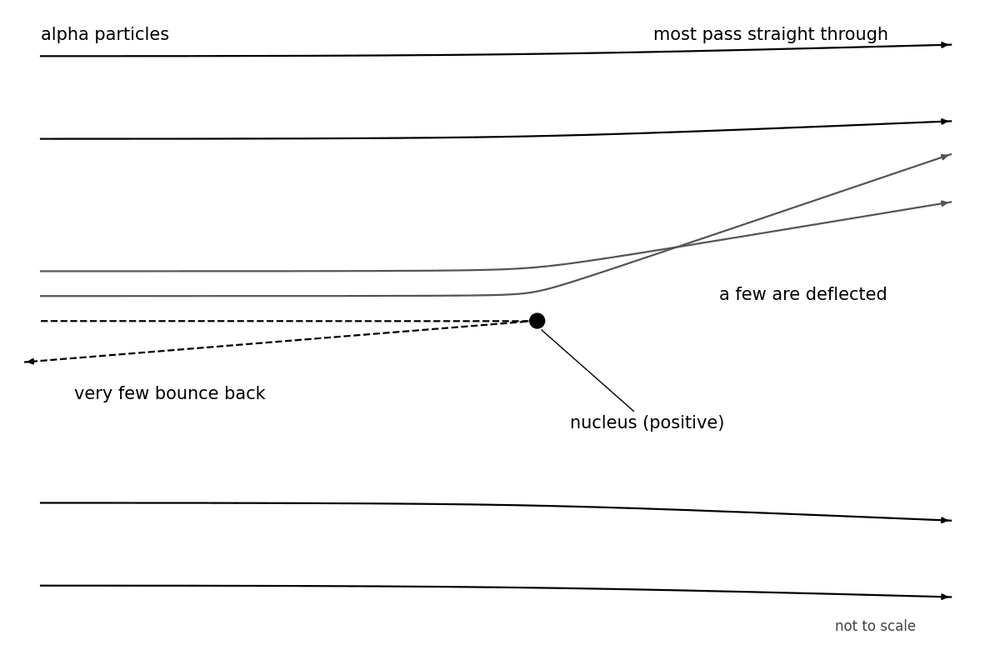
Remember that the nucleus is positively charged. The negative electrons are in the energy levels outside it.
Because the nucleus is so tiny compared to the whole atom, most of an atom is just empty space.
Electrons must absorb radiation to move further out, and they emit radiation to drop closer in.