


G GCSE Apps

GCSE Science

P1 Energy

9 subtopics in this section

Energy stores and systems

Definition

A system is an object or a group of objects. When a system changes, energy moves between different stores.

The main energy stores are kinetic (moving objects), gravitational potential (objects raised high up), elastic potential (stretched or compressed objects), thermal (internal energy of warm objects), chemical (fuel, food, batteries), magnetic, electrostatic and nuclear.

Energy is transferred between stores by heating, by radiation (such as light and sound waves), or by work being done. Work can be done mechanically (by a force) or electrically (by a moving current).

Diagram
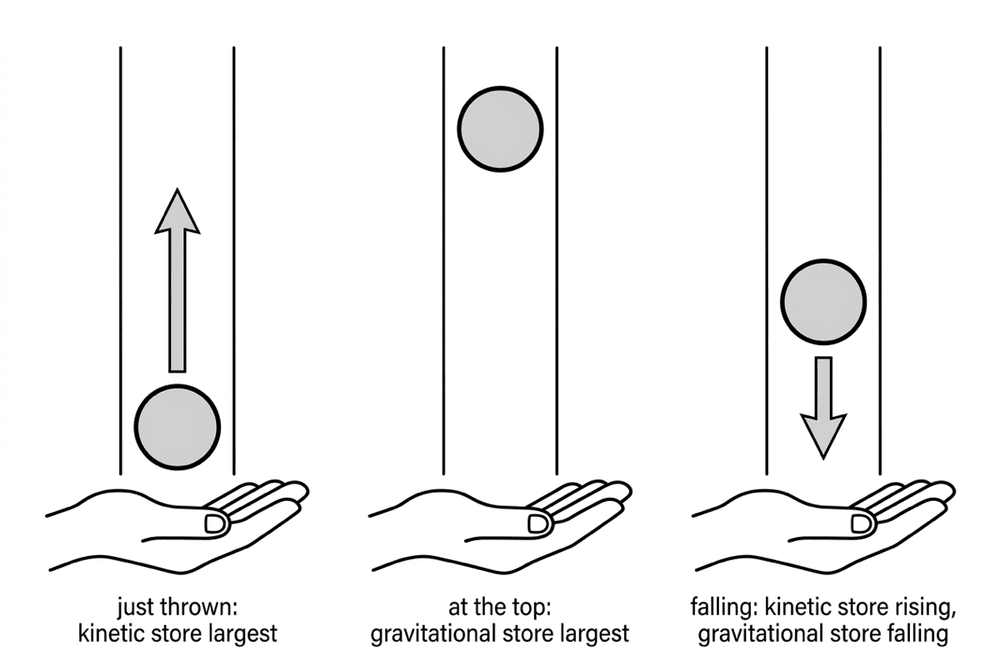
phys energy stores ball

Note

As the ball rises, its kinetic store decreases and its gravitational potential store increases. On the way down, the reverse happens.

Example

Describe the energy transfers when a wind-up toy car is wound up, released and runs until it stops.

Solution

Winding the spring stores energy in its elastic potential store.

When released, the spring does work on the wheels (a mechanical transfer), so the car's kinetic store increases.

Friction and air resistance then transfer the energy to the thermal store of the car and surroundings until the car stops. The total energy is the same throughout.

Tips/hints

In a closed system, the total energy never changes. Energy can be redistributed between stores, but it cannot be created or destroyed.

Do not confuse energy stores (like chemical and kinetic) with energy transfers (like electrical, heating and radiation).

When a car brakes, energy is transferred mechanically to the thermal store of the brakes, making them hot.
Calculating energy changes

Definition

Energy is stored in different ways called energy stores. Three of them can be calculated directly: the kinetic store of a moving object, the elastic potential store of a stretched or compressed spring, and the gravitational potential store of an object raised above the ground.

Energy is measured in joules (J). Mass must be in kilograms, distances in metres and speed in metres per second before you calculate.

Method

Kinetic energy: Ek = ½mv2, so kinetic energy = 0.5 × mass × speed². Only the speed is squared.

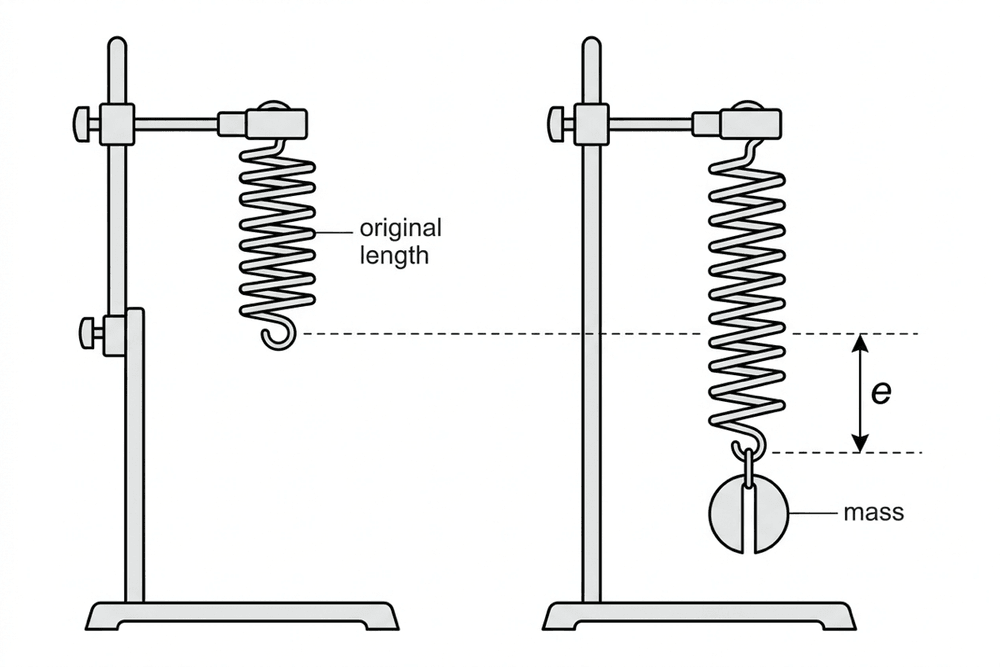
Elastic potential energy: Ee = ½ke2, so elastic potential energy = 0.5 × spring constant × extension². The spring constant is in N/m. This works only up to the limit of proportionality.

Gravitational potential energy: Ep = mgh, so g.p.e. = mass × gravitational field strength × height. The value of g (9.8 N/kg on Earth) is given in the question.

Diagram

phys spring extension

Note

The extension e is how much longer the spring gets, measured from its original length, not its total length.

Example

A 0.5 kg ball falls 3.2 m. Ignoring air resistance, how fast is it moving just before it lands? (g = 9.8 N/kg)

Solution

Gravitational potential energy lost = 0.5 × 9.8 × 3.2 = 15.68 J

All of it becomes kinetic energy: 15.68 = 0.5 × 0.5 × v2

v2 = 15.68 ÷ 0.25 = 62.72, so v = √62.72 ≈ 7.9 m/s

Tips/hints

Convert first: 250 g = 0.25 kg and 15 cm = 0.15 m. Most lost marks come from units.

Square only the speed or the extension, never the whole expression. Doubling the speed makes the kinetic energy four times as big.

When rearranging for speed, remember the final square root.

Energy is never used up: as a ball rises its kinetic store falls and its gravitational store rises by the same amount (ignoring air resistance).

Specific heat capacity

Definition

Specific heat capacity is the amount of energy needed to raise the temperature of 1 kg of a substance by 1 °C.

Substances with a high specific heat capacity, like water, need a lot of energy to heat up. They also cool down slowly because they transfer a lot of energy to the surroundings as they cool.

Substances with a low specific heat capacity heat up and cool down quickly.

Method

Change in thermal energy: ΔE = mcΔθ, so change in thermal energy = mass × specific heat capacity × temperature change.

Energy is measured in joules (J), mass in kilograms (kg), specific heat capacity in J/kg °C, and temperature change in °C.

The temperature change is the difference between the final temperature and the initial temperature.

Example

A 500 g block of copper is heated from 20 °C to 60 °C. The specific heat capacity of copper is 380 J/kg °C. How much thermal energy is transferred to the copper?

Solution

Convert the mass to kilograms: 500 g = 0.5 kg

Calculate the temperature change: 60 − 20 = 40 °C

Change in thermal energy = 0.5 × 380 × 40 = 7600 J

Tips/hints

Always check the mass is in kilograms. If it is in grams, divide by 1000 to convert to kg.

Make sure you use the temperature change (Δθ), not the final temperature.

When rearranging the equation to find mass, specific heat capacity or temperature change, remember to divide the energy by the other two values multiplied together. For example, m = ΔE ÷ (cΔθ).

Power

Definition

Power is defined as the rate at which energy is transferred or the rate at which work is done. It tells you how much energy is transferred every second.

Power is measured in watts (W). One watt is exactly equal to an energy transfer of one joule per second (1 J/s).

Method

Power from energy: P = E ÷ t, so power = energy transferred ÷ time.

Power from work done: P = W ÷ t, so power = work done ÷ time.

In both equations, power is in watts (W), energy and work are in joules (J), and time must be in seconds (s).

Diagram

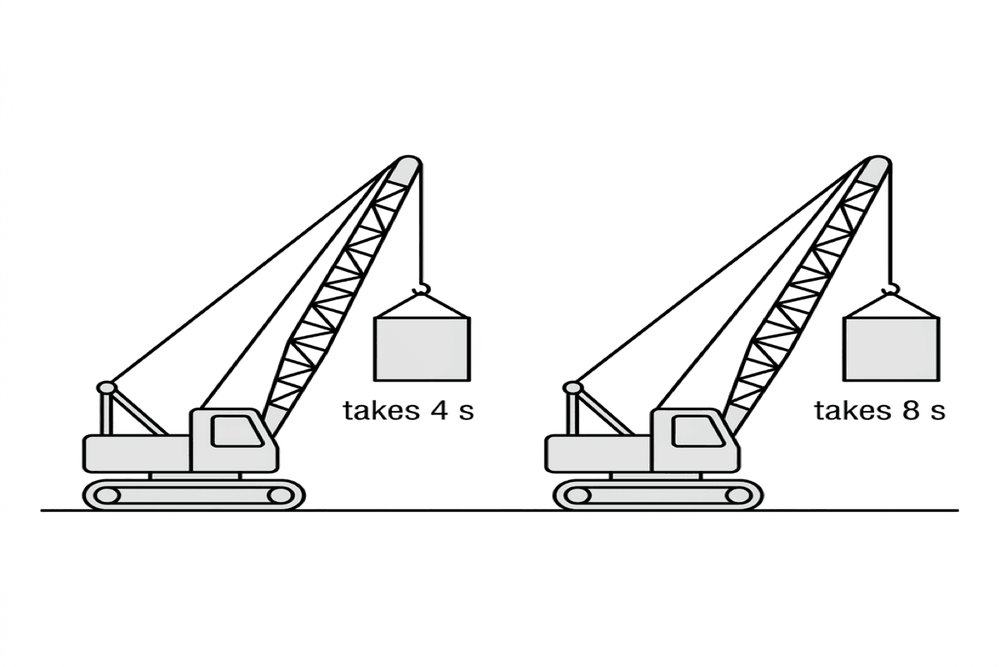
phys two motors power

Note

Both cranes lift the same load to the same height, so they do the same work. The crane that takes 4 s transfers the energy twice as fast, so it has twice the power.

Example

A microwave has a power rating of 800 W. How much energy does it transfer in 2 minutes?

Solution

First, convert the time to seconds: 2 minutes = 2 × 60 = 120 s

Rearrange the equation: energy transferred = power × time

Energy transferred = 800 × 120 = 96 000 J

Tips/hints

Always check your units before calculating. Convert time in minutes to seconds, and power in kilowatts (kW) to watts (W) by multiplying by 1000.

When rearranging an equation to find time, make sure you divide the energy by the power, not the other way around.

An appliance with a higher power rating will take less time to do the same amount of work as one with a lower power rating.

Energy transfers and dissipation

Definition

The conservation of energy means that energy can be transferred usefully, stored or dissipated, but it cannot be created or destroyed.

A closed system is a system where no energy can enter or leave. In a closed system, there is no net change to the total energy.

In every real change, some energy is dissipated. This means it spreads out into the surroundings (usually heating them) and is stored less usefully. This is often called 'wasted' energy.

Method

Unwanted energy transfers can be reduced in two main ways.

Lubrication (like putting oil on a bicycle chain) reduces the friction between moving parts, so less energy is dissipated as thermal energy.

Thermal insulation (like wrapping a hot water tank or putting insulation in walls) reduces the rate that thermal energy is transferred to the surroundings.

Diagram

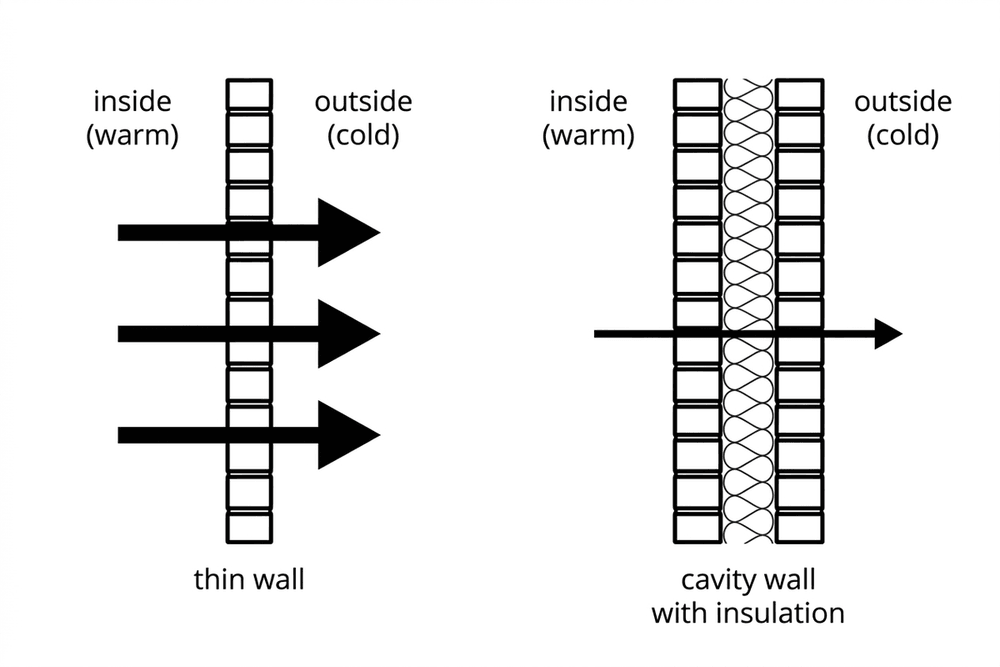
phys wall insulation cooling

Note

Heat escapes faster through the thin, uninsulated wall. The thick cavity wall with insulation reduces the rate of cooling.

Example

A house is built with very thick walls made from a material with a low thermal conductivity. How does this affect the rate of cooling of the building?

Solution

The rate of cooling is slower. Thicker walls mean the energy has further to travel, and a lower thermal conductivity means the material is worse at conducting heat.

Tips/hints

Energy is never 'used up' or 'lost' — it is just transferred to a different store, often the thermal store of the surroundings.

Make sure you remember the two main ways to reduce unwanted energy transfers: lubrication (for moving parts) and thermal insulation (for keeping things warm or cold).

Efficiency

Definition

Efficiency is a measure of how much of the total input energy is transferred usefully. No device is more than 100% efficient (or has an efficiency greater than 1).

Energy that is not transferred usefully is wasted, often by heating the surroundings. Wasted energy = total input energy − useful output energy.

Method

Efficiency (energy) = useful output energy transfer ÷ total input energy transfer.

Efficiency (power) = useful power output ÷ total power input.

Efficiency can be written as a decimal (e.g. 0.25) or as a percentage (e.g. 25%). To convert a decimal to a percentage, multiply by 100.

Diagram

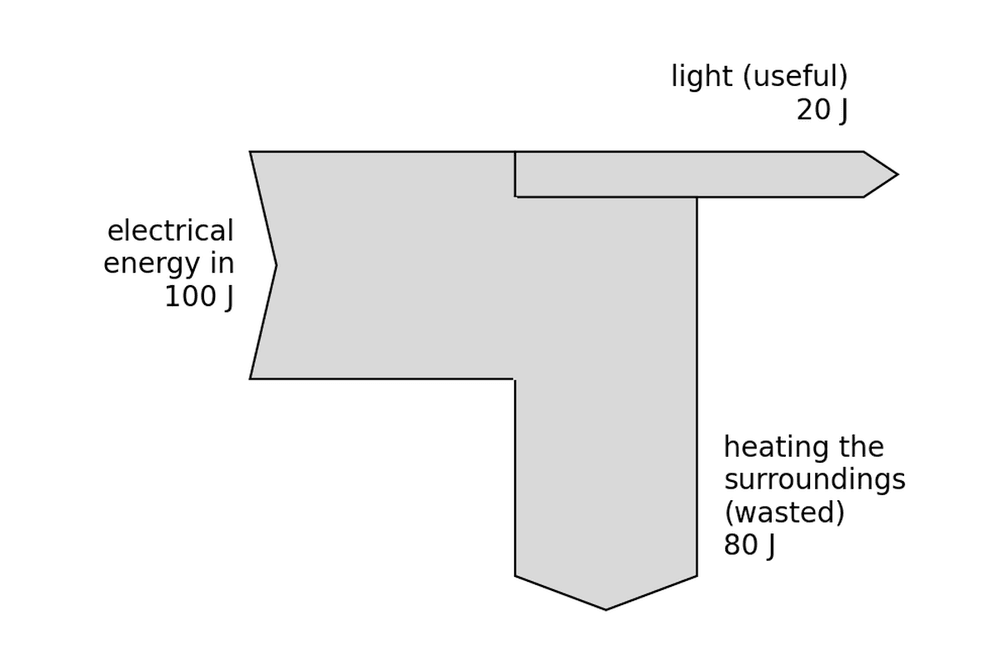
phys sankey lamp

Note

A Sankey diagram for a lamp. The width of each arrow is proportional to the amount of energy. The total input electrical energy splits into useful light energy and wasted energy heating the surroundings.

Example

An electric motor is supplied with 800 J of energy and transfers 200 J usefully. What is its efficiency, as a decimal and as a percentage?

Solution

Efficiency = useful output energy ÷ total input energy

Efficiency = 200 ÷ 800 = 0.25

As a percentage: 0.25 × 100 = 25%. The other 600 J (75%) is wasted.

Tips/hints

Efficiency has no units because it is a ratio of two energies (or two powers).

If your efficiency calculation gives a number greater than 1 (or 100%), you have probably divided the total input by the useful output by mistake.

Always check whether the question asks for the efficiency as a decimal or a percentage.

National and global energy resources

Definition

Energy resources are used for transport, electricity generation and heating. The main resources are fossil fuels (coal, oil and gas), nuclear fuel, bio-fuel, wind, hydroelectricity, geothermal, tides, the Sun (solar) and water waves.

A renewable energy resource is one that is being (or can be) replenished as it is used. A non-renewable energy resource will eventually run out.

Method

Different resources suit different uses. Oil is processed into fuels for transport. Gas is widely used for heating homes. Most resources can be used to generate electricity.

Reliability is important. Fossil fuels, nuclear, geothermal, and hydroelectricity are reliable because they can generate power on demand. Wind and solar are unreliable because they depend on the weather and time of day.

Example

Identify the environmental impacts of different energy resources.

Solution

Burning coal and oil releases sulfur dioxide, which causes acid rain.

Burning fossil fuels releases carbon dioxide, which contributes to global warming.

Nuclear power produces dangerous radioactive waste but no carbon dioxide.

Wind turbines and solar panels have a visual impact.

Hydroelectric dams flood valleys, causing habitat loss.

Tips/hints

Science can identify environmental issues, but deciding how to solve them also depends on political, social, ethical and economic factors.

Trends show the UK is using less coal and more renewable resources to reduce carbon dioxide emissions.

Remember that nuclear fuel is non-renewable, while bio-fuels are renewable: the carbon dioxide they release was recently taken in by the plants they were made from.

Increasing efficiency (Higher)

Definition

Efficiency can be increased by reducing the amount of energy dissipated (wasted) to unwanted stores. When less energy is transferred to the thermal store of the surroundings, a larger fraction of the input energy becomes useful output.

Method

Different methods reduce energy dissipation depending on the cause of the waste.

Lubrication: Oil or grease reduces friction between moving parts, so less energy is transferred to the thermal store.

Streamlining: A more aerodynamic shape reduces air resistance, meaning less energy is dissipated to the air.

Thermal insulation: Insulators reduce the rate of heat transfer to the surroundings, keeping more energy in the useful thermal store.

Low resistance: Using thicker wires or lower-resistance metals in circuits reduces the electrical energy dissipated as heat.

Tightening loose parts: Securing components reduces vibrations, meaning less energy is transferred away as sound.

Example

A machine has a total energy input of 500 J and dissipates 150 J as heat due to friction. Lubricating the moving parts reduces the energy dissipated to 50 J. How does this affect the efficiency?

Solution

Before lubrication, the useful energy output was 500 − 150 = 350 J.

Initial efficiency = 350 ÷ 500 = 0.70.

After lubrication, the new useful energy output is 500 − 50 = 450 J.

New efficiency = 450 ÷ 500 = 0.90.

The efficiency has increased because less energy is transferred to the unwanted thermal store.

Tips/hints

Insulators slow down energy transfer but do not stop it completely.

Energy is never 'used up'; it is only transferred to different stores.

Replacing filament lamps with LED lamps increases efficiency because LEDs transfer a much smaller fraction of their input energy to unwanted thermal stores.

Required practical: Specific heat capacity

Overview

This practical finds the specific heat capacity of a material. You heat a metal block with an electric immersion heater and measure the temperature rise.

Method

1. Measure and record the mass of the metal block.

2. Wrap the block in insulation. Place a heater and a thermometer into the two holes in the block.

3. Record the starting temperature.

4. Switch the heater on and start a stopwatch.

5. Record the joulemeter reading (energy supplied) and the temperature at regular intervals, e.g. every minute.

6. Plot temperature rise against energy supplied and use the gradient (or ΔE = mcΔθ) to find c.

Knowledge Required

Variables: The independent variable is the energy supplied. The dependent variable is the temperature rise. The control variables are the mass of the block, the material, the insulation, and the starting temperature.

Energy: You can measure energy directly with a joulemeter, or calculate it using energy = power × time, where power = potential difference × current.

Note

Hazards: The heater and metal block get very hot. Let them cool down completely before you touch them.

Diagram

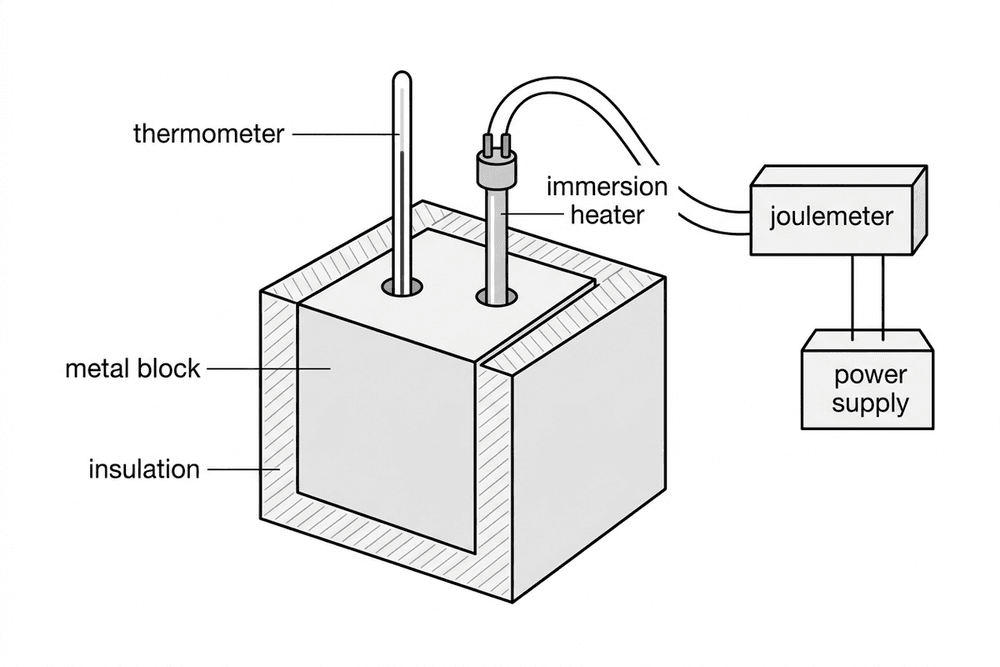
phys shc apparatus

Note

The immersion heater and thermometer sit in holes in the metal block, which is wrapped in insulation. The joulemeter between the power supply and the heater measures the energy supplied.

Tips/hints

Putting a drop of water or oil in the thermometer hole improves the thermal contact between the thermometer and the block, giving a more accurate reading.

Energy is always lost to the surroundings, so the measured temperature rise is smaller than it should be. This makes the calculated specific heat capacity too high. Using insulation reduces this error.

Calculate specific heat capacity using c = ΔE ÷ (m Δθ).

If you plot a graph of temperature against energy supplied, the specific heat capacity = 1 ÷ (gradient × mass).

Test yourself on this topic

Try the free quiz with worked solutions.

Start quiz →

Get GCSE Science

Full notes, full question bank, offline.