


G GCSE Apps

GCSE Science

C6 The rate and extent of chemical change

8 subtopics in this section

Calculating rates of reaction

Definition

The rate of a chemical reaction is how quickly a reactant is used up or a product is made. It is found by measuring the amount of a reactant or product at intervals of time.

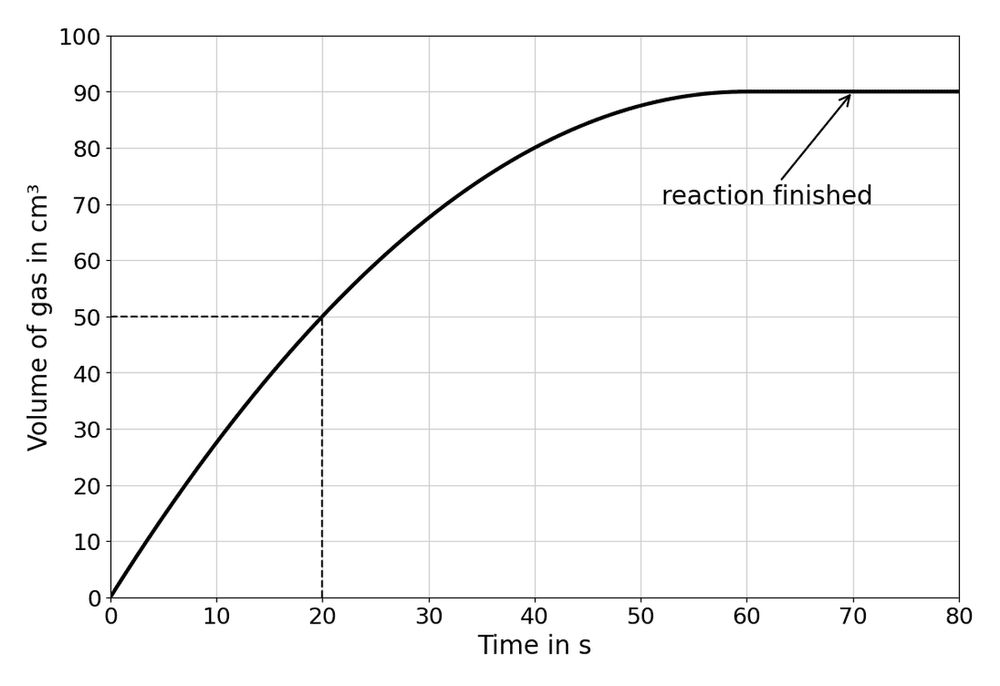
A graph of quantity against time is steepest at the start because reactant concentration is highest, so the rate is fastest. As reactants are used up, the curve becomes less steep. When the limiting reactant is fully used up, the reaction stops and the graph becomes horizontal.

Method

Equation: mean rate = quantity of reactant used (or product formed) ÷ time taken.

Quantity is usually measured as mass in grams (g) or volume in cubic centimetres (cm3), giving a rate in g/s or cm3/s. Time must be in seconds.

Diagram
chem gas volume time graph

Note

A graph of the volume of gas produced against time. The mean rate over the first 20 s = 50 ÷ 20 = 2.5 cm3/s. The mean rate for the whole reaction = 90 ÷ 60 = 1.5 cm3/s.

Example

Zinc granules react with dilute sulfuric acid to produce hydrogen gas. In 1.5 minutes, 36 cm3 of hydrogen is collected. What is the mean rate of reaction?

Solution

First, convert the time into seconds: 1.5 × 60 = 90 s.

Then apply the equation: mean rate = volume of gas ÷ time = 36 ÷ 90 = 0.40 cm3/s.

Tips/hints

Always convert time in minutes to seconds before dividing.

For the mean rate over a specific part of a reaction, divide the change in quantity by the time interval. Do not use total quantity instead of change in quantity.

Estimate the rate at a specific moment by drawing a tangent to the curve. A steeper tangent means a faster rate.
Factors affecting the rate of reaction

Definition

The rate of a chemical reaction is how quickly reactants are used up or products are formed.

Five factors can increase the rate of reaction: increasing the temperature, increasing the concentration of reactants in solution, increasing the pressure of reacting gases, increasing the surface area of solid reactants (like using powder instead of chips), and adding a catalyst.

Method

Mean rate of reaction = quantity of reactant used ÷ time taken, or quantity of product formed ÷ time taken.

Rate is measured in g/s or cm3/s. A faster reaction makes the same amount of product in less time.

Diagram

chem rate curves surface area

Note

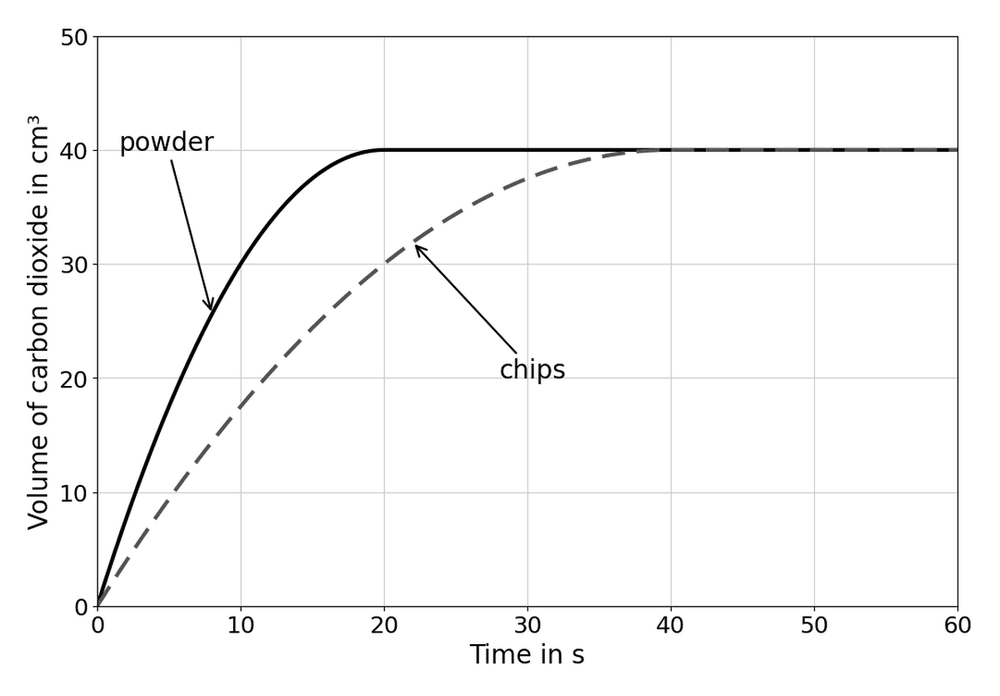
The powder (larger surface area) reacts faster, so its curve is steeper at the start. Both give the same final volume because the same mass of calcium carbonate reacts.

Example

A piece of zinc reacts with dilute sulfuric acid to produce 150 cm3 of hydrogen gas in 50 s. What is the mean rate of reaction?

Solution

Mean rate = quantity of product formed ÷ time taken

Mean rate = 150 ÷ 50 = 3.0 cm3/s

Tips/hints

A faster reaction has a steeper curve that levels off sooner.

Changing the rate of reaction does not change the final amount of product. Only changing the amount of the limiting reactant changes the final amount.

Larger lumps have a smaller surface area than the same mass of powder, so they react more slowly.

Lowering the temperature slows a reaction down, but it does not completely stop the reaction.

Adding more of a reactant that is already in excess does not speed up the reaction because the concentration has not increased.

Collision theory and activation energy

Definition

According to collision theory, chemical reactions can only happen when reacting particles physically collide with each other.

Not every collision leads to a reaction. The colliding particles must also have enough energy. The minimum amount of energy that particles must have in order to react is called the activation energy.

Method

Four main factors affect the rate of a reaction: temperature, concentration (for solutions), pressure (for gases) and surface area (for solids).

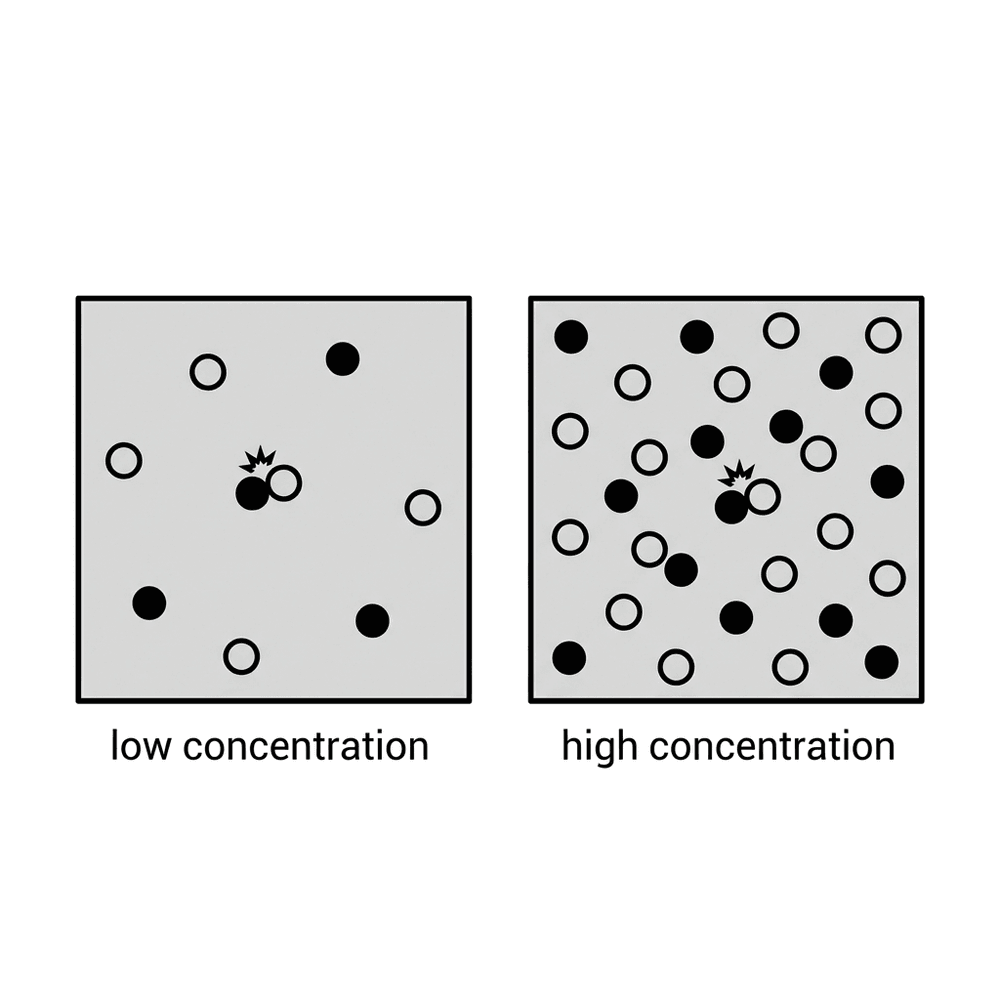
Increasing concentration or pressure puts more particles into the same volume. They are closer together, so collisions become more frequent. The particles do not move any faster.

Cutting a solid into smaller pieces (or a powder) increases its surface-area to volume ratio. More particles are exposed on the surface, so collisions are more frequent.

Increasing the temperature makes the particles move faster, so they collide more frequently. More importantly, they collide with more energy, so a much higher proportion of collisions have at least the activation energy.

Diagram

chem collision concentration particles

Note

At a higher concentration, there are more particles in the same volume so collisions are more frequent.

Example

A solid cube has sides of length 10 cm. What is its surface area to volume ratio?

Solution

Surface area = 6 faces × (10 × 10) = 6 × 100 = 600 cm2

Volume = 10 × 10 × 10 = 1000 cm3

Ratio = 600 ÷ 1000 = 0.60 : 1

Tips/hints

Temperature is the only factor that changes the energy of the collisions. The other three factors just make collisions more frequent.

When explaining temperature, remember to mention both the increased frequency of collisions and the increased energy of the collisions.

A common mistake is thinking a larger solid lump has a larger surface area. A fine powder has a much larger surface area for the same mass.

Catalysts

Definition

A catalyst changes the rate of a chemical reaction (speeds it up) but is not used up during the reaction. The same mass of catalyst is left at the end, chemically unchanged, so it can be reused. Only a small amount is needed.

Different reactions need different catalysts. In living things, biological catalysts are called enzymes.

Method

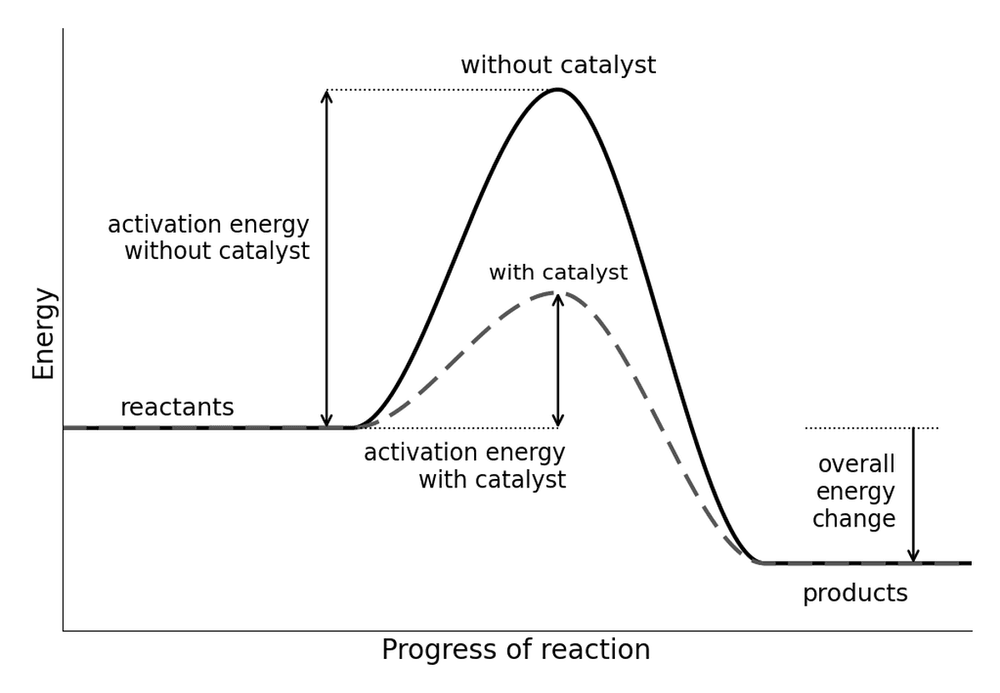
A catalyst works by providing a different reaction pathway that has a lower activation energy. This means that a greater proportion of the reacting particles have enough energy to react when they collide.

A catalyst does not give the particles more kinetic energy, it does not raise the temperature, and it does not change the overall energy change or the final yield of the reaction.

Diagram

chem catalyst reaction profile

Note

A reaction profile showing the pathway with and without a catalyst. The catalysed pathway has a lower peak (lower activation energy), but the overall energy change between reactants and products is exactly the same.

Example

A student investigates the effect of a catalyst by adding 0.5 g of manganese(IV) oxide to hydrogen peroxide solution. After 40 s, 60 cm3 of oxygen gas is collected. What is the mean rate of reaction?

Solution

Mean rate = volume of product ÷ time taken

Mean rate = 60 ÷ 40 = 1.5 cm3/s

Tips/hints

A common mistake is thinking a catalyst increases the yield (the amount of product made) or gives particles more energy. It only speeds up how quickly the product is formed.

In an experiment comparing different catalysts, you must keep the mass of the solid, the volume and concentration of the solution, and the temperature the same to ensure a fair test.

Catalysts are crucial in industry because they allow reactions to happen at lower temperatures, which saves energy and money.

Reversible reactions and equilibrium

Definition

In a reversible reaction the products can react to re-form the reactants. The symbol ⇌ shows this. Changing the conditions, such as heating or cooling, can change which direction goes.

Example: ammonium chloride (white solid) ⇌ ammonia + hydrogen chloride. Heating breaks the solid down into gases; on a cool surface the gases react to re-form the white solid.

If a reversible reaction is exothermic in one direction, it is endothermic in the other, and exactly the same amount of energy is transferred each way.

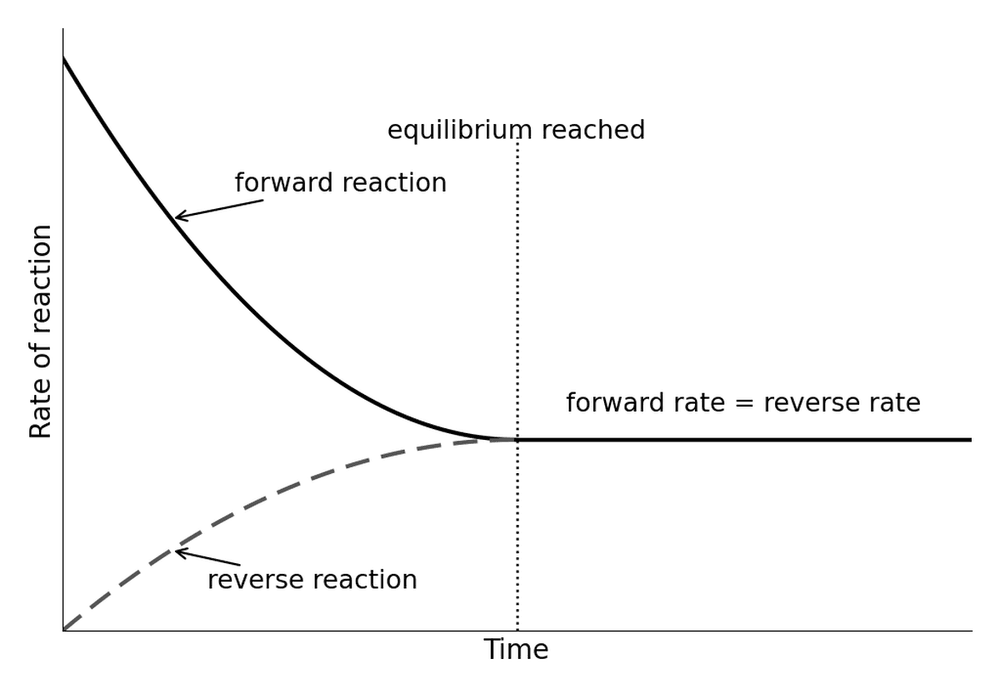
In a closed system (nothing can get in or out), a reversible reaction reaches equilibrium when the forward and reverse reactions go at exactly the same rate. Both reactions keep going, so the amounts of reactants and products stay constant, but they are not usually equal.

Diagram

chem equilibrium rates graph

Note

The forward rate starts high and falls as reactants are used up. The reverse rate starts at zero and rises. Where they meet, equilibrium is reached, and from then on the forward rate equals the reverse rate.

Example

Blue hydrated copper(II) sulfate is heated: hydrated copper(II) sulfate ⇌ anhydrous copper(II) sulfate + water. The forward reaction takes in 450 J. What happens when the same amount of white anhydrous copper(II) sulfate has water added back?

Solution

Adding water is the reverse reaction. The forward reaction is endothermic, so the reverse is exothermic.

It gives out exactly the same amount of energy: 450 J is transferred to the surroundings, the solid turns blue and the mixture gets hot.

Tips/hints

Reactions do not stop at equilibrium: they carry on at equal rates (a dynamic equilibrium).

Equilibrium does not mean equal amounts of reactants and products.

Equilibrium cannot be reached in an open container if a gas escapes, because the reverse reaction cannot happen.

Rate from the gradient of a tangent (Higher)

Definition

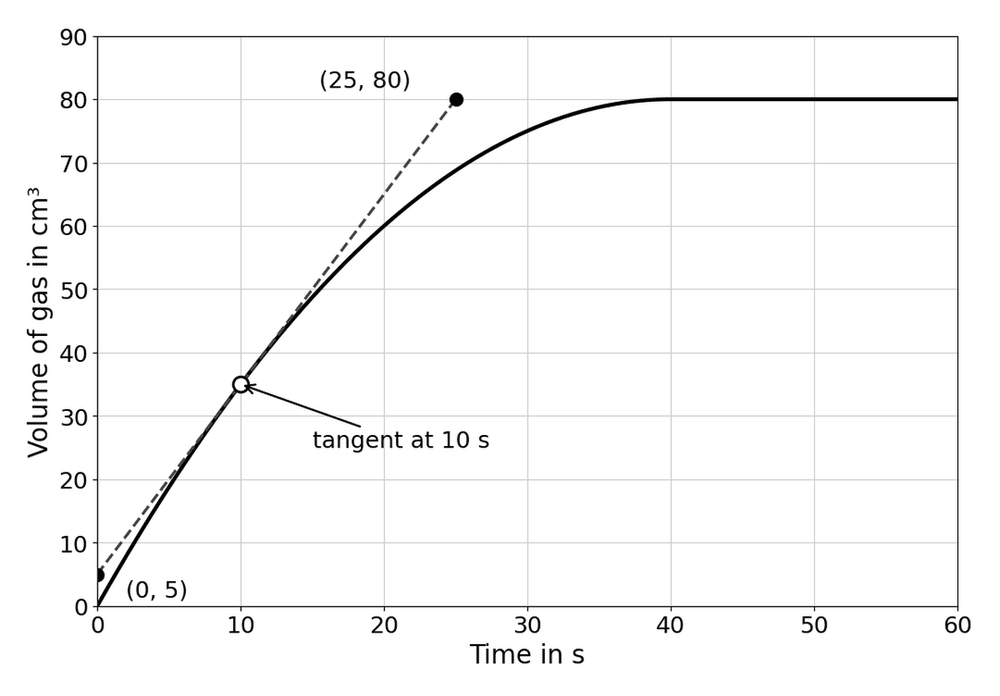
The rate of reaction at a specific instant is found by drawing a tangent to the curve on a reaction graph.

For a reactant falling, the curve slopes down (negative gradient). For a product forming, the curve slopes up (positive gradient). The size of the gradient gives the rate.

Method

1. Draw a tangent line touching the curve at the chosen time.

2. Pick two points far apart on the tangent and read their coordinates.

3. Gradient = change in y ÷ change in x.

To find the rate in mol/s, first calculate the rate in g/s, then use: amount in moles = mass ÷ Mr. So, rate in mol/s = rate in g/s ÷ Mr.

Diagram

chem tangent gradient graph

Note

A straight dashed tangent touches the curve at 10 s (35 cm3) and passes through the marked points (0, 5) and (25, 80). Gradient = (80 − 5) ÷ (25 − 0) = 3 cm3/s.

Example

A tangent drawn at 30 s on a curve of the mass of magnesium remaining against time passes through (10 s, 0.48 g) and (50 s, 0.16 g). What is the rate at 30 s in mol/s? (Ar of Mg = 24)

Solution

Gradient = (0.16 − 0.48) ÷ (50 − 10) = −0.32 ÷ 40 = −0.0080 g/s, so the rate is 0.0080 g/s.

Convert to mol/s by dividing by the relative atomic mass: 0.0080 ÷ 24 ≈ 0.000333 mol/s.

In standard form, this is 3.3 × 10⁻⁴ mol/s.

Tips/hints

Always pick two points on the tangent, never just one on the curve. Dividing a single y value by an x value gives the mean rate from the start, not the rate at that time.

The rate is highest at the start because the reactant concentration is highest.

Convert minutes to seconds before calculating.

Changing conditions at equilibrium (Higher)

Definition

Le Chatelier's principle states that if a system at equilibrium is changed, the position of equilibrium moves to oppose that change.

If you add more reactant, the system opposes this by moving the equilibrium to the right, forming more product. Removing a product also makes more product.

Method

Temperature: Raising the temperature favours the endothermic direction. Lowering the temperature favours the exothermic direction.

Pressure: For gases, raising the pressure moves the equilibrium towards the side with fewer gas molecules. Lowering the pressure moves it to the side with more. If both sides have the same number of molecules, changing pressure does not move the equilibrium.

Catalysts: A catalyst speeds up both directions equally. It helps the system reach equilibrium faster but does not change the position of equilibrium.

Example

Carbon monoxide reacts with hydrogen to make methanol: CO(g) + 2H2(g) ⇌ CH3OH(g). The forward reaction is exothermic.

What happens to the yield of methanol if the temperature is lowered and the pressure is raised?

Solution

Lowering the temperature favours the exothermic direction (the right), opposing the drop in temperature.

There are 3 gas molecules on the left and 1 on the right. Raising pressure moves the equilibrium to the side with fewer molecules (the right).

Both changes move the equilibrium to the right, increasing the yield of methanol.

Tips/hints

A higher temperature decreases the yield if the forward reaction is exothermic.

Count the large numbers (coefficients) in front of the formulas to find the number of gas molecules, not the small subscripts.

The equilibrium does not 'use up' all the added reactant; it shifts to oppose the change.

Changing conditions might increase the rate, but lower the yield.

Required practical: Rates of reaction

Overview

Investigate how acid concentration affects reaction rate by measuring gas volume or timing a disappearing cross.

Method

A: Volume of gas

1. Put 50 cm3 of dilute hydrochloric acid into a flask.

2. Add 3 cm of magnesium ribbon, insert the bung quickly and start the clock.

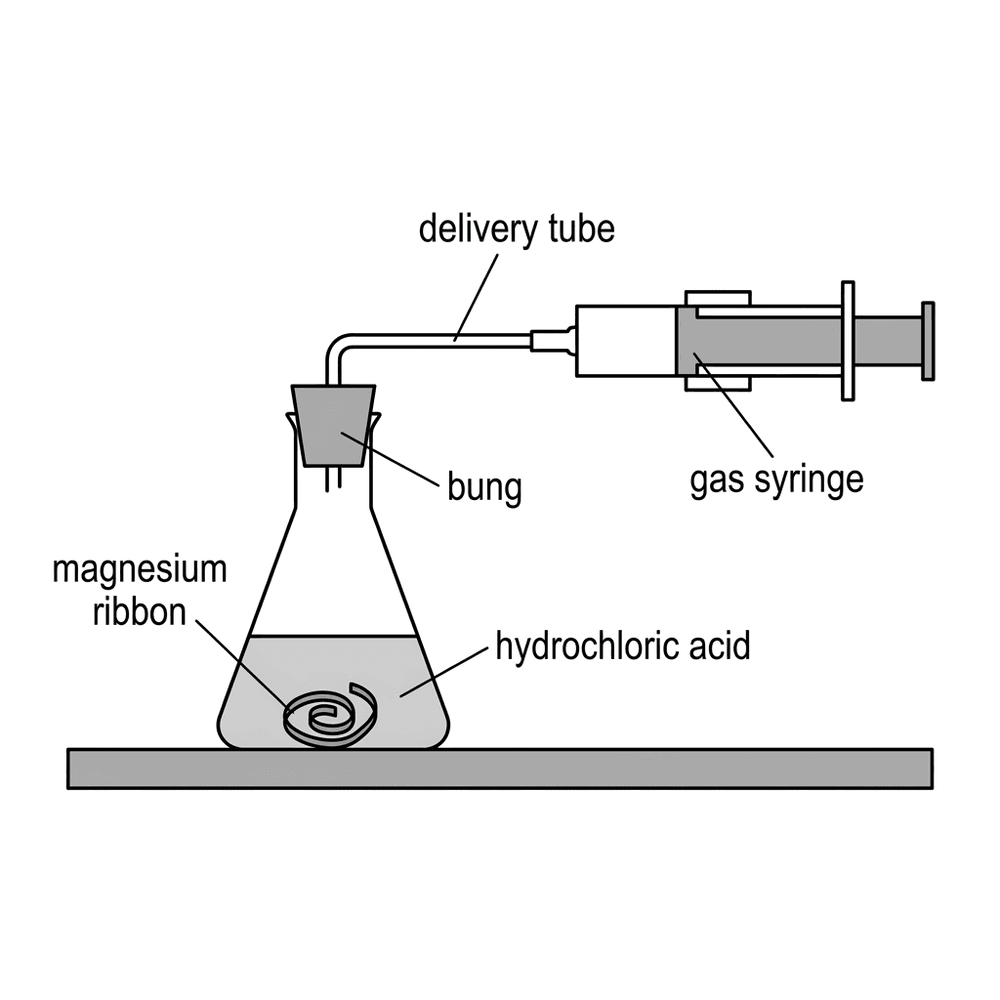
3. Record the volume of hydrogen in the gas syringe every 10 s.

4. Repeat with different acid concentrations.

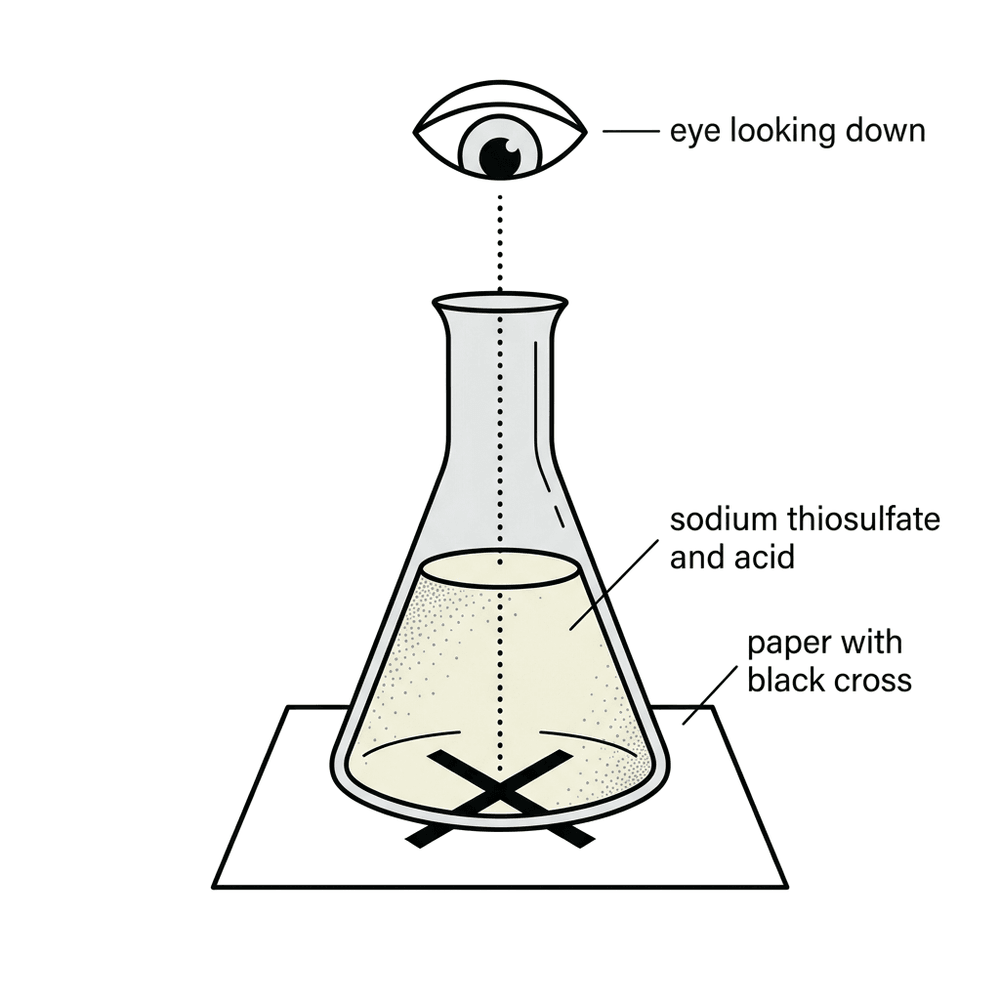
B: Disappearing cross

1. Put 10 cm3 sodium thiosulfate and 40 cm3 water into a flask.

2. Place on a printed black cross.

3. Add 10 cm3 dilute hydrochloric acid and start the clock.

4. Stop the clock when the cloudy sulfur precipitate hides the cross.

5. Repeat with different thiosulfate concentrations.

Knowledge Required

Independent variable: concentration.

Dependent variable: volume of gas or time for the cross to disappear.

Control variables: volume of acid, length of magnesium, total volume, temperature.

Mean rate = quantity of product ÷ time taken.

Note

Hydrochloric acid is an irritant (wear eye protection). The sulfur dioxide produced is toxic and can trigger asthma (ensure good ventilation).

Diagram

chem rate gas syringe

Note

A gas syringe measures the volume of hydrogen.

Diagram

chem disappearing cross

Note

Look down through the flask to see the cross disappear.

Tips/hints

If gas escapes before inserting the bung, the measured volume is too low.

The cross disappearing is subjective; using a light sensor improves accuracy.

Rate increases at higher concentrations because more particles in the same volume increase the frequency of collisions.

Test yourself on this topic

Try the free quiz with worked solutions.

Start quiz →

Get GCSE Science

Full notes, full question bank, offline.