


G GCSE Apps

GCSE Science

C3 Quantitative chemistry

6 subtopics in this section

Conservation of mass and balanced equations

Definition

In a chemical reaction, atoms are only rearranged: none are created or destroyed. So the total mass of the products is always equal to the total mass of the reactants. This is the law of conservation of mass.

It also means a symbol equation must be balanced, having the same number of atoms of each element on both sides of the arrow.

Method

When balancing a symbol equation, you can only change the coefficients (big numbers in front). These multiply the whole formula.

Never change the small subscript numbers inside a formula, because that changes the substance. Small subscripts belong only to the atom or group just before them.

For example, 2Mg(NO3)2 contains 2 magnesium atoms, 4 nitrogen atoms and 12 oxygen atoms.

Diagram
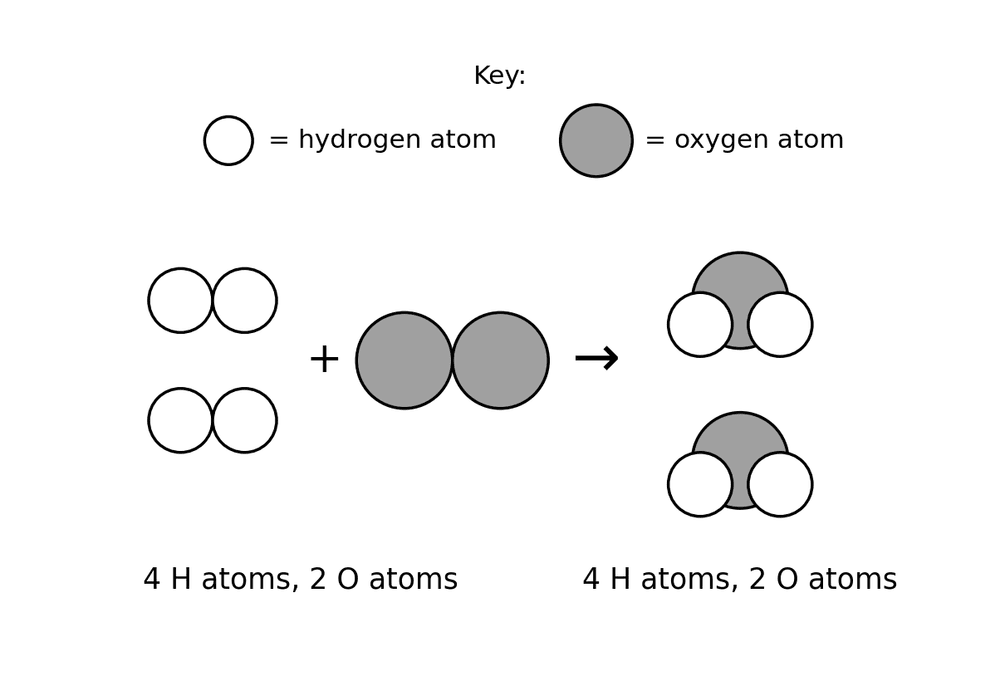
chem balanced equation particles

Note

In a balanced equation, the number of each type of atom on the left (reactants) is the same as on the right (products).

Example

12.0 g of carbon burns completely in 32.0 g of oxygen to make carbon dioxide. What mass of carbon dioxide is produced?

Solution

Total mass of reactants = 12.0 + 32.0 = 44.0 g.

Because mass is conserved, the total mass of the products must be the same.

Mass of carbon dioxide = 44.0 g.

Tips/hints

Mass is never lost or created in a chemical reaction.

When counting atoms, remember that a big number multiplies everything in the formula, and a small subscript multiplies only the atom or group immediately before it.

Never balance an equation by changing subscripts (for example, writing H2O2 instead of H2O for water).

If a reaction takes place in a closed system, such as two solutions forming a solid precipitate in a sealed flask on a balance, the mass remains unchanged.

Relative formula mass

Definition

The relative formula mass (Mr) of a compound is the sum of the relative atomic masses (Ar) of all the atoms shown in its formula.

It is just a ratio, so it has no units. In any balanced chemical equation, the sum of the relative formula masses of the reactants exactly equals the sum of the relative formula masses of the products because mass is conserved.

Method

Finding Mr: Find the Ar of each element from the periodic table. Multiply each one by the number of atoms of that element in the formula (its subscript), then add them together.

Percentage by mass: Percentage by mass = (total Ar of the element in the formula ÷ Mr of the compound) × 100.

Example

What is the percentage by mass of potassium in potassium nitrate, KNO3? (Ar values: K = 39, N = 14, O = 16)

Solution

First, find the Mr of KNO3: 39 + 14 + (3 × 16) = 101.

The formula contains one potassium atom, so the mass of potassium is 39.

Percentage by mass = (39 ÷ 101) × 100 = 38.6% (3 significant figures).

Example

What is the Mr of magnesium nitrate, Mg(NO3)2? (Ar values: Mg = 24, N = 14, O = 16)

Solution

The subscript 2 outside the brackets means there are two nitrogen atoms and six oxygen atoms.

Mr = 24 + (2 × (14 + 3 × 16)) = 24 + (2 × 62) = 148.

Tips/hints

Always use the relative atomic masses (the larger number for each element on the periodic table), not the atomic numbers.

If a formula has brackets, multiply everything inside the brackets by the little number outside them.

When finding a percentage, remember to count all the atoms of that element in the compound.

Mass changes and measurement uncertainty

Definition

The law of conservation of mass says that no atoms are lost or made in a chemical reaction. In a sealed container, the total mass always stays exactly the same.

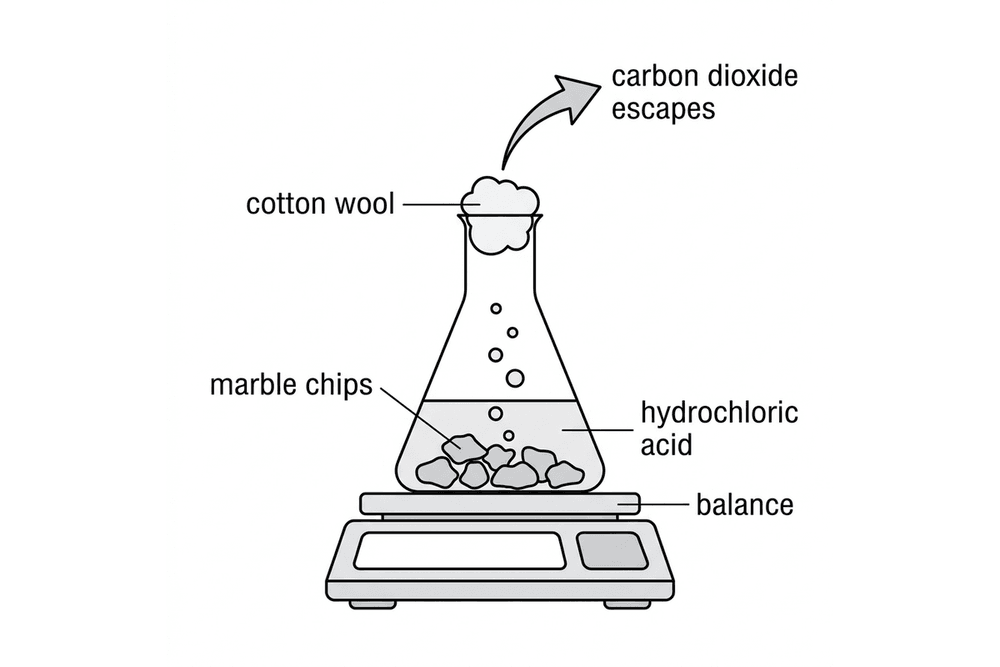
However, if a reaction happens in an open, non-enclosed container, the mass can appear to change. This happens when a gas is involved. The measured mass increases if a gas from the air reacts to form part of a solid product. The measured mass decreases if a solid or liquid reacts to form a gas that escapes into the air.

Diagram

chem open flask mass loss

Note

Carbon dioxide escapes from the open flask through the cotton wool. The balance shows the mass of the remaining marble chips, hydrochloric acid and flask, which is less than the starting mass.

Example

24.7 g of copper carbonate is heated in an open tube. The equation is: copper carbonate → copper oxide + carbon dioxide (CuCO3 → CuO + CO2).

The final solid has a mass of 15.9 g. What mass of gas escapes?

Solution

The mass lost is the mass of the carbon dioxide gas that escaped.

Mass of gas = initial mass − final mass

24.7 − 15.9 = 8.8 g

Tips/hints

If a mass appears to increase, a gas from the air was not weighed at the start but became part of the solid product.

Gas particles move randomly and spread out. If a gas escapes, its mass is no longer measured.

Every measurement has some uncertainty. If you take repeat readings, ignore any anomalous result and find the mean of the others.

Uncertainty can be estimated as half the range. Range is the largest value minus the smallest value. If results are 3.1, 3.3 and 3.5, the mean is 3.3, the range is 0.4 and the result is 3.3 ± 0.2.

Concentration of solutions

Definition

A solution forms when a solid (the solute) dissolves completely in a liquid (the solvent). In a salt solution, salt is the solute and water is the solvent.

The concentration of a solution tells you how much solute is dissolved in a given volume of solution. It can be measured in grams per cubic decimetre (g/dm3).

Method

Concentration: concentration = mass of solute ÷ volume of solution.

The mass must be in grams (g) and the volume must be in cubic decimetres (dm3) to give a concentration in g/dm3.

To convert a volume from cm3 to dm3, divide by 1000. (1 dm3 is the same volume as 1 litre, which is 1000 cm3).

Rearranging the equation gives: mass = concentration × volume.

Example

A student dissolves 7.5 g of glucose in water to make 300 cm3 of solution. What is the concentration of the solution in g/dm3?

Solution

First, convert the volume into dm3 by dividing by 1000: 300 ÷ 1000 = 0.30 dm3.

Then use the equation: concentration = 7.5 ÷ 0.30 = 25 g/dm3.

Example

A sodium chloride solution has a concentration of 15 g/dm3. What mass of sodium chloride is present in 2.0 dm3 of this solution?

Solution

Rearrange the equation to find the mass: mass = concentration × volume.

mass = 15 × 2.0 = 30 g.

Tips/hints

Always check the units of volume in the question. If they are in cm3, divide by 1000 first.

When dissolving a solid, the final volume of the solution is slightly larger than the volume of water added because the solute particles take up space. Do not assume the volume of the solution is exactly equal to the volume of the water.

Make sure not to confuse dm3 (which is a volume) with cm3. 1 dm3 equals 1000 cm3, not 100 cm3.

Moles (Higher)

Definition

A mole is the unit for amount of substance (symbol: mol).

The mass of one mole of a substance in grams is numerically equal to its relative formula mass (Mr).

One mole of any substance contains the same number of individual particles (atoms, molecules or ions). This number is the Avogadro constant: 6.02 × 10²³ per mole.

Equations to remember:

moles = mass (g) ÷ Mr, so mass (g) = moles × Mr

number of particles = moles × (6.02 × 10²³)

Example

How many atoms are in 11 g of carbon dioxide (CO2)? (Mr = 44)

Solution

First, find the number of moles:

moles = mass ÷ Mr = 11 ÷ 44 = 0.25 mol

Then, multiply by the Avogadro constant to find the number of molecules:

0.25 × (6.02 × 1023) = 1.505 × 10²³ molecules

Each CO2 molecule contains 3 atoms (one carbon, two oxygen). Multiply the number of molecules by 3:

Total atoms = 3 × (1.505 × 1023) = 4.515 × 1023 = 4.52 × 10²³ atoms (3 significant figures).

Note

Concentration is the mass of solute in a given volume of solution, in g/dm3.

concentration = mass of solute (g) ÷ volume of solution (dm3)

A larger mass of solute in the same volume gives a higher concentration. The same mass of solute in a larger volume gives a lower concentration. Evaporating some water raises the concentration.

Tips/hints

Always convert volume from cm3 to dm3 by dividing by 1000 before calculating concentration.

Read carefully whether a calculation asks for the number of moles, the number of molecules, or the number of individual atoms.

The mass of one mole of a substance depends on its Mr, so 1 mole of carbon (12 g) has a different mass from 1 mole of water (18 g).

Reacting masses and limiting reactants (Higher)

Definition

A balanced symbol equation gives the mole ratio of reactants and products. The large numbers (coefficients) show the number of moles.

For example, N2 + 3H2 ⇌ 2NH3 means 1 mole of nitrogen reacts with 3 moles of hydrogen to make 2 moles of ammonia.

The limiting reactant is used up first. It limits the maximum amount of product. Other reactants are in excess.

Method

Reacting masses: 1. Calculate moles of the known substance (mass ÷ Mr).

2. Find moles of the unknown substance using the mole ratio.

3. Convert back to mass (moles × Mr).

Balancing from masses: Convert all masses to moles. Divide each by the smallest number to get a simple whole-number ratio for the coefficients.

Example

What mass of copper is made when 4.0 g of copper(II) oxide is heated with excess hydrogen? (H = 1, O = 16, Cu = 63.5). Equation: CuO + H2 → Cu + H2O.

Solution

Mr of CuO = 63.5 + 16 = 79.5.

Moles of CuO = 4.0 g ÷ 79.5 = 0.0503 mol.

The ratio of CuO to Cu is 1 : 1, so 0.0503 mol of copper is made. Hydrogen is in excess, so CuO is the limiting reactant.

Mass of copper = 0.0503 × 63.5 = 3.2 g (2 significant figures).

Tips/hints

Never multiply by the large coefficient when finding relative formula mass. Use only the subscripts.

The reactant with the smallest mass is not always limiting; always compare moles and ratios.

Adding more of an excess reactant will not produce more product.

Test yourself on this topic

Try the free quiz with worked solutions.

Start quiz →

Get GCSE Science

Full notes, full question bank, offline.