


G GCSE Apps

GCSE Science

C2 Bonding, structure and properties

10 subtopics in this section

Chemical bonds and ionic bonding

Definition

There are three strong chemical bonds. Ionic bonding happens between a metal and a non-metal, involving an attraction between oppositely charged ions. Covalent bonding happens between non-metals, where atoms share pairs of electrons. Metallic bonding happens in metals and alloys, where metal atoms share delocalised electrons.

Method

In ionic bonding, the metal atom transfers its outer-shell electrons to the non-metal atom.

Metal atoms lose electrons to become positive ions. Non-metal atoms gain electrons to become negative ions. Ions from Groups 1, 2, 6 and 7 end up with the electronic structure of a noble gas (a full outer shell).

The charge on an ion comes from its group number. Group 1 forms 1+ ions, Group 2 forms 2+ ions, Group 6 forms 2− ions and Group 7 forms 1− ions.

Diagram
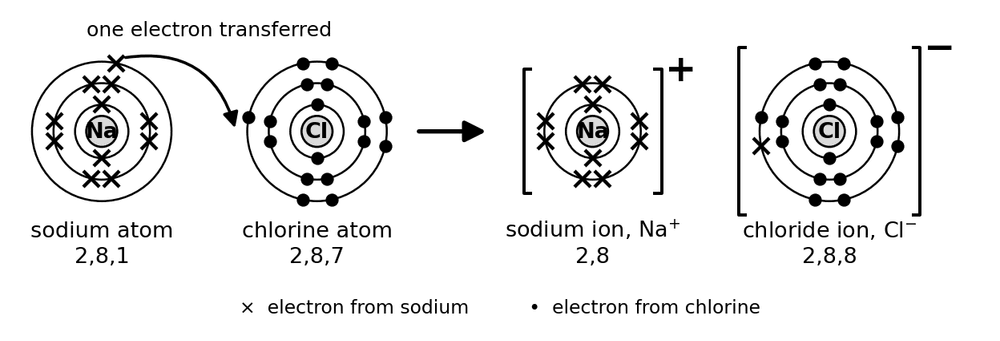
chem sodium chloride dot cross

Note

A sodium atom (2,8,1) transfers its one outer electron, shown as a cross, to a chlorine atom (2,8,7). This forms a sodium ion, Na+ (2,8), and a chloride ion, Cl− (2,8,8). Both ions have the electronic structure of a noble gas.

Example

Deduce the formula of magnesium fluoride.

Solution

Magnesium is a metal in Group 2, so its atom transfers 2 electrons to form a Mg2+ ion.

Fluorine is a non-metal in Group 7, so its atom needs 1 electron to form an F− ion.

Two fluorine atoms are needed to receive the 2 electrons, so the formula is MgF2.

Tips/hints

Remember that electrons are negative. When a non-metal atom gains electrons, its charge becomes negative, not positive. A negative ion has not lost electrons.

Ionic bonds are electrostatic attractions between oppositely charged ions. Do not say that ions share electrons (that is covalent bonding).

When drawing a dot-and-cross diagram for an ion, always include square brackets round each ion and put the charge at the top right.
Ionic compounds

Definition

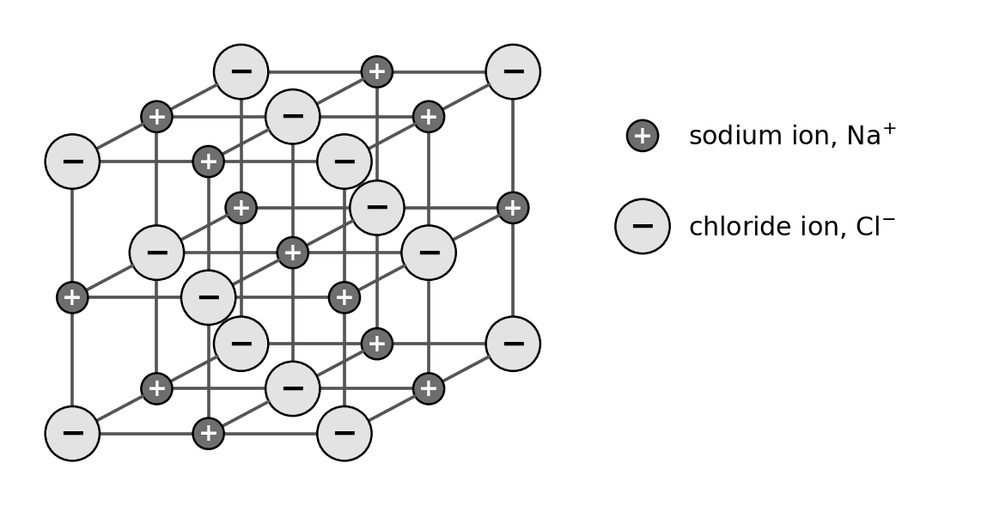
An ionic compound is a giant lattice of ions held together by strong electrostatic forces of attraction between oppositely charged ions. These forces act in all directions.

There are no individual molecules in an ionic compound. A crystal of sodium chloride is one continuous lattice.

Method

Scientists use models to represent these giant structures, each with limitations.

Dot-and-cross diagrams show how electrons transfer, but not the 3D lattice or relative sizes.

Ball-and-stick models show the 3D pattern, but exaggerate empty space and show sticks looking like real bonds.

3D space-filling models show relative sizes, but hide inner ions and only show a tiny fraction of the lattice.

Diagram

chem sodium chloride lattice

Note

Part of the giant ionic lattice of sodium chloride. Small Na+ ions and larger Cl− ions alternate in all three directions, so each ion is surrounded by six ions of the opposite charge. The real lattice continues in every direction.

Example

A model of part of an ionic lattice contains 40 Na+ ions and 20 O2− ions. What is the empirical formula?

Solution

The empirical formula is the simplest whole-number ratio of the ions.

The ratio of Na+ to O2− ions in the model is 40 : 20. Divide both by 20 to get 2 : 1.

Check the charges: two 1+ charges balance one 2− charge, so the total charge is zero.

The empirical formula is Na2O.

Tips/hints

An ionic compound is not made of molecules, and each ion is attracted to all the ions around it, not to just one.

For an empirical formula, simplify the counts from the model; do not copy the raw numbers.

Check your formula with the charges: the total positive charge must equal the total negative charge.

Covalent bonding

Definition

A covalent bond is a shared pair of electrons between non-metal atoms. This is a strong bond that allows each atom to achieve a full outer shell. Covalent substances can exist as small molecules, very large molecules like polymers, or giant covalent structures.

Method

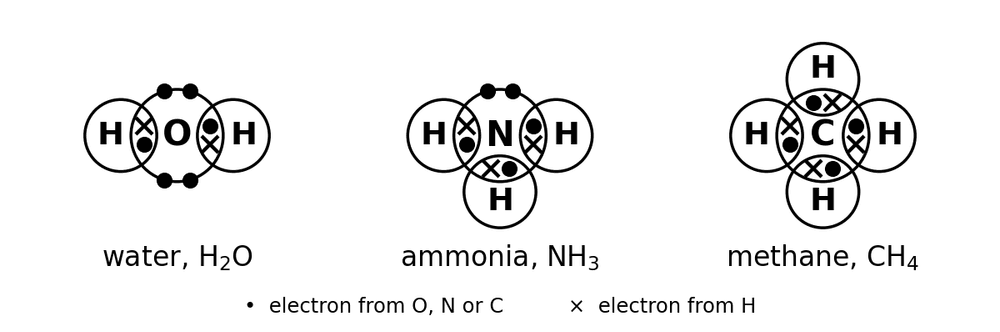
Dot-and-cross diagrams show only the outer shells, using dots for one atom's electrons and crosses for the other's. They show where electrons came from but not the 3D shape.

Displayed formulae use a line for a single bond and a double line for a double bond. They show connections but not the 3D shape or electrons.

Ball-and-stick models show the 3D shape, but the sticks exaggerate the distance between atoms.

Diagram

chem covalent dot cross molecules

Note

Dot-and-cross diagrams (outer shells only) for water, ammonia and methane. Each shared pair, one dot and one cross where the shells overlap, is one covalent bond. Oxygen keeps two lone pairs, nitrogen keeps one and carbon has none.

Example

A chlorine molecule (Cl2) contains a single covalent bond. Chlorine is in group 7. How many shared electrons and how many lone pairs are there in the whole molecule?

Solution

The atoms form 1 shared pair, which is 2 shared electrons.

Each atom has 7 outer electrons and shares 1, leaving 6 non-bonding electrons (3 lone pairs).

For the two atoms, this means 2 shared electrons and 6 lone pairs in total.

Tips/hints

A single bond is a shared pair (2 electrons); a double bond is two shared pairs (4 electrons).

Electrons from one atom are identical to electrons from another. Dots and crosses are just used for bookkeeping.

Boiling a covalent substance overcomes weak intermolecular forces, not the strong covalent bonds.

Metallic bonding

Definition

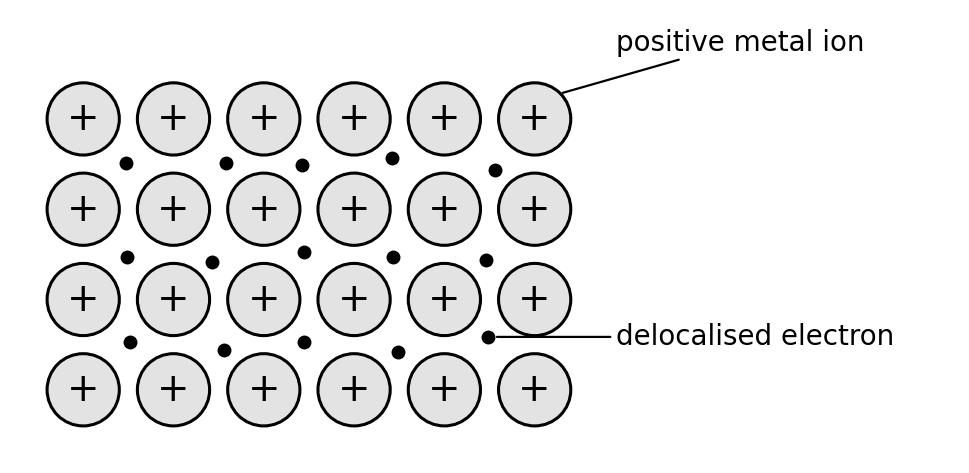
A metal is a giant structure of atoms arranged in a regular pattern or lattice. The outer-shell electrons of each metal atom leave their atoms to become delocalised.

This leaves behind a regular arrangement of positive metal ions. The delocalised electrons are free to move through the whole giant structure.

Method

Metallic bonding is the strong electrostatic attraction between the positive metal ions and the shared sea of delocalised electrons.

This strong electrostatic attraction acts in all directions throughout the structure, making metallic bonds very strong. Metallic bonding is found in pure metal elements and in alloys.

Diagram

chem metallic bonding

Note

Positive metal ions sit in regular rows. The dots between them are delocalised electrons, which are free to move through the whole structure.

Example

A calcium atom has the electronic structure 2,8,8,2. Describe the particles in a piece of calcium metal.

Solution

A calcium atom has two electrons in its outer shell, and both become delocalised.

This leaves Ca2+ ions arranged in a regular lattice, surrounded by a sea of delocalised electrons (two for every ion).

The strong attraction between the Ca2+ ions and the delocalised electrons is the metallic bonding.

Tips/hints

Remember that the ions in a metallic lattice are positive, not negative. There are no negative ions in a metal.

A common mistake is to confuse metallic bonding with covalent bonding (which is sharing electron pairs between two specific atoms) or ionic bonding (which has alternating positive and negative ions, with no free electrons).

The number of delocalised electrons per atom equals the number of outer-shell electrons: sodium (2,8,1) gives one per atom, while aluminium (2,8,3) gives three.

States of matter and state symbols

Definition

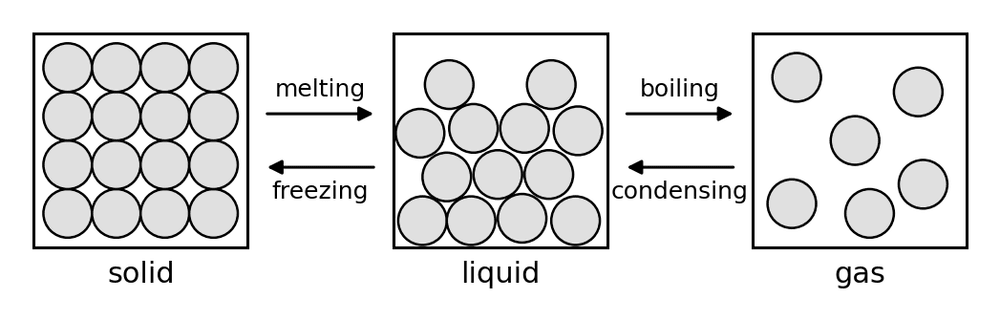
The three states of matter are solid, liquid and gas. Substances change state at specific temperatures: melting and freezing happen at the melting point, while boiling and condensing happen at the boiling point.

Melting (solid to liquid) and boiling (liquid to gas) require energy from the surroundings to overcome the forces between particles. The stronger these forces, the more energy is needed, so the higher the melting and boiling points.

Freezing (liquid to solid) and condensing (gas to liquid) release energy to the surroundings as the forces between particles become stronger.

The properties of a material depend on many particles acting together. A single atom does not have a state of matter or a colour.

Method

State symbols in chemical equations show the state of each substance:

(s) solid (including precipitates)

(l) pure liquid (including liquid water)

(g) gas

(aq) aqueous (dissolved in water)

Diagram

chem three states particles

Note

Solid: particles touch in a regular pattern and vibrate about fixed positions. Liquid: particles touch but are arranged randomly and move around each other. Gas: particles are far apart and move quickly in all directions. The arrows name each change of state.

Example

Substance R has a melting point of −7 °C and a boiling point of 59 °C. What is its state at 70 °C?

Solution

70 °C is above the melting point, so R has melted.

70 °C is also above the boiling point, so R has boiled.

So substance R is a gas at 70 °C.

Tips/hints

Particles themselves do not melt, expand or change size. The arrangement of the particles and the spaces between them change.

Watch out for negative temperatures. A temperature of −50 °C is warmer than −100 °C.

Do not confuse (l) and (aq). Liquid water is (l), but a solution of salt dissolved in water is (aq).

Properties of ionic compounds and small molecules

Definition

Ionic compounds are giant lattices of positive and negative ions held by strong electrostatic forces in all directions.

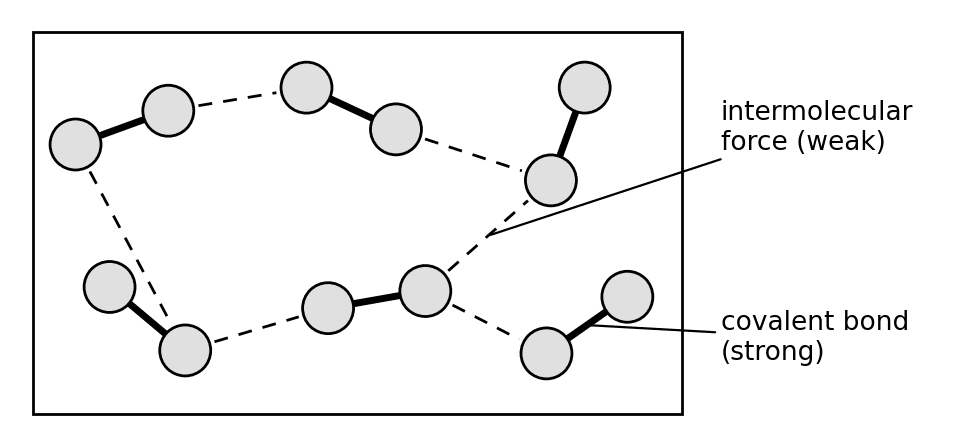
Small molecules have atoms joined by strong covalent bonds, but only weak intermolecular forces between the separate molecules.

Method

Ionic compounds: melting or boiling needs a lot of energy to overcome the many strong electrostatic forces, so the melting and boiling points are high. Solids do not conduct because the ions are fixed; molten or dissolved, the ions are free to move and carry charge.

Small molecules: melting or boiling only overcomes the weak intermolecular forces, not the covalent bonds, so the melting and boiling points are low. Larger molecules have stronger intermolecular forces and higher boiling points. They do not conduct, because the molecules have no overall charge.

Diagram

chem intermolecular forces

Note

The thick lines are strong covalent bonds inside each molecule. The dashed lines are the weak intermolecular forces between molecules, which are overcome on melting or boiling.

Example

Substance Q melts at 1400 °C. It does not conduct as a solid, but its solution in water does conduct. Substance R boils at −5 °C and does not conduct in any state. Identify the type of structure in each.

Solution

Q is an ionic compound: its high melting point shows many strong electrostatic forces must be overcome, and it conducts in solution because its ions are then free to move.

R is made of small molecules: its low boiling point shows only weak intermolecular forces are overcome, and its molecules have no overall charge, so it does not conduct.

Tips/hints

A common mistake is to say that boiling water breaks the covalent bonds between hydrogen and oxygen. Boiling overcomes the weak intermolecular forces between the water molecules.

In a molten or dissolved ionic compound, the ions carry the current, not electrons.

Polymers and giant covalent structures

Definition

Polymers are very large molecules made of long chains. The atoms in the chain are held together by strong covalent bonds. Due to their size, intermolecular forces between chains are relatively strong, making them solid at room temperature.

Giant covalent structures are continuous networks where every atom is joined to others by strong covalent bonds. They are not made of separate molecules. They have very high melting points because many strong covalent bonds must be broken.

Method

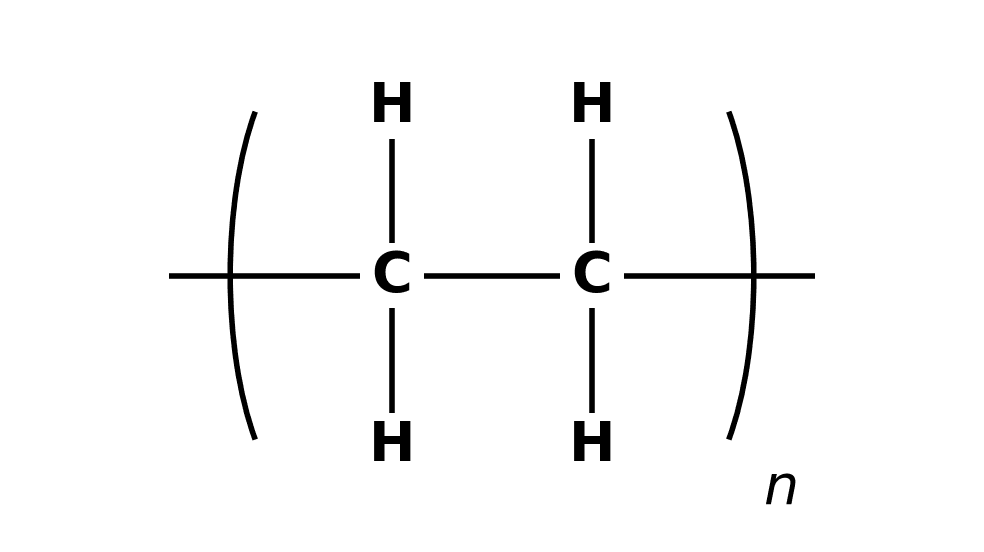
Polymers are represented by a repeating unit in brackets. Bonds passing through the brackets show they join to the next units. A subscript n (a large number) shows how many units are in the chain.

Diagram

chem poly ethene repeat unit

Note

The repeating unit of poly(ethene): two carbon atoms joined by a single covalent bond, each also bonded to two hydrogen atoms. The bonds that pass through the brackets join to the next units, and n is a large number.

Example

Explain why poly(ethene) is a solid at room temperature, but methane, CH4, which is made of small molecules, is a gas.

Solution

Both substances have strong covalent bonds inside their molecules, and these do not break when they melt or boil.

Poly(ethene) molecules are very long chains, so the intermolecular forces between them are relatively strong.

Methane molecules are very small, so the intermolecular forces between them are weak and little energy is needed to separate them.

Tips/hints

Melting a polymer only overcomes the intermolecular forces between chains. It does not break the strong covalent bonds.

A giant covalent substance has no separate molecules, so it has no intermolecular forces.

Do not confuse giant covalent structures with giant ionic lattices. Silicon dioxide is made of non-metals (covalent bonds), not ions.

Metals and alloys

Definition

Metals are giant structures with strong metallic bonding: positive metal ions held in layers by a sea of delocalised electrons. A lot of energy is needed to overcome this attraction, so most metals have high melting and boiling points.

An alloy is a mixture of a metal with at least one other element, usually another metal. Steel (iron with carbon), brass and bronze are alloys.

Method

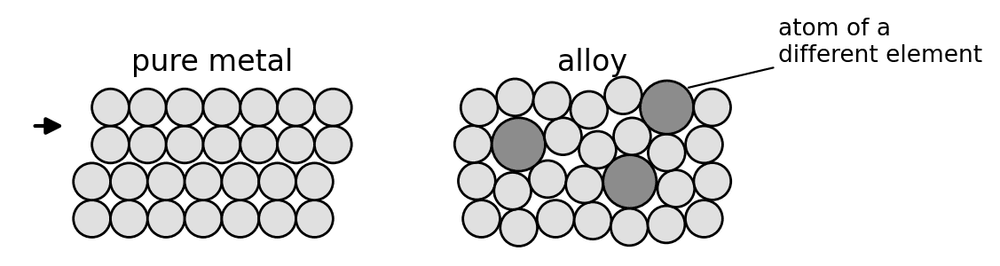
Pure metals bend: all the atoms are the same size, so the layers can slide over each other. This is why pure metals can be bent and shaped, but it also makes many of them too soft to use.

Alloys are harder: atoms of a different size distort the layers, so the layers cannot slide over each other as easily.

Conduction: delocalised electrons move through the metal and carry charge (electricity). They also transfer energy through the metal (thermal conduction).

Diagram

chem alloy layers

Note

In the pure metal, the arrow shows the top layers sliding over the layers below. In the alloy, the larger atoms of a different element distort the layers, so they cannot slide easily.

Example

Bronze is an alloy of copper and tin. Explain why a bronze statue keeps its shape better than a statue made of pure copper.

Solution

In pure copper all the atoms are the same size, so the layers slide easily when a force is applied.

In bronze, tin atoms of a different size distort the layers.

The layers cannot slide over each other as easily, so bronze is harder and keeps its shape.

Tips/hints

An alloy is a mixture, not a compound.

Alloys are harder because the distorted layers cannot slide, not because the metallic bonds are stronger.

In a metal the current is carried by delocalised electrons. The positive ions stay in place.

Diamond, graphite, graphene and fullerenes

Definition

Diamond, graphite, graphene and fullerenes are all structures made entirely of carbon atoms, but they differ in how the atoms are bonded.

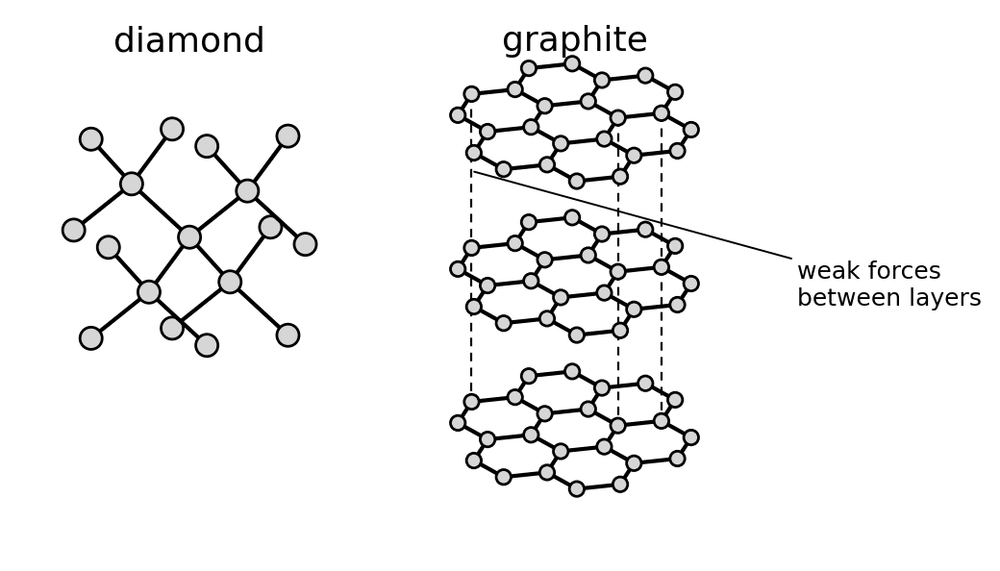
Diamond is a giant covalent structure where each carbon atom forms four strong covalent bonds to four other carbon atoms. It is very hard and does not conduct electricity.

Graphite forms flat layers of hexagonal rings. Each carbon atom makes three covalent bonds to three others, leaving one delocalised electron per atom that can carry electrical charge.

Graphene is a single layer of graphite, just one atom thick. It is very strong, very light and conducts electricity.

Fullerenes are molecules of carbon atoms with hollow shapes based on hexagonal rings. Buckminsterfullerene (C60) is spherical, while carbon nanotubes are cylindrical.

Diagram

chem diamond graphite structures

Note

Diamond (left): each carbon atom inside the structure is bonded to four other carbon atoms. Graphite (right): each carbon atom is bonded to three others in flat layers of hexagonal rings, with only weak forces between the layers.

Example

Graphite is used to make electrodes, but diamond is not. Explain the difference in terms of structure and bonding.

Solution

In diamond, each carbon atom uses all four outer electrons in covalent bonds, so there are no free electrons and diamond does not conduct.

In graphite, each carbon atom forms only three covalent bonds, so one electron from each atom is delocalised.

The delocalised electrons move through the layers and carry charge, so graphite conducts electricity.

Tips/hints

Graphite is soft and slippery because the weak forces between layers allow them to slide. The covalent bonds themselves are not weak.

Diamond has a very high melting point because a lot of energy is needed to break the many strong covalent bonds, not because of intermolecular forces.

Fullerenes like Buckminsterfullerene are molecules, not giant covalent structures.

Limitations of the particle model (Higher)

Definition

The simple particle model draws the particles in solids, liquids and gases as small, solid, inelastic spheres with no forces between them.

It is useful for showing how the particles are arranged and how they move in each state, but it has important limitations.

Method

No forces: the model cannot explain why energy is needed to melt or boil a substance, or why different substances melt and boil at different temperatures. Both depend on the strength of the forces between the particles.

All spheres: real particles are often molecules with other shapes, or ions.

Solid spheres: atoms are mostly empty space, with a tiny nucleus and electrons around it.

No motion or scale: a drawing cannot show how fast the particles move, and gas particles are much further apart than any diagram shows.

Example

Oxygen boils at −183 °C and mercury boils at 357 °C. A student uses the simple particle model to explain the difference. Explain why the model cannot do this.

Solution

A substance boils when enough energy is transferred to overcome the forces between its particles.

Mercury must have much stronger forces between its particles than oxygen.

The model shows no forces between particles, so it cannot show this difference.

Tips/hints

The particles themselves do not melt, boil or expand. It is the arrangement and spacing of the particles that changes.

Name the limitation clearly, e.g. "the model does not show the forces between particles", rather than saying the model is wrong.

Remember what the model does well: it shows the arrangement and movement of particles in each state.

Test yourself on this topic

Try the free quiz with worked solutions.

Start quiz →

Get GCSE Science

Full notes, full question bank, offline.