

G GCSE Apps

GCSE Statistics

Data Processing

9 subtopics in this section

Mode (F)

Definition

The Mode is the value that appears most often in a set of data. It is also referred to as the Modal Value.

If two or more values are the most common, then there will be two or more Modal Values

Method

It often helps to find the mode if you put the data in order first.

Tips/hints

To help you remember: MOde is MOst common value

Example

Find the mode of the data set: 5, 0, 1, 3, 8, 1, 3, 0, 2, 4, 8, 0, 3, 1, 0

Solution

Put the data in order: 0, 0, 0, 0, 1, 1, 1, 2, 3, 3, 3, 4, 5, 8, 8

There are 4 occurrences of 0 so that is the Mode
Median (F)

Definition

The Median of a set of data is the Middle Value.

Method

Put the data in order from smallest to largest. If there's an odd number of items (2n+1), the Median is the value of the nth item. If there's an even number (2n), the Median lies halfway between the nth and (n+1)th items.

Example

Find the median of the data set: 5, 0, 1, 3, 8, 1, 3, 0, 2, 4, 8, 0, 3, 1, 0

Solution

Put the data in order: 0, 0, 0, 0, 1, 1, 1, 2, 3, 3, 3, 4, 5, 8, 8

There are 15 items so the 8th one in order is the Median ie.2

Mean (F)

Definition

The Mean of a set of numbers is what is commonly known as the Average ie. Sum of all Items ÷ Number of Items

Method

Simply use the formula above.

Example

Hilton's marks in his last 5 German tests were 10, 15, 12, 16 and 11. What was his mean mark to 1 d.p.?

Solution

Add up all the items to get 10+15+12+16+11 = 64. There are 5 items in total so the Mean = 64/5 12.8

Range (F)

Definition

The Range of a set of data is the difference between its largest and smallest values.

Method

Put the data in order. Then subtract the smallest value from the largest.

Example

Find the range of the data set: 5, 0, 1, 3, 8, 1, 3, 0, 2, 4, 8, 0, 3, 1, 0

Solution

Put the data in order: 0, 0, 0, 0, 1, 1, 1, 2, 3, 3, 3, 4, 5, 8, 8

The range = 8 - 0 = 8

Which average to use (F)

Definition

There are various advantages and disadvantages with the different forms of average, the Mean, Median and Mode. Here are some of the pros and cons

Mean

The Mean uses all of the data. The Mean is affected by extreme values and it can be difficult to calculate. Use the Mean when all the data is relevant (eg. an average number of goals scored per game)

Median

The Median is not affected by extreme values The Median can be quite laborious to find Use the Median when the data has extreme values

Mode

The Mode is the only average that can be used on non-numerical data. The Mode is usually easy to find The Mode can be much higher or much lower than most of the other values Sometimes there is no Mode if every value is different Use the Mode when there are many repeated values

Method

When presented with a set of data, weigh up the pros and cons of each type of average. Is one average more meaningful than the others? Or is one average skewed by extreme values?

Example

Which would be the most meaningful average to use on the data collected during a survey of favourite soft drinks

Solution

This data is non-numerical so the Mode is the only average possible

Example

You collect the following set of data: 10, 11, 8, 7, 6, 6, 7, 9, 12, 13 and you calculate the mean and the median. You then discover the final two items are incorrect and should be 29 and 22 (instead of 12 and 13). What effect does this have on the mean and median?

Solution

First find the mean: (10+11+8+7+6+6+7+9+12+13)/10 = 8.9 and the median: order the data, 6, 6, 7, 7, 8, 9, 10, 11, 12, 13 The median is (8+9)/2 = 8.5 Now if you change the final two values, the mean becomes 11.5 but the median remains the same.

Frequency tables (F)

Definition

A Frequency Table is a way of organising data that makes the frequency of each category easy to see. It's often a stepping stone on the way to drawing up a statistical diagram such as a bar chart or pie chart

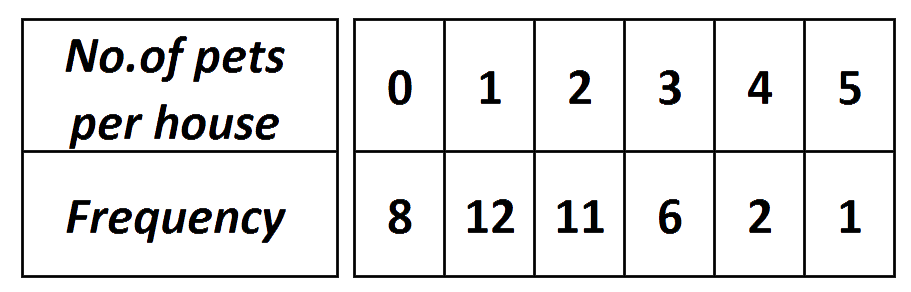
The table below shows the results of a door-to-door survey conducted on a particular street to find the number of pets per house.

Diagram

pets tab def

Note

It's easy to see that the 11 households had 2 pets, but only 1 household had 5

Mean, Median, Mode and Range can all be worked out using Frequency Tables.

Method

Follow through the worked example to see how to use a Frequency Table to calculate various statistics

Example

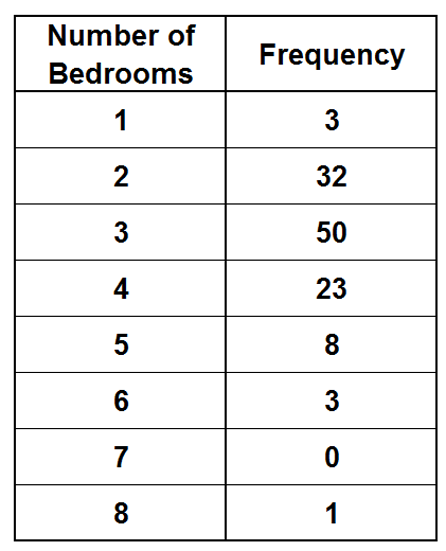
An estate agent goes through all the properties on her books and finds out how many bedrooms each one has. She puts the data into this frequency table

Diagram

freq tab ex

Note

Calculate the mode, median, mean and range of the number of bedrooms per property.

Solution

The Mode is very simple to find using a frequency table, it's simply the value with the highest frequency. Here, the mode is 3 bedrooms

To find the Median from a Frequency Table, first find the total number of items. This is given by summing the frequencies in the second column ie. 3+32+50+23+8+3+0+1 = 120

The Median will be halfway between the 60th and 61st values. These will lie in the 3 bedroom box so, 3 bedrooms is also the Median of the data.

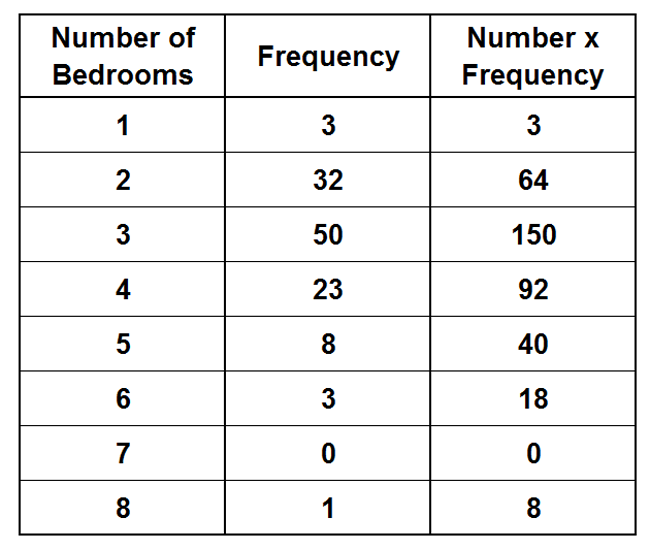
The Mean is a little more complicated to work out (but that's because it's mean!). You need to add a third column as shown

Diagram

freq tab sol

Note

Now, sum the third column and divide it by the sum of the second column ie. 375/120 = 3.125. That's the Mean

The Range is simply the highest number of bedrooms take away the lowest number ie. 8 - 1 = 7

Grouped data (F)

Definition

If data can take many values, then Grouping it makes it simpler to use. The downside is that some accuracy is lost.

A Group normally covers a range of values from V to V+A, V+A+1 to V+2A etc say.

The Class Boundaries are the values where we pass from one group to another. In this instance, the Class Boundary between the first two groups would be at V+A+0.5

The Mid-Interval Values of a group are self-explanatory; the Mid-Interval Value of the first group would be V+A/2

Method

Finding the Mean, Mode and Median with Grouped Data isn't possible. However, we can Estimate the Mean, we can find the Modal Group, and we can say which group the Median lies in.

Look through the example below to see how this works in practice.

Example

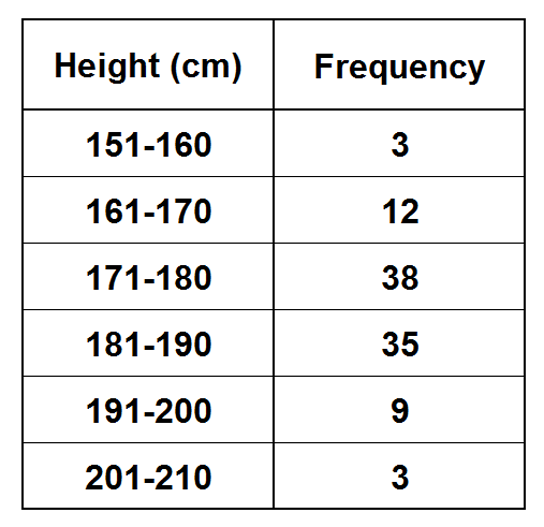
Asif has measured the height of everyone in Year 11 and put the results in the Grouped Frequency Table below.

Diagram

grouped freq tab ex

Note

Use the data to find: (i) The Modal Group (ii) In which range the Median lies (iii) An estimate for the Mean

Solution

(i) As ever, the Modal Group is easy to find. It's the one with the highest frequency ie. 171-180 cm

(ii) Firstly, add up all the frequencies to get 3+12+38+35+9+3 = 100. So, the Median lies between the 50th and 51st values, ie. in the group 171-180cm

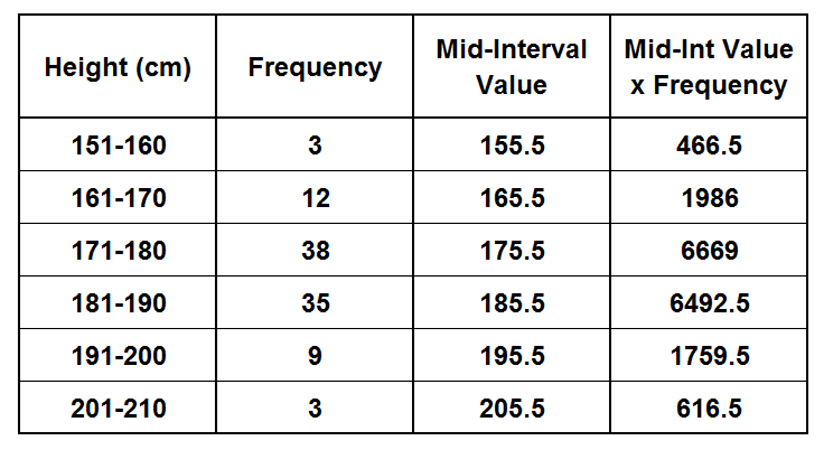
(iii) Again, for the Mean, we need to do some extra work. We need to add a column with the Mid-Interval Value for each group and then we need to add another column containing Frequency x Mid-Interval Value

Diagram

grouped freq tab sol

Note

We now sum the fourth column and divide it by the total of the frequencies (100) to estimate the Mean. So, the Estimated Mean = (466.5+1986+6669+6492.5+1759.5+616.5)/100 = 179.9cm

Stem and leaf diagrams (F)

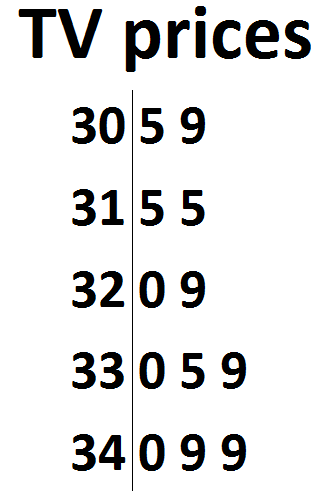
Definition

A Stem and Leaf diagram is a simple way of presenting ordered data.

Diagram

tv prices stem and leaf

Note

On this diagram, 32 | 1 represents £321

The 'Stem' is the figure to the left of the line and the 'Leaves' are those to the right.

Method

To draw a Stem and Leaf Diagram, put the data in order and then decide on what Key to use ie. which figures to put before and after the vertical line.

Work through the example to see how to find the median and mode

Example

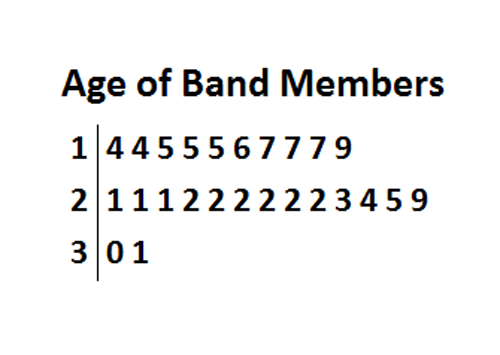
The Minethorpe Brass Band has collected data on the age of the band members as presented in the table below. 14, 17, 21, 23, 15, 25, 22, 21, 17, 30, 22, 15, 22, 29, 24, 22, 16, 14, 19, 21, 22, 15, 31, 17, 22 Draw a Stem and Leaf Diagram for the data and use it to work out the Median and Modal age of members in the band

Solution

The Key for the diagram is 2 | 3 represents 23 years.

Diagram

band members stem and leaf

Note

The number of band members is 25 so the Median value is the 13th one. Only count the values on the right of the line. The 13th value is 2 | 1 ie 21 years old is the Median age. The Mode is the most common value, in this case, it's 2 | 2 so 22 years old is the Modal age.

The data handling cycle (F)

Definition

The Data Handling Cycle outlines the steps in gathering, organising and analysing data. It goes as follows:

State a Hypothesis: this is a proposal for example, tall people have larger ears than short people is a hypothesis to test.

Data Collection: decide what data to collect and how to collect it. For example, conduct a questionnaire or take measurements

Organise and present the data: for example in a Scatter Graph

Interpret the results and draw conclusions

Method

You need to have a general overview of the Data Handling Cycle. Most of it is common sense, there's just the jargon words that you need to learn.

Example

Jane wants to find out what is the most popular flavour of Squaretrees Fruit Pastille. Put these stages of the Data Handling Cycle in the correct order

Construct a Frequency Table Conduct a Survey Draw a Conclusion Draw a Pie Chart

Solution

The data collection comes first ie. Conduct a Survey. Next, the data should be organised so Construct a Frequency Table. Following on from that, a Pie Chart can be drawn. Finally, a conclusion can be reached.

Test yourself on this topic

Try the free quiz with worked solutions.

Start quiz →

Get GCSE Statistics

Full notes, full question bank, offline.