

G GCSE Apps

GCSE Statistics

Data Presentation

12 subtopics in this section

Pictograms (F)

Definition

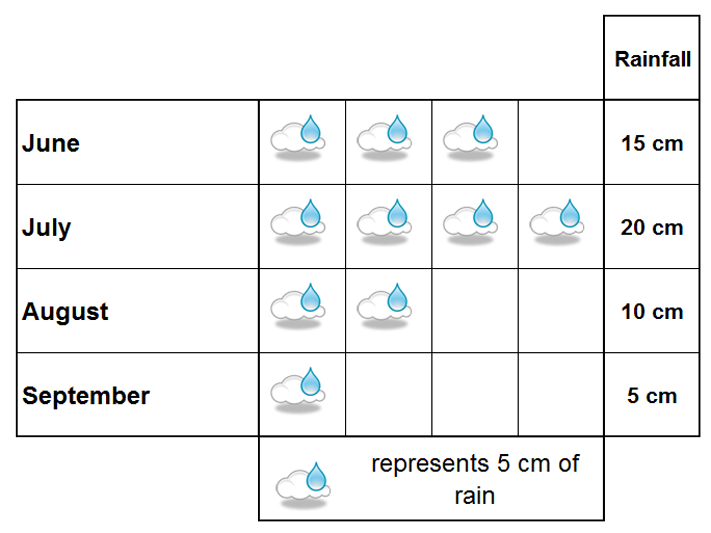
A pictogram is simply a way of portraying data using pictures. Usually a relevant symbol is used to represent the frequency of a particular item. Eg a single car symbol might represent 10 motorists. A symbol of a raindrop might represent 5 cm of rain. This information is shown in the 'key'

Diagram
raindrop pictogram

Method

If you're drawing a pictogram, remember to include the key and to use a symbol that can be divided equally into parts (a circular symbol is particularly helpful)

Tips/hints

If you're reading data from a pictogram and the key isn't shown, you'll have to work out what the symbol represents using the information supplied.

Example

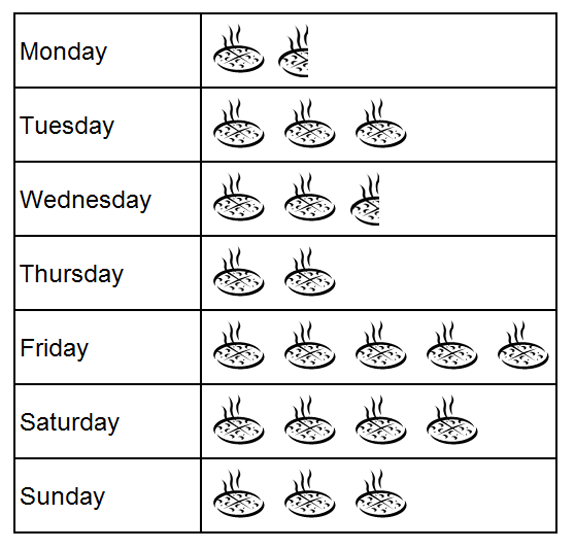
Italian restaurant owner Luigi is analysing the number of meals he sells each night. He's created the pictogram to portray this information. If on his busiest night he sold 50 meals, how many did he sell on his quietest night?

Diagram
pizza pictogram

Solution

Looking at the pictogram, his busiest night is Friday. This has 5 pizzas representing 50 meals so each pizza represents 10 meals. The quietest night is the one with the fewest pizzas ie. Monday where there are 1.5 pizzas. So, this represents 1.5 x 10 meals is. 15 meals.
Bar charts (F)

Definition

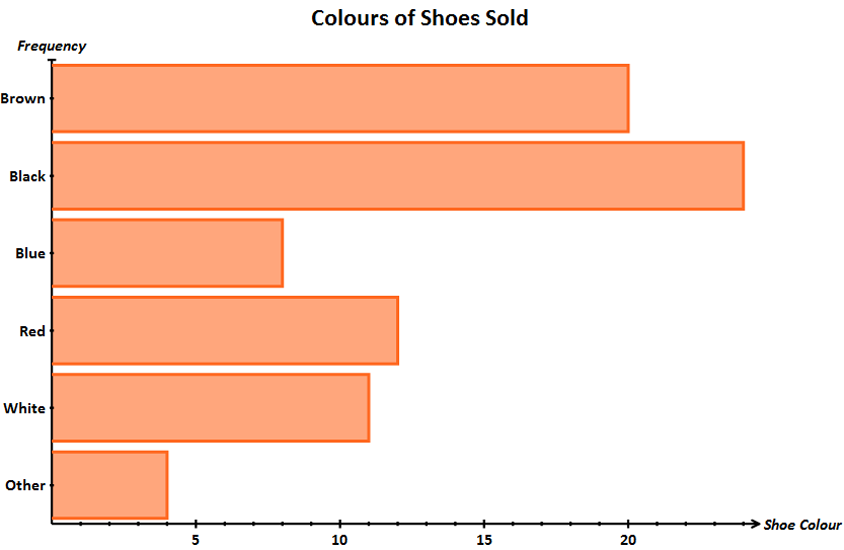
As their name suggests, Bar Charts use bars whose heights (or less commonly, lengths) represent frequencies.

Diagram

weekend activity bar chart

Diagram

shoe colour bar chart

Note

Dual bar charts are useful for comparing two sets of data.

Tips/hints

When drawing a Bar Chart be sure to give it a title and label both the axes.

Put a small gap in between each bar (or each pair of bars on a dual chart).

Example

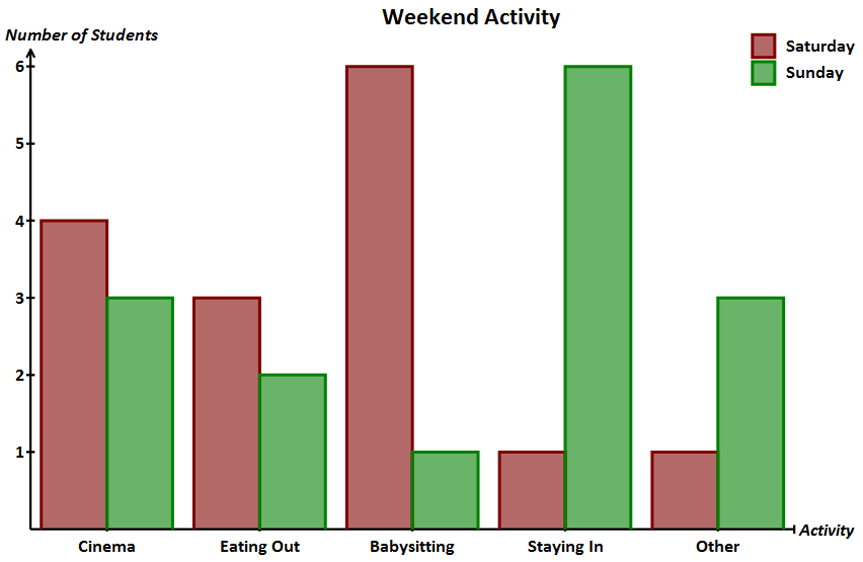
One Monday morning, Lilith asked some of her classmates what they'd spent the last two evenings doing. She represented the data in this bar chart.

Diagram

weekend activity bar chart

Note

(i) How many of her classmates did she ask? (ii) What's the most popular activity on a Sunday evening?

Solution

(i) This is a dual bar chart showing what each classmate did on each of two evenings. So, we need to add the frequencies of one night's activities, Saturday's, say, to find out how many students were surveyed. Looking at the heights of the red columns from left to right we have 4 + 3 + 6 + 1 + 1 = 15 so, she asked 15 classmates.

(ii) The green bars represent Sunday's activities. The most popular activity is represented by the highest green bar, ie. Staying In

Statistics (F)

Definition

Statistics covers the collection, presentation and analysis of data.

Method

It's important to know the various forms of data collection, presentation and analysis covered in this app.

Example

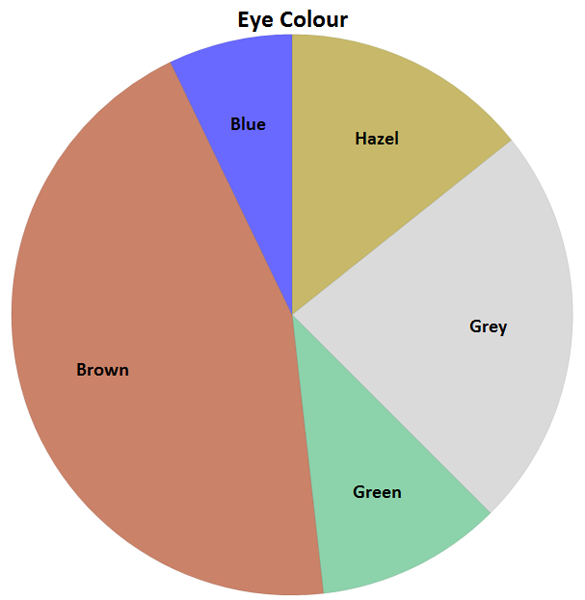
The pie chart shows the distribution of eye colour for the pupils in Year 10. Which colour is the second most prolific?

Diagram

eye colour pie chart

Solution

The size of the sector represents the number of pupils with each eye colour. Grey is the second largest sector so it's the second most prolific eye colour.

Pie charts (F)

Definition

A Pie Chart is a circular chart that's divided into sectors. Each sector represents a category of data and the size of the sector is proportional to the frequency of data in that category.

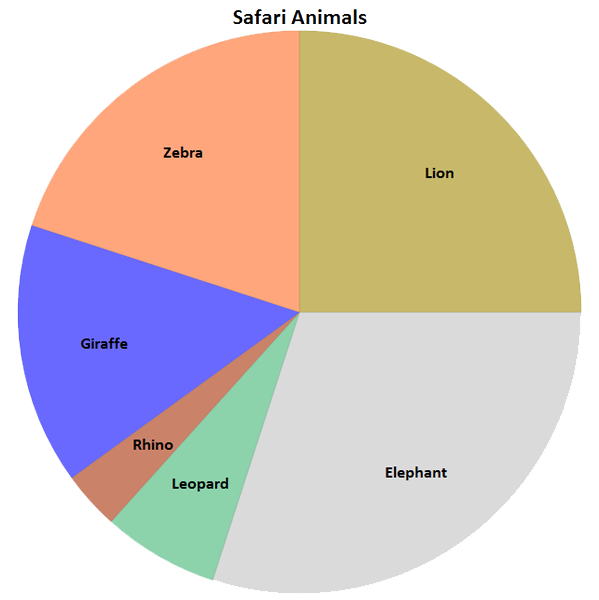
A Safari Tour company logs the number of sightings of each type of creature. Here, the results of the previous month are shown in a pie chart.

Diagram

safari animals pie chart

Method

Create a frequency table for the data. Work out the total of all the frequencies. Let this be T. The data is going to be represented by sectors in a circle and the size of each sector is proportional to the frequency of each category of data.

So, we need to convert each category into a sector, ie. into an angle. There are 360° at the centre of the circle, and this whole represents T, the sum of all our data.

To calculate the angle size for a sector representing a category with frequency f, simply work out 360° x f/T Do this for each category and divide the circle up into the appropriately sized sectors.

Work through the example below to see this in practice.

Tips/hints

Don't forget to label the diagram and label each sector.

Example

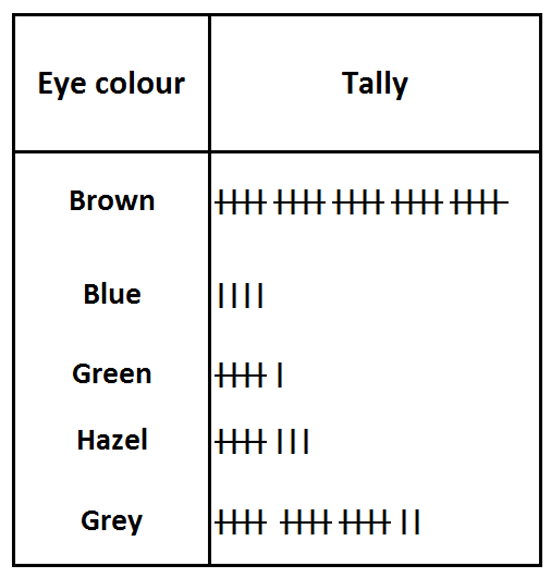
Convert the data in the tally chart into a pie chart.

Diagram

tally chart def

Solution

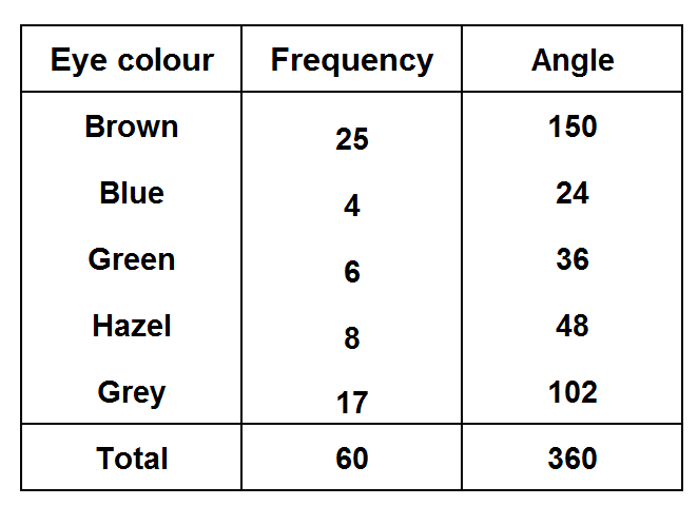
Count up the tally marks for each eye colour. Find the total of all the frequencies (60). Enter the data in a table. Create a column alongside the frequencies for the angles.

Diagram

eye chart sol

Note

To work out each angle, use the formula 360° x f/T. So, for Brown, we have Angle size = 360° x 25/60 = 150° Do the same for all the categories. Draw a circle and then split it into sectors drawing the appropriate angles.

Diagram

eye colour pie chart

Scatter diagrams (F)

Definition

A Scatter Graph or Scatter Chart is used to see whether two sets of data are linked or not. The two sets are plotted as coordinates on a graph.

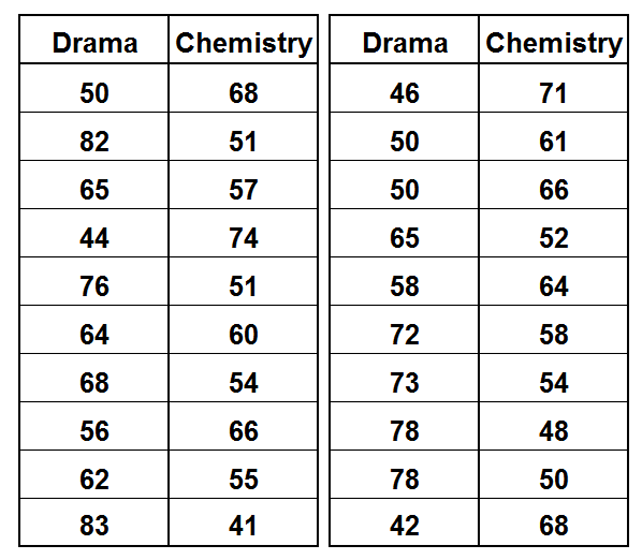
Here are the marks for 20 students in recent Chemistry and Drama tests.

Diagram

drama chem tab

Note

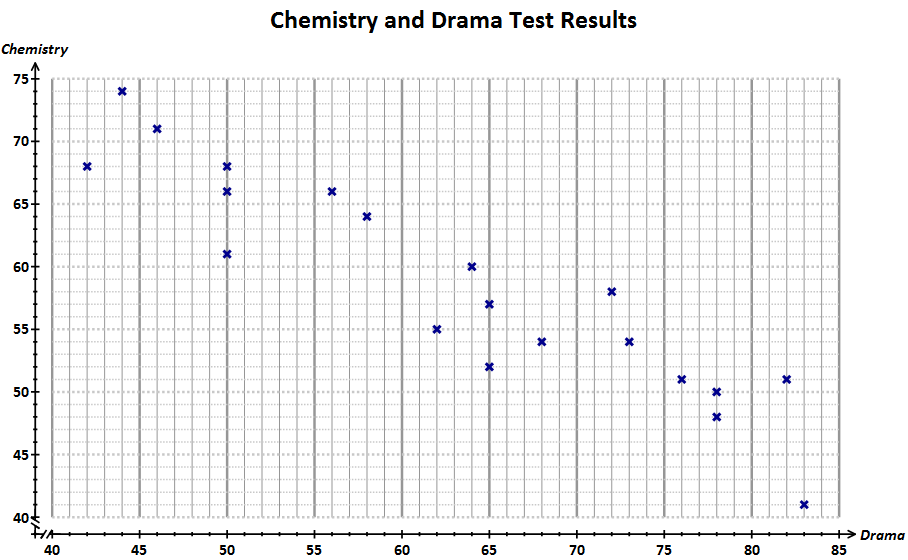
They've been plotted to create a Scatter Graph

Diagram

chem v drama scatter graph

Note

The x axis represents the Drama result and the y axis, the Chemistry result. So, if a student got a mark of 60 in Drama and 80 in Chemistry it would be represented by the point with coordinates (60, 80)

Method

Look at the highest and lowest values in each set of data and choose appropriate scales for your graph. Plot the points carefully as crosses.

For some x values there may be more than one y value and vice versa. Don't worry, this is normal.

Read data from the graph in the normal way

Example

Use the Scatter Graph above showing the results of 20 students in recent Drama and Chemistry exam to find out: (i) How many students scored 50 or less in the Drama Test (ii) What was the Chemistry result of the student with the highest mark in Drama?

Solution

(i) Drama is represented by the x axis so look along there to 50. There are 3 X's at 50 and 3 before 50. So, 3+3 = 6 students scored 50 or less in Drama

(ii) The highest result in Drama is the X furthest along the x axis. This has coordinates (83, 41) so the student's Chemistry result was 41

Line graphs (F)

Definition

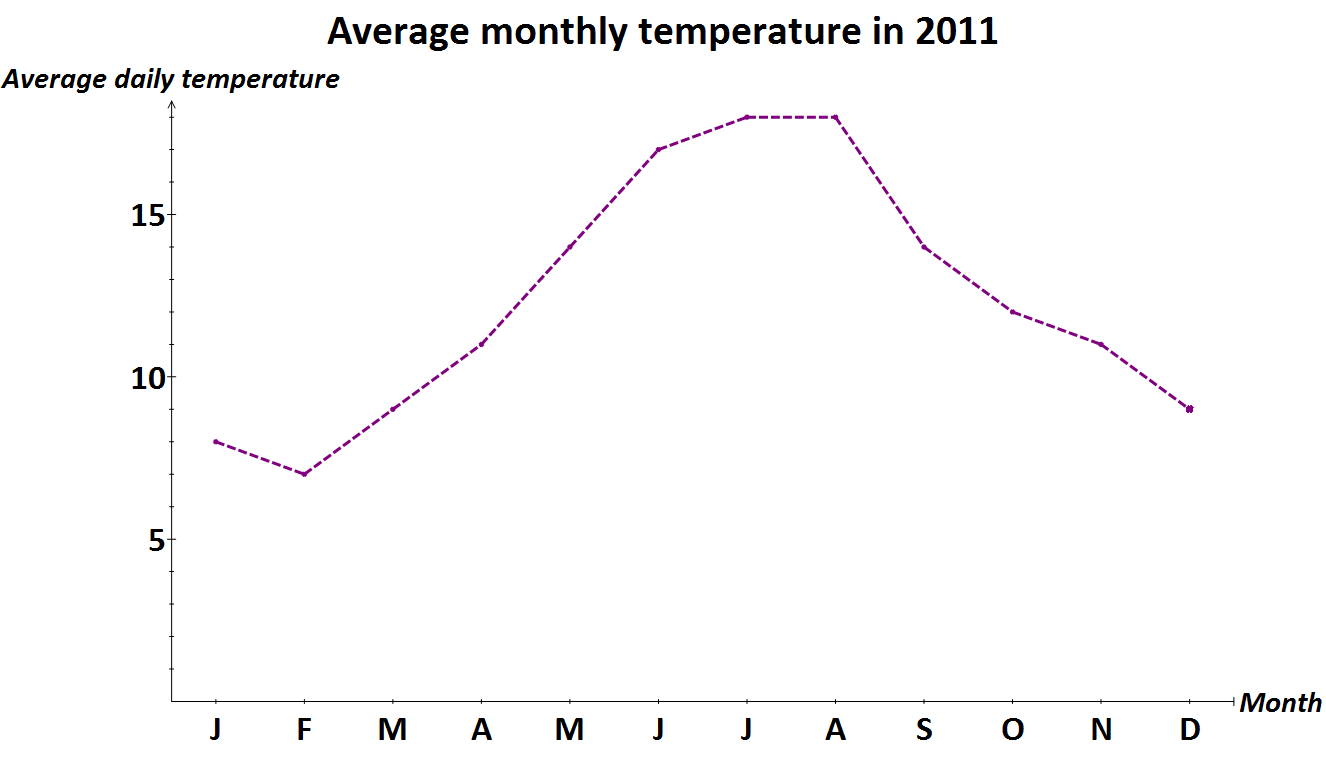
A Line Graph is a set of plotted points joined up with straight lines. It's also known as a Frequency Polygon.

Line Graphs are used to show how data changes with time.

Diagram

av monthly temp line graph

Method

It's quite straightforward. Plot the points and join them with straight lines. Don't forget to label the graph and the axes.

Sometimes two related sets of data are portrayed on the same graph.

Example

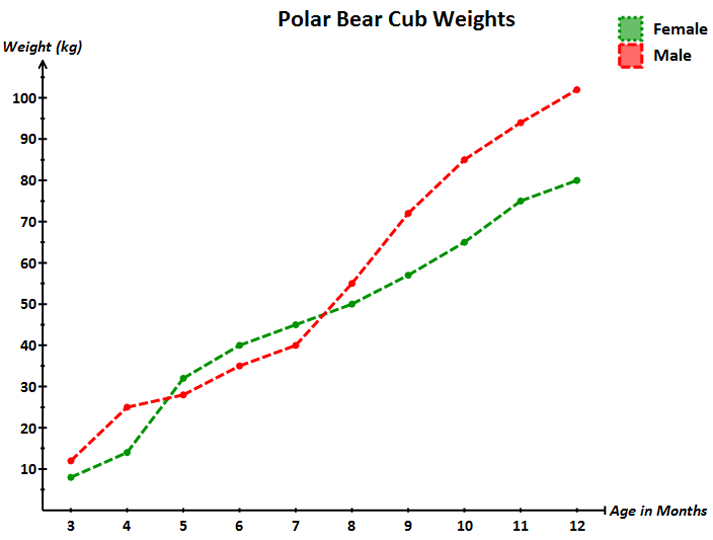
At Cross-Twy Zoo, a female polar bear gives birth to twin cubs. Their weights are closely monitored from months 3 - 12 of their lives and the results are shown in the line graph.

Diagram

polar bear line graph

Note

From the graph determine: (i) After 12 months, which bear weighed more and by how much (to nearest 10 kg) (ii) For how many months the recorded weight of the male cub was less than that of his sister?

Solution

(i) The red line represents the male cub so he weighs more after 12 months. Put your ruler across the graph from the red point at 12 months and read the value. It's just over 100 kg. Do the same with the green dot, that's 80 kg. So to the nearest 10 kg, the male cub weighs 20 kg more than his sister.

(ii) There are three red points plotted that lie below the green ones (in months 5, 6 and 7) so for 3 months, the recorded weight of the male was less than that of the female.

Correlation (F)

Definition

Correlation is the statistical term for the relationship between two sets of data or variables.

If the variables are Correlated then we can predict how one will behave given the behaviour of the other.

If they're not Correlated, then information about one variable doesn't help us to determine anything about the other.

Correlation between variables can be identified using Scatter Graphs. You should recognise the different types of Correlation from their Scatter Graph patterns.

Variables have Positive Correlation if they increase and/or decrease together. This is shown by a Scatter Graph's points going up from left to right.

Diagram

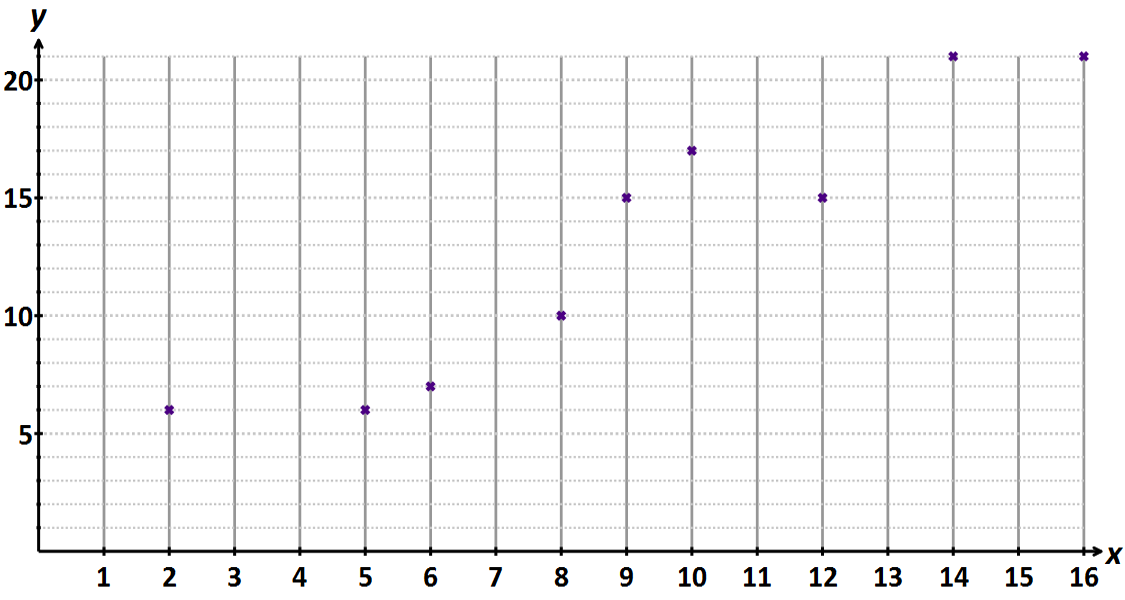
moderate positive correlation scatter graph

Note

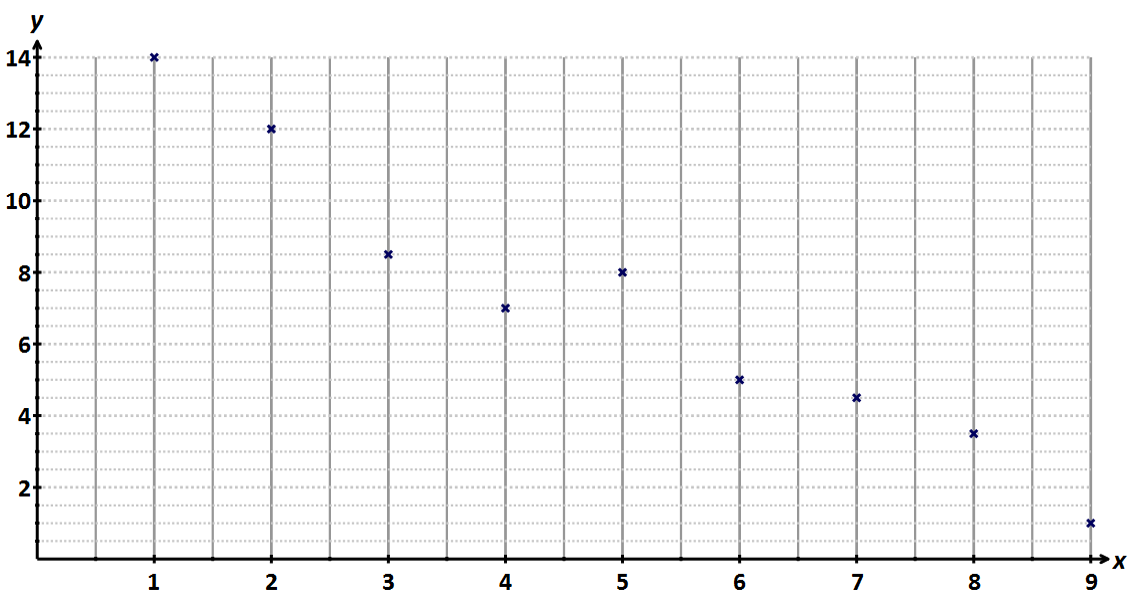
Variables are have Negative Correlation if, as one increases the other decreases (or vice versa). This is shown by a Scatter Graph's points going down from left to right.

Diagram

moderate negative correlation scatter graph

Note

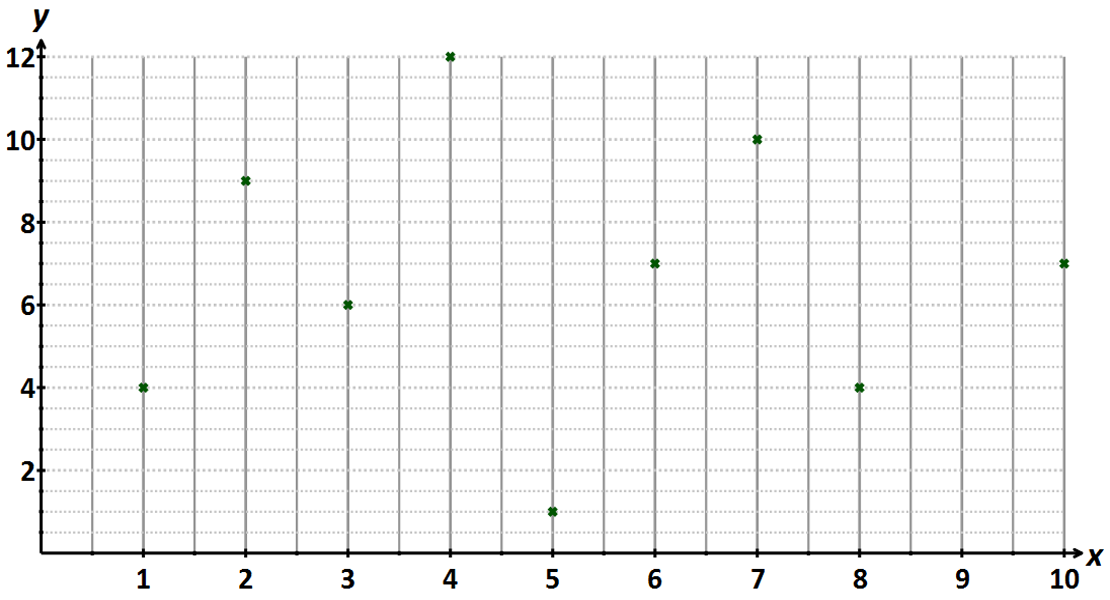
Variables have No Correlation if the points in the Scatter Graph are all over the place.

Diagram

no correlation scatter graph

Note

Correlation is strongest when the points in the Scatter Graph are closest to the Line of Best Fit (see notes on module of that name)

Method

Learn the different definitions and the graphs that go with them.

Example

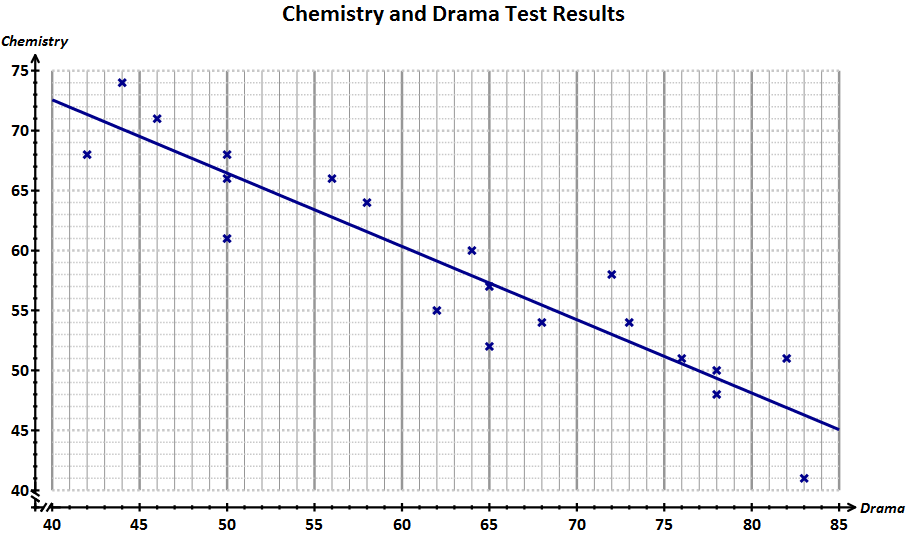
The Scatter Graph shows the results of 20 students in recent Chemistry and Drama tests. Is their any correlation between the results and if so, what sort?

Diagram

chem v drama scatter graph

Solution

The points are related - as the Drama scores increase, the Chemistry scores decrease. So, the correlation is Negative.

Diagram

chem v drama wlobf scatter graph

Note

Drawing a line of best fit through the points, the correlation is moderate rather than strong as the points aren't very close to the line.

Line of best fit (F)

Definition

A Scatter Graph shows how well two sets of data are related. A Line of Best Fit does exactly what it says on the tin - it fits the points of the Scatter Graph as best it can. It goes roughly through the middle of them.

Once drawn, it can be used to predict the value of one variable given the other.

Method

You'll normally be asked to draw a 'Line of Best Fit' on the graph. This should show the general direction of the crosses you've plotted

Tips/hints

The Line of Best Fit doesn't have to pass through any points but it's not a problem if it does pass through some.

Example

Add a line of best fit to the scatter graph showing the results of 20 students in recent Chemistry and Drama tests. Use it to predict the Chemistry score of a student who gets 80 in Drama

Diagram

chem v drama scatter graph

Solution

Your line of best fit should look something like this.

Diagram

chem v drama wlobf scatter graph

Note

Find the point on the line where x = 80 ie. a Drama score of 80. Now go along to the y axis, ie. the Chemistry axis. This has a value of 48, so that's our answer.

Two way tables (F)

Definition

A Two Way Table is a good way to organise data with two variables.

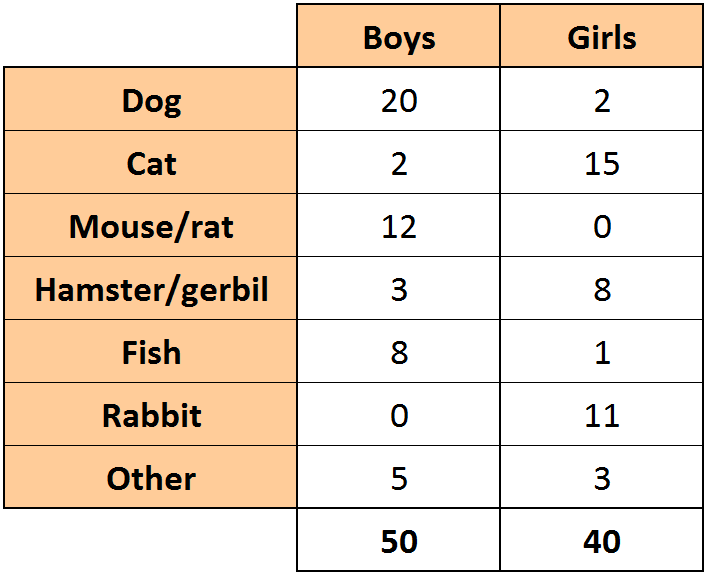
For example, here is data gathered on boys and girls to see what their favourite pet animal is

Diagram

pets

Method

Two Way tables are very straightforward. Often you'll be given a partially completed one and asked to fill the remaining data in. Just use the information you have to work out the missing values. Remember that the horizontal totals add up to the vertical totals.

Example

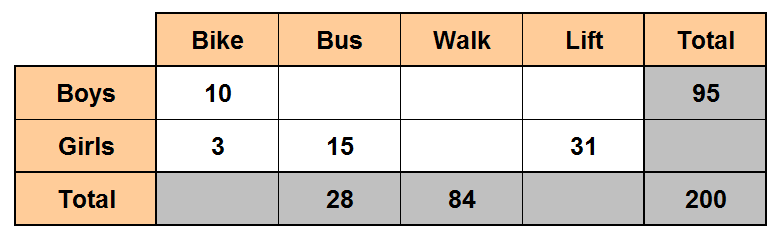
A survey is conducted on the students in year 11 to see how they get to school, whether it's by bus, bike, walking or getting a lift. Fill in the missing data and determine the most popular method for girls getting to school

Diagram

two way tab ex

Solution

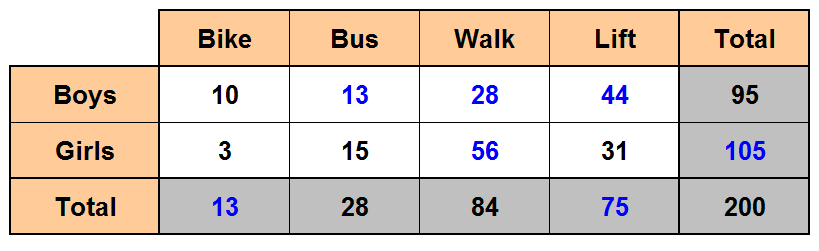
Start by working out the total number of girls (200 - 95) and from that, the number of girls who walk. Carry on in the same way until the table is completed.

Diagram

two way tab sol

Note

The highest entry in the Girls row is 56 and that's in the Walk column so that's the most popular way for Year 11 girls to get to school.

Cumulative frequency diagrams (H)

Definition

Cumulative Frequency is basically the running total of the frequencies of data that is less than a particular value.

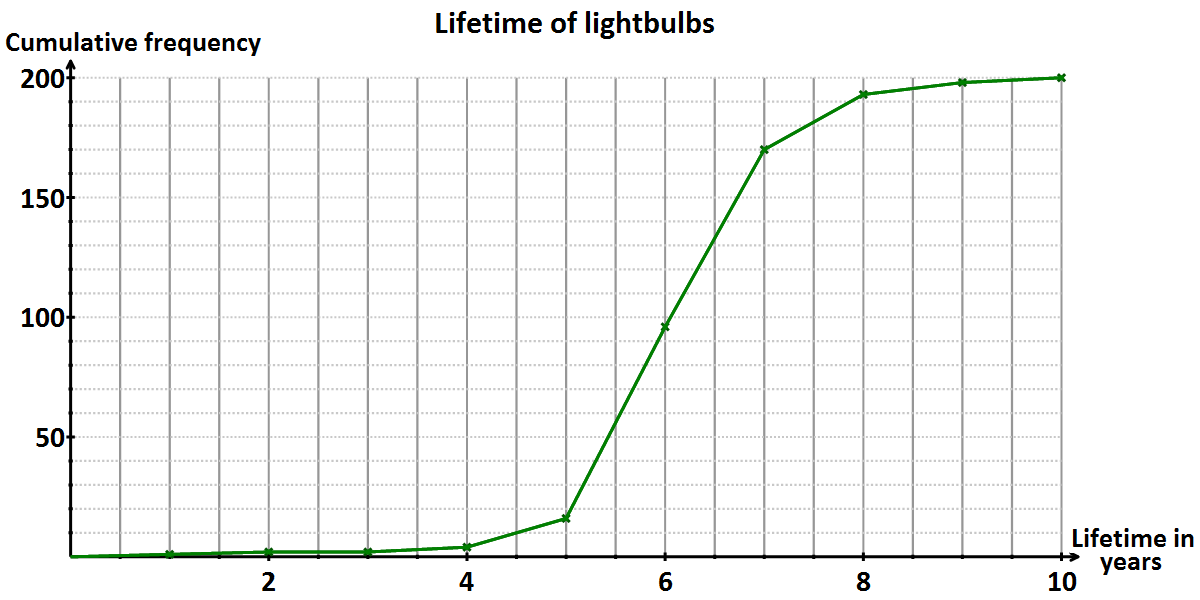
A Cumulative Frequency Diagram is the graphical portrayal of this data. Here is the cumulative frequency diagram showing the lifetime of a batch of 200 light bulbs

Diagram

lightbulbs

Note

The Cumulative Frequency is always plotted on the vertical axis.

A Cumulative Frequency Diagram is useful for finding the Median and the Inter-Quartile Range.

The Median is the 'half-way' value in the data. That is, half of the sample/population will be above it and half below it.

Similarly, the Lower Quartile is the 'quarter-way' value in the data and the Upper Quartile is the 'three-quarter way' value.

The Interquartile Range is the difference (on the x axis) between the two Quartile values and indicates the range into which half of the sample/population fits

Method

To find the Median, find the point on the y axis that represents half the cumulative frequencies ie. is half of T where T is the total of all the frequencies. Go across to the graph at this point and then read the value on the x axis for the Median.

As the Median is the value on the x axis when y = T/2, the quartiles are the x values when y = T/4, y = 3T/4

Follow the worked example to see what all this means in practice.

Example

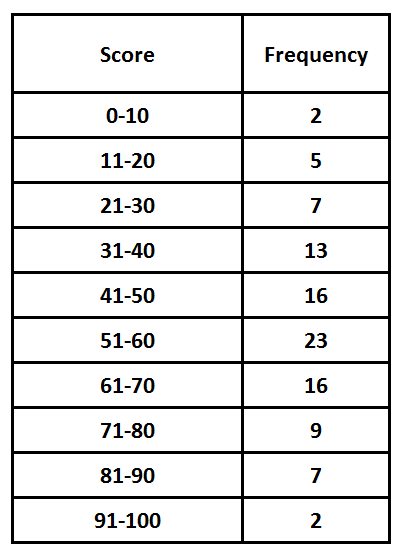
Below is the frequency table for the scores of 100 Year 8 pupils in a recent test. Use it to plot a Cumulative Frequency Diagram and from that work out the Median and the Inter-Quartile Range to the nearest whole numbers.

Diagram

test score cf tab ex

Solution

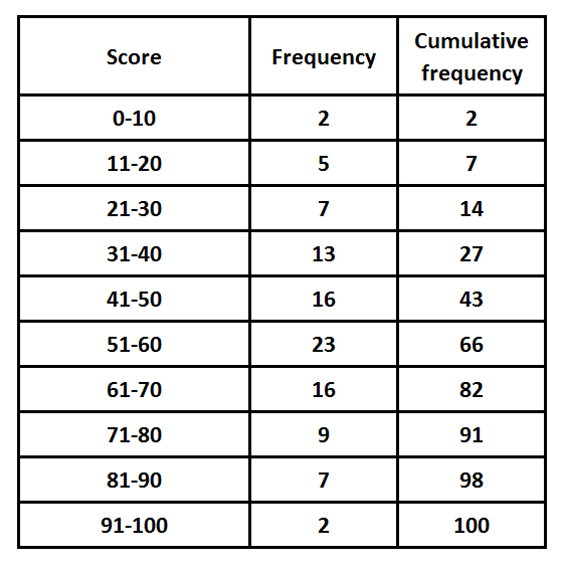
Firstly, create a third column in the table which contains the Cumulative Frequencies. The first entry is the same as that in the middle column, ie. 2. For the next entry, add on the next frequency so, 2+5 = 7. Keep going in this way. The final entry in the third column should equal the sum of the second column.

Diagram

test score cf tab sol

Note

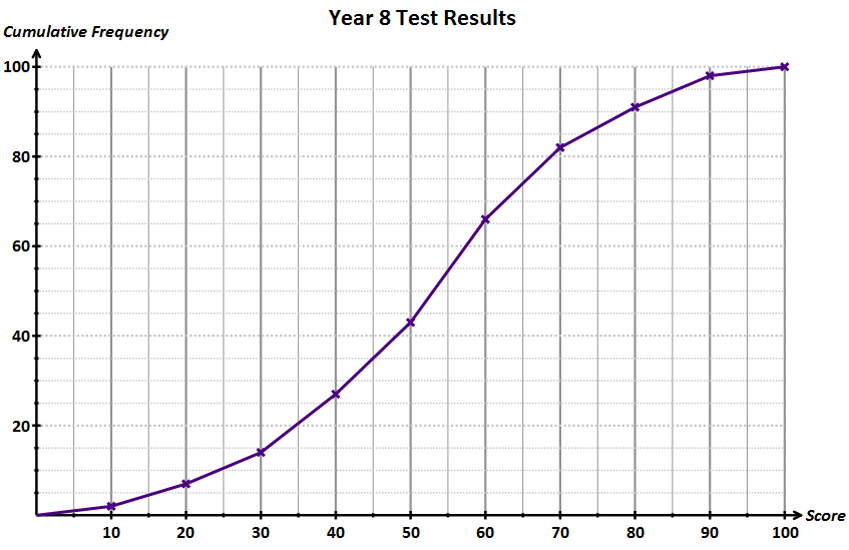
Now plot the diagram.

Diagram

test results cfd

Note

The size of the population (ie. number of students) is 100, so, to find the median, look at the graph when the Cumulative Frequency = 100/2. Go down to the x axis at this point. The value is just over halfway between 50 and 55 so to the nearest whole number, it's 53

Now do the same to find the Lower Quartile and Upper Quartile. The Lower is approximately 39 and the Upper, approximately 66 so the Inter-Quartile Range is 66 - 39 = 27.

Box plots (H)

Definition

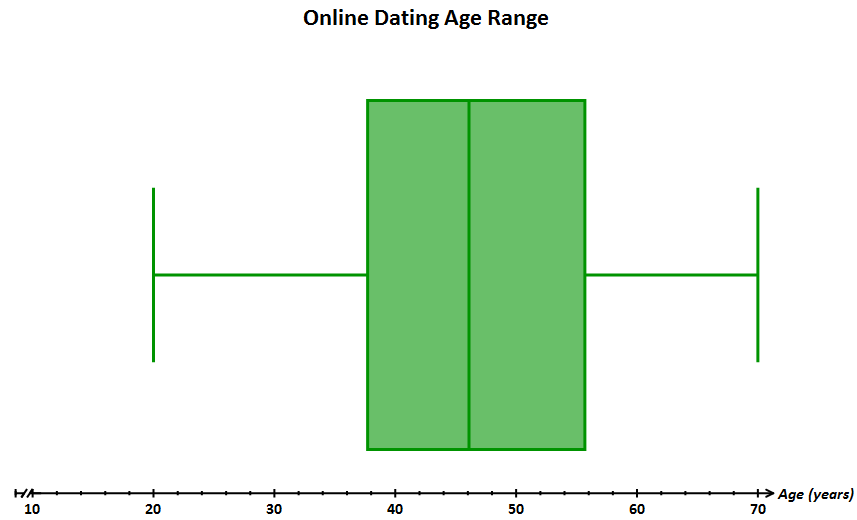
A Box Plot (sometimes known as a Box and Whisker Plot) is another way of showing the same basic information as a Cumulative Frequency Diagram.

It portrays the Median and Quartiles as a box.

The Range of the data is indicated by the Whiskers.

Diagram

def box plot

Note

The Range is indicated by the shorter, vertical lines at either end the diagram. 20-70 so a range of 50 years

The vertical lines that form the sides of the box are the Lower and Upper Quartiles so these are approximately 38 and 56, making an Inter-Quartile Range of 56-38 = 18 and the vertical line inside the box is the Median, which is approximately 46.

Method

These are very straightforward. Remember what the five vertical lines represent and you should be able to answer any question.

If you're required to draw one of these, it will be an addition to a Cumulative Frequency Diagram. Just put vertical lines on the CFD for the end points of the range, the lower and upper quartiles and the median. Then, extend them down to make your box plot.

Example

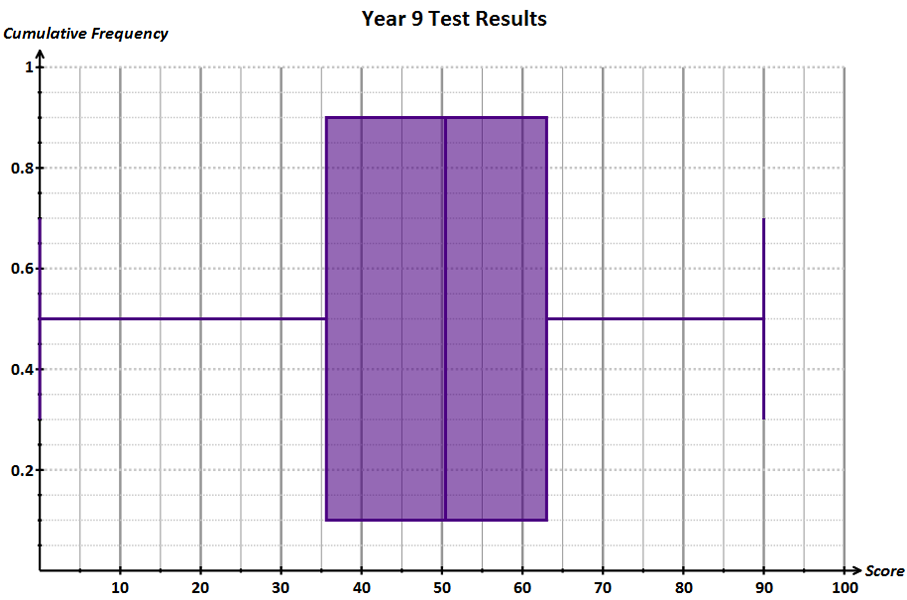
Use the Box Plot to find the Median of the scores in the Year 9 Test

Diagram

test results box plot

Solution

The Median is the vertical line inside the box. It's value is approximately 50.

Histograms (H)

Definition

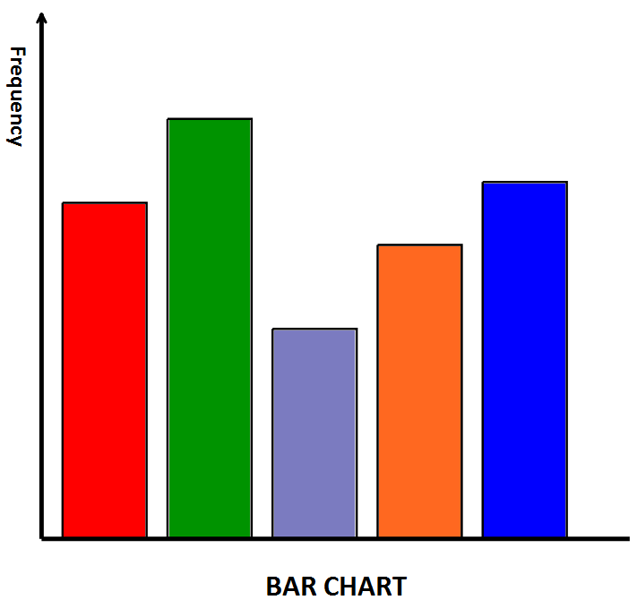
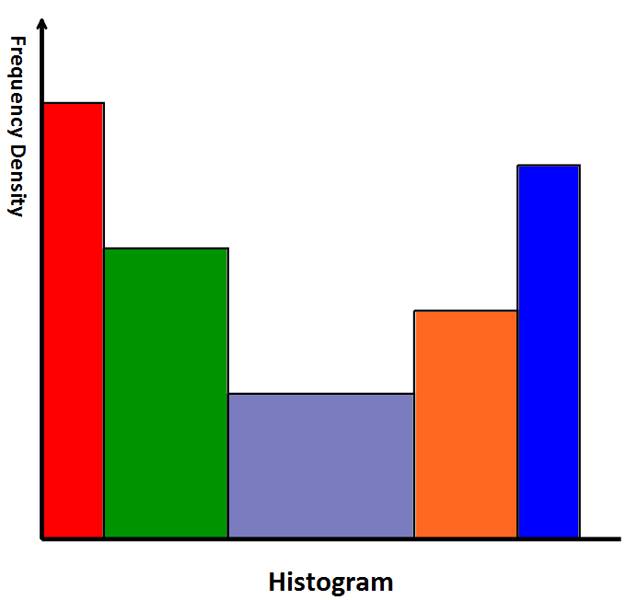
A Histogram is similar to a Bar Chart BUT whereas the height of the bars is important on a Bar Chart, it's the area of the blocks that's important on a Histogram

Histograms can have blocks that are different widths. The frequency is measured by taking the area of a bar, NOT the height.

Diagram

basic bar chart

Diagram

basic histogram

Note

Notice that the y axis represents 'Frequency Density' on a Histogram (on a Bar Chart it represents 'Frequency')

Strictly speaking, there should always be gaps between the bars on a Bar Chart but NOT on a Histogram

Because the area of each block is important on a Histogram, they're usually drawn on squared paper. Work out what frequency each square represents, divide the x axis up to reflect the data given and then calculate the Frequency Density (ie. the y axis) using the formula: Frequency Density = Frequency ÷ Class Width.

Method

The Median on the Histogram can be found by drawing a vertical line which divides the total area of the Histogram in half. The value where this crosses the x axis is the Median.

Follow through the worked example to see how Histograms work in practice.

Example

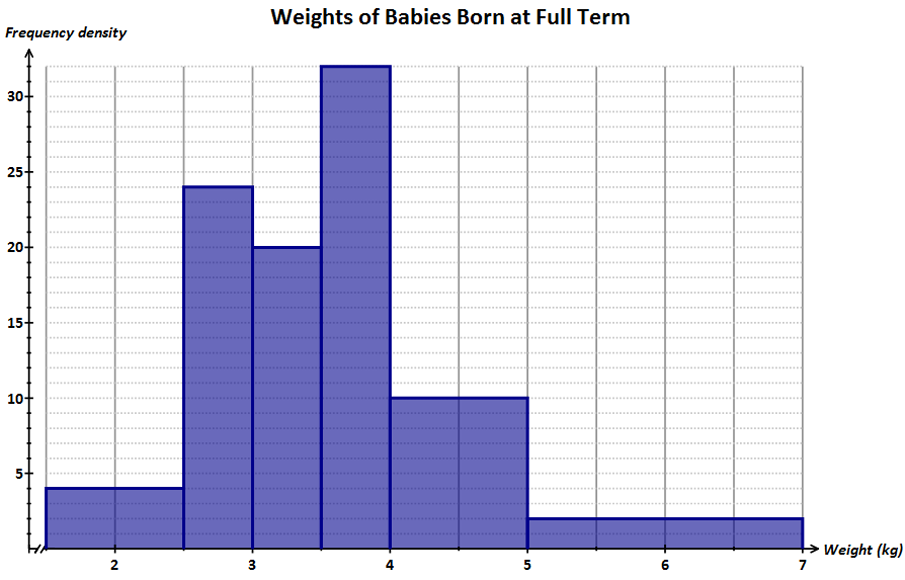
The Histogram shows the birth weights of all the babies born at full term during the month of December in the Popham Maternity Hospital.

Diagram

baby weights histogram

Note

From the chart, calculate the total number of babies that weighed 2-3kg at birth

Solution

We need the area of the blocks between the 2 and 3 on the x axis. This is half the area of the first block (from 1.5-2.5) and then the whole area of the block from 2.5-3.

The area is simply Width of the Base x Height. So, the first (half) block is 0.5 x 4 = 2. And the second (full) block is 0.5 x 24 = 12. So, the total number of babies born weighing 2-3kg is 2 + 12 = 14.

Test yourself on this topic

Try the free quiz with worked solutions.

Start quiz →

Get GCSE Statistics

Full notes, full question bank, offline.