


G GCSE Apps

GCSE Number

Powers, roots and surds

15 subtopics in this section

Square numbers

Definition

A Square Number (sometimes called a Perfect Square) is simply a whole number multiplied by itself. 5 x 5 = 25 so 25 is a Square Number.

Tips/hints

You'll already know some perfect squares from your times tables - 1 x 1 = 1 2 x 2 = 4 3 x 3 = 9 etc.

It's no coincidence that a rectangle with equal sides is called a square. If its sides are whole units in length, then its area is a perfect square. Eg. A square with sides of length 7cm has area 7x7 = 49cm²

Example

Which square number is missing from the sequences 4, 9, ...., 25, 36, ...?

Solution

4 = 2 x 2 9 = 3 x 3 25 = 5 x 5 so the missing number must be 4 x 4 = 16
Powers of 10

Definition

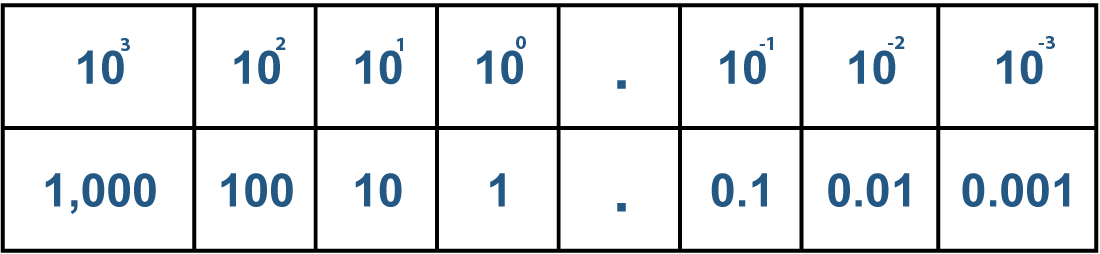
You're already familiar with powers of 10. 100 = , 0.1 = . Our decimal number system is based on them.

Diagram

dec number system

Note

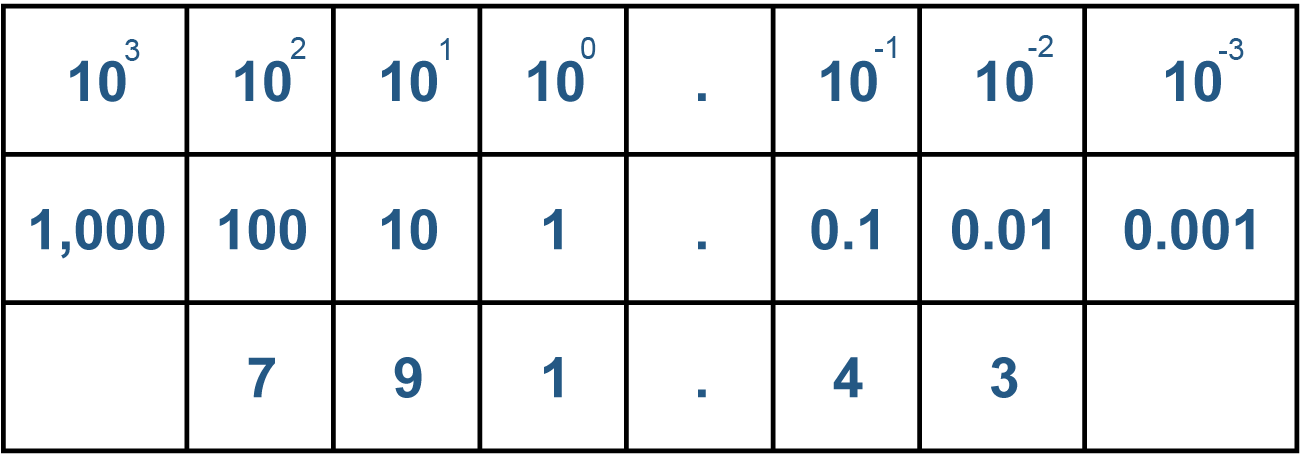
When we write any number, we're just saying how many of each power of 10 it consists of. For example, 791.43 actually represents the following:

Diagram

dec number system 791 pt 43

Method

For any power of 10, , when n ≥ 0 this can also be written as a 1 followed by n zeros, So, = 100,000

For any power of 10, , when n < 0 this can be written as a 1, n decimal places after the point So, = 0.00001 (there are 4 zeros after the decimal point so the 1 is 5 places after it)

Example

(i) Write 10,000 as a power of 10 (ii) Write as a decimal

Solution

(i) There are 4 zeros after the 1 so 10,000 =

(ii) The power is -3 so the 1 will come 3 places after the decimal point. So, = 0.001

Multiplying using powers of 10

Definition

Multiplying a number by a power of 10 can be in the format 32 x 100 or 2.5 x . Either way, it's very straightforward.

Method

If the power of 10 is written as a normal number, a 1 followed by n zeros, then just move the decimal point n places to the right. If there's no decimal point in the original number, just add n zeros to the end.

If the power of 10 is written in the form , do the same - either move the decimal point n places to the right or add n zeros.

Example

(i) What is 32 x 10,000? (ii) What is 2.51 x ?

Solution

(i) There are 4 zeros so add those on to the end of 32 to get 320,000 (ii) Move the decimal point 3 places to the right to get 2,510

Dividing using powers of 10

Definition

Dividing a number by a power of 10 is very straightforward.

Method

If the power of 10 is written as a normal number ie. a 1 followed by n zeros, then just move the decimal point in the number being divided n places to the left. If there is no decimal point in the original number, add .0 to the end of it.

If the power of 10 is written in the form , do the same - move the decimal point n places to the left. Again, if there's no decimal point in the original number, add .0 to the end of it.

Example

What is 35.777 ÷ 100?

Solution

There are 2 zeros so move the point 2 places to the left to give 0.35777

Example

What is 24000 ÷ ?

Solution

There's no decimal point so rewrite it as 24000.0 Now move the point 3 places to the left to give 24.0000 = 24

Square roots and cube roots

Definition

The Square Root (written using the symbol √) of a number, X, is another number which, when multiplied by itself is X

Eg The Square Root of 100 = √100 = 10 because 10 x 10 = 100

The Cube Root (written using the symbol ³√) of a number, X, is another number which when multiplied by itself and itself again is X

Eg. The Cube Root of 1000 = ³√1000 = 10 because 10 x 10 x 10 = 1000

Tips/hints

This might all sound a bit complicated but if you think of it in terms of shapes - squares and cubes, it might be simpler. The Area of a Square with sides of length A is A² The Volume of a Cube with sides of length A is A³ So, the length of the side of a square is the Square Root of its area. The length of the side of a cube is the Cube Root of its volume.

Example

(i) A square has area 2500cm². How long are each of its sides? (ii) A cube's volume is 27mm³. How long are each of its sides?

Solution

(i) We know that the length of the side of a square is the Square Root of its area so we need to find √2500 = 50. Remember to use the correct units in the answer - 50cm.

(ii) We know that the length of the side of a cube is the Cube Root of its volume. So, we need to find ³√27. 3 x 3 x 3 = 27 so 3 = ³√27. Again, don't forget to add the correct unit, 3mm

Multiplying powers

Definition

A number raised to a power is just a short hand way of expressing a number. Two powers of a number can be multiplied or divided quite easily.

Method

To multiply two powers of the same number together simply add the powers.

Tips/hints

Make sure the powers are of the same base number eg 5³ x 5² and not 4² x 6³. If it's the latter, the rules don't apply and you need to expand out the powers and do a normal multiplication.

If it's 5³ x 5², simply do 3 + 2 = 5 and the answer is

Example

What is x ?

Solution

The powers are 2 and 9 so add them together for the answer,

Dividing powers

Definition

A number raised to a power is just a short hand way of expressing a number. Two powers of a number can be divided or multiplied quite easily.

Method

To divide two powers of the same number together simply subtract the powers.

Tips/hints

Make sure the powers are of the same base number eg 5³ ÷ 5² and not 6³ ÷ 4². If it's the latter, the rules don't apply and you need to expand out the powers and do a normal division.

If it's 5³ ÷ 5², simply do 3 - 2 = 1 and the answer is 5¹ = 5

Example

What is ÷ ?

Solution

Subtract the power of the divisor from the power of the number being divided to get 9 - 2 = 7. So, the answer is

Calculated Powers

Definition

A Calculated Power is one where the power has been expanded and written as a regular number.

The basic form of a power is . In this module, a is a whole number and n is a whole number > 0.

Method

To calculate the power, simply multiply a by itself n times.

Example

Calculate

Solution

= 20 x 20 x 20 = 8000

Power of a power

Definition

A Power of a Power is a number to a power which itself in turn is raised to a power.

Method

Sounds complicated but it's straightforward if you just remember to multiply the powers together.

So,

Example

Express as a single power of 3

Solution

Multiply the powers together ie. 2 x 4 = 8 so the answer is

Negative powers

Definition

A Negative Power is one of the form where n > 0 and is equivalent to

Method

Whenever you see a negative power just remember to change the negative to positive and put 1 over everything.

Example

(i) Write as a decimal (ii) What is 1/64 written as a power of 4?

Solution

(i) It's a negative power so we remove the minus sign and put 1 over it. = = 1/8 Convert to a decimal for the answer 0.125

(ii) First work out what 64 is as a power of 4. 64 = 4 x 4 x 4 = 4³ Now, 1 over means we'll need a negative power so, 1/64 =

Fractional and zero powers

Definition

A Fractional Power is one of the form and means you're looking for a root.

A Zero Power is one of the form and is ALWAYS equal to 1 whatever the value of a

Tips/hints

It may or may not help you to think of as Normally the fractional roots you'll have to deal with will be quite straightforward.

Example

What is ?

Solution

Simple. ANYTHING to the power zero is 1 so the answer is 1.

Example

Evaluate

Solution

Not so simple but straightforward if you take it step by step. Let's write it in root form: First find the square root of 25. That's simple, it's 5. Now raise it to the power 3, ie. 5 x 5 x 5 = 125. And that's the answer.

Standard form

Definition

Standard form is written as K x , 1 ≤ K < 10 and n is an integer. Any number can be expressed in Standard Form

Method

When converting a number to Standard Form, the easiest way to find n is to count the steps you need to move the decimal point in the given number to make it between 1 and 10. If the decimal point goes to the left, n is positive, otherwise it's negative.

Example

(i) Write five thousand, two hundred and eighty-two in Standard Form (ii) Write 0.00201 in Standard Form

Solution

(i) First, write it out in digit form ie. 5282 To convert to Standard Form, we first need to make it a number between 1 and 10. To do this, we need to move the decimal point 3 places to the left. That means the power of 10 is positive so is equal to 3 So, the answer is 5.282 x

(ii) To make this a number between 1 and 10, we need to move the decimal point 3 places to the right. So, the power of 10 ie. -3 0.00201 = 2.01 x

Surds and pi

Definition

A Surd is simply an expression that contains an irrational square root eg. √3 (Definitions of Rational and Irrational numbers are given in the notes for Rationalising the Denominator)

Pi, normally written as the Greek letter, π, is a mathematical constant which is equal to 3.142 (to 3 decimal places). It's widely used in maths but the place you're most likely to come across it is in circle geometry. If r is the radius of a circle, then its circumference is 2πr and its area is πr²

Method

Surds and π are just alternative ways of writing numbers that are actually messy decimals aka irrational numbers. By using symbols instead of writing them out as decimals, we can simplify expressions much more easily. Also, no accuracy is lost which would be the case if we were rounding them.

Surds work along the same lines as algebraic letters

√2 x √3 = √(2x3) = √6 √2 ÷ √3 = √(2/3) 3√2 + 4√2 = (3+4)√2 = 7√2

When handling surds, look to see if the number in the square root sign can be factorised at all especially if one of its factors is a square number.

For example, √18 = √(2x3x3) = √2 x √3² = √2 x 3 which is normally written as 3√2

Example

(i) Simplify the expression 3√2 - √50 + √200

Solution

(i) First, factorise the numbers in the square root signs to get: 3√2 - √(2 x 5 x 5) + √(2 x 2 x 2 x 5 x 5) = 3√2 - √2√5² + √2√2²√5² = 3√2- 5√2 + (2)(5)√2 = -2√2 + 10√2 = 8√2

Example

(ii) What is the area of a circle with radius √7 cm? Leave your answer in terms of π

Solution

(ii) The area of a circle radius r is πr² so in this case it's: π (√7)² = 7π. Don't forget to add the correct units on to the final answer: 7π cm²

Rationalising the denominator

Definition

Rationalising a Denominator is simply turning the bottom part of a fraction into a Rational Number.

Rational Numbers are basically those that can be written as a fraction. So, all whole numbers are rational eg. 26 = 26/1 ie. can be written as a fraction. And obviously, all fractions are rational. Any terminating decimal (0.255, 410.11213) is rational And, recurring decimals are rational, too (0.333..., 0.7272...) as these can be written as fractions.

And, not surprisingly, Irrational Numbers are those that can't be written as a fraction. π is irrational, and roots such as √2, ³√7 are irrational. There are no whole numbers, a and b such that π = a/b or √2 = a/b.

Method

If the fraction you're given has a straightforward square root (or multiple of a square root) on the bottom, just multiply top and bottom by the square root.

Slightly more tricky are those fractions where the bottom is a square root with something added or subtracted. For example, if you're asked to rationalise the denominator of 3/(1-√2), multiplying top and bottom by √2 will still leave a √2 on the bottom. In these instances, if there's something of the form (a ± √b), multiply it by the same expression but with the sign before the √b reversed.

Example

(i) Rationalise the denominator of 4/(5√7) (ii) Rationalise the denominator of 3/(2-√5)

Solution

(i) This is a straightforward multiple of a square root on the bottom so multiply the numerator and denominator by the surd to get: 4√7/(5x√7x√7) = 4√7/35

(ii) Here the bottom is of the form a - √b so, we multiply top and bottom by a + √b ie. 2 + √5 This gives 3(2+√5)/(2-√5)(2+√5) Let's just look at the denominator: (2-√5)(2+√5) = (2)(2) -2√5 + 2√5 -√5√5 This simplifies to -1 So, our answer is -3(2 + √5).

Solving problems with surds

Definition

Problems involving surds tend to be those where an area or volume is to be calculated.

Tips/hints

Always try and leave your answer in its simplest form, taking out any factors from the square root.

Example

What is the volume of a cuboid with sides √5cm, √12cm and √15cm?

Solution

The volume of a cuboid is the product of its length, width and height, in this case, √5 x √12 x √15 = √900 900 = 30 x 30 so √900 = 30. Adding the units back in we have the answer 30 cm³

Test yourself on this topic

Try the free quiz with worked solutions.

Start quiz →

Get GCSE Number

Full notes, full question bank, offline.