


G GCSE Apps

GCSE Number

Number Basics

7 subtopics in this section

The number line

Definition

A number line is a visual way to display numbers. Usually it is horizontal with zero in the middle, positive numbers to the right and negative numbers to the left.

Diagram

number line

Method

To add two numbers, A + B, using a number line, start at A and then count B steps to the right. The number you arrive at is your answer.

To subtract two numbers, A - B, using a number line, start at A and then count B steps to the left. The number you arrive at is your answer.

Tips/hints

The numbers get bigger as you move from left to right and smaller as you move from right to left.

Example

Using the number line, find a number < -4

Diagram

number line

Solution

The numbers get smaller as you move from right to left. So, any number to the left of -4 will be less than it. So, -5, -6 and -7 on this number line.
Ordering Numbers and Place Values

Definition

A number is made up of one or more digits and possibly a decimal point. Where these digits are placed indicates the value they represent.

For example, 32,145 24.513 1.2345 are all written using the digits 1, 2, 3, 4, 5 but are very different in size.

Method

If there is no decimal point in a given number, the rightmost digit represents the units and as we move left by one digit, the value it represents is 10 times more than the digit to its right. So, in the case of 32145, the 5 represents units, the 4, tens, the 1, hundreds and so on.

When there is a decimal point, the digit to the right represents tenths and then as we move right by one digit, the value it represents is 10 times less than the digit to its left. So, in the case of 24.513, the 5 represents 10ths, the 1, 100ths and the 3, 1000ths.

Tips/hints

When placing a given set of numbers in order, it can help to add decimal points if they don't have them and then write them in a column aligning the decimals points and making sure the units, tens, hundreds etc line up as well as the decimal parts.

Example

What is the value of the 7 in the number 42.073?

Solution

Start at the decimal point. The digit to the right represents the 10ths, the one to its left, the 7, represents the 100ths ie. equals 0.07

Negative numbers

Definition

Negative numbers are those which are less than 0. We use them in everyday life to tell the temperature or if we're overdrawn on our bank account.

Method

When adding or subtracting negative numbers, it can be helpful to use a number line.

Tips/hints

Don't forget, the larger the number part of a negative number is, the smaller the actual number.

Example

Yesterday it was -2°C and today it is 3° lower. What is today's temperature?

Solution

Using a number line, the numbers get smaller as we move from right to left so to find 3 less than -2, start at -2 and move 3 steps to the right, ie to -5.

Diagram

number line

Note

So, today's temperature is -5°C

Column addition and subtraction

Definition

Column Addition is a written method of adding numbers together for those times when a calculator isn't allowed or available. Similarly, Column Subtraction can be used when taking numbers away from each other.

Tips/hints

The clue is in the title - put the numbers in columns!

And don't forget to put all your workings in, the carried digits and the borrowed ones.

Addition Example

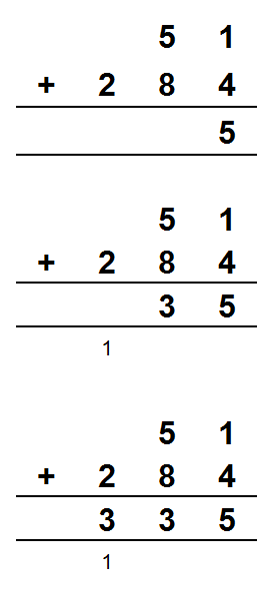
Add 51 to 284 without using a calculator.

Diagram

addition example

Solution

First write the sum in columns. Add the units together (right hand column). 1 + 4 = 5. Write 5 in the answer line. Next add the Tens column 5 + 8 = 13. Put the 3 in the answer line and put the one below the answer line in the next column. Finally, add the hundreds column. Here, there's a 2 above the answer line and a 1 below it. 2 + 1 = 3. Write that in the answer line for the solution.

Subtraction Example

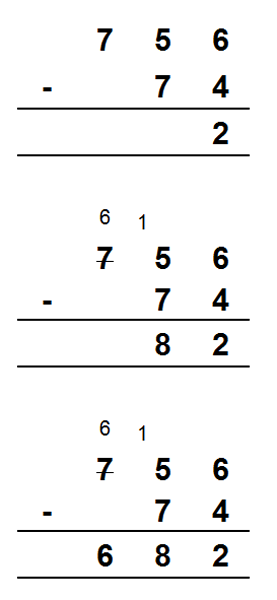
Subtract 74 from 756 without using a calculator.

Diagram

subtraction example

Solution

First write the sum in columns. Subtract the units (right hand column). 6 - 4 = 2. Write 2 in the answer line below. Next subtract the Tens column But 5 - 7 gives a negative result so, we need to borrow from next column. We take a 1, so the 7 becomes a 6, and we give the 1 to the 5 making it 15. The subtraction in the tens column is now 15 - 7 = 8. Write that in the answer line. Finally, the hundreds subtraction is 6 - 0 = 6 which we put in the answer line.

Addition and subtraction with negative numbers

Tips/hints

If the signs are the same ( adding a positive + (+) OR subtracting a negative, - (-) ) it's the same as a + ie. it's an addition

If the signs are different ( adding a negative + (-) OR subtracting a positive, - (+) ) it's the same as a - ie. it's a subtraction

Remember if there's no sign before a number it's a positive.

Example

i) Calculate 3 + (-2)

Solution

i) This is a + (-) so equivalent to a - so, 3 + (-2) = 3 - 2 = 1

Example

ii) Calculate 3 - (-2)

Solution

ii) This is a - (-) so equivalent to a + so, 3 - (-2) = 3 + 2 = 5

Order of operations and BODMAS

Definition

BODMAS stands for: Brackets Other (squaring, roots, other exponents) Division Multiplication Addition Subtraction and denotes the order in which operations must be done when working out sums with more than one operation

Tips/hints

It often helps to add brackets round the parts of a calculation that must be done before the others.

Example

Calculate ( 3 + 5 ) x 4 - 6 ÷ 3 + 7

Solution

Using BODMAS, the part that needs to be done first is in the Brackets so the calculation becomes 8 x 4 - 6 ÷ 3 + 7 Now it will help to put some brackets around those steps that need to be worked out before the others in this case Division and Multiplication. So, the calculation becomes ( 8 x 4 ) - ( 6 ÷ 3 ) + 7 = 32 - 2 + 7 = 37.

Number problems in words

Definition

This is simply translating word problems into mathematical ones.

Method

It's basically common sense. Typical word forms of mathematical symbols are:

+ more than, added to, in addition to, sum of - less than, subtracted from, reduced by x multiplied by, product of ÷ divided by, split into ___ parts

Example

A bag of 24 sweets is split into 6 equal portions. How many sweets in each portion?

Solution

"Split into" indicates ÷ so we're looking for 24 ÷ 6 = 4

Example

What is the product of 5 and 7?

Solution

"Product" indicates x so we're looking for 5 x 7 = 35.

Test yourself on this topic

Try the free quiz with worked solutions.

Start quiz →

Get GCSE Number

Full notes, full question bank, offline.