

G GCSE Apps

GCSE Number

Fractions, decimals and percentages

26 subtopics in this section

Fractions of a shape

Definition

Fractions of a shape are simply the parts that a shape is divided into. Imagine a pizza being divided into 6 equal slices. Each slice is a fraction of the pizza, in this case 1/6 of the pizza.

Method

Count the total number of (equally sized) parts that a shape is divided into. This provides the denominator (bottom) of the fraction. The numerator (top) of the fraction, will be given by the specified number of parts (maybe those in a particular colour).

Diagram
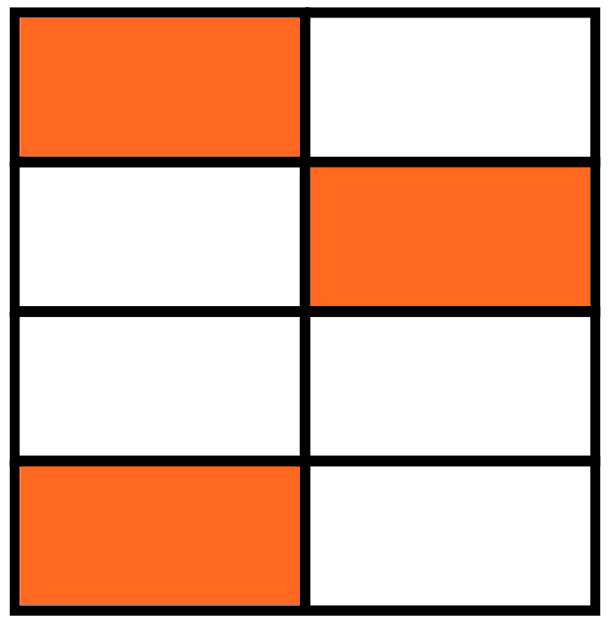
three eighths rectangle

Note

Here, the rectangle is divided into 8 equal parts (so the denominator of the fraction is 8). If we look at those parts that are white, there's 5 of them so 5/8 of the rectangle is white.

Example

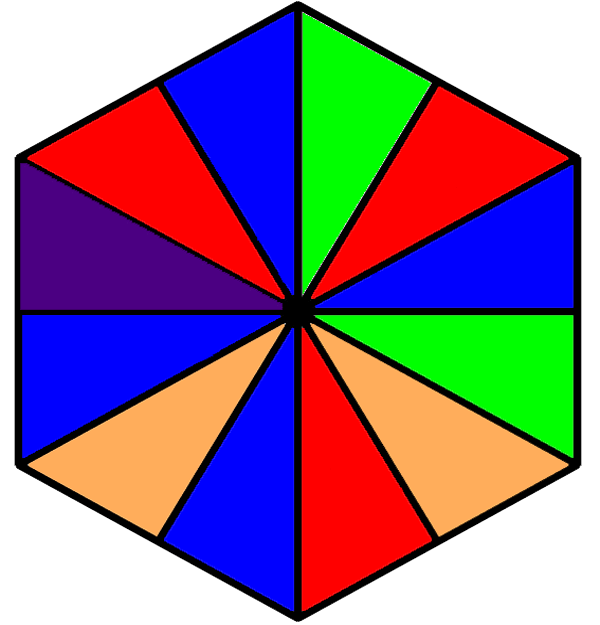
What fraction of the hexagon is coloured red?

Diagram
multicoloured hexagon

Solution

Count the total number of parts, 12. Now count those coloured red, 3. So, the fraction coloured red is 3/12. Divide top and bottom by 3 for the answer, 1/4
Finding a fraction of a quantity

Definition

A fraction of a quantity is simply a part of a quantity. Half (1/2) of 20 apples is 10 apples. A third (1/3) of £6 is £2.

Method

To work out what a given fraction of a given quantity is, multiply the top of the fraction by the quantity and divide the total by the bottom of the fraction.

So to calculate 3/4 of 24, multiply 3 x 24 = 72 and divide by 4 to get 18.

You can check the answer by putting it over the original quantity, in this case 18/24. Divide top and bottom by 6 to see that it's 3/4.

Example

What is 2/5 of £60?

Solution

Multiply the 2 by 60 to get 120 then divide by 5 to get 24. Remember to add the £ in your answer. Check by putting 24/60. Divide top and bottom by 12 to get 2/5.

Improper fractions and mixed numbers

Definition

An Improper Fraction is basically one where the top part is larger than the bottom 6/5 and 100/7 are Improper Fractions

A Mixed Number is a combination of a whole number and a proper fraction (a proper fraction is one where the top part is smaller than the bottom part) 1 3/4 and 5 18/19 are Mixed Numbers

Method

You need to be able to convert Improper Fractions to Mixed Numbers and vice versa in order to be able to do calculations with fractions.

To convert an Improper Fraction, divide the numerator (top part) by the denominator (bottom part). This gives the whole number part of the Mixed Number. The remainder goes over the original denominator for the fractional part.

To convert a Mixed Number to an Improper Fraction, multiply the whole number part by the denominator (bottom) of the fraction, add the numerator (top) of the fraction to it and put the total over the denominator.

Example

(i) Convert 7/5 to a Mixed Number. (ii) Convert 4 3/7 to an Improper Fraction

Solution

(i) 7 ÷ 5 = 1 remainder 2 so the answer is 1 2/5 (ii) 4 x 7 = 28. 28 + 3 = 31 so the answer is 31/7

Equivalent fractions 1

Definition

One fraction is equivalent to another when it represents the same part of a whole.

Eg. 1/2 = 2/4 = 5/10 because in each case, the fraction represents a half of a whole.

Method

Cancel fractions down to their simplest form to see if they're equivalent.

Multiplying the numerator and denominator of a fraction by the same number will produce an equivalent fraction.

Similarly, dividing the numerator and denominator of a fraction by the same number will produce an equivalent fraction.

Example

Which fraction with a numerator of 30 is equivalent to 5/6?

Solution

The numerator is the top part of the fraction. 30 = 5 x 6. So, if we've multiplied the top by 6, we need to multiply the bottom by 6 too to form an equivalent fraction. So, 5/6 is equivalent to 30/36

Equivalent fractions 2

Definition

One fraction is equivalent to another when it represents the same part of a whole.

Eg 3/6 = 50/100 = 14/28 as all of them represent one half of a whole

Method

Sometimes it's not always possible to see if two fractions are equivalent by a single division or multiplication. It's always best to cancel fractions down to their simplest form to check.

Example

Which fraction with a denominator of 16 is equivalent to 75/100?

Solution

The denominator of the given fraction is 100 but 16 doesn't divide into 100 so we can't simply divide top and bottom to achieve the answer.

Reduce 75/100 to its simplest form by dividing top and bottom by 25 to get 3/4. Now, if the denominator of our new fraction is 16, that means the bottom has been multiplied by 4 so we must do the same to the top to get 3 x 4 = 12. So, 12/16 is equivalent to 75/100.

One quantity as a fraction of another

Definition

To express one quantity as a fraction of another, put the first quantity on top of the fraction and the second quantity below.

Method

Once you've created the fraction, you may be able to simplify it by dividing top and bottom (numerator and denominator) by the same amount.

Example

(i) Express 12 as a fraction of 30 (ii) Express 30 as a fraction of 24 (write as a mixed number)

Solution

(i) Write the fraction as 12/30. Divide top and bottom by 6 to get 2/5

(ii) Write the fraction as 30/24. Divide top and bottom by 6 to get 5/4. We're told to write it as a mixed number ie. 1 1/4

Converting fractions into decimals 1

Definition

Fractions and decimals are two ways of writing the same thing.

Method

We convert a fraction into a decimal by dividing the numerator (top) of the fraction by the denominator (bottom).

If the denominator is a multiple of 2 or 5 (4, 8, 25 etc) or a combination of such multiples (10, 40, 160 etc), then the decimal equivalent will terminate. This module deals with this type of fraction/decimal conversion

Tips/hints

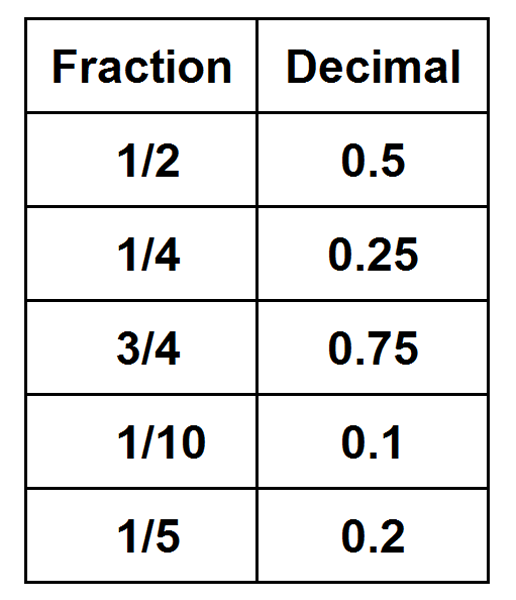
It's worth learning a few of the simpler conversions so you don't spend time on them in the exam.

Diagram

convert fracs to decs

Example

Express the following as decimals: (i) 1/4 (ii) 3/5 (iii) 3/8

Solution

(i) If you've learnt the table, then 1/4 is simply 0.25

(ii) From the table we know that 1/5 is 0.2 so, 3/5 = 3 x 0.2 = 0.6

(iii) For 3/8, we need to divide 8 into 3 (consider it as 8 into 3.0000) This will give an answer of 0.375

Converting fractions into decimals 2

Definition

Fractions and decimals are two ways of writing the same thing.

Method

We convert a fraction into a decimal by dividing the numerator (top) of the fraction by the denominator (bottom).

If the denominator is NOT a multiple of 2 or 5 or a combination of such multiples, then the decimal equivalent will recur/repeat. This module deals with this type of fraction/decimal conversion

Tips/hints

Don't be put off by recurring decimals, they're quite straightforward. They are usually denoted with dots above the sequence that recurs. When writing a recurring decimal, the key is to find the pattern of numbers in the decimal part that repeats on put the dots over each number in this pattern. For example, 6/11 = 0.5454545454.... The repeating pattern here is 54 so the decimal is written

Example

Write 1/3 as a decimal.

Solution

Divide 3 into 1.000 to get 0.33333... The repeating pattern is simply 3 so the decimal is written:

Converting decimals into fractions

Definition

A decimal and a fraction are two ways of writing the same number. For example 0.5 = 1/2.

There are two types of decimal to consider, terminating (eg. 0.125, 0.7) and recurring (eg. , )

Method

We'll look at converting the two types of decimal, terminating and recurring.

Terminating decimals

It's easiest to show with an example. To convert 4.875 to a decimal, proceed as follows: Put the whole number part of the decimal to one side. Now, the decimal part of the number (875) becomes the numerator (top) of the fraction. The denominator (bottom) is simply 1 followed by the same number of zeros as there are digits in the numerator (in this case 3) So our fraction is 875/1000. This cancels to 7/8

Recurring decimals

Again, let's use an example. Convert to a fraction. Firstly, let x = So, x = 0.0833333.... The repeating pattern is 3 which is just one digit long so, we multiply x by 10. If the repeating pattern is 2 digits long, multiply by 100, if it's 3 digits, by 1000 etc. 10x = 0.83333... Now the clever bit is to do a subtraction to get rid of the repeating part of the decimal. We say 10x - x = 0.83333.... - 0.08333333 ie. 9x = 0.75 So, x = 0.75/9 = 75/900. Cancel to get x = 1/12

That was quite a tough example. The key is to multiply by powers of 10 so that when we subtract two numbers, the recurring pattern disappears.

Tips/hints

If the recurring pattern starts straight after the decimal point, there's an even easier method - see the first example below.

Example

Convert the following decimals into fractions: (i) (ii)

Solution

(i) If the recurring pattern comes straight after the decimal point, then there's a short cut to converting to a fraction. Put the recurring pattern (in this case, 72) on top of the fraction. Count the number of digits in it, 2, and put this number of 9s on the bottom of the fraction, 99. So, our fraction is 72/99. Cancel through by 9 to get 8/11.

(ii) The recurring pattern doesn't come straight after the decimal so, let's say x = . So, x = 0.3181818... The repeating pattern is 18 ie. 2 digits long so multiply by 100 100x = 31.8181... 100x - x = 31.8181... - 0.3181... ie. 99x = 31.5 which makes x = 31.5/99 = 315/990. Cancel through by 5 to get 63/99 and cancel again by 7 to get 7/11. Phew!

Adding and subtracting fractions 1

Definition

Fractions can be added and subtracted like any other numbers, they just require a bit more care.

This module deals with adding and subtracting fractions which have the same denominator (bottom).

Method

When the denominator is the same for each fraction, just carry out the arithmetic on the numerators.

Tips/hints

Once you've performed the addition/subtraction, see if the fraction can be simplified by cancelling.

Example

Work out the following leaving your answers in their simplest form: (i) 3/10 + 1/10 (ii) 5/6 - 1/6

Solution

(i) The denominators are the same so the answer is (3+1)/10 ie. 4/10 which cancels to 2/5

(ii) The denominators are the same so the answer is (5-1)/6 ie. 4/6 which cancels to 2/3

Adding and subtracting fractions 2

Definition

Adding and subtracting fractions sometimes involves or results in whole numbers as well as fractions.

This module deals with adding and subtracting fractions which have the same denominator (bottom) and include mixed numbers in the sum or in the answer.

Tips/hints

If there are mixed numbers in the sum, separate these out before dealing with the fractions.

If the answer results in an improper (top-heavy) fraction, unless told otherwise, convert it to a mixed number.

Example

Work out the following: (i) 7/8 + 3/8 (ii) 2 1/4 - 1 3/4

Solution

(i) The denominators are the same so the sum is simply (7+3)/8 = 10/8 Divide through by 2 to get 5/4. Now convert to a mixed number, 1 1/4 for the answer.

(ii) Separate out the whole numbers from the fractional parts to get two sums: 2 - 1 = 1 and 1/4 - 3/4. The denominators are the same so 1/4 - 3/4 = (1-3)/4 = -2/4 This cancels to -1/2. Reintroducing the whole numbers we have 1 + (-1/2) = 1/2.

Adding and subtracting fractions 3

Definition

The fractions you're asked to add and subtract won't always have the same denominators. Don't worry as you can convert them to fractions with the same denominators and then proceed as usual.

Method

To make your fractions have the same denominators, just find a number both denominators divide into and then convert them to equivalent fractions.

For example, if you're asked to do the sum 4/5 + 2/3 first find a number that 5 and 3 divide into, 15, and then convert both fractions to have 15 as their denominator. 4/5 = 12/15 and 2/3 = 10/15 so the sum becomes: 12/15 + 10/15 = 22/15. Convert to a mixed number for the answer.

Tips/hints

If mixed numbers are involved in the sum, treat the whole numbers separately to the fractions.

Example

Work out the following giving your answers in their simplest form. (i) 5/7 - 1/4 (ii) 3 1/12 + 2 3/8

Solution

(i) First find a number that both 7 and 4 divide into. 28 is the smallest such number. Convert the fractions to be over 28 so the sum becomes: 20/28 - 7/28 = 13/28

(ii) We've got mixed numbers here so separate into two sums: 3 + 2 = 5 and 1/12 + 3/8 Find a number that both 12 and 8 divide into. 24 will do. So, the fraction part of the sum becomes 2/24 + 9/24 = 11/24. Putting it altogether, the answer is 5 11/24

Multiplying fractions

Definition

As with other numbers, fractions can be multiplied together.

Method

Multiplying fractions is very straightforward. Always remember to convert any mixed numbers into improper (top-heavy) fractions. Then simply multiply the numerators (tops) together and the denominators (bottoms) together to get the answer. Convert the answer to a mixed number unless told otherwise.

Tips/hints

Don't forget that whole numbers are simply fractions with a denominator of 1 so, 3 = 3/1, 5 = 5/1 etc.

Example

(i) Multiply 3 2/5 by 1/2 (ii) Multiply 4/5 by 10

Solution

(i) Convert mixed numbers to improper fractions so the sum becomes 17/5 x 1/2. This gives(17 x 1)/(5 x 2) = 17/10. Convert back to a mixed number to get 1 7/10.

(ii) Remember to think of whole numbers as fractions with a denominator of 1. So, 4/5 x 10 = 4/5 x 10/1 = (4 x 10)/(5 x 1) = 40/5 which cancels down to 8

Dividing fractions

Definition

As with other numbers, fractions can be divided into one another

Method

Dividing fractions is the same as multiplying but with one extra step. The first step is the same as with multiplication - convert any mixed numbers to improper fractions. The second step is the extra one. Turn the second fraction (the one you're dividing by) upside-down and change the ÷ to a x. Multiply the two fractions together for the answer. Simple!

Example

What is 2 5/8 ÷ 2 4/5?

Solution

First step convert to mixed numbers so the sum becomes: 21/8 ÷ 14/5. Second step is the extra one - turn the second fraction upside-down and change the ÷ to a x 21/8 x 5/14 = (21 x 5)/(8 x 14) = 105/112. Cancel through by 7 to get 15/16.

Reciprocals

Definition

The Reciprocal of a number is simply 1 over (ie. divided by) that number.

Eg. the reciprocal of 2 is 1/2. The reciprocal of 0.2 is 1/0.2 = 5

Method

To find the reciprocal of any fraction, just turn the fraction upside-down. The reciprocal of 5/6 = 6/5 = 1 1/5. If it's a mixed number you're given, convert to an improper fraction then turn it upside down. To find the reciprocal of 2 2/3, first convert to a mixed number, 8/3 and then turn it upside-down, 3/8. That's it.

You might be asked a question like 'Of which number is 0.4 the reciprocal?' Here you need to find x such that 1/x = 0.4 ie. 1/0.4 = x from which x can be found.

Tips/hints

A really neat thing about reciprocals is they pair up. Eg. the reciprocal of 2 is 1/2 and the reciprocal of 1/2 is 1/(1/2) = 2.

Example

Find the reciprocal of 4/5. Give your answer as a decimal.

Solution

To find the reciprocal of a fraction, just turn it upside-down so we get 5/4 = 1 1/4. Convert to a decimal for the answer, 1.25

Fraction problems in words

Definition

Fraction problems in words can be quite complicated and involve a number of different parts. The key is to take each part at a time.

Method

Read the question carefully. Look at what is being asked for. If it's a complicated question, break it down into simple steps.

Tips/hints

Once you have calculated the answer, put it back into the question and see if the figures stack up. If not, you've made an error.

Example

Carter has a bag of marbles. He gives 1/3 to Tyler, 1/4 to Todd and 1/5 to Tim. He has 26 left. How many marbles did he have originally?

Solution

The facts we know are the number of marbles he has left (26) and the fractions of the original he gave away. Start off by finding out the total fraction of the marbles he gave away. This is the sum 1/3 + 1/4 + 1/5. If you feel confident, you can do this sum all in one go but it might be safer to break it into two parts. Do 1/3 + 1/4. Find a common denominator (12) so the sum becomes 4/12 + 3/12 = 7/12. Now we need to add this to 1/5. 7/12 + 1/5 becomes 35/60 + 12/60 (using 60 as the common denominator) So, we know that he's given away 47/60 of his marbles.

Initially he had all of the marbles that is, all sixty sixtieths ( 60/60 ). So now, as a fraction, he has 60/60 - 47/60 = 13/60 of the original number of marbles. So, 26 represents 13/60 of his original total. So, if T is his original total, T x 13/60 = 26 So, T = 26 ÷ 13/60. Remember that 26 = 26/1. So, the sum becomes 26/1 x 60/13. This equals 1560/13 = 120. So, the answer is 120 marbles.

Finally, check by putting the answer back into the question. He gives 1/3 of his marbles to Tyler: 1/3 x 120 = 40 He gives 1/4 to Todd, 1/4 x 120 = 30 He gives 1/5 to Tim, 1/5 x 120 = 24. So, in total he's given away 40 + 30 + 24 = 94. So he's left with 120 - 94 = 26 which agrees with the question so we can be confident our answer is correct.

Adding and subtracting decimals

Definition

Adding and subtracting decimals is a part of daily life. Whenever we add up our shopping bill or work out how much change we should get, we're adding and subtracting decimals.

Tips/hints

The key thing is to use the column method (see the module Column Addition and Subtraction) and LINE UP the decimal points.

Also, if the decimal parts are of different lengths, add zeros at the end of the shorter one to make it the same length as the other.

Example

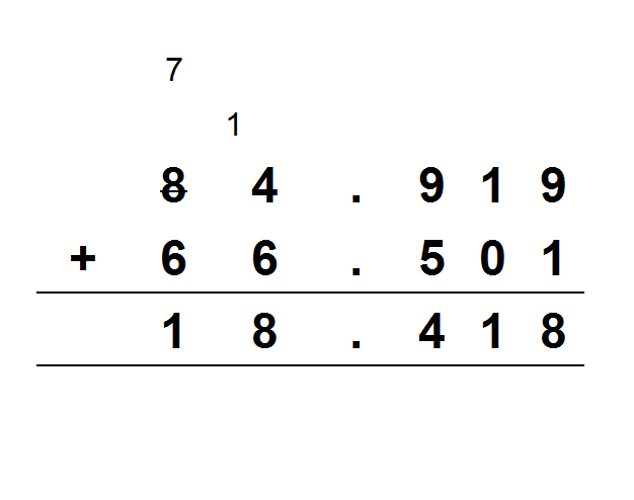
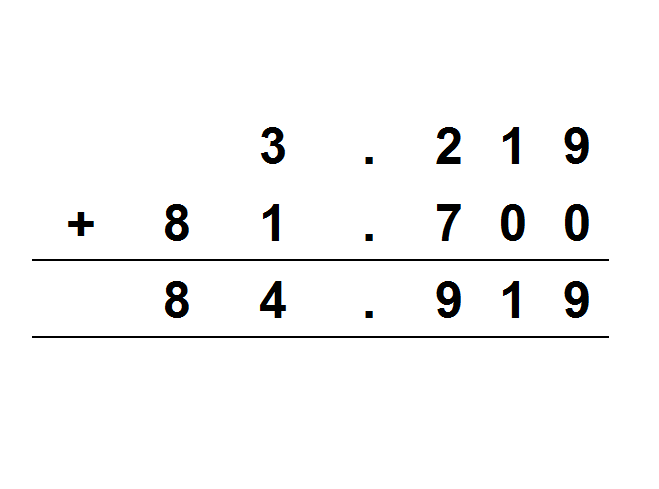
Calculate 3.219 + 81.7 - 66.501

Do the addition first using the column method

Diagram

dec col add

Note

Now do the subtraction 84.919 - 66.501

Diagram

dec col sub

Decimals - multiplication and division 1

Definition

Multiplying and dividing decimals by single digit numbers is something you do already without thinking about it. Calculating how much 3 bottles of cola cost when you know 1 bottle costs £1.20, or splitting the cost of a meal that was £4.68 between 2 of you are both examples of this.

This unit looks at multiplying and dividing decimals by single digit numbers.

Method

The two types of sum to consider are as follows.

Multiplying decimals by a single digit number

Remove the decimal point but count the number of figures after it. Do the multiplication and replace the decimal point in the answer so that the same number of figures as the number you counted are after the point.

Dividing decimals by a single digit number.

Leave the decimal point in place and remember to keep it aligned in your answer.

Tips/hints

When dividing a decimal, it makes it clearer to understand what's going on if you add extra 0s on to the right hand part of the number after the decimal point eg. 2.5 = 2.5000

Example

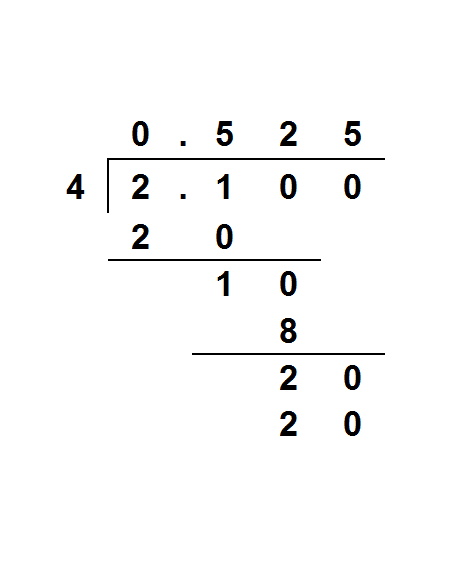
(i) Multiply 3.95 by 6 (ii) Divide 2.1 by 4

Solution

(i) Count the number of digits after the decimal point (2). Now remove the decimal point and calculate 395 x 6 = 2370. Replace the decimal point so that there are 2 digits after it. So, 3.95 x 6 = 23.70 = 23.7

(ii) Write this out as a normal division taking care to keep the decimal place in line in the answer. Here, extra 0s have been added on at the right hand side ( 2.1 = 2.100 ) and these are brought down to continue until the division is done.

Diagram

2 pt 1 div 4

Decimals - multiplication and division 2

Definition

Multiplying and dividing using decimals is the same as with whole numbers except there's a decimal point! The sums can be fiddly but if you can do multiplication and division with whole numbers, you should have no problems.

Method

There are two types of sum to consider.

Multiplying two decimals

Remove any decimal points but count the total number of figures after the points in the two numbers. Do the multiplication and replace the decimal point so that the same number of figures as the total you counted are after the point.

Dividing two decimals

Rewrite the sum as a fraction and then multiply top and bottom by a multiple of 10 to remove the decimal points. Then do the division in the normal way or, if possible, cancel the fraction and then divide.

Example

(i) If $1 is worth £0.65, to the nearest 1p, what is the cost in £ of a book with the price tag $7.80? (ii) If $1 is worth £0.65, to the nearest cent, what is the cost in $ of a book with the price tag £19.50?

Solution

(i) If each $ is worth £0.65, then $7.80 is worth 7.80 x 0.65 = 7.8 x 0.65 Count the number of digits in total after the decimal points ( 7.8 has 1 digit, 0.65 has 2 digits so the total is 3). Now remove the decimal points, calculate 78 x 65 = 5070 Replace the decimal point so that there are 3 digits after it. So, 7.8 x 0.65 = 5.070 = 5.07 We were working out the cost in £ so replace the £ in the answer giving, £5.07

(ii) If each £0.65 is worth $1, then £19.50 is worth £19.50/£0.65 dollars. So we need to calculate 19.50 ÷ 0.65 = 19.5 ÷ 0.65 Rewrite the sum as a fraction to get 19.5/0.65 We need to remove the decimal points by multipling top and bottom by a power of 10. Multiply top and bottom by 100 to get 1950/65. You can do a long division on this or, you can try and cancel the fraction. 5 goes into top and bottom so the fraction becomes 390/13 Cancel again by dividing by 13 to get the answer 30. Don't forget we were asked to find the cost in $ so the answer is $30.

Equivalent percentages, fractions and decimals

Definition

Percentages, fractions and decimals are simply different ways of expressing the same thing, namely a proportion of something.

Method

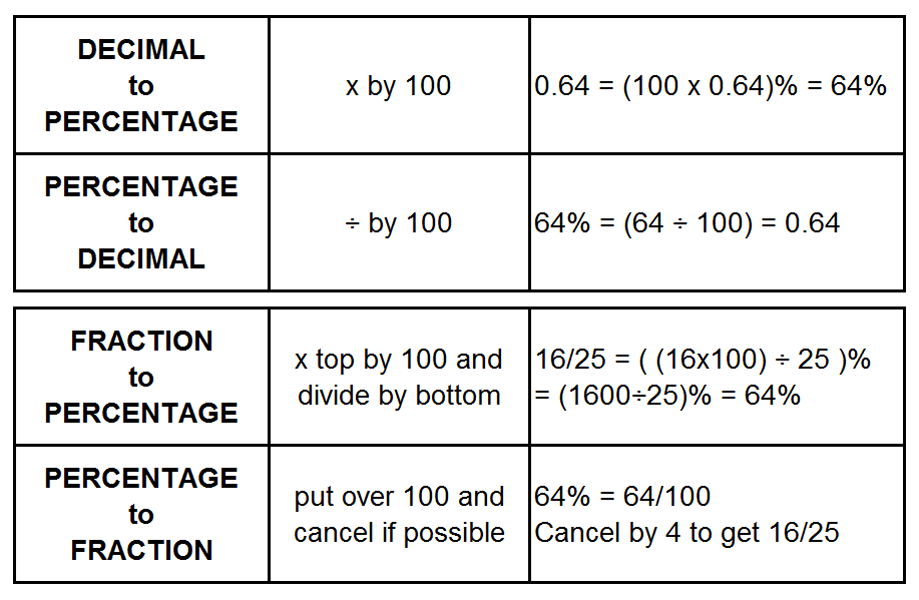
The rules for conversion are very straightforward. There are three other modules in this section that deal with converting fractions into decimals and decimals into fractions so here we'll concentrate on conversion of percentages.

Diagram

perc conv

Tips/hints

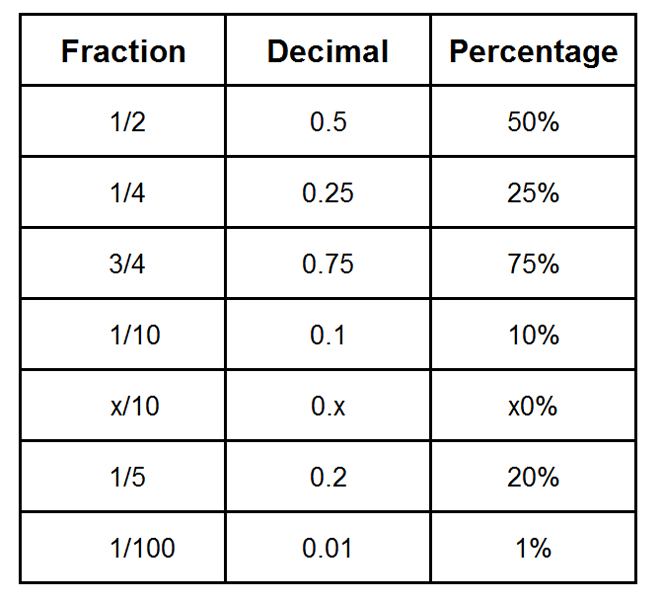
It's worth remembering the simpler ones so that you can reproduce them without having to think - it'll save time in the exam.

Diagram

frac dec perc

Example

(i) Express 35% as a fraction (ii) Express 7% as a decimal (iii) Express 3/20 as a percentage (iv) Express 0.125 as a percentage

Solution

(i) This is PERCENTAGE to FRACTION so put over 100 and cancel if possible. 35/100 = 7/20

(ii) This is PERCENTAGE to DECIMAL so divide by 100 7 ÷ 100 = 0.07

(iii) This is FRACTION to PERCENTAGE so x top by 100 and divide by bottom (3 x 100) ÷ 20 = 300 ÷ 20 = 15 so the answer is 15%

(iv) This is DECIMAL to PERCENTAGE so multiply by 100 100 x 0.125 = 12.5 ie. 12.5%

Calculating a percentage of a quantity

Definition

A percentage of a quantity is something you're probably familiar with in everyday life eg. in signs such as '40% off original price', '30% extra'.

Method

To work out p% of q simply do the calculation

Example

What is 40% of £50?

Solution

Using the formula we get: 40/100 x 50 = 20. Don't forget to put the £ on for the answer, £20

One quantity as a percentage of another

Definition

One quantity can be expressed as a percentage of another. For example, 3 is 50% of 6. And 6 is 200% of 3. 10 is 100% of 10.

Method

To work out what percentage one quantity, q, is of another quantity, r, use the formula

Example

A coat originally cost £50 but was reduced by £15 in the sale. What was the percentage reduction?

Solution

We need to find what percentage £15 is of £50. Use the formula So, the % reduction is 15/50 x 100 = 30%

Percentage change

Definition

Percentage change is the amount a quantity has changed expressed as a percentage. An increase means the amount has gone up, a decrease means the amount has gone down.

Method

To calculate a change as a percentage, first work out what the actual change is. Then use this and the original amount to express one quantity as a percentage of another ie. use the formula

Tips/hints

Normally you're asked to express the change as a percentage of the original amount - be careful to use the original amount in your calculation and not the new amount.

Example

After Christmas, the price of a frozen turkey went from £20 to £14. What was the percentage decrease in price?

Solution

First calculate the actual decrease: £20 - £14 = £6. Now we want to calculate this as a percentage of the original amount (£20) so use the formula This gives 6/20 x 100 = 30%

Percentage problems in words

Definition

Percentage problems in words are usually simple calculations wrapped up in a lot of words.

Method

The key is to understand what the question is asking you to find. Look out for key words like 'change', 'increase', 'decrease', 'of the original amount', 'as a percentage', 'what was the original...' It's often best to break the question down into several simple steps rather than do too many calculations at once.

Example

On a charity's website, it shows how each £20 donated is spent. £4 goes directly to providing medicines for sick children £12 pays for doctors and nurses £1.50 pays for transport The remainder pays for admin and running costs. What percentage of the money donated is spent on admin and running costs?

Solution

First, we need to work out what the remainder is. £20 - (£4 + £12 + £1.50) = £20 - £17.50 = £2.50 So, £2.50 of every £20 donated is used on admin etc. We need to express this as a percentage ie. one quantity as a percentage of another. For this, use the formula 2.50/20 x 100 = 12.5%

Compound interest

Definition

The easiest way to think of Compound Interest is to imagine a savings account that pays r% interest each year. After one year, you'll have the original amount you saved plus the interest. So, in the second year, the amount in your account is bigger and so the interest you'll get on it will be bigger. So, it's basically interest on the interest.

Method

Although the topic's called 'Compound Interest', it's not restricted to savings accounts. Other sorts of growth and decay can use the same rules.

Unfortunately there's only one way to do compound interest problems and that's to learn the formula: where V is the current value P is the initial amount r is the rate of increase/decrease (as a percentage) n is the number of years/months/weeks etc.

If you know this and can work out what V, P, r and n are from the question you're home and dry.

If the question talks about depreciation or decay, then r will be negative.

Tips/hints

Be careful that the units of time you use are consistent - a question may give you an annual interest rate but tell you it's compounded monthly. Always use the unit that the rate is compounded by, in this case months.

Example

Find the value of a deposit of £12,000 that is invested for 5 years at a rate of 6% p.a. compounded monthly.

Solution

OK... This is as tricky as it gets. We're told the rate is compounded monthly so we need to convert everything to months. 5 years = 5x12 = 60 months. 6% per annum = 6%/12 per month = 0.5% per month. Now we can use the formula:

We know the following P = 12000 r = 0.5 n = 60 So we get: Which makes V = £16.186.20

Reverse percentage

Definition

Sometimes we're told what a certain percentage of a quantity is and have to work out the quantity. This is a Reverse Percentage

Method

One thing you need to remember is that the Original Quantity is 100% of the Original Quantity. You'll be told another quantity that's a different % of the Original. With a bit of common sense, you can work out what 1% of the Original Quantity would be and then multiply up by 100 to get the Original Quantity itself.

If you'd rather learn a formula, then let q be the original quantity. If we know that r is p% of q, then we can use the formula to calculate q

Example

(i) If 30% of a number is 270, what is the number? (ii) In a sale, the price of a laptop has been reduced by 30% and its sale price is £280. What was the original price?

Solution

(i) We'll use the common sense approach here. We're told that 30% of a number is 270. So, 1% of that number must be 270 ÷ 30 ie. 9 So, 100% of that number must be 9 x 100 = 900. You can check the answer by putting it into the question. 30% of 900 = 30/100 x 900 = 270 which is correct.

(ii) Here we'll use the formula. The laptop's price was reduced by 30% so the new price is (100%-30%) of the original ie. 70% or the original. So, we know £280 is 70% of the Original. The formula can be used when we know r is p% of q. So, r = 280, p = 70 Making q = 280/70 x 100 = £400.

Again, check your answer in the question. The original price is what we've worked out, £400, and this was reduced by 30% 30% of £400 = 30/100 x 400 = £120. £400 - £120 = £280 which is the sale price we were given. Bingo!

Test yourself on this topic

Try the free quiz with worked solutions.

Start quiz →

Get GCSE Number

Full notes, full question bank, offline.