


G GCSE Apps

GCSE Number

Factors, multiplication and division

13 subtopics in this section

Times tables

Definition

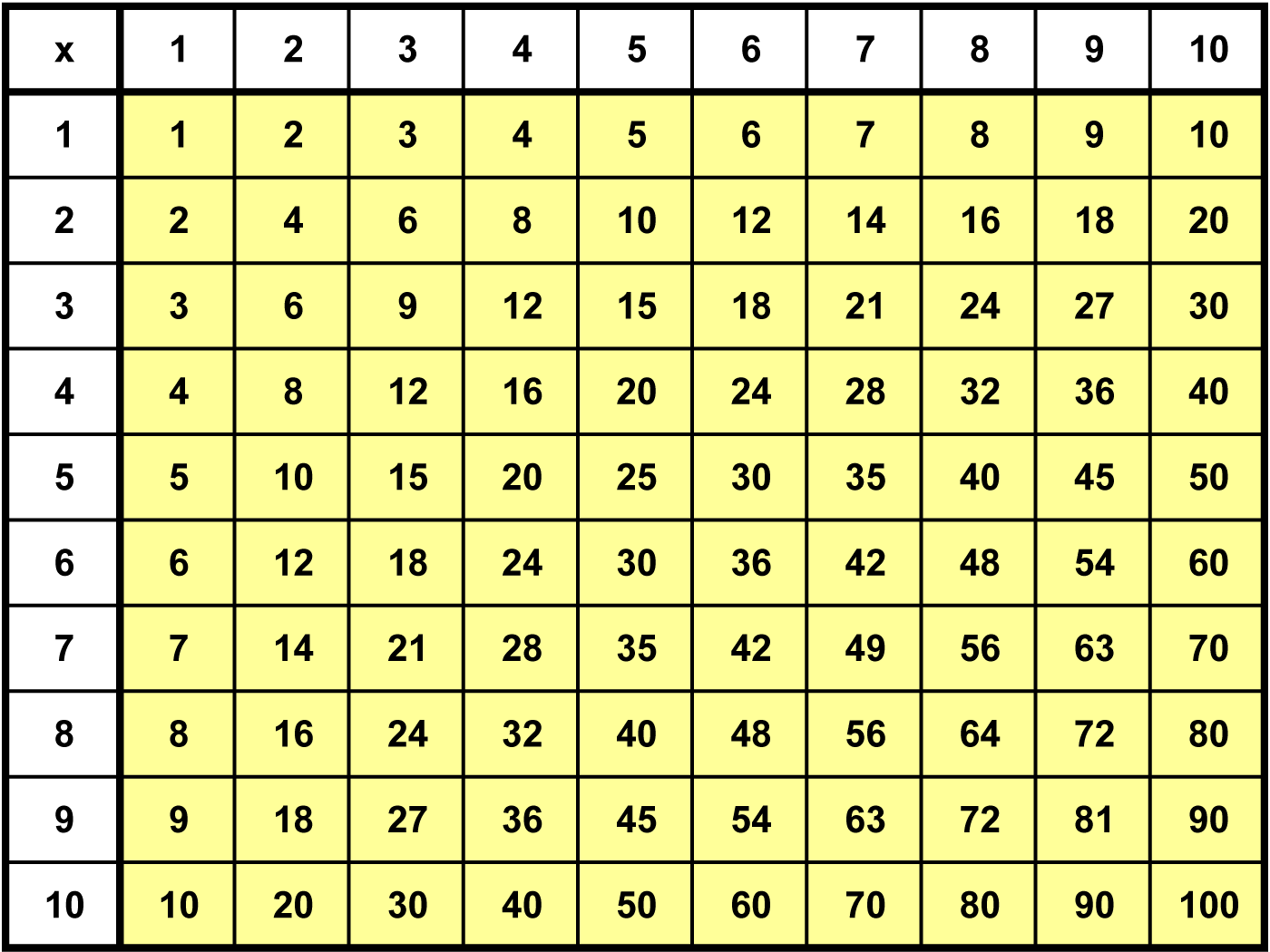
Times Tables are simply Multiplication Tables and you need to learn them for all numbers up to and including 10.

Diagram
times tables

Tips/hints

Learn them off by heart. The quicker you can recall them, the more time you'll save in the exam.

Some of them are really easy to learn. For example, 10 times any number is just the number with a zero added onto the end.

Also, remember that 3 x 5 = 5 x 3 so that means there's not so many to learn.

Notice that the perfect squares are down the diagonal from the top left to the bottom right.

Example

Annie thinks of a number and multiplies it by 7. She subtracts 1 and divides it by 8. The answer is 6. What number did she think of?

Solution

In this sort of problem, start at the end first. She gets 6 by dividing a number by 8 so that number must be 6 x 8 = 48. This is 1 less than the previous number so that must be 48 + 1 = 49. And this is 7 times the original number so that must be 49 ÷ 7 = 7.
Multiplying and dividing by single-digit numbers

Definition

Multiplication and division by a single digit number without a calculator is quite straightforward.

Method

See the worked examples below.

Tips/hints

Try to do a rough estimate of the answer before you start. For example, 7 x 392 will be a bit under 7 x 400 = 2800.

And don't forget to put all your workings in, the carried digits and the borrowed ones.

If you find the traditional method of multiplication difficult, try using the grid method (see the notes on Long Multiplication).

Multiplication Example

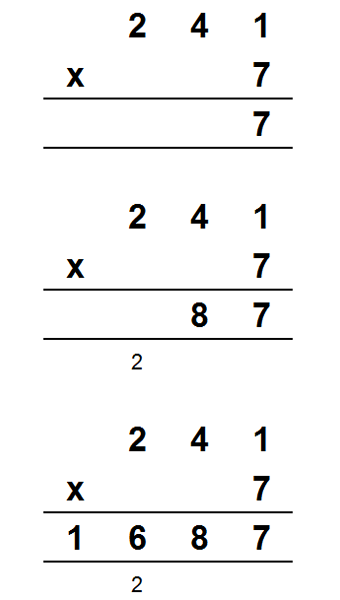
Work out 7 x 241 without using a calculator.

Doing a rough estimate, 7 x 241 will be about halfway between 7 x 200 (1400) and 7 x 300 (2100) ie. about 1700

Diagram

multiplication example

Solution

Start at the right and do the Units. 7 x 1 = 7. Write 7 in the answer line. Next move to the Tens column 7 x 4 = 28. Put the 8 in the answer line and put the 2 below the answer line in the next column. Finally, move to the Hundreds column. 7 x 2 = 14. There's a 2 below the answer line so add that on to make 16. As there are no more columns to multiply, write 16 in the answer line. This is in line with the rough estimate we did at the start.

Division Example

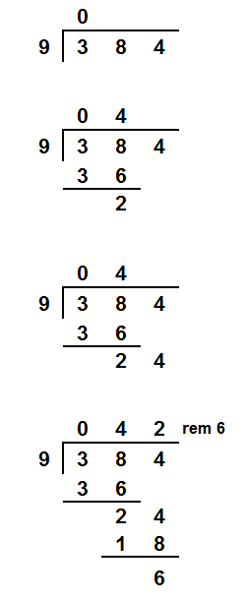
Divide 384 by 9

Diagram

division example

Solution

First write the sum as shown. Work from the left. 9 into 3 doesn't go, so put a zero in the answer line above the 3. 9 into 38 goes 4 times. Write 4 on the answer line. 4 x 9 = 36. Write 36 below 38 and take away to give 2. Bring down the next digit, 4 and divide 9 into 24. 9 into 24 is 2 remainder 6. Put this on the answer line for the final solution.

Prime numbers

Definition

A prime number is a a number that has exactly two factors. It only divides by 1 and itself.

The first few prime numbers are 2, 3, 5, 7, 11, 13, 17, 19, 23, 29...

Note that 1 is NOT a prime number (it only has one factor).

Tips/hints

There's no rule for finding prime numbers but, with the exception of 2 and 5, all prime numbers end in 1, 3, 7 or 9 (that's because numbers ending in 2, 4, 6, 8, are divisible by 2 and those ending in 0 or 5 are divisible by 5).

Also, if a number appears in a times table (but not the 1 times table!) then it's NOT a prime (because it can be divided by numbers other than itself and 1). So, 63 isn't prime because 7 x 9 = 63.

Example

Write down all the prime numbers between 30 and 40

Solution

You only need consider those ending in 1, 3, 7 or 9 ie. 31, 33, 37 and 39.

Then, to decide if they're prime, see if they'll divide by 3 or 7 (this simple rule, dividing by 3 or 7, can be used to check primes all the way up to 120).

33 ÷ 3 = 11, 39 ÷ 3 = 13 so these aren't prime but the other two are. So the answer is 31 and 37.

Prime factors

Definition

A Prime Factor is a Prime Number that divides into another number without leaving a remainder.

For example, 2 is a Prime Factor of 10. 3 is a Prime Factor or 24.

Any number can be broken down into a list of Prime Factors (Prime Numbers) multiplied together.

10 = 2 x 5 24 = 2 x 2 x 2 x 3

Tips/hints

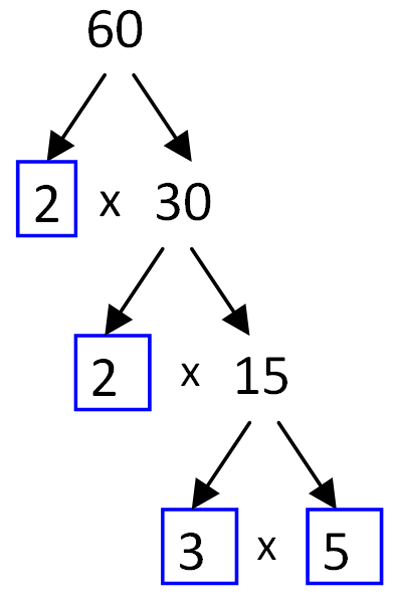
The easiest way to work out the Prime Factors of a number is to use a Factor Tree. Split each number into products and when a prime appears, circle it and leave it. When all the numbers have been split into primes, write down the primes - these are your prime factors.

Diagram

60 prime factor tree

Note

So, splitting 60 into Prime Factors we get 60 = 2 x 2 x 3 x 5

Example

Find the Prime Factors of 54.

Solution

Use a Prime Factor tree

Diagram

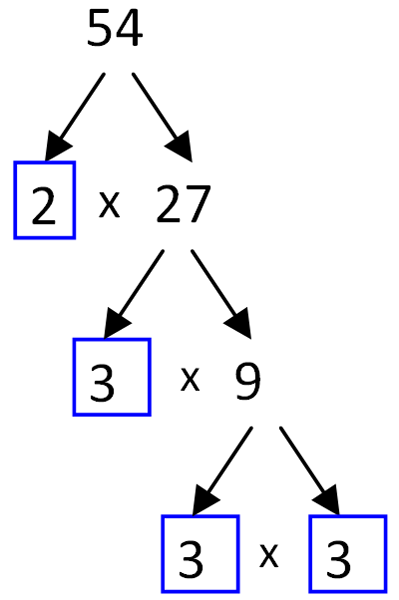
54 prime factor tree

Note

54 = 2 x 27. Circle the 2 because it's prime. 27 = 3 x 9. Circle the 3 because it's prime. 9 = 3 x 3. Circle the 3s because they're prime.

There are no more numbers that aren't prime so, 54 = 2 x 3 x 3 x 3

Factors

Definition

The Factors of a number are all the numbers that divide into it without leaving a remainder.

Method

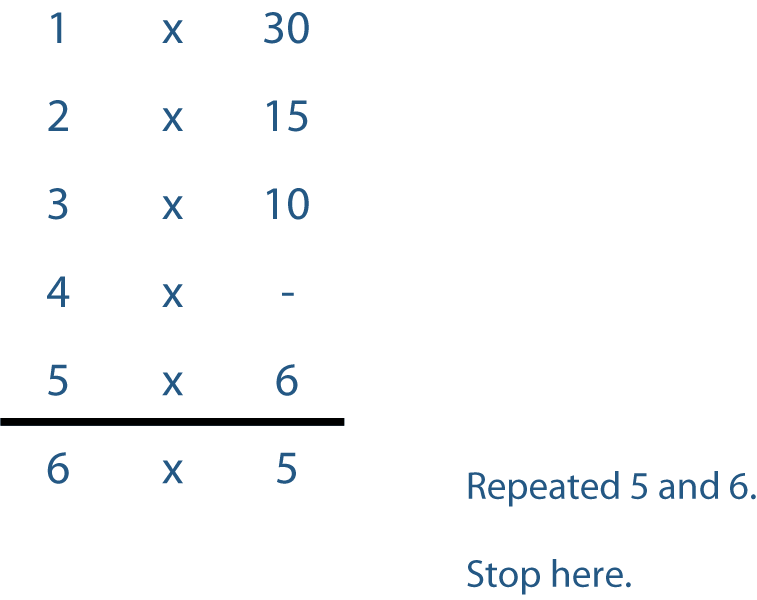
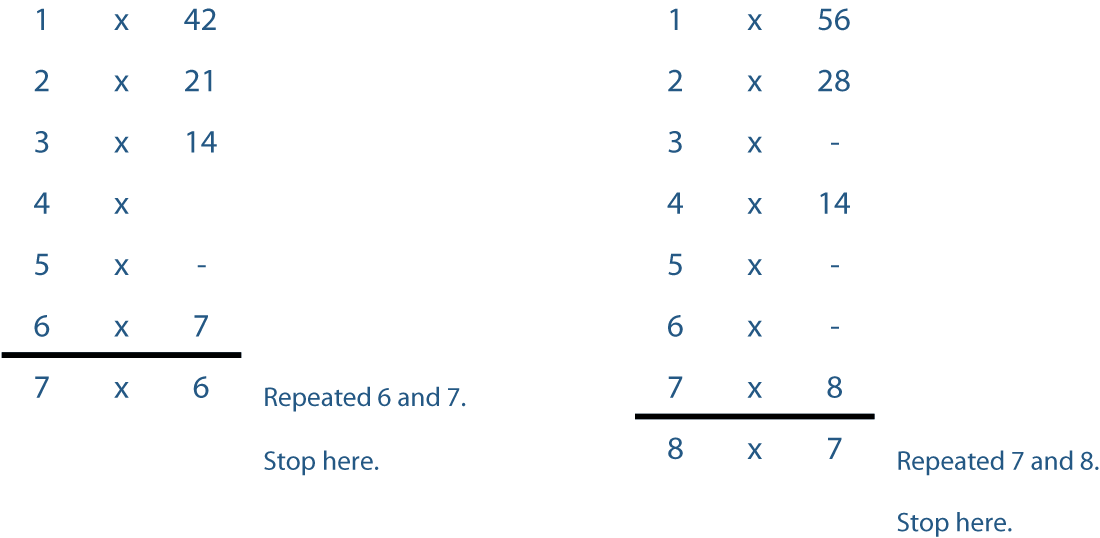
The easiest way to find them is to write a list of pairs of numbers that can be multiplied together to get the given number. Start with 1 x the number itself. Then see if 2 will divide into it, then 3, then 4 and so on. If a number doesn't divide, write a dash. Below is a list of the pairs of numbers that multiply up to make 30.

Diagram

factors of 30

Note

Once you get a number that's already appeared in your list, stop. The factors are all the numbers in your list above this point which aren't next to a dash.

So, the factors of 30 are 1, 2, 3, 5, 6, 10, 15, 30.

Tips/hints

Don't forget 1 and the number itself - they are ALWAYS factors.

Example

Which numbers between 1 and 10 are NOT factors of 90?

Solution

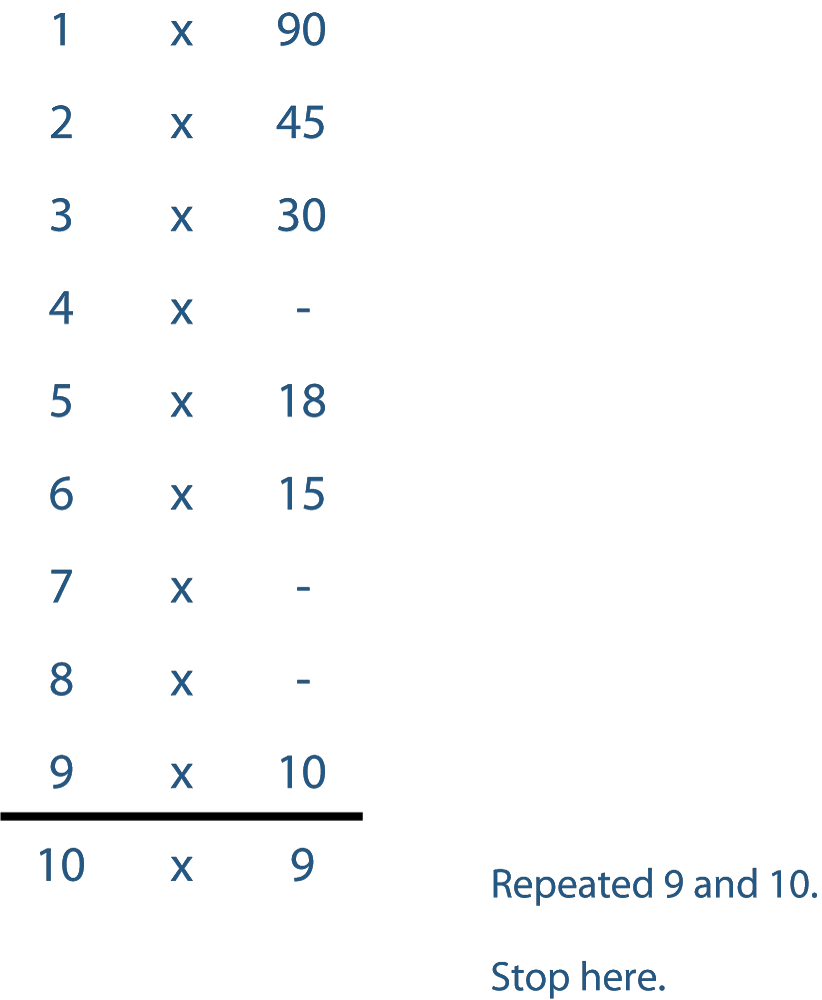
Create a factor list.

Diagram

factors of 90

Note

The factors of 90 are 1, 2, 3, 5, 6, 9, 10, 15, 18, 30, 45, 90. So, the answer to the question is 4, 7 and 8.

Highest common factor

Definition

The Highest Common Factor (HCF) of two numbers is the highest number that is a factor of both of them.

Method

Work out of all the factors of the given numbers and see what is the highest number common to both lists.

Example

What is the Highest Common Factor of 42 and 56?

Solution

Finding the factors by listing them all as shown in the diagram, we get: Factors of 42 1, 2, 3, 6, 7, 14, 21, 42 Factors of 56 1, 2, 4, 7, 8, 14, 28, 56

Diagram

factor lists 42 and 56

Note

See which is the highest number that's common to both lists, in this case, 14.

Multiples

Definition

The Multiples of a number are its times table. To say one number is 'a multiple of' another number is the same as saying one number is 'divisible by' another number.

Method

To see if one number is a multiple of another, divide the larger number by the smaller one. If there's no remainder, then it's a multiple. If there is a remainder then it's not a multiple.

Tips/hints

Some multiples are easy to spot.

2: any number whose last digit is divisible by 2 is a multiple of 2 (ie. any even number).

4: any number whose last two digits are divisible by 4 is a multiple of 4. So, 716 is divisible by 4 because 16 is divisible by 4

5: any number ending in 0 or 5 is a multiple of 5.

3: any number whose digits add up to a number divisible by 3 is a multiple of 3. So, 52458 is a multiple of 3 because 5+2+4+5+8 = 24 which is divisible by 3.

6: if a number's divisible by 2 and 3 it's a multiple of 6.

Example

One of these numbers is a multiple of 3, which one: 2002, 2004, 2006, 2008?

Solution

We can test for multiples of 3 by adding the digits in each number and seeing if their sum is divisible by 3.

Here, 2+0+0+2 = 4, 2+0+0+4 = 6, 2+0+0+6 = 8, 2+0+0+8 = 10. So, as 6 is divisible by 3, 2004 must be a multiple of 3.

Lowest common multiple

Definition

The Lowest Common Multiple (LCM) of two numbers is the smallest number which both numbers will divide into without remainder.

Method

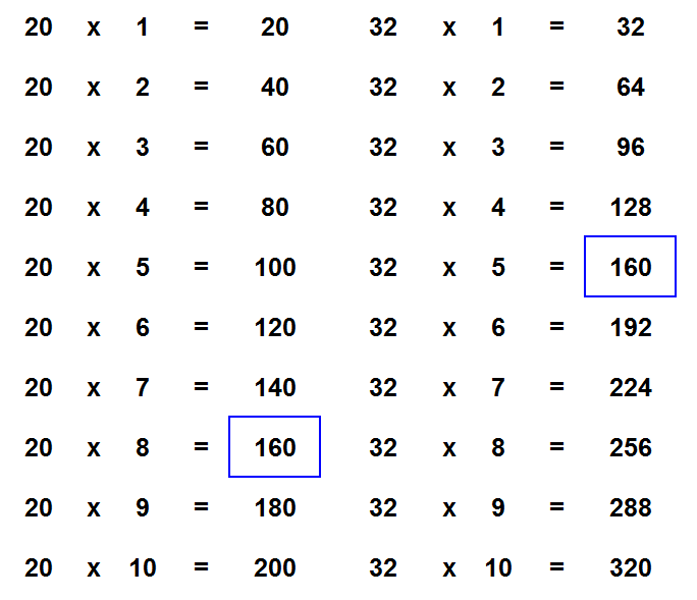
Simply write out the times tables of the numbers given until you find a number that's common to both lists. This is the Lowest Common Multiple.

Example

Find the Lowest Common Multiple of 20 and 32

Solution

Write out the times table of each number.

Diagram

20 and 32 multiples

Note

160 is the smallest number that appears in both lists so is the Lowest Common Multiple.

Long multiplication

Definition

Long multiplication is simply a sum where two numbers which are both two or more digits long are multiplied together.

Method

There's the traditional way of doing this but an easier method is the grid method. The grid method can also be used for multiplication by single digit numbers.

It's a bit more long-winded and requires you to add numbers up carefully but, as long as you know your basic times tables, it's very straight forward. See the example below.

Example

Multiply 371 by 24

Solution

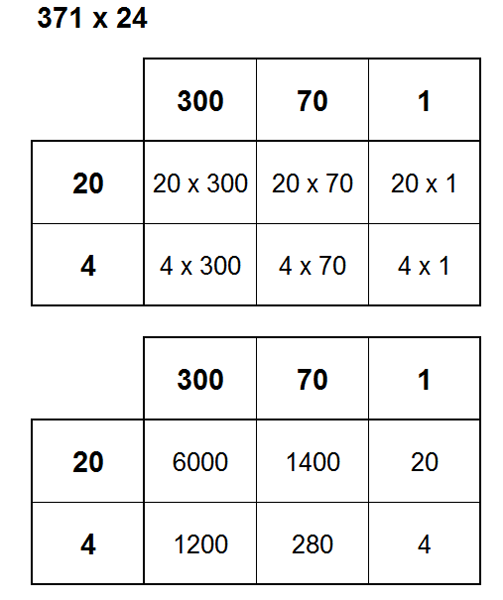
The first thing to do with the grid method is to break each number down into 100s, 10s and units. So, 371 = 300 + 70 + 1 and 24 = 20 + 4. Now draw your grid!

Diagram

mult grid 371 x 24

Note

Fill each blank square in, multiplying the number at the top of its column by the number at the left hand side of its row.

Then simply add all those products together, in this case: 6000 + 1400 + 20 + 1200 + 280 + 4 = 8904

Long division

Definition

Long division is simply the division of a number with three or more digits by one with two or more digits for example 813 ÷ 17

Method

You can follow the traditional method which runs along the same lines as division by a single digit number (as outlined in Multiplication and Division by a Single Digit Number) or, the simpler Repeated Subtraction or 'Chunking' method (see the example below)

Example

Without using a calculator, work out 694 ÷ 53

Solution

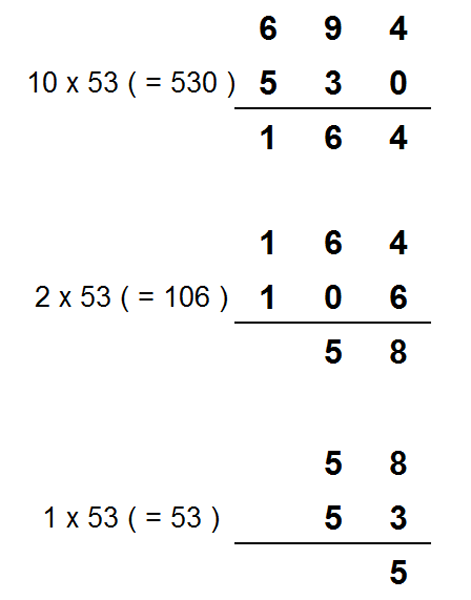
To use the 'chunking' method, firstly, write down 2 x the divisor and 10 x the divisor, in this case 2 x 53 = 106, 10 x 53 = 530. These will help to speed up the process.

Diagram

div 694 by 53

Note

694, the number we're dividing is > 530 so subtract 530 ( = 10 x 53 ) from it to leave 164. Keep a note of what we've subtracted from the original number on the left hand side.

Repeat this process with 164. 530 can't be subtracted but 106 ( = 2 x 53 ) can so remove that.

Finally, we subtract 53 from 58 to leave 5. No more multiples of 53 an be removed so 5 is our remainder.

Add up the multiples of 53 ( 10 + 2 + 1 ) that we've subtracted.

The answer is 13 remainder 5.

Multiplying and dividing with negative numbers

Definition

Multiplying and dividing with negative numbers follows the same rules as with positive numbers - you must just remember how the signs work.

Method

The simplest thing to do is to 'park' the signs, do the sum with the numbers and then apply the following rule to the answer: If the signs of the original numbers are the same, the answer is positive. If the signs of the original numbers are different, the answer is negative.

Example

Calculate the following: (i) -7 x -8 (ii) 64 ÷ -2

Solution

(i) First park the minus signs and calculate 7 x 8 = 56. Now, both numbers in the original sum were negative ie. had the same sign, so the answer is positive. So, -7 x -8 = 56.

(ii) Park the minus sign and calculate 64 ÷ 2 = 32. Now, there was one negative and one positive number in the original so, ie. the signs were different so the answer is negative ie. 64 ÷ -2 = -32.

Multiplying and dividing by decimals

Definition

Multiplying and dividing using decimals is the same as with whole numbers except there's a decimal point! The sums can be fiddly but if you can do multiplication and division with whole numbers, you should have no problems.

Method

There are three types of sum to consider.

Multiplying by a decimal

Remove any decimal points but count the total number of figures after the points in the two numbers. Do the multiplication and replace the decimal point in the answer so that the same number of figures as the total you counted are after the point.

Dividing by a decimal

Rewrite the sum as a fraction and then multiply top and bottom by a multiple of 10 to remove the decimal points. Then do the division in the normal way or, if possible, cancel the fraction.

Dividing a decimal by a whole number.

Leave the decimal point in place and remember to keep it aligned in your answer.

Example

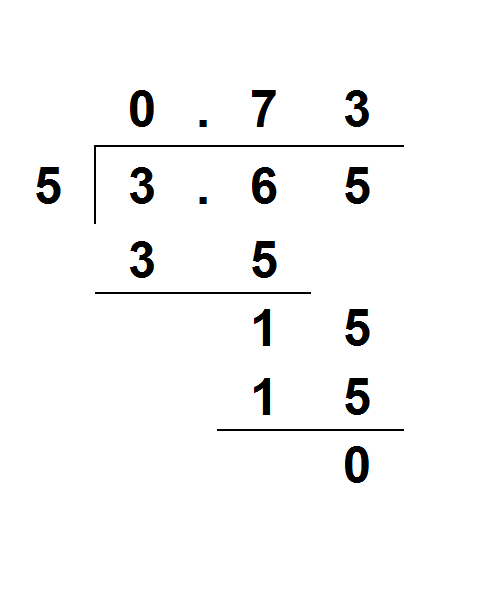
Calculate the following: (i) 0.4 x 2.7 (ii) 35 ÷ 0.07 (iii) 3.65 ÷ 5

Solution

(i) Count the number of digits in total after the decimal points ( 0.4 has 1 digit, 2.7 has 1 digit so the total is 2). Now remove the decimal points, calculate 4 x 27 = 108. Replace the decimal point so that there are 2 digits after it. So, 0.4 x 2.7 = 1.08

(ii) Consider the sum as a fraction ie. 35 / 0.07. Multiply top and bottom by 100 to remove the decimal point. The fraction becomes: 3500 / 7. Do the division to get an answer of 500.

(iii) Write this out as a normal division taking care to keep the decimal place in line in the answer.

Diagram

3 pt 65 div 5

Real-life problems using multiplication and division

Definition

Real life multiplication problems can include calculating areas and working out the total cost of a number of similarly priced items. Real life division problems include working out the cost per item and splitting a total up into a number of parts.

Method

The key is to convert the word problem into a number problem. And to use common sense. For example, if you're told the cost of 1 item and are asked to calculate the cost of a number of items, this will be a multiplication problem. On the other hand, if you're told the cost of a number of items and asked to calculate the cost per item (ie. of 1 item), this will be a division problem.

Example

Frank buys 5 packs of pens. Each pack contains 24 pens. He wants to split them equally between his 12 friends. How many pens does each friend get?

Solution

This problem has two parts. First we're told he has 5 packs of 24 pens so calculate the total number of pens. This is a multiplication problem. Total pens = 5 x 24 = 120.

Now he's splitting them up equally so we have a division problem. He's dividing them into 12 equal parts so the sum becomes 120 ÷ 12 = 10.

Test yourself on this topic

Try the free quiz with worked solutions.

Start quiz →

Get GCSE Number

Full notes, full question bank, offline.