


G GCSE Apps

GCSE Geometry

Trigonometry

16 subtopics in this section

Pythagoras' theorem

Definition

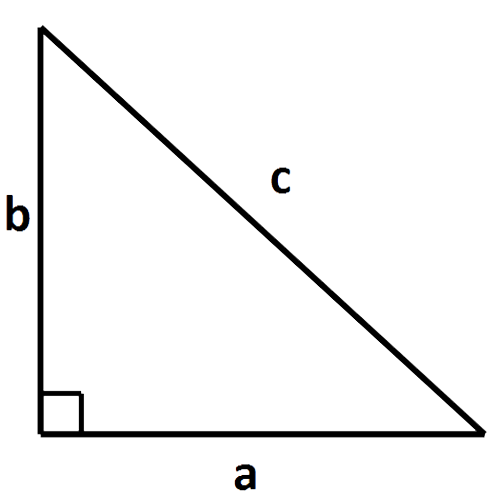
Pythagoras' Theorem states that for any right angled triangle, the square of the hypotenuse is equal to the sum of the squares of the other two sides.

Diagram
pythagoras theorem def

Note

a² + b² = c²

Method

If you know the lengths of two sides of a right angled triangle, you can work out the third by plugging the numbers in. Make sure you put them in the right place in the equation though. The longest side (opposite the right angle) is the hypotenuse and the square of that equals the sums of the squares of the two shorter sides.

Tips/hints

Remember that Pythagoras' Theorem can only be used on right angled triangles. Also, it only involves the lengths of the sides, it doesn't involve any angles.

Example

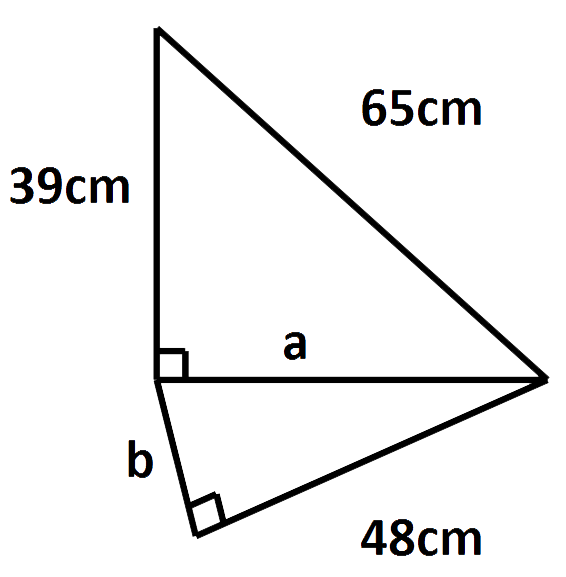
Find the length of a and b in the diagram below.

Diagram
pythagoras theorem ex

Solution

Use Pythagoras' Theorem in the top triangle. The hypotenuse is 65cm so: 65² = 39² + a² a² = 65² - 39² = 2704 So, a = 52cm

Now use Pythagoras' Theorem in the bottom triangle. Here, 52cm is the length of the hypotenuse so: 52² = b² + 48² So, b² = 52² - 48²= 400 So, b = 20cm
Pythagoras' theorem in real life

Definition

Pythagoras' Theorem can be applied to all sorts of real life problems as right angles crop up everywhere.

Method

If a diagram isn't provided, then draw one making sure you label the lengths correctly.

Example

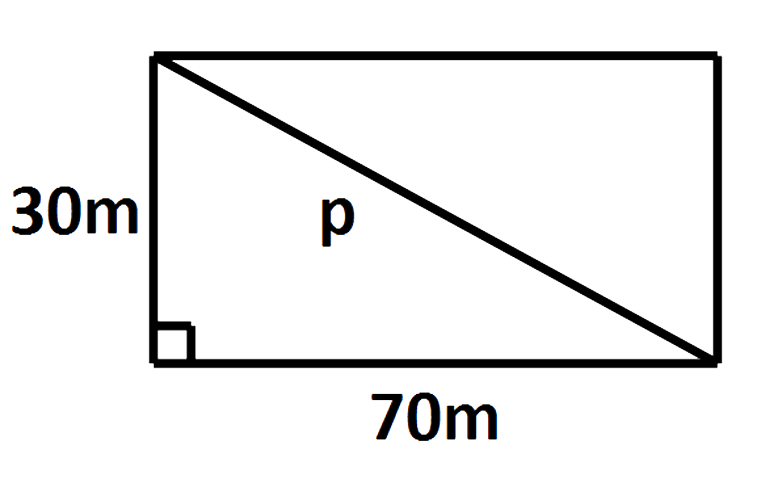
A farmer decides to put a path through a field. The field is a 30m x 70m rectangle and the path runs from one corner to the diagonally opposite one. To the nearest metre, what's the length of the path?

Solution

Draw a diagram!

Diagram

path through field

Note

From the diagram, p is the hypotenuse of a triangle whose other sides are 30m and 70m so, using Pythagoras' Theorem: p² = 30² + 70² p² = 900 + 4900 = 5800 So, to the nearest metre, the length of the path, p = 76m

Pythagoras' theorem in 3D

Definition

Pythagoras' Theorem can be applied to 3 dimensional problems as well as 2 dimensional ones.

Method

To apply Pythagoras' Theorem in 3D, break the problem down into a series of 2D right angled triangles.

Look through the worked example to see this in practice.

Example

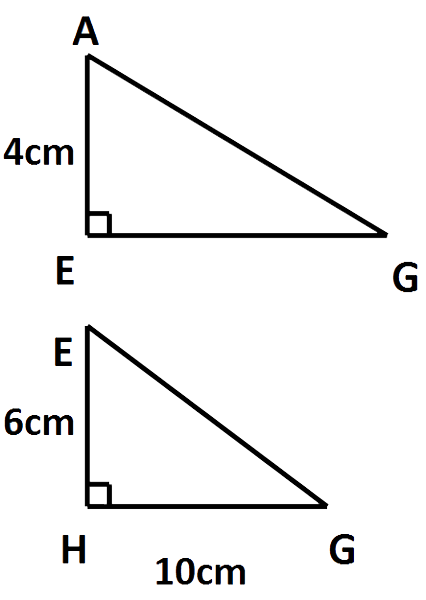
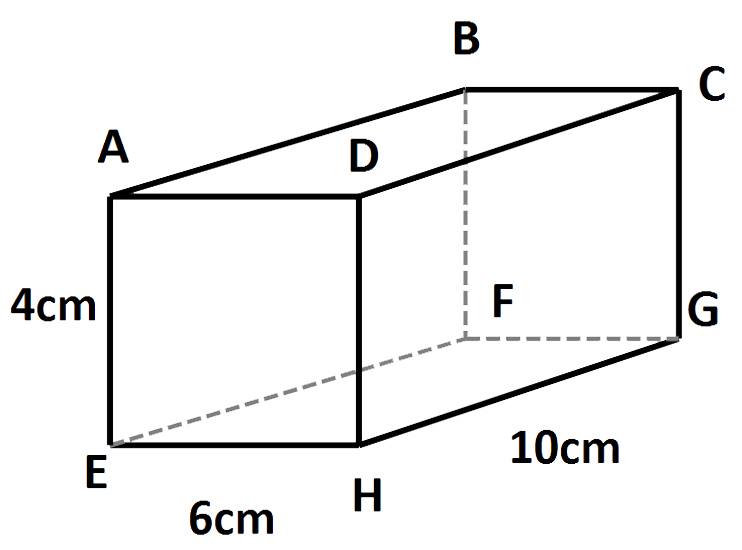
ABCDEFGH is a cuboid with dimensions 4cm x 6cm x 10cm. Find the length of AG to 1 d.p.

Diagram

pythagoras in 3D ex

Solution

AG is the hypotenuse of the triangle AEG. AE = 4cm (given) So, we need to find EG

Diagram

pythagoras in 3D sol

Note

EG is the hypotenuse of the triangle EHG. We're given EH and HG so, using Pythagoras' Theorem: EG² = EH² + HG² EG² = 6² + 10² EG = √136

Now look at triangle AEG. Using Pythagoras' Theorem: AG² = AE² + EG² AE = 4 EG = √136 So, AG² = 4² + 136 = 152 So, AG = 12.3cm to 1 d.p.

Trigonometry basics

Definition

Trigonometry is all about triangles, their angles and sides.

Diagram

basic trig triangle

Note

The size of an angle, θ, can be worked out if two of the sides shown are known.

There are 3 basic trigonometric ratios as follows:

There are true for any right angled triangle.

Another key basic of trigonometry is Pythagoras' Theorem which, in the triangle above is: hyp² = adj² + opp²

Method

Learn the definitions of sin, cos and tan and learn Pythagoras' Theorem. When presented with a right angled triangle, find the hypotenuse and work out the adjacent and opposite sides for any other given angle.

Example

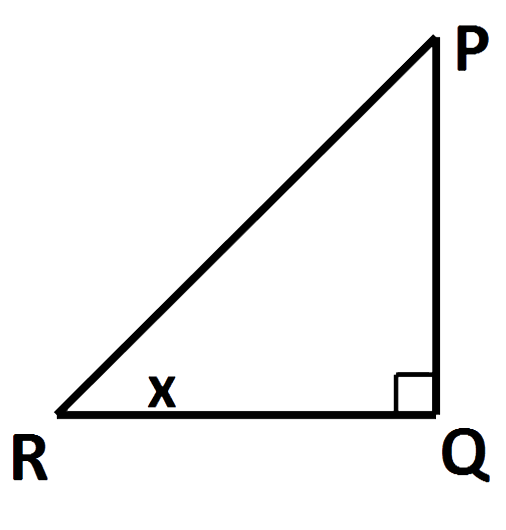
Find an expression for sin(x) in the triangle below.

Diagram

basic trig ex

Solution

sin = opp/hyp So, sin(x) = PQ/PR

Sine

Definition

In a right angled triangle, the Sine (normally known as Sin) of an angle θ, is the ratio between the side opposite the angle and the hypotenuse (see the triangle below)

Diagram

basic trig triangle

Method

Learn the formula for sin. Learn how to find the sin of an angle using a calculator. Learn also how to use the inverse sin function.

Tips/hints

For any angle θ, -1 ≤ sin(θ) ≤ 1

So, if you've come up with a sine that's not in this range, there's an error somewhere.

Example

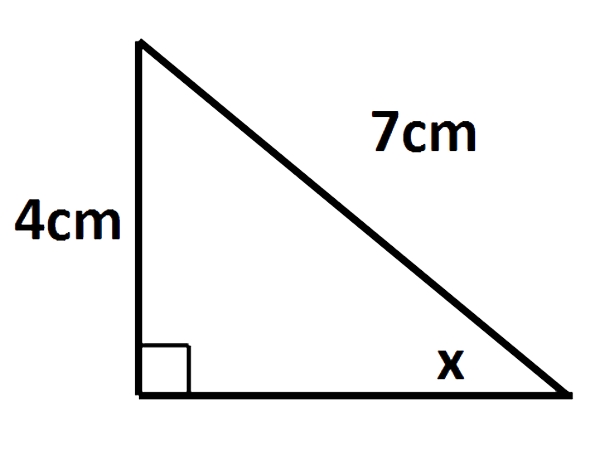
Calculate the angle x in the triangle below. Give your answer to the nearest degree.

Diagram

sine ex

Solution

So, here, sin(x) = 4/7 = 0.571429 Use the inverse sin function to find x = 35°

Cosine

Definition

In a right angled triangle, the Cosine (normally known as Cos) of an angle θ, is the ratio between the side adjacent to the angle and the hypotenuse (see the triangle below).

Diagram

basic trig triangle

Method

Learn the formula for cos. Learn how to find the cos of an angle using a calculator. Learn also how to use the inverse cos function.

Tips/hints

For any angle θ, -1 ≤ cos(θ) ≤ 1

So, if you've come up with a cosine that's not in this range, there's an error somewhere.

Example

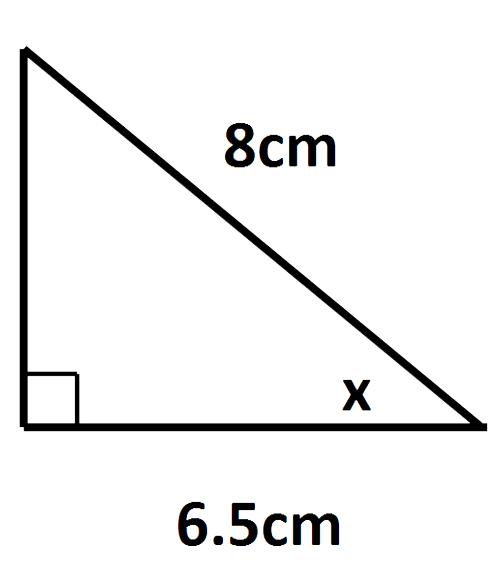
Calculate the angle x in the triangle below. Give your answer to the nearest degree.

Diagram

cosine ex

Solution

So, here, cos(x) = 6.5/8 = 0.8125 Use the inverse cos function to find x = 36°

Tangent

Definition

In a right angled triangle, the Tangent (normally known as Tan) of an angle θ, is the ratio between the side opposite the angle and the side adjacent to it (see the triangle below).

Diagram

basic trig triangle

Method

Learn the formula for tan. Learn how to find the tan of an angle using a calculator. Learn also how to use the inverse tan function.

Tips/hints

There are no bounds on the size of a tangent of an angle. -∞ < tan(θ) < ∞

Example

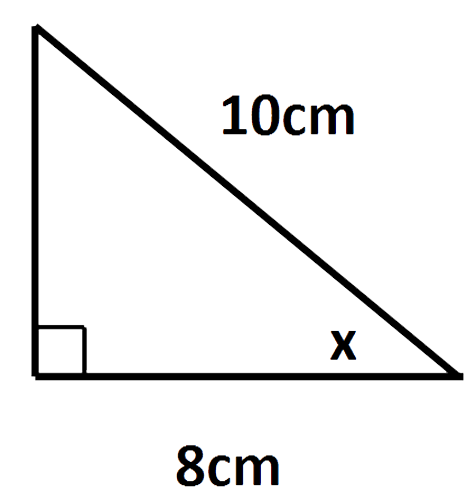
Find tan(x) in the triangle below.

Diagram

tangent ex

Solution

Now, be careful here. The sides we've been given are the side adjacent to x (8cm) and the hypotenuse. For tan, we need the adjacent and opposite sides.

To find the third side of the triangle, use Pythagoras' Theorem. 10² = 8² + opp² So, opp² = 100 - 64 = 36 The side opposite x is 6cm long. This makes tan(x) = 6/8 = 0.75

Sin, cos or tan?

Definition

Using the correct trig formula is crucial to finding an angle correctly.

Diagram

basic trig triangle

Method

If it helps, label the sides of the triangle adj, opp, hyp according to the angle you've been asked to find/given. Then decide which trig ratio to use.

Example

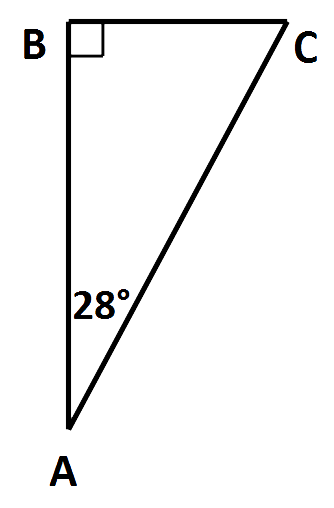
If BC = 15mm, find the length of AB in the triangle below. Give your answer to the nearest mm.

Diagram

sin cos or tan ex

Solution

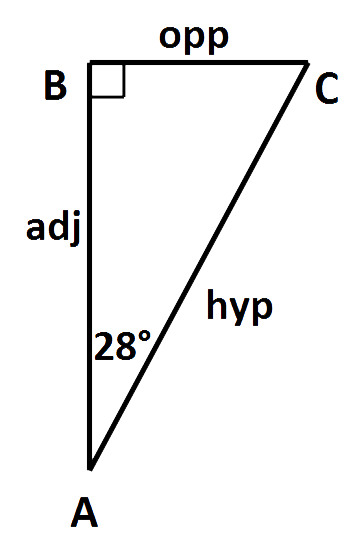
Put the opp, adj, hyp labels on the triangle for the angle you've been given.

Diagram

sin cos or tan sol

Note

We've been told the length of BC (opp) and we need to find the length of AB (adj) so, the ratio we need is tan.

So, tan(28°) = 15/AB AB = 15/tan(28°)

So, to the nearest mm, AB = 28mm

The sine rule

Definition

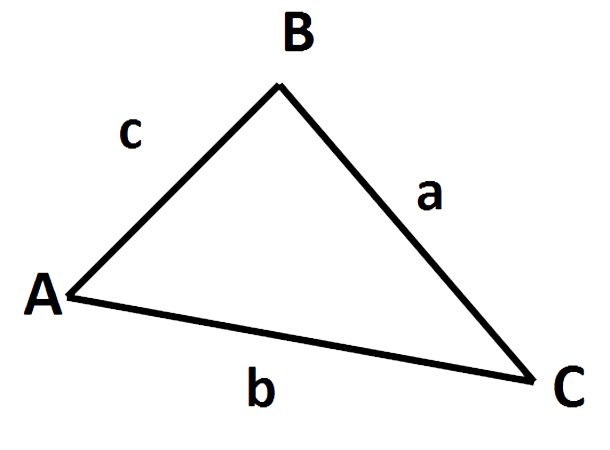
The trig ratios, sin, cos and tan only work in right angled triangles when using opp, adj and hyp. However, there are two rules, the Sine Rule and the Cosine Rule that can be used in any triangles.

Diagram

sine rule triangle

Note

The Sine Rule states:

Note how the sides are labelled, a is opposite angle A etc.

Method

The Sine Rule can be used in trig problems in the following circumstances:

When 2 Angles and Any Side are known

When 2 Sides and an Angle NOT enclosed by them are known.

Normally, we only need to use part of the Sine Rule eg. b/Sin B = c/Sin C

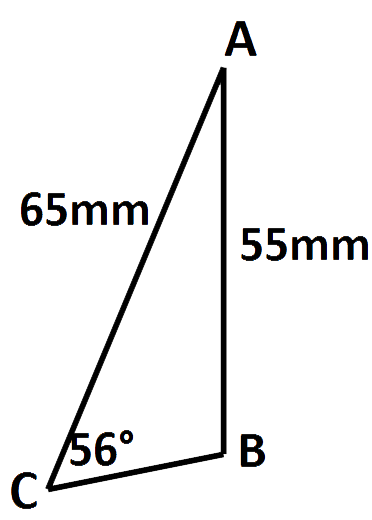
Example

Find the size of the angle at A in the triangle below. Give your answer to 1 d.p. (Note, the angle at B is > 90°)

Diagram

sine rule ex

Solution

We know 2 Sides and an Angle that's NOT enclosed between them so the Sine Rule is good to use here.

The Sine Rule states:

First we'll find the angle at B. b/Sin B = c/Sin C So, 65/Sin B = 55/Sin (56) Sin B = (65 x Sin(56))/55 = 0.9798 to 4 sig.figs.

Taking the inverse sine we get B = 78.46° BUT we're told that the angle at B is > 90°. So, since sin(θ) = sin(180°-θ), B must be 180° - 78.46° = 101.54° So, A = 180° - (101.54° + 56°) = 22.5° to 1 d.p.

Note

In a GCSE question, it will either be stated or the diagram will indicate which inverse value of the sine function you should use. The examiners will not try to trick you.

The cosine rule

Definition

The trig ratios, sin, cos and tan only work in right angled triangles when using opp, adj and hyp. However, there are two rules, the Sine Rule and the Cosine Rule that can be used in any triangles.

Diagram

sine rule triangle

Note

The Cosine Rule states: a² = b² + c² - 2bc cosA The letters can be rotated so, b² = a² + c² - 2ac cosB c² = a² + b² - 2ab cosC

Note how the sides are labelled, a is opposite angle A etc.

Method

The Cosine Rule can be used in trig problems in the following circumstances:

When 2 Sides plus the Angle Between them are known

When all 3 Sides but no angles are known

Example

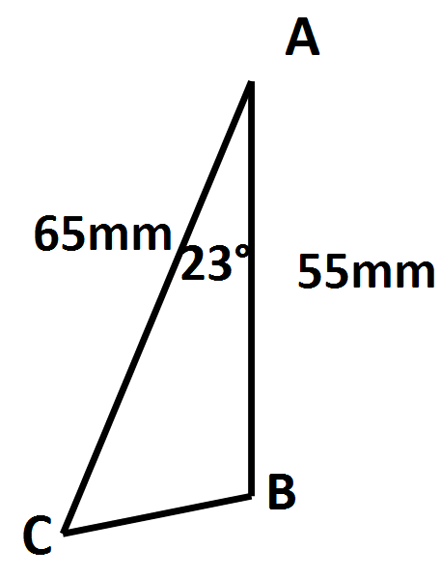
Find the angle at B to the nearest degree in the triangle below.

Diagram

cosine rule ex

Solution

We're given 2 sides and the angle between them so we can use the Cosine Rule. We know the lengths b, c and Angle A

The Cosine Rule states: a² = b² + c² - 2bc CosA

So, a² = 65² + 55² - 2(65)(55) cos(23°) Expanding it all out gives a = 25.85mm

Now use the Cosine Rule again to find B. This time we'll use the form: b² = a² + c² - 2ac CosB

Rearrange this to get: cosB = (a² + c² - b²)/2ac

Putting in the values we have: cosB = (25.85² + 55² - 65²)/(2(25.85)(55)) cosB = -0.1870 to 4 sig.figs.

So, B = 101° to the nearest degree.

Using sine to find the area of a triangle

Definition

The Area of a Triangle is given by the formula: Area = (Base x Height)/2 There is another formula which is also works: Area = (ab SinC)/2 The proof is below.

Note

using sine for area of triangle def

Consider the triangle ABC. The Area is (ah)/2 Now consider the triangle AXC where AX = h (ie. the perpendicular height of ABC).

SinC = h/b So, h = bSinC

Substituting this in Area = (ah)/2 we get Area = (ab SinC)/2

Rotating the letters, Area = (bc SinA)/2 = (ac SinB)/2

Method

Using this formula, we can work out the area of a triangle if we know the lengths of 2 Sides and the Angle between them.

Example

Find the area of the triangle below to the nearest cm²

Diagram

cosine rule ex

Solution

The area of ABC is (bc SinA)/2 ie. (55 x 65 x sin(23))/2 = 698.43 mm² So, to the nearest cm², the Area is 7 cm²

2-D trigonometric problems

Definition

The Sine and Cosine Rules can be used to solve countless 2 Dimensional problems involving angles and distances.

Method

If you're not given a diagram, draw one. See what information you have and so decide which rule to use.

Example

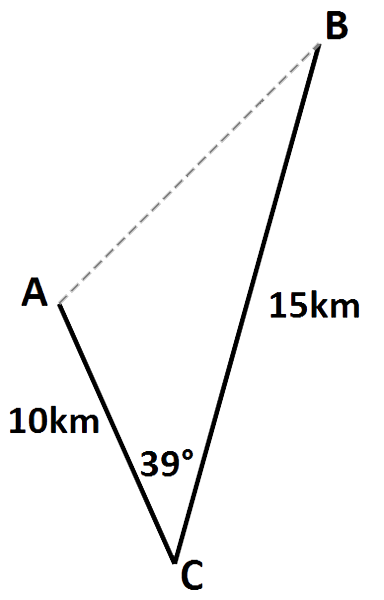
Two boats, A and B are out at sea. The distance of A to the lighthouse C is 10km. The distance of B is 15km. If the angle BAC is 39°, what is the distance between the boats to 1 d.p.?

Solution

First draw a diagram.

Diagram

two boats ex

Note

We know 2 Sides and the Angle between them so we should use the Cosine Rule.

c² = a² + b² - 2ab cosC This becomes: c² = 15² + 10² - 2(10)(15)cos(39°)

So, c² = 325 - 300cos(39°) = 91.856 Which makes AB, the distance between the boats, 9.6km to 1 d.p.

3-D trigonometric problems

Definition

What can be applied to 2 Dimensional problems can be applied to 3 Dimensional ones too. The trig ratios, sin, cos and tan, Pythagoras' Theorem and the Sine and Cosine rules can all be used to solve problems in solid geometry.

Method

Convert the 3D problem into a series of 2D problems. Draw diagrams and make sure you label them clearly and correctly.

Example

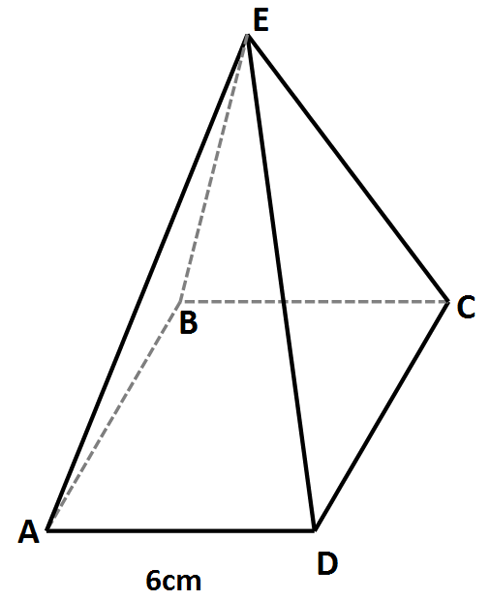
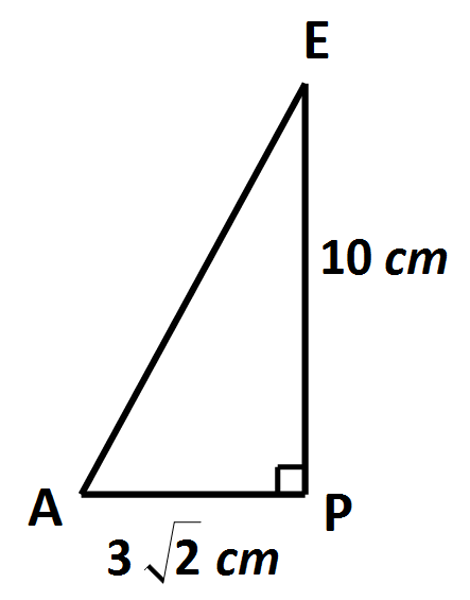
A square based pyramid's base has sides length 6cm and its volume is 120 cm³. Find the following: (i) Its height (ii) The length of the diagonal of its base (leave your answer in surd form) (iii) The length of a sloping edge to 1 d.p.

Solution

We need a diagram.

Diagram

3D trig ex

Note

(i) The volume of a pyramid is (Area of Base x Height)/3 So, 120 = (6 x 6 x Height)/3 This makes the Height 10cm

(ii) Consider the triangle ABD. AB = AD = 6cm. AD is the hypotenuse so using Pythagoras' Theorem, BD² = 6² + 6² BD = √72 = 6√2 cm

(iii) We'll draw another diagram where P is the centre of the base ABCD. From the first part of the question, EP = 10cm and from the second part, AC = BD = 6√2 cm so, AP = 3√2 cm

Diagram

3D trig ex2

Note

So, using Pythagoras' Theorem, AE² = AP² + PE² AE = √(100+18) = 10.9 cm to 1 d.p.

Real-life trig problems

Definition

Sin, Cos, Tan, Pythagoras' Theorem, the Sine and Cosine Rules are all applicable in the real world.

Method

The key is working out a diagram (if one isn't supplied) and then deciding which of the tools in your trig toolbox to use.

Example

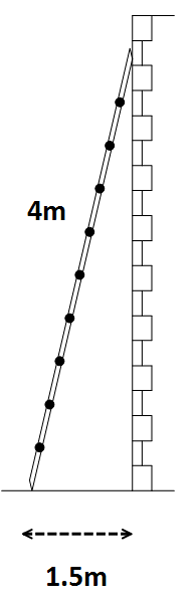
The safety instructions with a ladder say that it must not be used with the base any closer than 1.5m to the wall it's leaning against. If the length of the ladder is 4m, how high up the wall can it reach to 1 d.p.?

Solution

First draw a diagram. The ladder will reach highest up the wall when its base is as close as possible to the wall ie. 1.5m from the wall.

Diagram

real life trig ex

Note

Here we have a right angled triangle and two lengths. We want to find the third length so we use Pythagoras' theorem. If h = the height the ladder reaches up the wall, 4² = h² + 1.5² So, h² = 16 - 2.25 = 13.75 To 1 d.p., h = 3.7m That is, the maximum height the ladder can reach up the wall is 3.7m

Exact Trig Values

Definition

For certain special angles, the values of sin, cos and tan can be expressed exactly using fractions and surds, rather than decimals.

You must learn these exact values for your GCSE exam — they will not be given on the formula sheet.

The Values

Note: tan 90° is undefined because you would be dividing by zero.

Method

To remember these values, note the patterns:• sin values go: 0, ½, √2/2, √3/2, 1 (increasing from 0° to 90°)• cos values are the REVERSE of sin: 1, √3/2, √2/2, ½, 0• tan = sin ÷ cos for each angle

A useful trick: write the numbers 0, 1, 2, 3, 4. Take the square root of each and divide by 2:√0/2 = 0, √1/2 = ½, √2/2, √3/2, √4/2 = 1.These give sin 0°, sin 30°, sin 45°, sin 60°, sin 90°.

Example

Find the exact value of sin 30° + cos 60°.

Solution

sin 30° = ½ and cos 60° = ½

So sin 30° + cos 60° = ½ + ½ = 1

Tips/hints

Notice that sin θ = cos(90° − θ). For example, sin 30° = cos 60° = ½. This is because sine and cosine are complementary functions.

In the exam, if the answer involves √2 or √3, the question is likely testing exact trig values.

Area of Segments

Definition

A segment of a circle is the region between a chord and the arc it cuts off. A minor segment is the smaller region; a major segment is the larger one.

The area of a segment is found by subtracting the area of a triangle from the area of a sector.

Key Formulas

Area of sector:

Area of triangle in sector = ½r² sin θ

Area of segment = Area of sector − Area of triangle

Or using a single formula:

Method

To find the area of a segment:1. Calculate the area of the sector using (θ/360) × πr²2. Calculate the area of the triangle using ½r² sin θ3. Subtract: Segment area = Sector area − Triangle area

Example

A circle has radius 10 cm. A chord subtends an angle of 90° at the centre. Find the area of the minor segment to 1 decimal place.

Solution

Area of sector = (90/360) × π × 10² = 25π = 78.5 cm²

Area of triangle = ½ × 10² × sin 90° = 50 × 1 = 50 cm²

Area of segment = 78.5 − 50.0 = 28.5 cm²

Tips/hints

Make sure your calculator is in degree mode when using sin θ in these calculations.

For major segments, calculate the minor segment first, then subtract from the full circle area.

Test yourself on this topic

Try the free quiz with worked solutions.

Start quiz →

Get GCSE Geometry

Full notes, full question bank, offline.