

G GCSE Apps

GCSE Geometry

Transformational Geometry and Vectors

18 subtopics in this section

Congruent shapes

Definition

Two shapes are Congruent if they're the same size and shape. They can be rotated or reflected but they must be the same size and shape.

Diagram
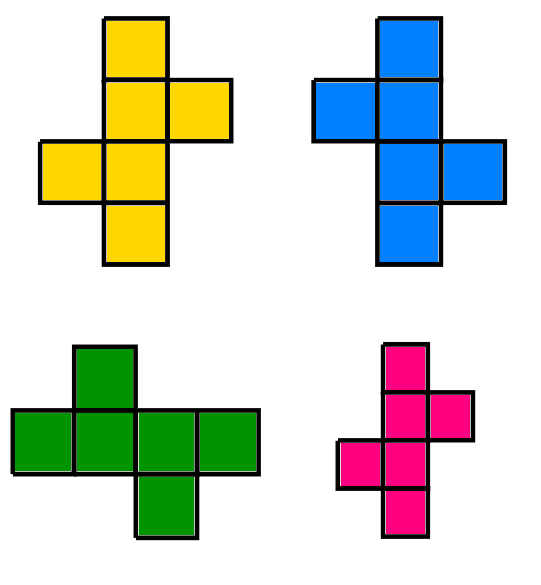
congruent def

Note

In the diagram above, the Blue shape is Congruent to the Yellow one as it's the same shape and size, it's just been reflected. The Green shape is also Congruent to the Yellow one (and the Blue one) - it's the Yellow one rotated through 90° The Pink shape, though it's similar to the Yellow, it's not Congruent as it's not the same size.

Method

Just remember, Congruent means same shape AND size. Similar means just same shape.

Example

Which shapes are congruent to the blue one?

Diagram
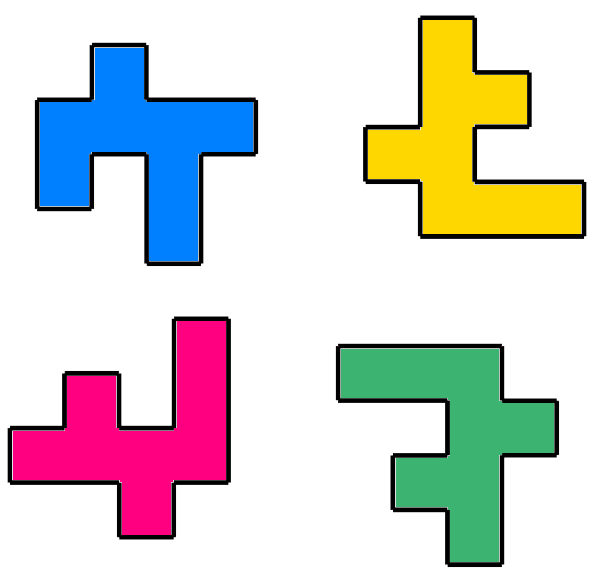
congruent shapes ex

Solution

None of them! The pink, yellow and green shapes are all congruent to one another but not to the blue shape.
Lines of symmetry

Definition

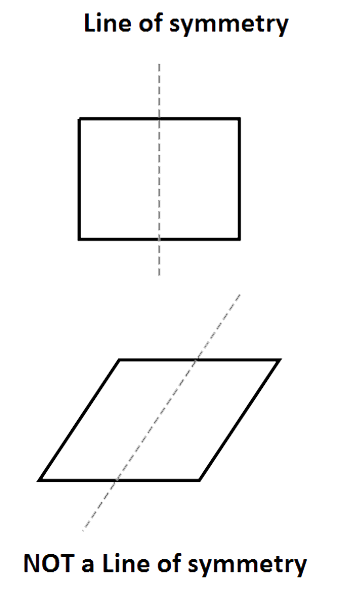
A Line of Symmetry is a line that divides a shape into two halves, each of which is the mirror image of the other.

Diagram

line of symmetry def

Note

The line through the rectangle divides it in half, each half being a mirror image of the other. So, it's a Line of Symmetry.

The line through the parallelogram divides it in half but, although the halves are identical shapes, they are NOT mirror images of each other. So, this is NOT a Line of Symmetry.

Tips/hints

Don't forget to look for diagonal Lines of Symmetry.

The number of Lines of Symmetry of a regular polygon is equal to the number of sides of the polygon.

Example

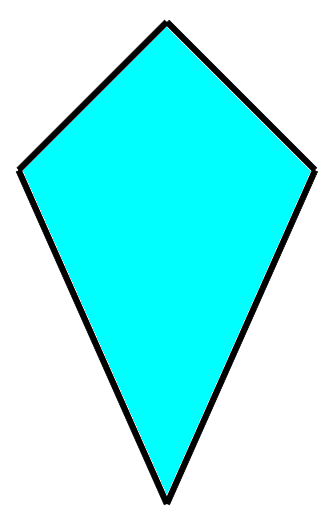
How many lines of symmetry does the shape below have?

Diagram

symmetry kite

Solution

It just has one, the vertical line that divides it in two.

Similarity

Definition

Two shapes are Similar if they're the same shape but different sizes. The corresponding angles in Similar shapes are the same.

If a pair of two-dimensional shapes are Similar, the lengths of corresponding sides will be in the same ratio.

Diagram

similar rectangles def

Note

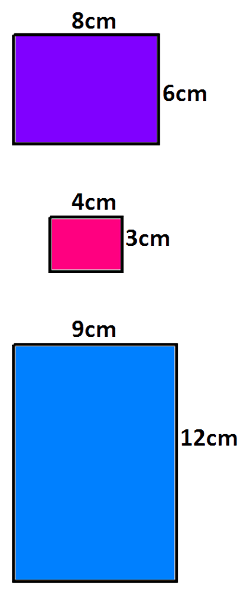
The three rectangles above are all similar. The Pink one has dimensions that are half those of the Purple. The Blue one (it's been rotated) has dimensions that are 3 times those of the Pink one.

So, looking at the longer sides of the rectangles in the order Purple to Pink to Blue, they're in the ratio 8 : 4 : 12 ie. 2 : 1 : 3. And the shorter sides are in the ration 6 : 3 : 12 ie. 2 : 1 : 3. So, the lengths of corresponding sides are in the same ratio.

The Scale Factor tells us how much bigger/smaller the sides of one shape are than another. In the example of the rectangles above, the scale factor of the Purple to the Pink is 0.5 because the lengths in the Pink rectangle are half those in the Purple one. The scale factor from Pink to Blue is 3 because the lengths in the Blue rectangle are 3 times as large.

Method

Notice that if the Scale Factor is < 1, the shape gets smaller. If it's > 1, it gets bigger. (And if it's = 1, the shapes are congruent)

Example

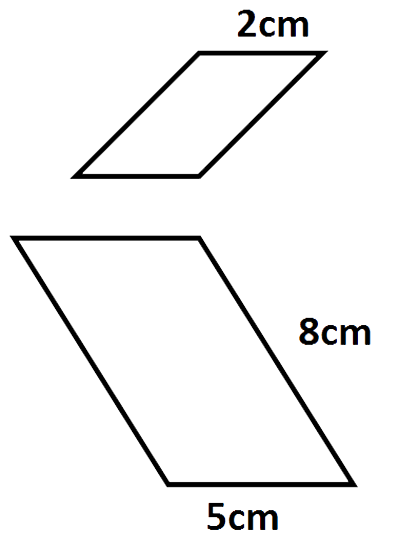
The parallelograms in the diagram below are similar. What is the length of the longer side in the smaller parallelogram?

Diagram

similar parallelograms ex

Solution

To work this out, we need to work out the scale factor. We know the lengths of the shorter sides in both parallelograms Large to small is 5 : 2 so the scale factor is 2/5 = 0.4

So, the longer sides will be in the same ratio. So, the longer side of the small parallelogram will be 0.4 x 8cm = 3.2cm

Rotational symmetry and tessellations

Definition

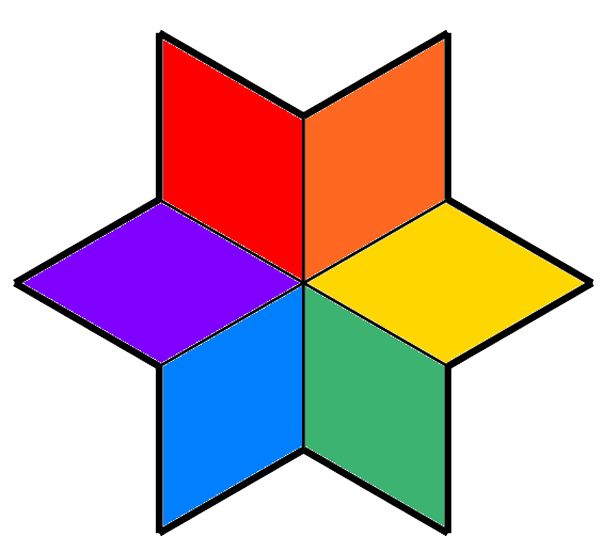
If a two-dimensional shape can be rotated about a point and look exactly the same in the new position then it has Rotational Symmetry.

Diagram

rotational star

Note

The star above has Rotational Symmetry of order 6, That means, that, starting at one position, (as shown) we can turn it to 5 more positions (turn it clockwise about the centre so that purple replaces red, then blue replaces purple etc) that fill the same space. So, including the first position, there are 6 different rotations that fill the same space.

Definition

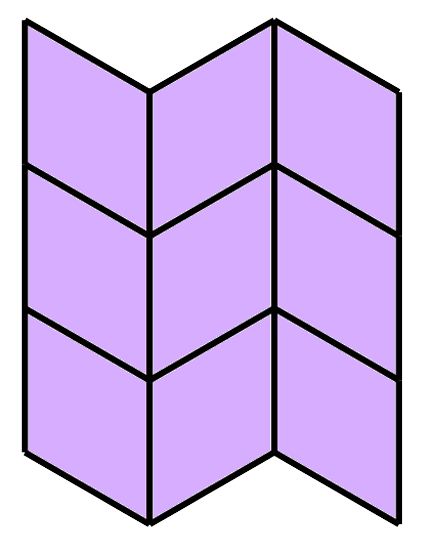
Shapes that Tessellate can be fitted together without any gaps. The pattern formed by such shapes fitting together is called a Tessellation.

Diagram

tessellating parallelograms def

Tips/hints

The Order of Rotational Symmetry of a regular polygon is the same as its number of sides.

Example

For each of the shapes listed below, give its order of Rotational Symmetry and state whether it will tessellate.

Solution

(i) Regular pentagon (ii) Isosceles triangle (iii) Regular hexagon

(i) All regular polygons have Rotational Symmetry of the same order as their number of sides so a regular pentagon has order 5 A regular pentagon does NOT tessellate.

(ii) An isosceles triangle has no Rotational Symmetry. It does tessellate

Diagram

isos tessellation

Note

(iii) All regular polygons have Rotational Symmetry of the same order as their number of sides so a regular hexagon has order 6 A regular hexagon does tessellate (think of a honeycomb)

Planes of symmetry

Definition

A Plane of Symmetry is a 3D version of Line of Symmetry, that is, a Plane of Symmetry divides a solid shape into two identical halves that are mirror images of each other.

Diagram

cylinder with plane of symmetry

Note

Here the cylinder is cut vertically into two equal halves by the Plane of Symmetry.

Tips/hints

Regular solids usually have several planes of symmetry so look out for diagonals and longitudinal planes as well as the more obvious cross-sections.

Example

How many planes of symmetry does a square-based pyramid have?

Diagram

pyramid def

Solution

It has 4 planes of symmetry. Two cut the pyramid vertically through the apex cutting the square base into two equal rectangles. The other two cut the pyramid vertically through the apex cutting the square base into two equal triangles along its diagonal.

Translations

Definition

Shapes can be Transformed in four different ways: Translation, Reflection, Rotation and Enlargement.

A Translation moves the shape. It doesn't change its orientation or its size and it doesn't reflect it. It simply shifts it to another position.
Diagram

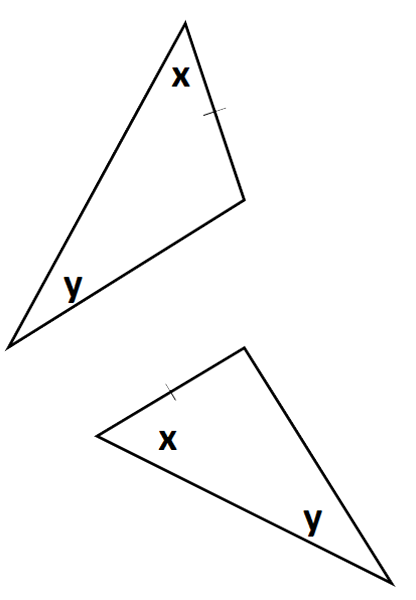
triangle translations

Note

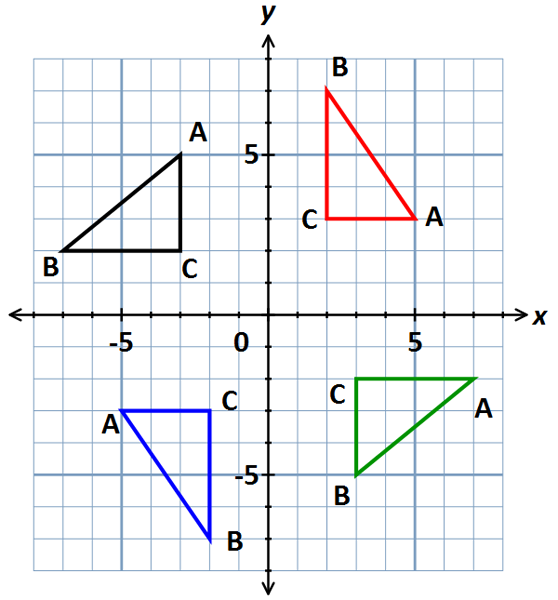
In the diagram, each triangle is a translation of each of the others. For example, if the Red triangle is moved 2 to the right and 3 up, it becomes the Yellow triangle.

We show this by using a Vector of Translation The top number shows the distance moved along the x axis, the bottom one, the distance moved up the y axis.

The Vector of Translation to get from the Yellow triangle to the Red one is . The numbers are negative because it's moved in a negative direction along the x axis and in a negative direction along the y axis.

Method

To find the Vector of Translation, find two equivalent points on each shape. Work out the difference in their x and y coordinates. Use these figures in the Vector of Translation, remembering to get the signs right depending on which shape is being translated to which other shape.
To translate a shape using a Vector of Translation, simply move it along the axes by the amounts indicated in the vector. Don't forget, a negative x value means shift left, and a negative y value means shift down.

Example

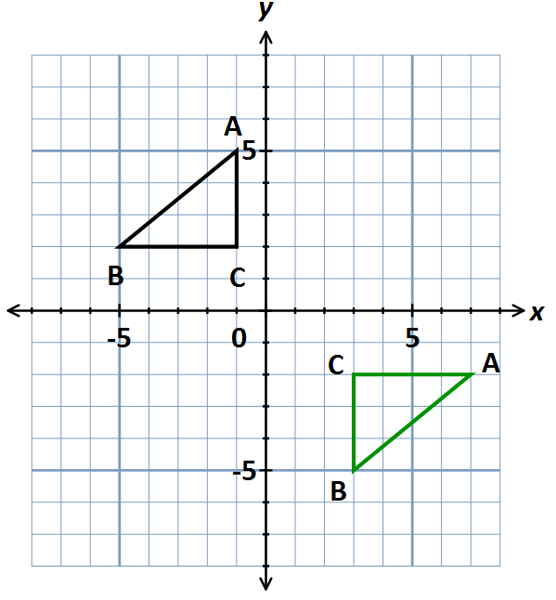
Which vector translates the Black triangle to the Green one?

Diagram

triangle translations

Solution

The Green triangle is one position to the right of the Black one ie. -1 along the x axis. It's also 4 positions above on the y axis. So, the Vector of Translation is

Reflections

Definition

Shapes can be Transformed in four different ways: Translation, Reflection, Rotation and Enlargement.

A Reflection reflects the shape. It doesn't change its size but reflects it in a Mirror Line
Diagram

rectangle reflections def

Note

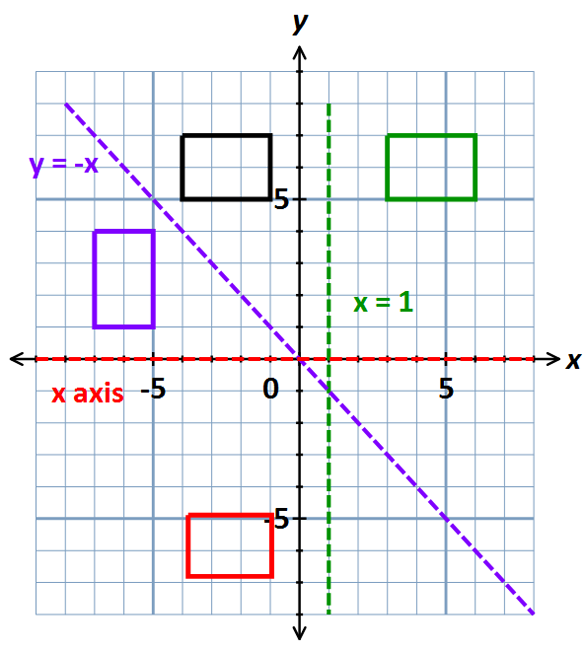
In the diagram, the Black rectangle has been reflected in 3 different Mirror Lines

The Red rectangle is its reflection in the x axis. The Green rectangle is its reflection in the line x = 1 The Purple rectangle is its reflection in the line y = -x

Method

Given a shape and its Reflection, you need to be able to work out the equation of the Mirror Line.

If it's a horizontal or vertical line, it's usually fairly obvious. However, if it's not or you're struggling to locate the Mirror Line, do the following:

Find a pair of equivalent points on the two shapes and join them with a line. Mark the point on this line that is midway between the two points you've just joined. Repeat the process with another pair of equivalent points. Join the two midpoints and extend to create the Mirror Line

If you're given a shape and a Mirror Line and asked to draw the Reflection, fold the paper along the Mirror Line with the shape on top. Trace the shape onto the paper below and then, unfold and draw the outline traced.

Example

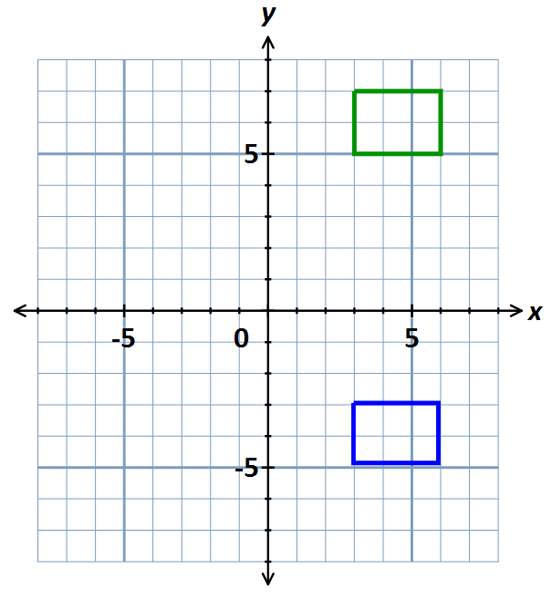
In which line has the Blue rectangle been reflected to produce the Green one?

Diagram

rectangle reflections ex

Solution

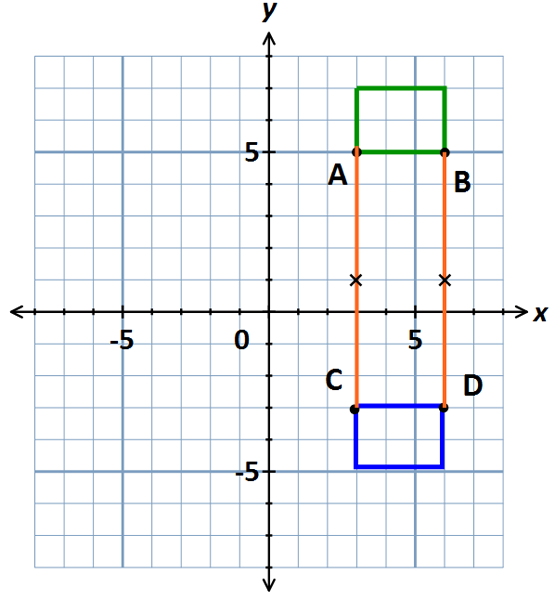
We're looking for a horizontal line that lies between the two rectangles that will act as a mirror. Find a pair of equivalent points (A and C) and join them. Find the midpoint of the line AC. Repeat the process with B and D. Midpoints are marked by crosses.

Diagram

rectangle reflections sol

Note

Join the crosses and extend the line. Its equation is y = 1

Rotations

Definition

Shapes can be Transformed in four different ways: Translation, Reflection, Rotation and Enlargement.

A Rotation rotates (turns) a shape about a point. It doesn't change its size and it doesn't reflect it. It just changes its orientation.

Diagram

single triangle rotation def

Note

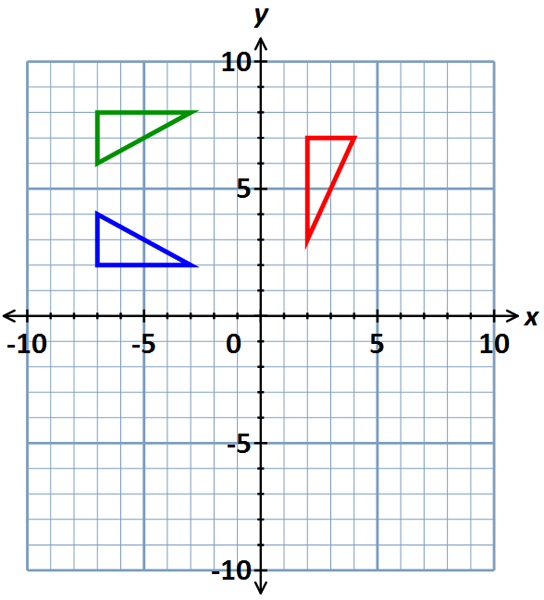
The Black triangle has been rotated Clockwise about the point (0,0) through 90° to create the Red triangle. The Blue triangle has been rotated Anti-clockwise about the point (0,0) through 90° to create the Green triangle.

Method

To specify a Rotation, you need to state the following: The Point about which it's been rotated known as the Centre of Rotation. The Angle through which it's been rotated. The Direction in which it's been rotated (clockwise or anti-clockwise)

To check the Centre of Rotation, trace the shape being rotated and then place your pencil tip at the rotation point you think it is and turn the tracing paper through the specified angle. If the traced shape now covers the new one exactly, the Centre of Rotation is correct. If not, try again.

Once you've found the Centre of Rotation, the angle and direction are easily worked out.

To rotate a shape about a point, again, the easiest thing is to use tracing paper. Trace the shape, then place your pencil tip at the Centre of Rotation, turn the tracing paper through the Angle of Rotation in the specified direction and trace the shape onto the paper below.

Example

The Black triangle has been rotated to create the Green one. Find the following: (i) Centre of Rotation (ii) Angle of Rotation (iii) Direction of Rotation

Diagram

single triangle rotation ex

Solution

(i) To find the Centre of Rotation, you're going to need to get the tracing paper out. Trace the Black triangle then use trial and error to find the point at which to pivot it so it rotates and then covers the Green one. You should find the answer to be (1, 0)

(ii) Once you've found the Centre, the Angle is straightforward - it's through a half-turn ie. 180°

(iii) As you've probably realised, a half-turn, 180°, is the same Clockwise as Anti-clockwise so both are correct.

Enlargements

Definition

Shapes can be Transformed in four different ways: Translation, Reflection, Rotation and Enlargement.

An Enlargement changes the size of the shape and in doing so, moves it too. Although it's called 'Enlargement' it can actually make a shape smaller. The Scale Factor tells you how much bigger or smaller the transformed shape will be.

Whereas the other three transformations produce a Congruent shape, an Enlargement produces a Similar shape. That is, it's the same shape but a different size.
Diagram

triangle enlargements def

Note

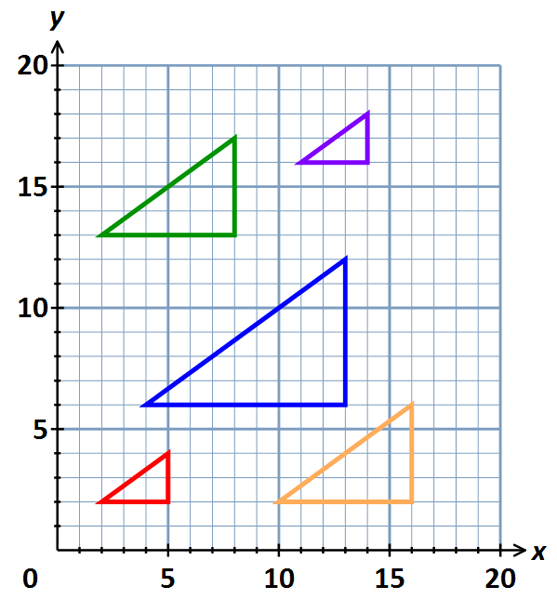
The Red triangle has been Enlarged by a Scale Factor of 3 to produce the Blue one. The Green triangle has been Enlarged by a Scale Factor of 0.5 to produce the Purple one.

If the Scale Factor is > 1, the shape becomes bigger. If it's < 1, the shape becomes smaller.

As well as a Scale Factor, an Enlargement is also defined by the Centre of Enlargement.

This defines where the Enlarged shape will be located. You can almost consider it as a projection point. Looking at the diagram below should illustrate that.

Diagram

centre of enlargement 1

Note

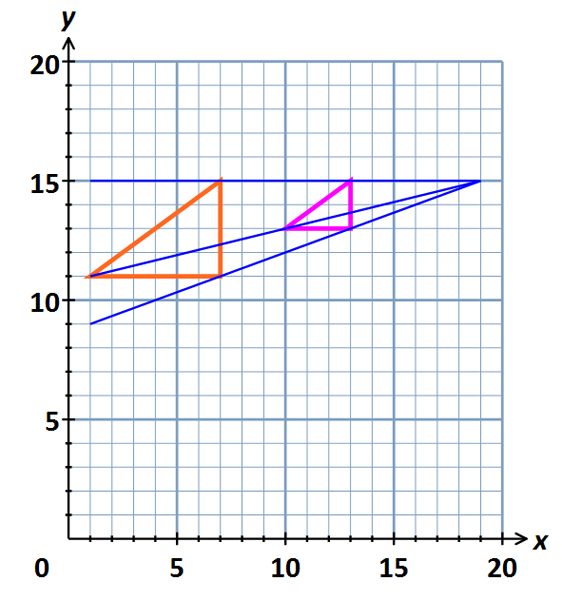
Here, the Centre of Enlargement is the point (19, 15). Looking from this point, any point in the Pink triangle is projected onto the equivalent point in the Orange triangle.

Method

To find the Scale Factor, just see how much bigger/smaller the sides of the transformed shape are compared to those of the original. (See the module on Similarity).

To find the Centre of Enlargement, draw lines between equivalent points on each shape and project them to meet at a central point. This point is the Centre of Enlargement.

To see how to create an Enlargement from a given shape, Centre of Enlargement and Scale Factor, work through the example below.

Example

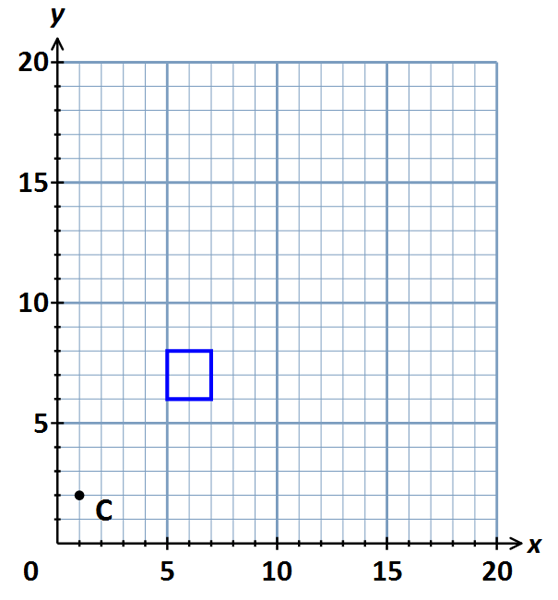
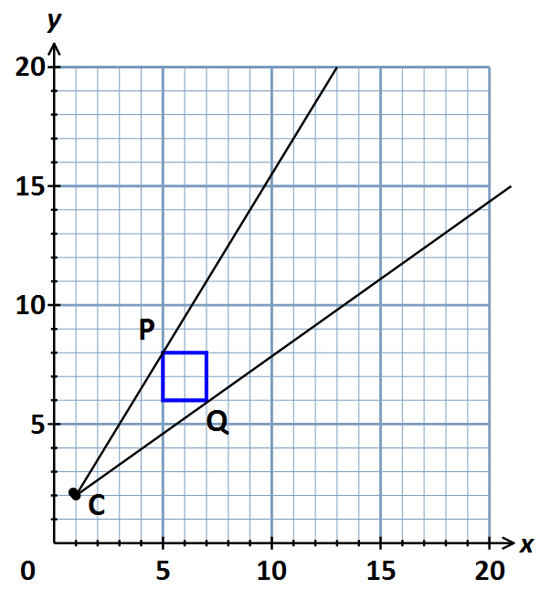
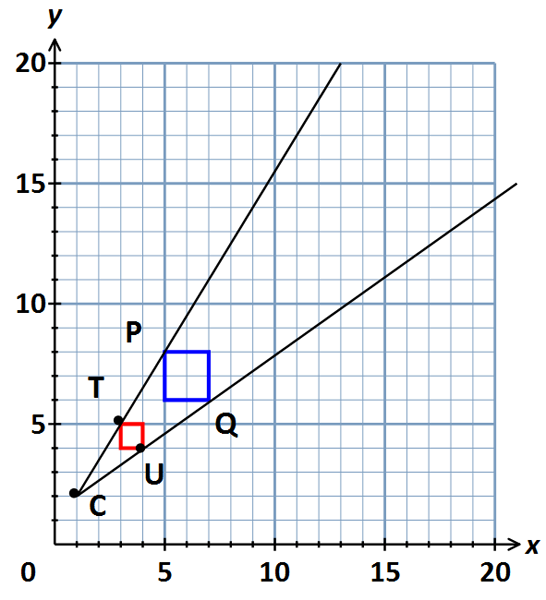
Using the Centre of Enlargement (1, 2), draw an Enlargement of the Blue Square with the following: (i) A Scale Factor of 2 (ii) A Scale Factor of 0.5

Diagram

centre of enlargement 2

Solution

First, draw lines from C (the Centre of Enlargement) through two of the corners of the Blue square as shown. Let the points of contact with the square be P and Q

Diagram

centre of enlargement 3

Note

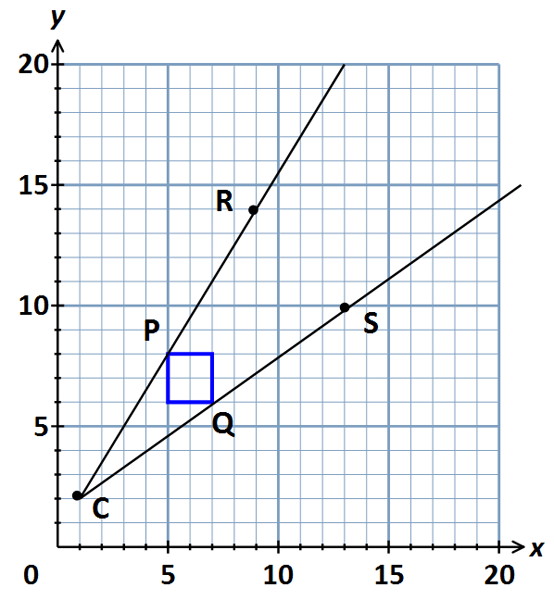
Now calculate the x and y distances from C to P and C to Q. Considering CP, the x distance is 4 and the y distance is 6. Now, the Scale Factor is 2 so mark a point along the extension of CP that has an x distance of 2 x 4 and a y distance of 2 x 6 from C. Call this point R

Diagram

centre of enlargement 4

Note

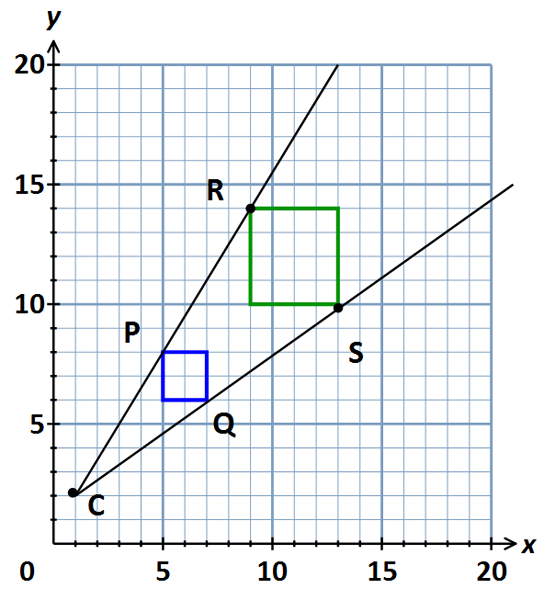
The coordinates of R are (9, 14)

Repeat the process for the projection of the point Q. The coordinates of the projected point S will be (13,10)

Now draw the enlarged square with opposite corners, R and S

Diagram

centre of enlargement 5

Note

To check, you can draw the projections through the other two corners of the original square.

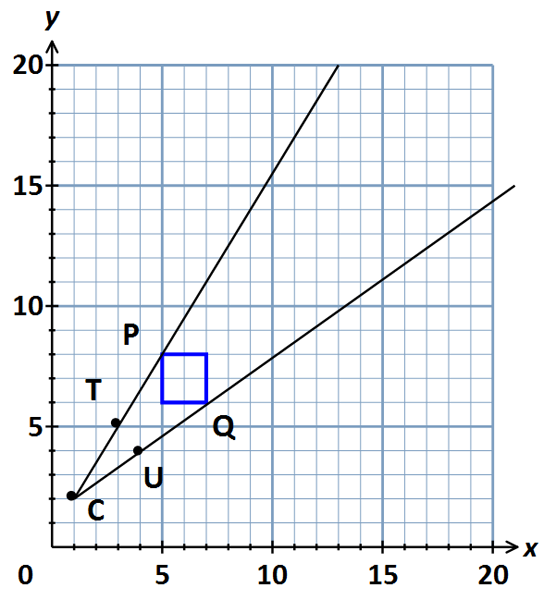
(ii) As before, mark P and Q and draw extended lines CP and CQ.

Diagram

centre of enlargement 3

Note

This time, the scale factor is 0.5 so we need to mark points that are 0.5 times the x and y distances from C as P and Q. Call these T and U

Diagram

centre of enlargement 6

Note

Now complete the square.

Diagram

centre of enlargement 7

Note

And that's all there is to it...

Enlargements 2D and 3D

Definition

See the revision notes on the module 'Enlargements (foundation)' for the definition of an Enlargement of a 2D shape by a Scale Factor > 0. In this module, we'll consider Enlargements where the Scale Factor is < 0 and also Enlargements of 3D shapes.

Diagram

triangles enlargements 3

Note

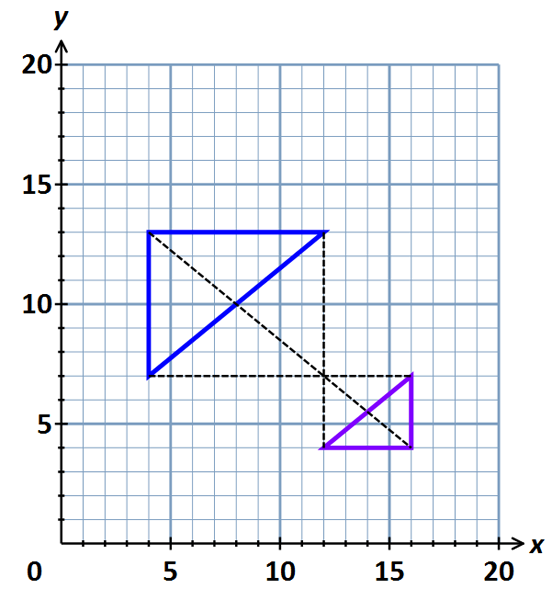
In the diagram, the Purple triangle has been Enlarged through the point (12, 7) by a Scale Factor of -2 to produce the Blue triangle. When the Scale Factor is negative, the Enlargement appears on the opposite side of the Centre of Enlargement and as a reflection. The size of the Scale Factor, 2, indicates the magnitude of the Enlargement.

Enlargement of Areas and Volumes. So far when we've considered Enlargements, we've looked at the effect on the dimensions of a 2D shape. The Scale Factor defines by what Factor the lengths of the sides will change. However, for the a rectangle with sides a, b, say, the area is ab. If, it's enlarged by a Scale Factor of p, its sides become pa and pb. So, its area becomes (pa)(pb) = p²ab that is, is p² times the area of the original.
Similarly, imagine a cuboid with sides a,b,c which is enlarged by a factor of p. Its sides become pa, pb, pc. So the volume of the enlarged shape is (pa)(pb)(pc) = p³abc ie. p³ times the volume of the original

Method

Remember that an Enlargement by a negative Scale Factor reflects the shape and projects it onto the opposite side of the Centre of Enlargement.

When a 2D shape is enlarged by a factor of p, its Area is enlarged by a factor of p². And when a 3D shape is enlarged by a factor of p, its Volume is enlarged by a factor of p³

Example

An engineer is making a model of a metal clamp. The dimensions of the model are all reduced to a quarter of their original lengths. What is the volume of the model compared to the original?

Solution

The Scale Factor is 1/4 So, the Volume of the model will be (1/4)³ of the original ie. 1/64 of the original.

Multiple transformations

Definition

The are four Transformations: Translation, Reflection, Rotation and Enlargement. A shape can have a number of Transformations carried out on it. For example, it can be Translated and then Reflected. Or it can be Rotated and then Enlarged.

Diagram

multiple transformations def

Note

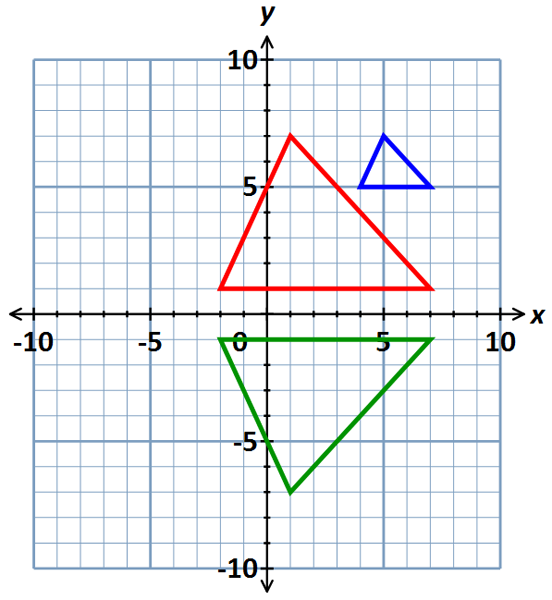
Here, the Red triangle has been rotated Anti-clockwise about the origin through 90° to produce the Blue triangle. The Blue triangle has in turn been reflected in the line y = 5 to produce the Green one.

Tips/hints

If you're drawing a Multiple Transformation, do each transformation separately.

When working out what transformations a shape has undergone, try to look for the simpler ones first eg. reflection.

Sometimes there may be more than one combination that brings about the same result.

Example

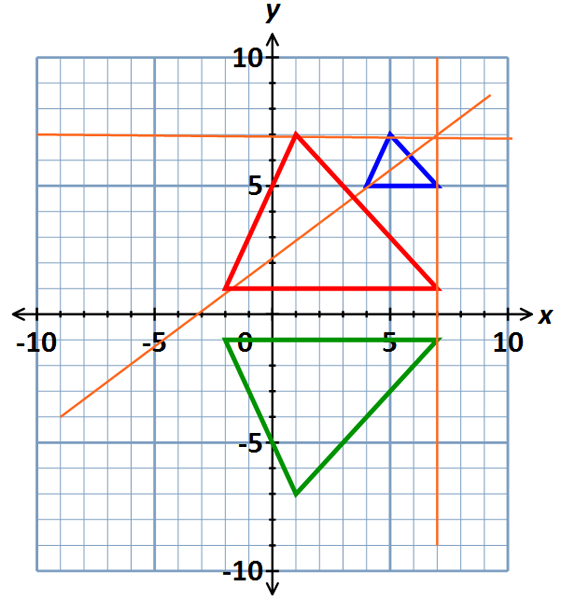
Describe the two transformations that have turned the Blue triangle into the Red triangle and then into the Green one.

Diagram

multiple transformations ex

Solution

The first transformation from Blue to Red is obviously an Enlargement.

From looking at the lengths of the bases, the Scale Factor is 3

Draw lines (orange) between the equivalent vertices and find their meeting point.

Diagram

multiple transformations sol

Note

The orange lines meet at (7, 7) so this is the Centre of Enlargement.

So, the first transformation from the Blue triangle to the Red one is an Enlargement with Scale Factor 3 and Centre of Enlargement (7, 7)

And the transformation from Red to Green is simply a Reflection in the x axis.

Similar triangles Basics

Definition

Two Triangles are Similar if they have the same angles.

Diagram

similar triangles def

Note

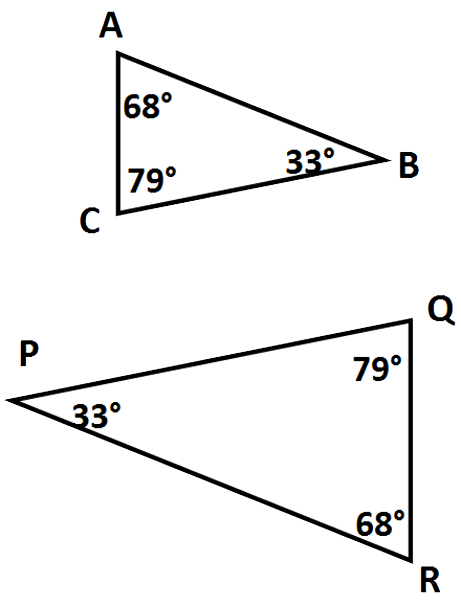
Triangle ABC is Similar to RPQ because their angles are the same.

Note that when talking about Similar Triangles, you need to match the angles up, angle A = angle R, angle B = angle P and angle C = angle Q So, ABC is similar to RPQ but NOT similar to PQR.

As with any other Similar shapes (see the notes on the Similarity module) when Triangles are Similar, their pairs of equivalent sides are in the ratio of the Scale Factor.

Triangles are also similar if their sides are in the same ratio. That means if Triangle ABC has sides a, b, c and PQR has sides p, q, r, if a : b : c is the same as p : q : r, then the triangles are similar.

Tips/hints

Make sure you match the angles and the sides up.

Example

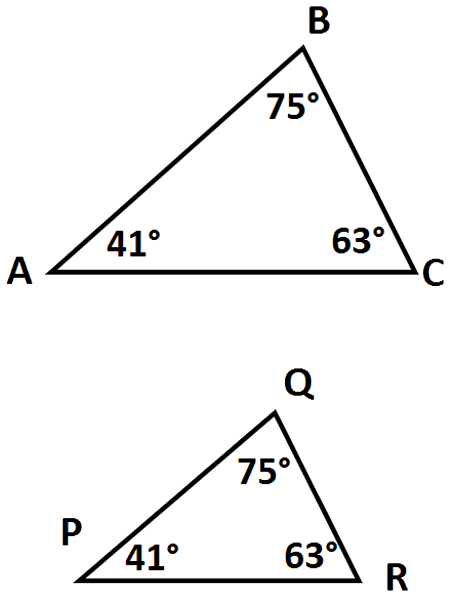
In the triangles shown, if AB = 8cm, BC = PQ = 6cm, what's the length of QR?

Diagram

similar triangles ex

Solution

Looking at the matching angles, the triangles ABC and PQR are similar. Find the Scale Factor: AB = 8cm, PQ = 6cm. These are equivalent sides. So, the Scale Factor from ABC to PQR is 6/8 = 0.75. So, QR = 0.75 x BC = 4.5cm

Similar triangles Advanced

Definition

Similar Triangles can be used to calculate side lengths much more simply than the Sine and Cosine Rules.

Tips/hints

Look out for parallel lines - because Corresponding Angles are equal, Similar Triangles often crop up around parallel lines.

Example

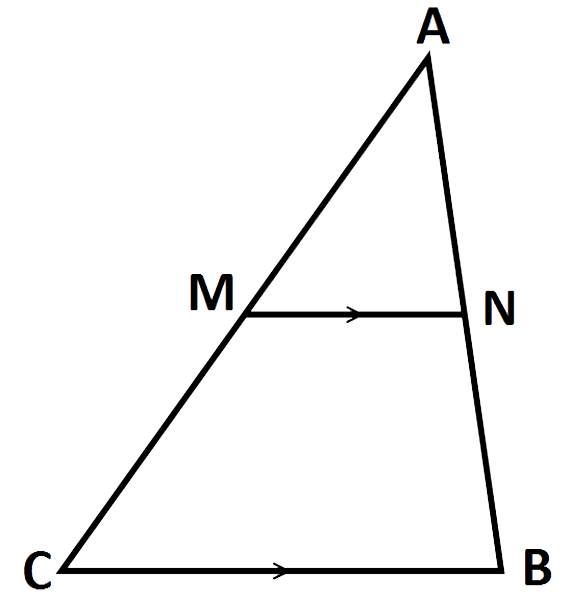
In the triangle shown, MN is parallel to CB. If AN = NB and MN = 3cm, what is the length of CB?

Diagram

advanced similar triangles ex

Solution

The triangles AMN and ACB are similar because angle A is common to both and ∠ACB = ∠AMN and ∠ABC = ∠ANM (corresponding angles).

Now, AN = NB so AB = 2AN ie. the Scale Factor from AMN to ACB is 2. So, if MN = 3cm, then CB = 2 x 3cm = 6cm

Congruent triangles

Definition

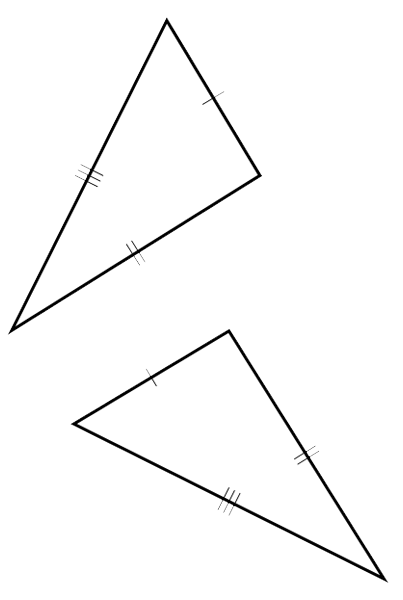
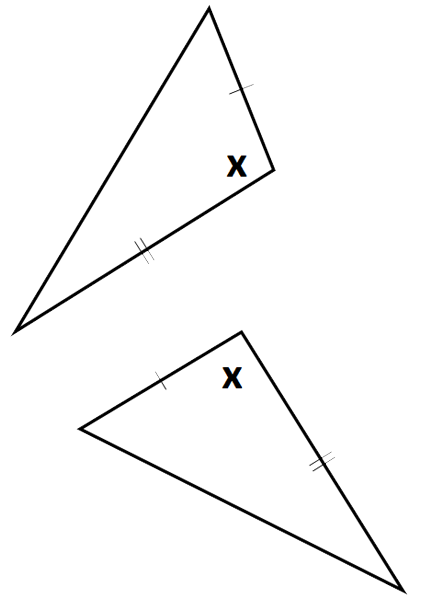
Two triangles are Congruent when they are identical in shape and size. They have the same length sides and the same sized angles.

You don't have to know that all the sides and all the angles are the same to prove that two triangles are Congruent. There are 4 tests you can apply. If a pair of triangles satisfy one of the tests, then they are Congruent.

SSS

This stands for Side Side Side

Diagram

congruent triangles SSS

Note

If the three sides of the first triangle equal the three sides of the second triangle, the triangles are Congruent.

AAS

This stands for Angle Angle Side

Diagram

congruent triangles AAS

Note

If two angles and a side (in the same relative position) match in the two triangles, then they are Congruent.

SAS

This stands for Side Angle Side.

Diagram

congruent triangles SAS

Note

If two sides and the angle between them match, the triangles are Congruent. Note, the angle MUST be between the two matching sides.

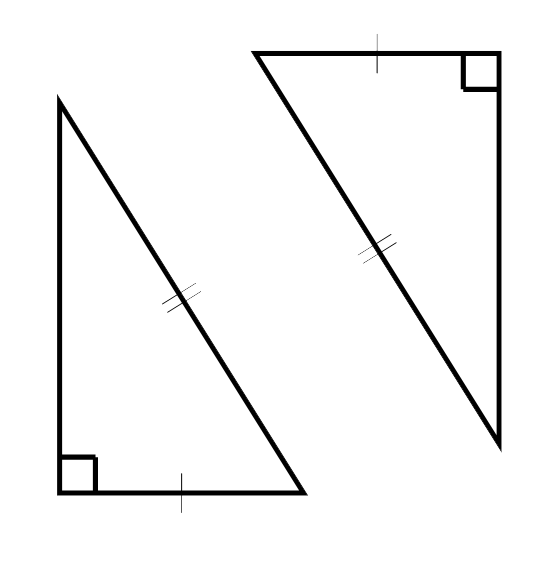
RHS

This stands for Right Angle, Hypotenuse, Side

Diagram

congruent triangles RHS

Note

If both triangles have a Right Angle, matching Hypotenuse and matching other Side, they are Congruent.

Example

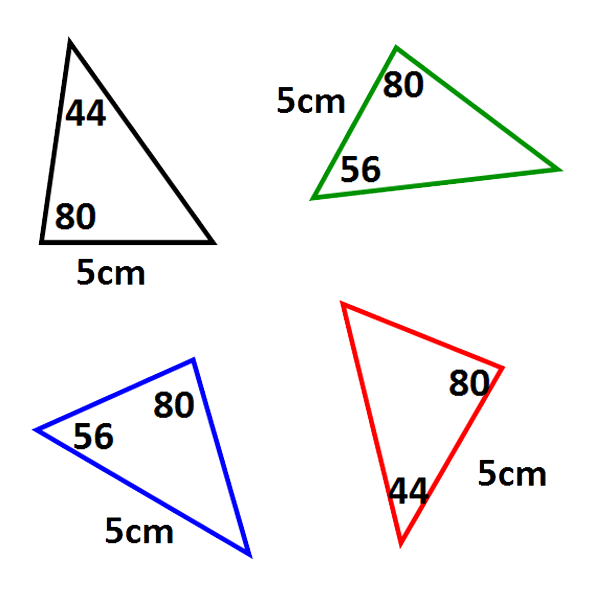
Which triangle is congruent to the Black one and why?

Diagram

congruent triangles ex

Solution

In the Black triangle, we're given two angles and a side. We can work out the third angle - it's 180° - (80° + 44°) = 56°

So, all three triangles have the same three angles. So, we need to look at the side we're given (= 5cm). In the Black triangle, it's opposite the 44° angle.

In the Green triangle it's opposite 44° but in the Blue it's opposite 80° and in the Red it's opposite 56°. So, the Green triangle is the one that is Congruent by AAS.

Vectors

Definition

A Vector has both Magnitude and Direction It is represented by a line with an arrow on it. The length of the line represents the Magnitude of the Vector. The direction of the arrow represents its Direction.

Vectors can be used to represent a number of things eg. Forces, Speeds.

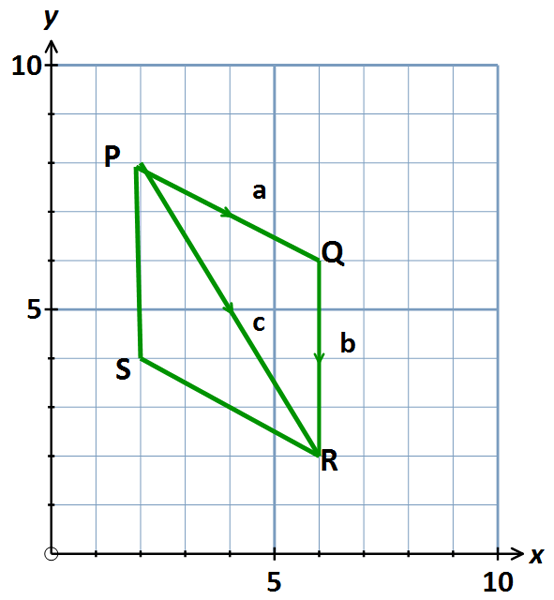
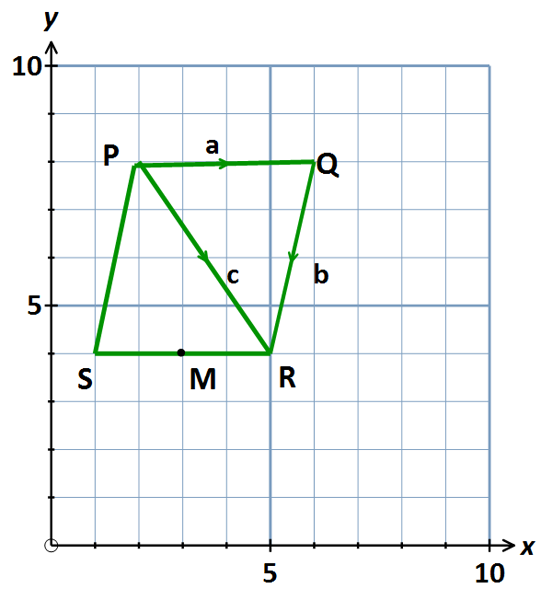
Vectors can be written in a number of different ways. In the diagram below, the following are all equivalent: = a = =

Diagram

vectors def

Note

Vectors can be added and subtracted. In the diagram above, a + b = c

The negative of a Vector is the Vector in the opposite direction. So, in the diagram above, -a =

Method

Always draw a diagram especially when adding and subtracting vectors.

Example

Using the diagram below: (i) Express as a column vector (ii) Express in terms of a

Diagram

vectors ex

Solution

(i) To go from S to P we go 1 to the right and 4 up. So, as a column vector, =

(ii) has the same magnitude as but the opposite direction. = a so, = -a

Vector geometry

Definition

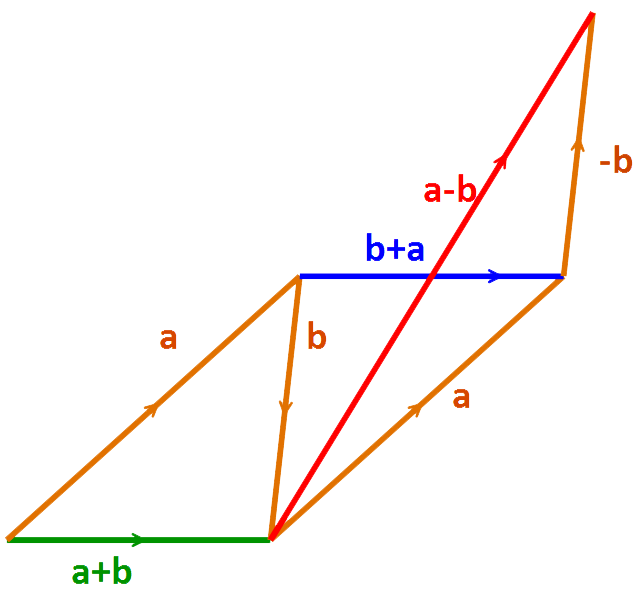
Vectors can be added and subtracted to form new vectors.

Diagram

vector geometry def

Note

Look at the diagram to see how the vectors add and subtract. To add vectors, arrange them as two sides of a triangle with their arrows following each other. Their sum is then the third side of the triangle. For subtraction, change the direction of the arrow of the vector being subtracted and write it with a minus sign in front. Then draw a vector triangle and add as before.

Method

Always draw a diagram. Make sure the arrows of the vectors you're adding or subtracting follow each other, ie. they don't both point into the same vertex.

Example

Express in terms of b and c.

Diagram

vectors ex

Solution

= + M is the mid-point of the line RS. So, = 1/2 = -a/2 So, = b-a/2

But the question asks for it in terms of b and c. c = a+b so, a = c - b So, = b - (c-b)/2 ie. = (3b - c)/2

Real life vector problems

Definition

Often Real Life problems can be solved using vectors. Force and speed both have Magnitude and Direction and so are vectors.

Method

Always draw a diagram. This will usually be a vector triangle. Make sure you get the directions of the vectors correct.

Example

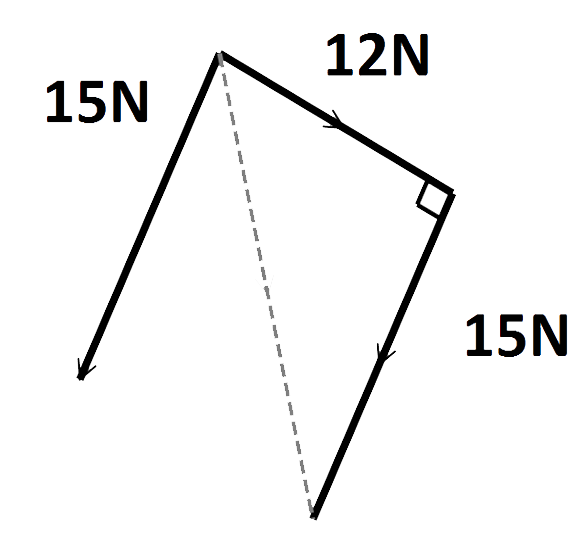
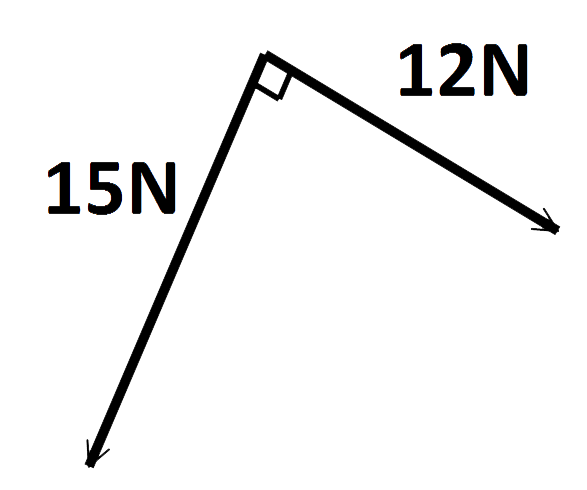
Two forces are acting on a mass as shown. Find the resultant force.

Diagram

force diag ex

Solution

Draw a vector triangle.

Diagram

force diag sol

Note

Here, the 15N force vector has been shifted to form the second side of a right angled triangle with the 12N force. The resultant force is the third side of the triangle, the hypotenuse.

Using Pythagoras' Theorem, if F is the resultant force, F² = 12² + 15² = 144 + 225 = 369 So, F = 19.2N to 1 d.p.

Column Vectors for Translations

Definition

A column vector describes a movement (translation) in two dimensions. It is written as:

where a is the horizontal movement (positive = right, negative = left) and b is the vertical movement (positive = up, negative = down).

Method

To translate a point by a column vector:Add the top number to the x coordinate and the bottom number to the y coordinate.

To find the column vector from point A to point B:Subtract: top number = x_B − x_A, bottom number = y_B − y_A

Vector Arithmetic

Adding vectors: add the top numbers together, add the bottom numbers together.

Subtracting vectors: subtract the top numbers, subtract the bottom numbers.

Scalar multiplication: multiply both components by the scalar.

Example

The point P(2, 5) is translated by the column vector (4, −3). What are the coordinates of the image P'?

Solution

x coordinate: 2 + 4 = 6

y coordinate: 5 + (−3) = 2

So P' = (6, 2)

Magnitude

The magnitude (length) of a vector (a, b) is found using Pythagoras: |v| = √(a² + b²)

Tips/hints

A reverse translation uses the negative of the original vector: if (3, −2) moves A to B, then (−3, 2) moves B back to A.

When describing a translation in the exam, you must give the column vector. Just saying "3 right and 2 down" is not sufficient.

Test yourself on this topic

Try the free quiz with worked solutions.

Start quiz →

Get GCSE Geometry

Full notes, full question bank, offline.