


G GCSE Apps

GCSE Geometry

Shapes - 2D and 3D

21 subtopics in this section

Perimeter

Definition

The Perimeter of a two-dimensional shape is the length of its outline.

Method

Most of the time you just need to find the length of each side of the shape and add them all up.

Some shapes have formulas for their perimeters: Perimeter of a square with sides a = 4a Perimeter of a rectangle with sides a, b = 2(a + b) Perimeter of a circle with radius r = 2πr

Tips/hints

For more complex shapes, be sure to include the length of every side when calculating the perimeter. It might help to mark the sides as you go around the shape.

Example

Calculate the perimeter of the shape below.

Diagram
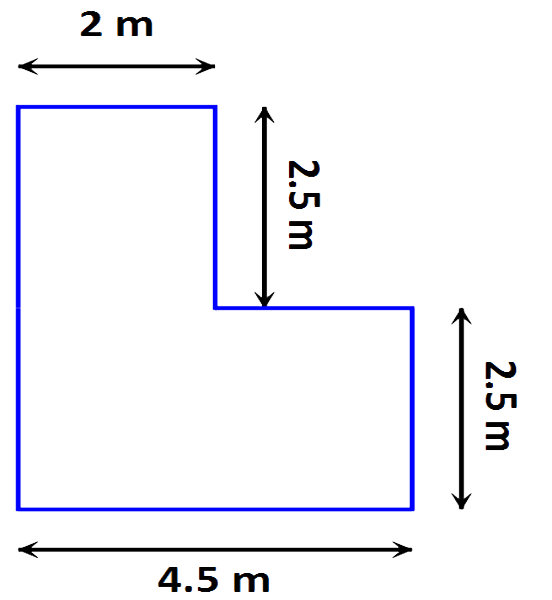
20 25 25 45 L shape

Solution

First, work out the lengths of the sides that aren't marked. The long vertical = 2.5m + 2.5m = 5m The short horizontal = 4.5m - 2m = 2.5m So, starting at the top left hand corner and going round clockwise Perimeter = 2 + 2.5 + 2.5 + 2.5 + 4.5 + 5 = 19m
Identifying 2D shapes

Definition

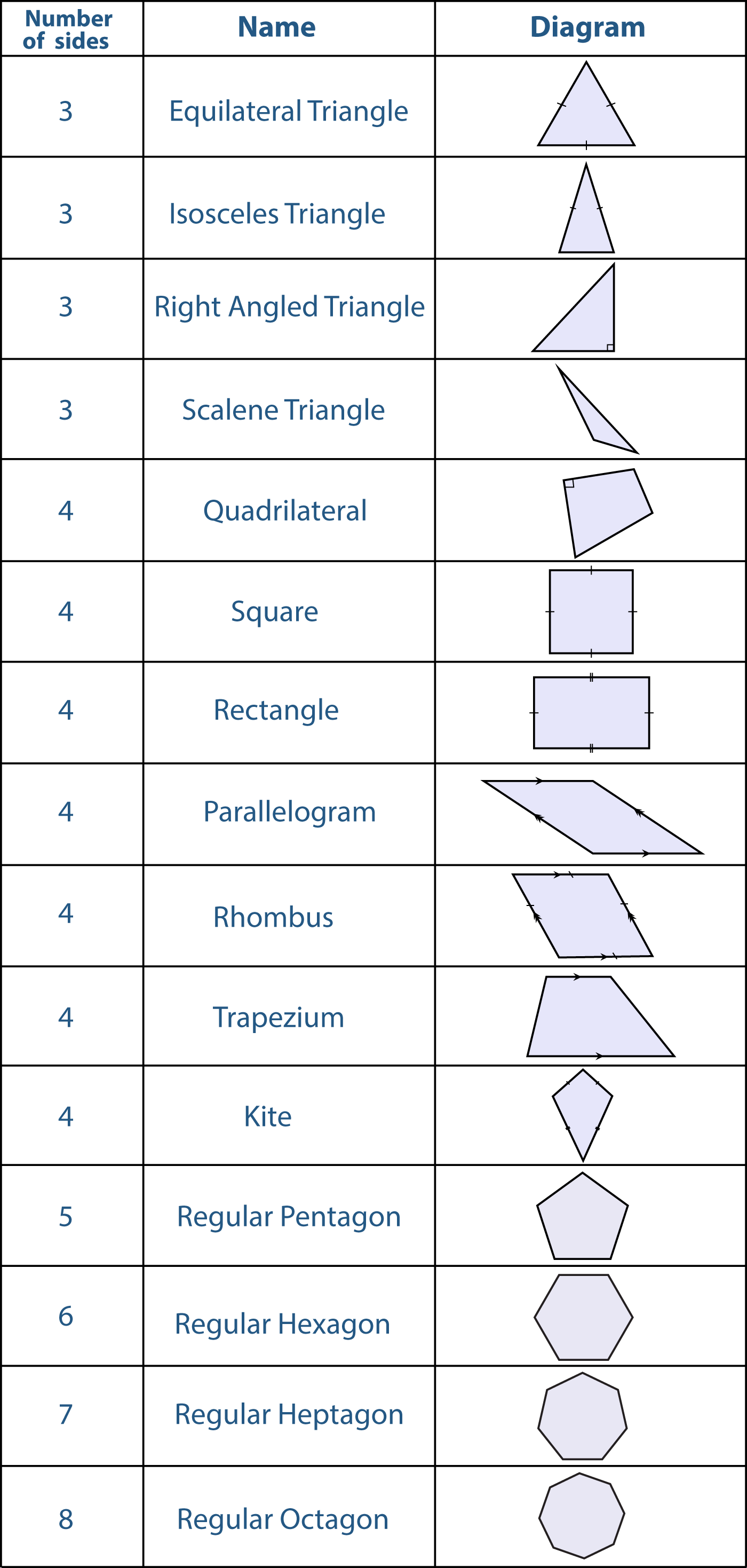
It's important to know the names of two-dimensional shapes. Some have various different types eg. triangles and quadrilaterals.

Method

Learn the names, appearance and properties of all the shapes in the table

Diagram

tab of shapes

Note

Also learn what the markings mean (eg. arrows for parallel lines, dashes across lines to show they're equal in length, right angle marks)

Example

How many sides does an octagon have?

Solution

8

Example

What's the special name for a quadrilateral with four equal sides but no right angles?

Solution

A rhombus (it looks like a squashed square)

Polygons

Definition

A Polygon is a two-dimensional shape with 3 or more sides.

Method

See the notes on Identifying 2D Shapes to learn some of the names of polygons.

In addition, a Nonagon has 9 sides and a Decagon has 10 sides.

To find out how to calculate the interior angles of a regular polygon, see the module Angles and Regular Polygons

Example

Which regular polygon has 4 pairs of parallel sides?

Solution

To have 4 pairs of parallel sides, there must be 2 x 4 sides in total so it's a regular octagon.

Special quadrilaterals

Definition

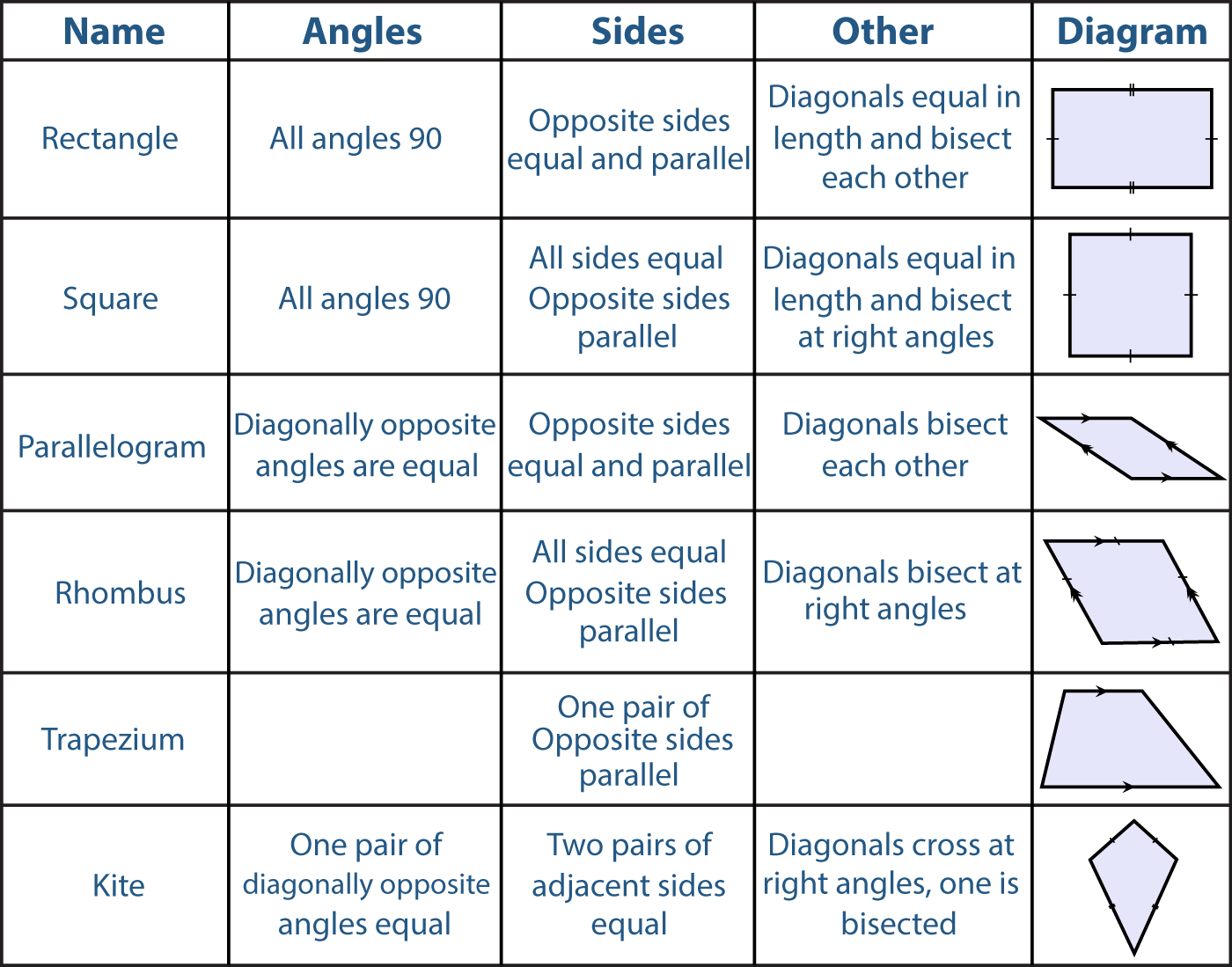
There are a number of Special Quadrilaterals. Here they are with some of their properties.

Diagram

special quads tab

Method

Learn the shapes and learn their properties.

Example

Which special quadrilateral has four equal angles and equal diagonals that bisect at right angles?

Solution

Squares and rectangles have four equal angles (all 90°). They also have equal diagonals. However, only the square's diagonals bisect at right angles.

Area of a rectangle

Definition

The Area of a Rectangle with sides lengths a, b is ab

Method

If in doubt, draw a diagram

Example

The surface area of a trestle table is 3m² and the length of its shorter side is 75cm. What's the length of its longer side?

Solution

Let the longer side be length a. So, we know the Area of a Rectangle with sides lengths a, b is ab In this case 0.75a = 3 So a = 4 The length of the longer side is 4m

Area of a triangle

Definition

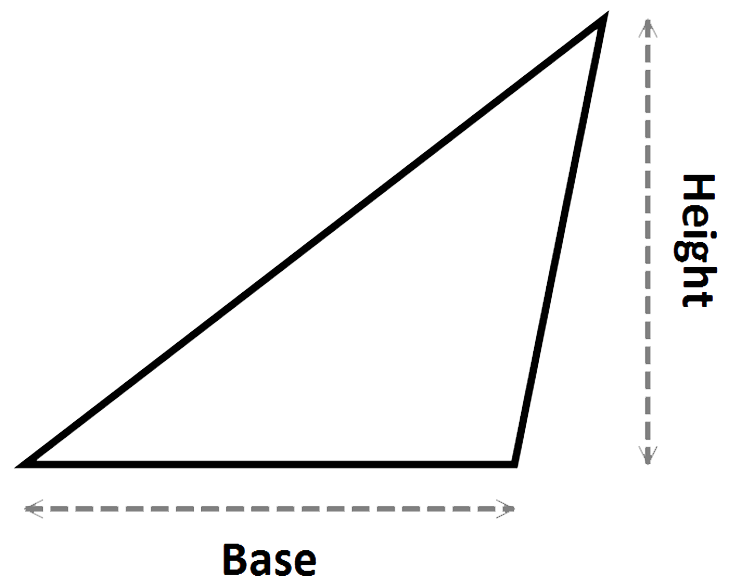
The Area of a Triangle is given by the formula 1/2 Base x Perpendicular Height

Diagram

area of a triangle

Method

The only potentially tricky bit is making sure the perpendicular height is the one for the base.

Example

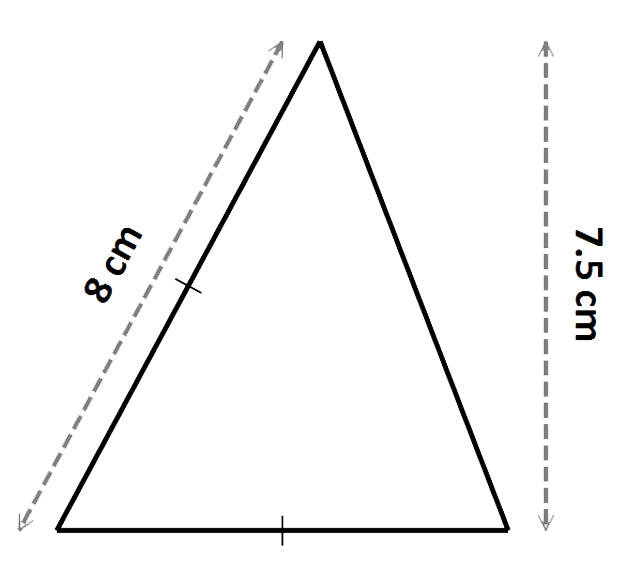
Find the area of the triangle below.

Diagram

area triangle ex

Solution

At first sight it seems as if there's not enough information. However... The base and the side marked 8cm are the same length (there are dashes on them). So, the area of the triangle = 1/2 x 8 x 7.5 = 30cm²

Area of a parallelogram

Definition

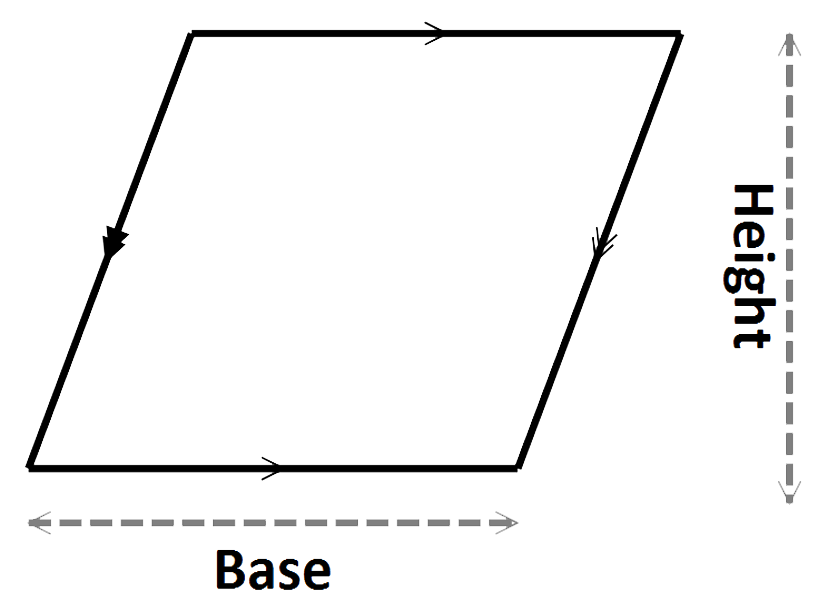
The Area of a Parallelogram is Base x Perpendicular Height

Diagram

area of a parallelogram

Method

Just use the formula!

Example

What is the perpendicular height of a parallelogram with base 8cm and area 56cm²

Solution

Area = Base x Height So, 56 = 8 x Height Height = 7cm

Area of a trapezium

Definition

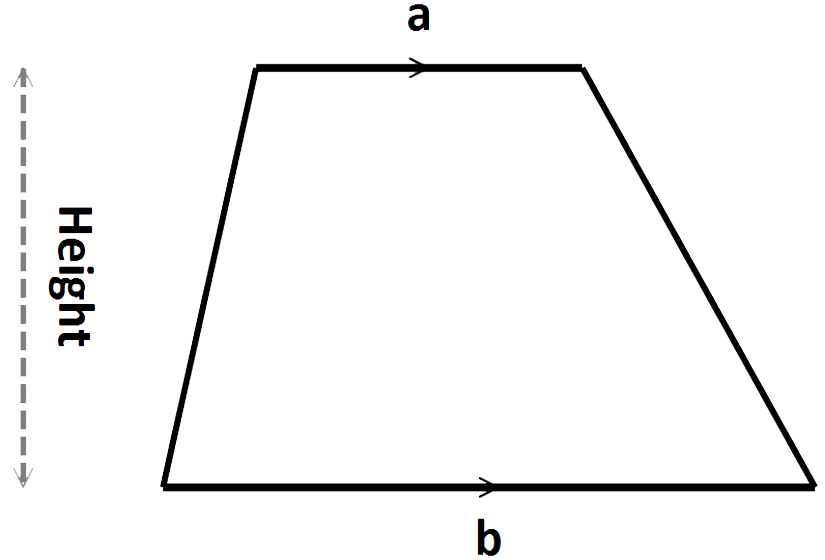
The Area of a Trapezium = h(a+b)/2 where h is the height and a, b the lengths of the parallel sides.

Diagram

area of a trapezium

Method

Use the formula, and if you need to, draw a diagram.

Example

A trapezium's base is 7cm, its height is 5cm and its area is 25cm². What's the length of the shorter side?

Solution

Area = h(a+b)/2 Putting in the values we have: 25 = 5(a+7)/2 Expanding and rearranging we get 50 - 35 = 5a This gives 5a = 15 So, the shorter side is 3cm

Area of a compound shape

Definition

Compound Shapes are made up of a number of smaller, simpler shapes.

Method

The key is to break the shape down into its constituent parts, work out the area of each part and then sum the areas up.

Tips/hints

It's a good idea to draw a diagram showing the constituent smaller shapes.

Example

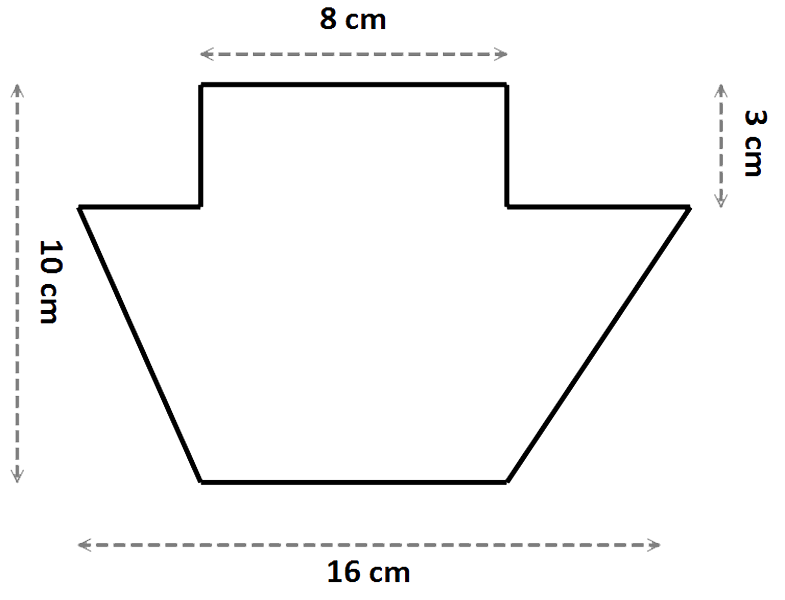
What is the area of this simple drawing of a ship?

Diagram

area of ship ex

Solution

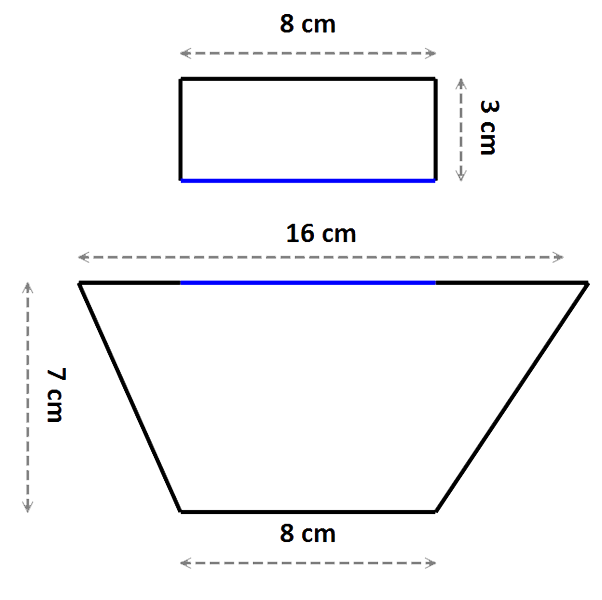
Break the ship down into its constituent parts. Here, the top is a rectangle and the bottom is a trapezium.

Diagram

area of a ship sol

Note

The area of the trapezium = (8+16)x7/2 = 84 cm² The area of the rectangle = 8 x 3 = 24 cm² So, the total area = 24 + 84 = 108 cm²

Cuboids

Definition

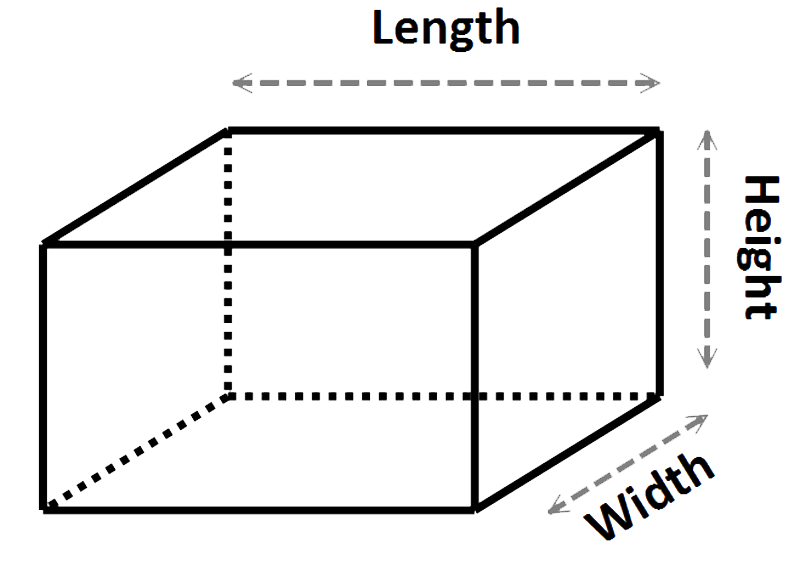
A Cuboid is a rectangular block

Diagram

cuboid-note

Note

Volume is Length x Width x Height Volume = lhw

Surface Area is 2 ( Length x Width + Width x Height + Height x Length) Surface Area = 2 (lw + wh + hl)

A Cube is a special case of a cuboid where Length = Width = Height

Method

Use the formulas and remember to give your answer in the correct units.

Example

A cuboid has two sides that are 3cm and 5cm and its volume is 120cm³ Calculate its surface area

Solution

Volume = Length x Width x Height So, 120 = 5 x 3 x h That makes h = 8cm Surface Area = 2 ( lh + hw + wl ) ie. 2 ( 5 x 8 + 8 x 3 + 3 x 5 ) = 158 cm²

Prisms

Definition

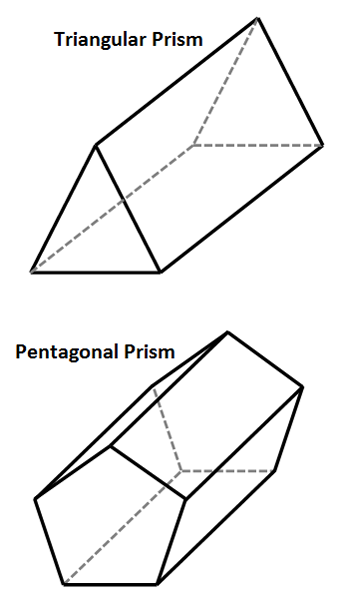
A Prism is a solid shape which has a cross-section with a constant area. This means that wherever you slice a prism perpendicular to its length, you'll get the same shape.

Diagram

prisms def

Note

A Cylinder is a Circular Prism A Cuboid is a Rectangular Prism

Volume = Cross-sectional Area x Length Surface Area depends on the type of Prism

Method

To calculate the volume of a non-standard prism, first work out the area of its cross-section.

To calculate the surface area of a prism, it can help to draw its Net and work out the area of each part of that.

Example

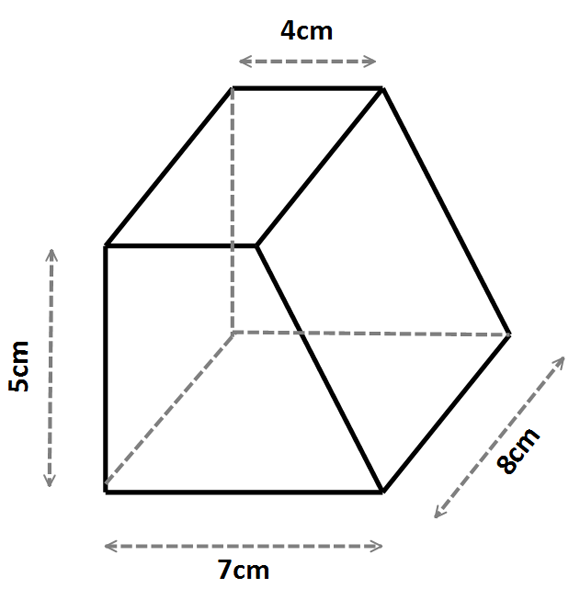
Calculate the volume of the prism below

Diagram

prism ex

Solution

First, calculate the area of the cross section. It's a trapezium so its area is: 5(4 + 7)/2 = 27.5 cm²

So, the volume of the prism = length x area of cross section ie. 8 x 27.5 = 220cm³

Pyramids

Definition

A Pyramid is a solid shape that goes up to a point at the top.

Volume = 1/3 x Area of Base x Height

Surface Area depends on the Pyramid.

A Tetrahedron is a pyramid with four faces each of which is an equilateral triangle.

Diagram

tetrahedron

Method

Use the formula to calculate the volume of a Pyramid.

To calculate its Surface Area it often helps to draw the Net

Example

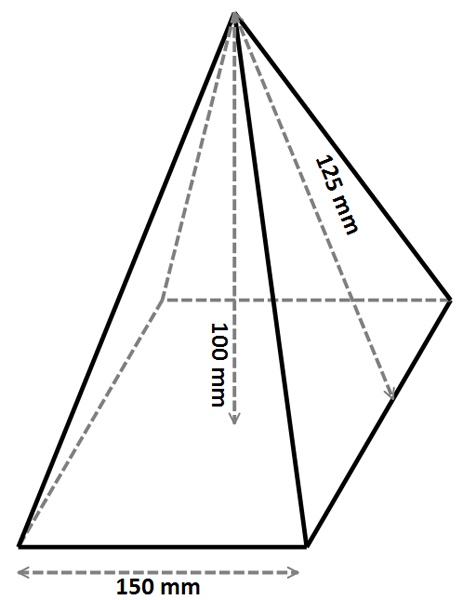
Calculate the Surface Area of the square-based pyramid below. Give your answer in cm²

Diagram

pyramid ex

Solution

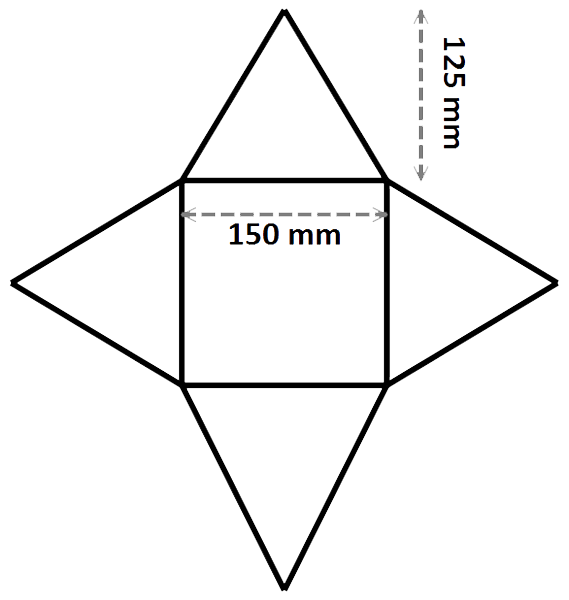
It will help to draw the net.

Diagram

square based pyramid net sol

Note

The area of the base is 150 x 150 = 22500 mm² The area of each triangular face is 1/2 x 150 x 125 = 9375 mm²

So, the total area is 22500 + 4 x 9375 = 60000 mm² = 600 cm²

Note that though we were told the height of the pyramid, it wasn't needed to calculate the Surface Area.

Parts of a circle

Definition

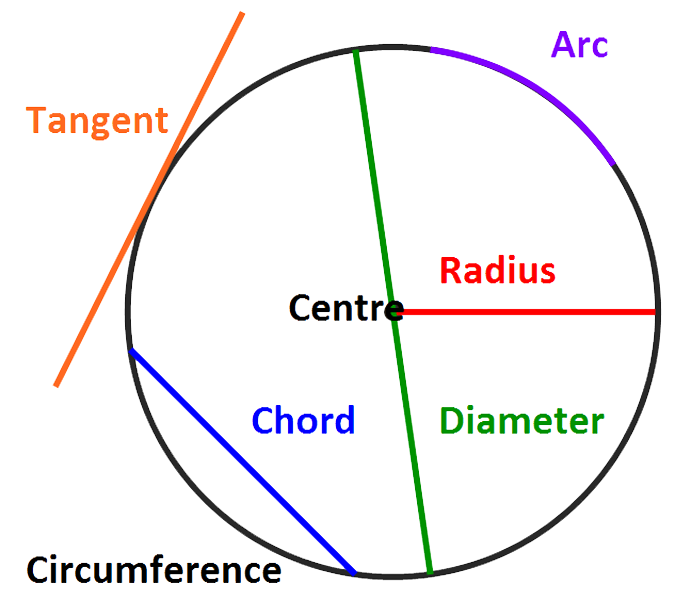
There are a number of different lines and areas associated with Circles. You need to learn which each of them is and how they relate to each other.

Diagram

lines of a circle def

Note

A Radius is a line from the Centre to the Circumference

A Diameter is a Chord which passes through the Centre of the Circle

The Circumference is the Perimeter of a Circle Circumference = 2π x Radius Circumference = π x Diameter

A Chord is a line from one part of the Circumference to another

An Arc is part of the Circumference

A Tangent is a straight line that just touches the outside of the circle. A Radius meets a Tangent at Right Angles

Diagram

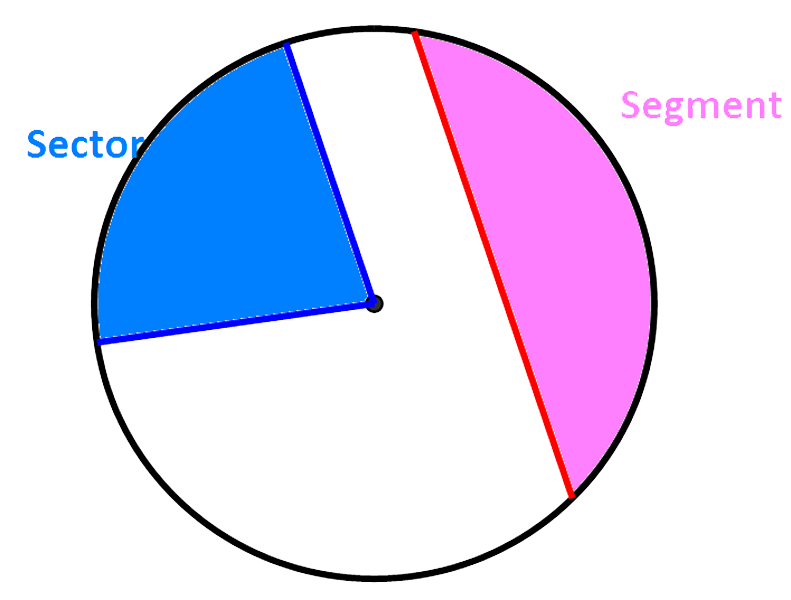
areas of a circle

Note

The area between two Radii (plural of Radius) is called a Sector (it looks like a slice of cake or what's left behind when a slice of cake has been taken).

The area between a Chord and the Circumference is a Segment

Method

Make sure you're familiar with the various parts of a circle and how they relate to each other.

Example

If the diameter of a circle is 8cm, what is its radius?

Solution

The diameter is twice the length of the radius so the radius is 4cm

Area of a circle

Definition

The Area of a Circle is πr² where r is the radius

Method

The Area of a Semi-Circle = Half the Area of a Circle The Area of a Quarter Circle = Quarter the Area of a Circle.

Tips/hints

Be careful if you're told the Diameter of the circle rather than the Radius. Divide by half and then use the formula Area = πr²

Example

The diameter of a semi-circular patio is 4m. What is its area to 1 d.p.?

Solution

The diameter is 4m so the radius is 2m. Area of a circle = πr² so, area of this semi-circle is: (π x 2²)/2 = 2π = 6.3 to 1 d.p. Area of patio = 6.3m² to 1 d.p.

Circumference of a circle

Definition

The Circumference of a Circle is its Perimeter.

The length of the Circumference is: 2π x Radius = π x Diameter

Method

The circular part of the Perimeter of a Semi-Circle = Half the Circumference. The circular part of the Perimeter of a Quarter-Circle = Quarter the Circumference

Example

Find the total perimeter of a semi-circle with radius 12mm. Leave your answer in terms of π

Solution

There are two parts to the perimeter of a semi-circle. The circular part and the straight part.

The circular part is 1/2 x 2π x Radius = 12π mm

The flat part is 2 x Radius = 24mm

So, the total perimeter of the semi-circle is: (12π + 24)mm = 12(π + 2)mm

Arcs and sectors

Definition

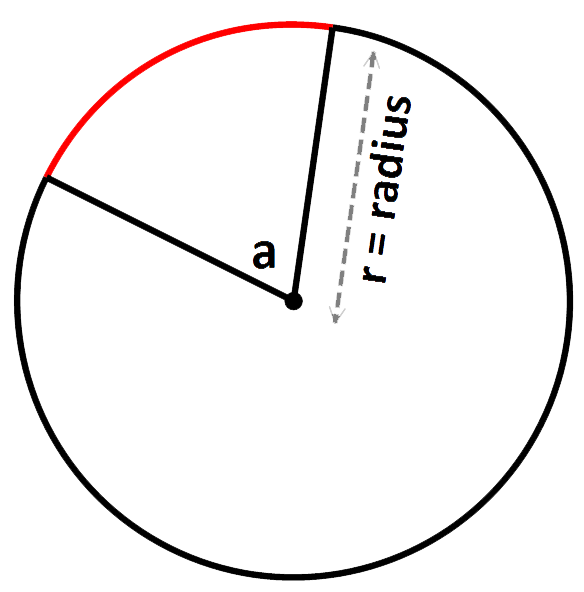
An Arc is a section of the circumference of a circle. A Sector is a portion of a circle formed by two radii and the arc that joins their ends.

Let a be the angle subtended by an arc at the centre of the circle and r be the radius of the circle

Diagram

length of arc

Note

The Length of an Arc is given by the formula: Arc Length = a/360° x 2πr

The Area of a Sector is given by the formula: Area = a/360° x πr²

Method

Just apply the formulas.

Example

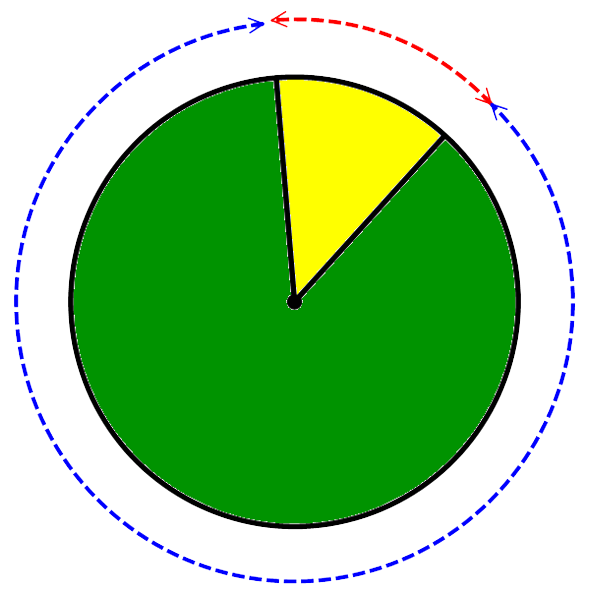
If the arc of the circle denoted by the blue dotted curved line is 5π cm, and that denoted by the red dotted curved line is π cm, in terms of π, what's the area of the green sector?

Diagram

arcs and sectors ex

Solution

Let the radius of the circle be r and the angle inside the yellow sector be a.

So, for the shorter arc, a/360 x 2πr = π And for the longer arc, (360 - a)/360 x 2πr = 5π

Multiplying both equations by 360 and dividing by π we get: 2ar = 360 360(2r) - 2ar = 5 x 360

Adding them together we get 360 x 2r = 6 x 360 So, r = 3 cm But, 2ar = 360 so, a = 60°

Therefore, the area of the green sector is 300/360 x πr² = 5/6 x 9π = 7.5π cm²

Cylinders

Definition

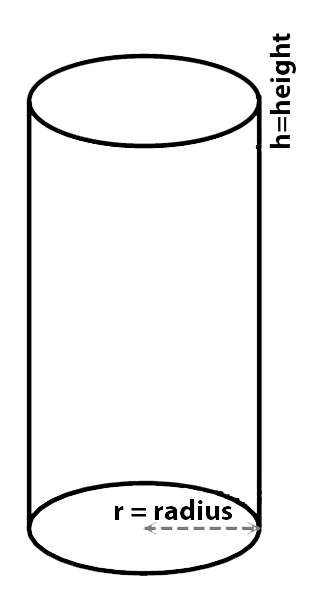
A Cylinder is a prism with a circular cross section.

Diagram

cylinder

Note

Volume of a Cylinder is πr²h Curved Surface Area of a Cylinder is 2πrh Total Surface Area of a Cylinder is 2πr(h + r) where r is the radius of the cross-section and h the height.

Method

Just apply the formulas. With a question about surface area, make sure you include/exclude the ends if appropriate.

Example

A cylinder's base has radius 5 cm and its volume is 200π cm³. What is its height?

Solution

Volume = πr²h So, 200π = π5²h That makes h = 200/25 = 8cm

Cones

Definition

A Cone is basically a pyramid with a circular base.

Diagram

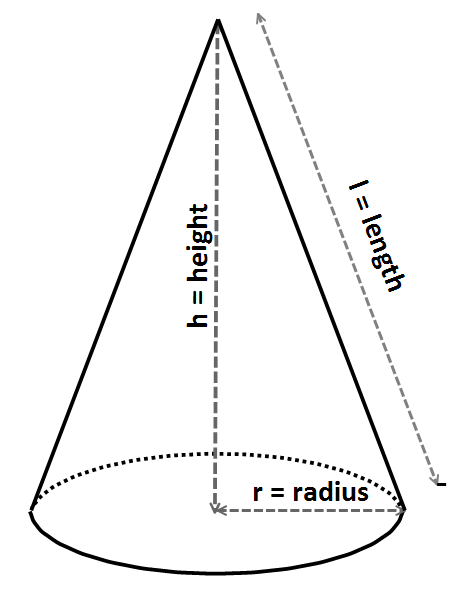
cone

Note

Volume of a Cone is 1/3 πr²h Curved Surface Area of a Cone is πrl where r is the radius of the base, h the height and l the length of the sloping side.

Method

You might have to use Pythagoras' theorem to work out the height or length of the sloping side

Example

What's the volume of a cone which has a base of radius 20mm and a height of 30mm? Leave your answer in terms of π

Solution

Volume = πr²h/3 = π x 400 x 30/3 = 4000 π mm³

Spheres

Definition

A Sphere is a round solid figure.

Diagram

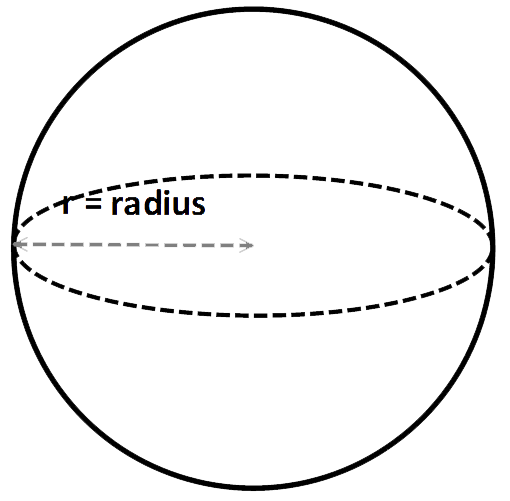
sphere def

Note

Volume of a Sphere = 4πr³/3 Surface Area of a Sphere = 4πr² where r is the radius of the sphere.

Method

Look out for hemi-spheres (half the volume, half the surface area of a full sphere) and other fractions of spheres.

Example

A sphere has a diameter of 30cm. To 1 d.p., what is its volume in litres?

Solution

The diameter is 30cm so the radius is 15cm Volume = 4πr³/3 ie. 4π x (15)³/3 = 14137.17 cm³ There are 1000cm³ in 1 litre so, the sphere's volume in litres is: 14.1 litres to 1 d.p.

Compound solids

Definition

Compound Solids are 3 dimensional figures that are made up of two or more simple figures. For example, a hemisphere attached to the bottom of a cone.

Method

The key thing in calculating volumes and surface areas of complex figures is to break them down into their constituent parts. Be careful when calculating surface areas as some will be lost where two shapes are joined together.

Example

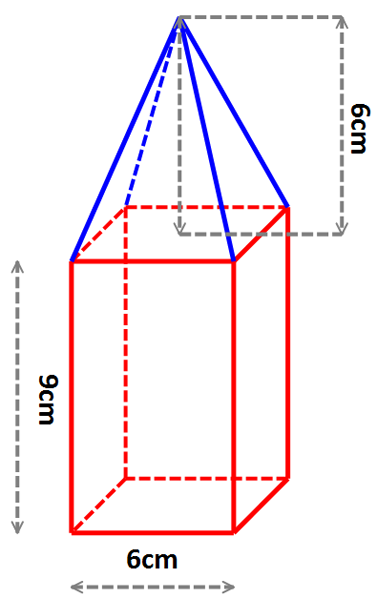
A toy wooden tower consists of a square-based pyramid, height 6cm, base 6cm x 6cm on top of a cuboid, base 6cm x 6cm, height 9cm. What's the volume of the figure?

Diagram

compound shape ex

Solution

Break the shape down into its consitutent parts.

Volume of pyramid = Base x Height/3 = 6 x 6 x 6 / 3 = 72 cm³

Volume of cuboid = Length x Width x Height = 6 x 6 x 9 = 324cm³

So, the total volume is 72 + 324 = 396cm³

Frustums

Definition

A frustum is the shape left when the top of a cone or pyramid is cut off by a plane parallel to the base.

It looks like a cone or pyramid with the pointy top removed, leaving a flat top and a larger flat bottom.

Key Formulas

Volume of a cone:

Volume of a frustum = Volume of big cone − Volume of small cone (that was removed)

There is also a direct formula for the volume of a frustum:

where R is the base radius, r is the top radius, and h is the height of the frustum.

Method

To find the volume of a frustum:1. Work out the dimensions of the full (big) cone using similar triangles if needed2. Calculate the volume of the big cone3. Calculate the volume of the small cone that was removed4. Subtract: Volume of frustum = Big cone − Small cone

Example

A cone has base radius 6 cm and height 10 cm. A smaller cone of radius 3 cm and height 5 cm is removed from the top. Find the volume of the frustum to 1 decimal place.

Solution

Volume of big cone = ⅓ × π × 6² × 10 = 120π

Volume of small cone = ⅓ × π × 3² × 5 = 15π

Volume of frustum = 120π − 15π = 105π = 329.9 cm³ (1 d.p.)

Tips/hints

If you're given the frustum dimensions but not the full cone, use similar triangles to find the height and radius of the complete cone.

For surface area questions, the curved surface area of the frustum = curved surface area of big cone − curved surface area of small cone. Don't forget to add the two circular ends.

Test yourself on this topic

Try the free quiz with worked solutions.

Start quiz →

Get GCSE Geometry

Full notes, full question bank, offline.