

G GCSE Apps

GCSE Geometry

Measurements And Scaling

12 subtopics in this section

Scales

Definition

We read measurements all the time, measurements of distance, weight, speed, time, temperature etc. To do this, we use a Scale that indicates how the quantity being measured is represented on our reading apparatus.

Method

The key thing is to understand the Scale. How much does each mark represent? Not each mark has a number by it so find two that have numbers, A and B say. Now count the number of divisions between A and B, n say. Then, each division represents (A-B)/n.

Look through the worked example to see this in practice.

Example

What weight is indicated on the scales below?

Diagram
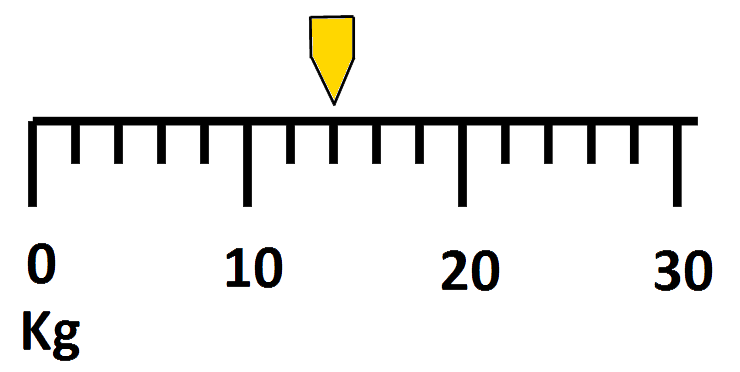
14kg scales

Solution

The section between 0kg and 10kg is divided into 5. So, each mark represents (10kg - 0kg)/5 = 2kg. The yellow marker is pointing to 2 divisions more than 10kg so that's 10kg + 2x2kg = 14kg.
Metric system

Definition

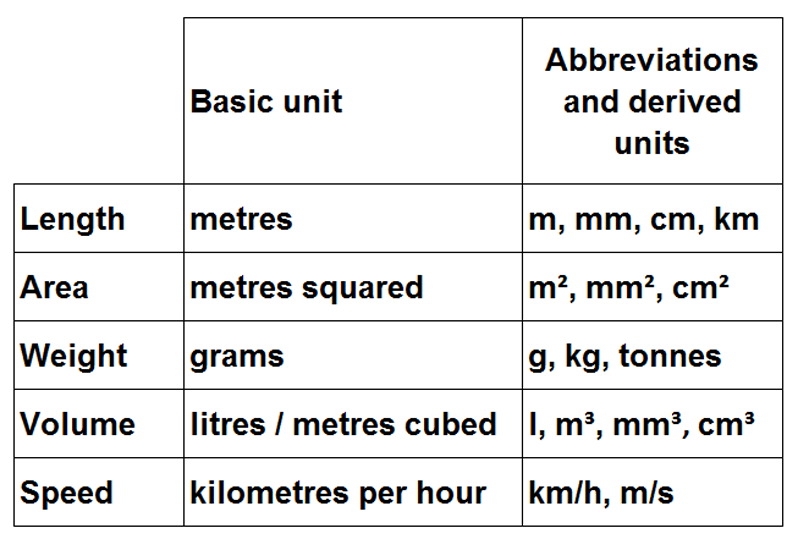
The Metric System is based on the decimal system which is good news. The basic units of the metric system are as follows:

Diagram

metric units

Note

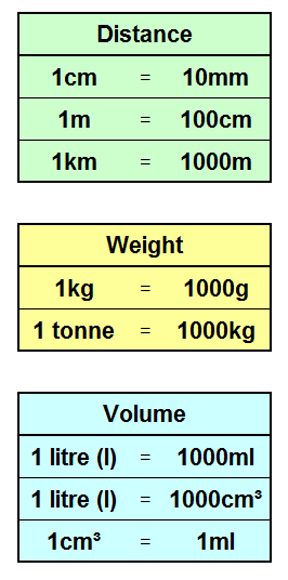
And here are some equivalents that you should know.

Diagram

metric equivalents

Tips/hints

Learn all the units and equivalents so you can use them without thinking. The volume units are a bit tricky as 1 litre = 1000 ml = 1000 cm³ that is, a millilitre = a centimetre cubed.

Example

Which of these volumes is the largest: 200cm³, 2 litres, 200ml?

Solution

1000 ml = 1000cm³ = 1 litre

So, taking the volumes in order and putting them all in ml we have: 200ml, 2000ml and 200ml So, 2 litres is the largest volume.

Imperial system

Definition

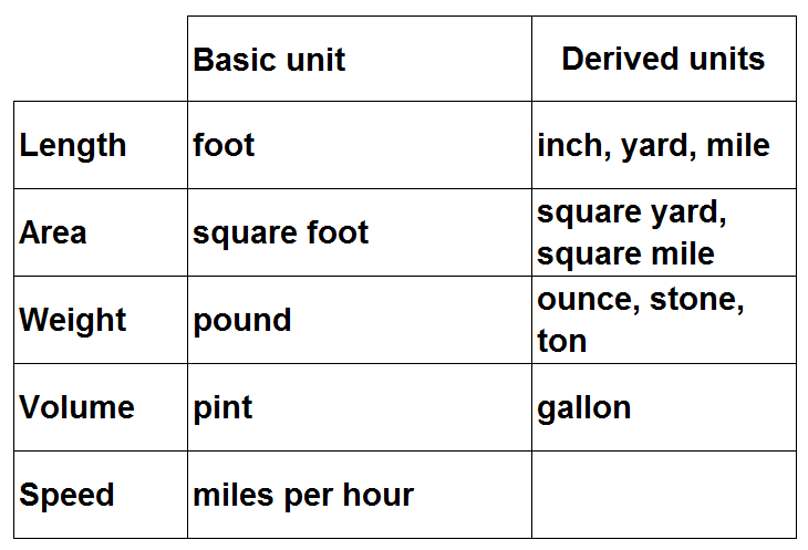
The Imperial System is NOT based on the decimal system which is bad news. The basic units of the Imperial system are as follows:

Diagram

imperial units

Note

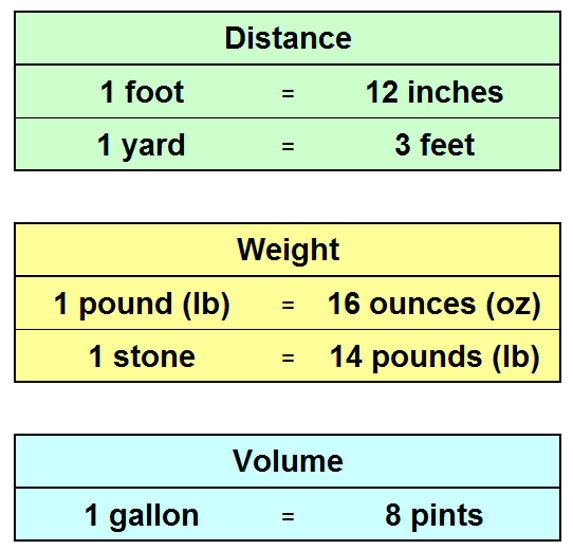
And here are some equivalents that you should know.

Diagram

imperial equivalents

Tips/hints

Learn all the units and equivalents so you can use them without thinking. This is tricky as, unlike the metric system, there's no consistency in the naming or the divisions of units.

Example

Which of these is the longest distance: 3 yards, 4 feet or 50 inches?

Solution

1 yard = 3 feet 1 foot = 12 inches So, in order, in inches the three measurements are: 36 inches, 48 inches and 50 inches. So, 50 inches is the longest.

Converting measurements

Definition

Depending on what's being measured, some units are more suitable than others. For example, if you're weighing a mouse, grams are the best unit. But if you're weighing a dog, kg are more suitable.

Tips/hints

Learn the conversion tables in the modules Imperial System and Metric System.

Example

Convert the following measurements: (i) 100g to kg (ii) 2.4 litres to cm³ (iii) 3 yards to inches

Solution

(i) 1kg = 1000g so 100g = 0.1kg

(ii) 1 litre = 1000cm³ so 2.4 litres = 2400cm³

(iii) 1 yard = 3 feet and 1 foot = 12 inches so 3 yards = 3 x 36 inches = 108 inches

Estimating measurements

Definition

Estimating Measurements is something that we do in everyday life. For example 'It's about half a mile and it'll take you about 10 minutes to walk it'

Estimating is a useful tool when doing some maths problems too. If you can estimate the answer then, having worked it out accurately, you can check to see if it's close to your estimate. If your answer is way off, you may have made an mistake with your calculations.

Tips/hints

A lot of this is common sense. It's worth knowing the size of a few everyday things. Eg an average man is just under 2m tall A can of soup weighs about 500g A football pitch is about 100m long You can then compare these to other objects to estimate their size.

Example

Estimate the following: (i) Weight of a mobile phone (ii) Height of a standard door frame

Solution

(i) Now, you've learnt that a can of soup weighs 500g. Does a mobile phone weigh more or less? Less. So, how many mobile phones are equivalent to a can of soup? Three maybe four? So, 150g is probably a good estimate.

(ii) And you've learnt that an average man is just under 2m tall. An average man fits through a standard door frame with a bit to spare, so, 2m is probably a good estimate for the height of a door frame

Measuring time

Definition

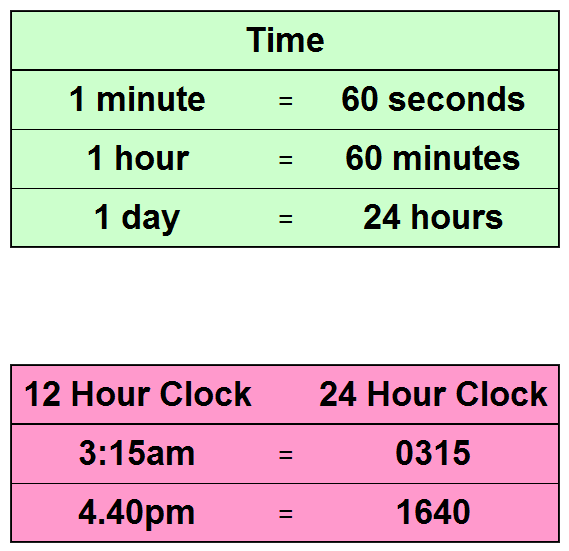
Time is measured in seconds, minutes, hours, days. When we tell the time we can do it using the 12 hour clock or the 24 hour clock.

Diagram

time equivalents

Tips/hints

If you've got to add lengths of time together, it's often easiest to convert everything into the smallest unit, do the addition and then convert back.

Example

Mark is travelling by train from Paris to Marseille. He leaves Paris at 0657 and arrives in Lyon at 1324. The train waits there for exactly half an hour. It then departs taking 2 hours 15 minutes to get to Marseille. (i) How long was the trip from Paris to Lyon? (ii) Using the 24 hour clock, at what time does Mark arrive in Marseille?

Solution

(i) Start time 0657. Arrival time 1324. Now, 0657 is 3 minutes before 0700 which is a much easier figure to use. So, the time from 0700 to 1324 is 6 hours 24 minutes. Add the 3 minutes back on to get a journey time of 6 hours 27 minutes.

(ii) If the train waits for half an hour in Lyon, its departure time is 1354. Add 2 hours onto that to get 1554. Now add on 15 minutes. 6 minutes takes us to 1600 which leaves 9 minutes to add on. So, he arrives in Marseille at 1609

Plans and elevations

Definition

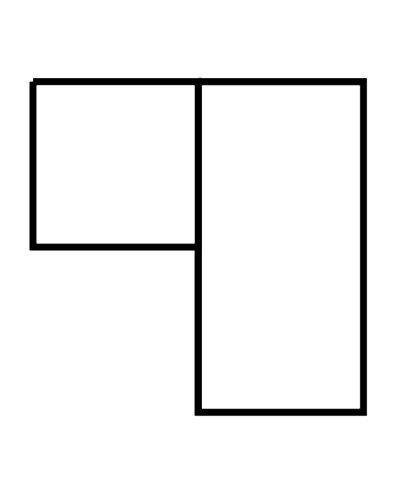
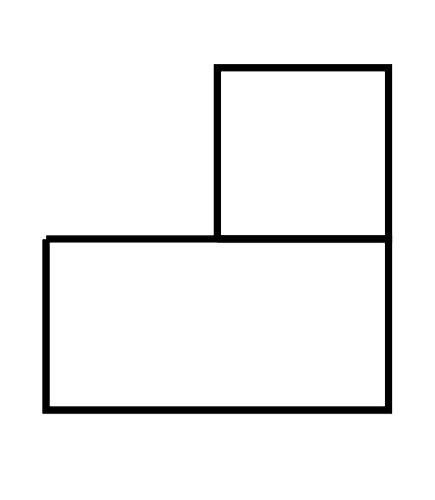
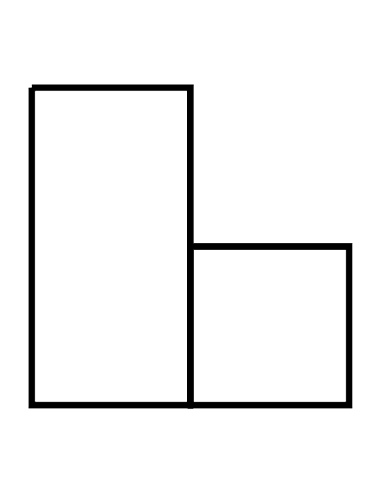
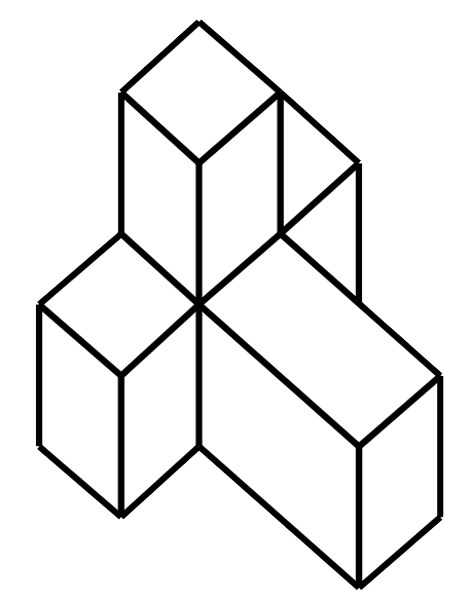
There are a number of ways to represent a 3 dimensional object in 2 dimensions.

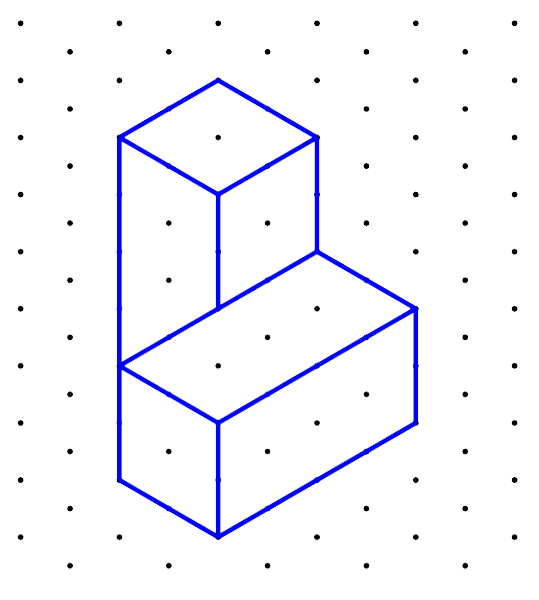
An Isometric projection is a 3D scale drawing looking straight at the corner.

Diagram

3d obj iso def

Note

A Plan is an overhead view.

Diagram

3d obj plan def

Note

A Front Elevation is, not surprisingly, the view from the front (front right in this case)

Diagram

3d obj front elev def

Note

And a side Elevation is the view from the side (left side in this case)

Diagram

3d obj side elev def

Tips/hints

Take care to keep everything to scale, especially in an isometric projection.

Example

Draw a plan for the object shown.

Diagram

3d obj ex

Solution

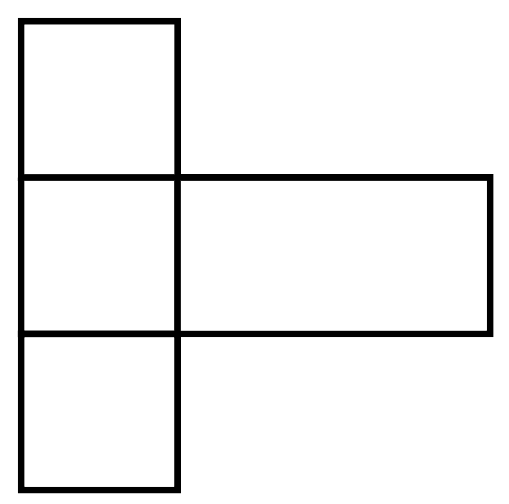
The overall shape from above is a T with the cross bar divided into 3.

Diagram

3d obj sol

Units of length, area and volume

Definition

Units of Length, Area and Volume are related. Length is used to measure 1 dimensional objects ie. lines Area is used to measure 2 dimensional objects ie. plane shapes Volume is used to measure 3 dimensional object ie. solids.

2D and 3D objects are defined by their outlines and so the units of Area and Volume are derived from the unit of length.

Length - metres, m Area - metres squared, m² Volume - metres cubed, m³

Tips/hints

Make sure you use the correct units for each of the three quantities. Also, pick a unit that's easy to work with. It's not much fun measuring the volume of a bath if its dimensions are in mm.

Example

Give a suitable unit in which to measure the following: (i) Length of a football pitch (ii) Area of the penalty spot (iii) Volume of the football

Solution

(i) Length is measured in km, m, cm, mm etc. Ideally, a unit that gives us a whole number measurement but that's not too large a number. A football pitch is a lot less than 1km long so km is no good. cm and mm are too small, so try m. A pitch is about 100m long, so metres is a good unit.

(ii) The penalty spot is about the size of a dinner plate, ie. about 20cm across. So, a good unit for the area is cm²

(iii) The volume of a football is the equivalent of a few cartons of milk so litres is a good unit for it.

Bearings

Definition

Bearings are used for navigation. They tell you the direction of travel relative to North.

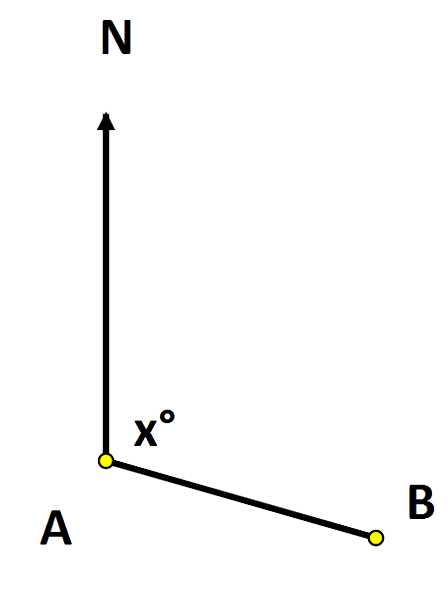
To give a Bearing, you need to state the Point from which you're going, and the angle of the direction you're travelling in. The angle is always measured Clockwise from the North line

Diagram

bearing x def

Note

Here, B is on a bearing of x° from A.

Tips/hints

Remember, you need the Point from which the bearing is being taken and the Clockwise Angle from the North line.

Example

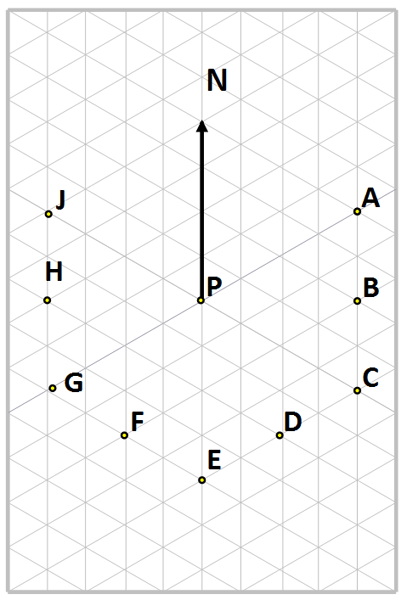
Which point is on a bearing of 150° from P? (The grid in the diagram is made up of equilateral triangles.)

Diagram

bearings A to J with grid-note

Solution

We measure Clockwise from the North line out of P. E is too far, B is not far enough so the point is either C or D. If each triangle is equilateral, the C's bearing is 120° so our answer is D.

Compass readings

Definition

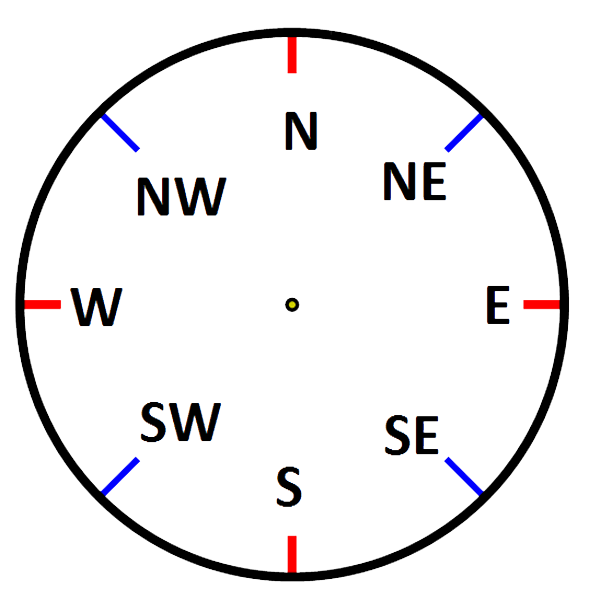
The compass has four main points, in clockwise order, North, East, South, West or N,E,S,W Halfway inbetween each adjacent pair are North East, South East, South West, North West.

Diagram

compass

Note

The angle between a pair of adjacent set of points is 45°. So, the angle between South West and West is 45°

Tips/hints

Learn the compass points, especially West and East which are easy to mix up.

Example

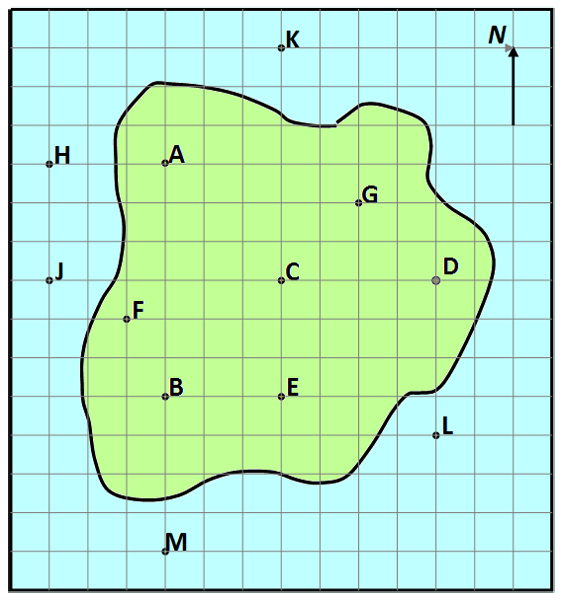
Looking at the map below, which points lie North East of B?

Diagram

coloured map outline with grid

Solution

The line North East of B runs at a bearing of 45° so, C and G lie North East of B

Maps and scale drawings

Definition

Maps and Scale Drawings are representations that accurately portray real objects.

Diagram

coloured map outline with grid

Note

Above is the map of an island with various locations shown. With such a diagram, you will be told the 'Scale' that is, how much the distances have been scaled down. For example, on the map, if each square is 1 inch x 1 inch and 1 inch represents 1 mile, then the distance from C to E in real life is 3 miles.

Tips/hints

Make sure you read the scale properly.

Example

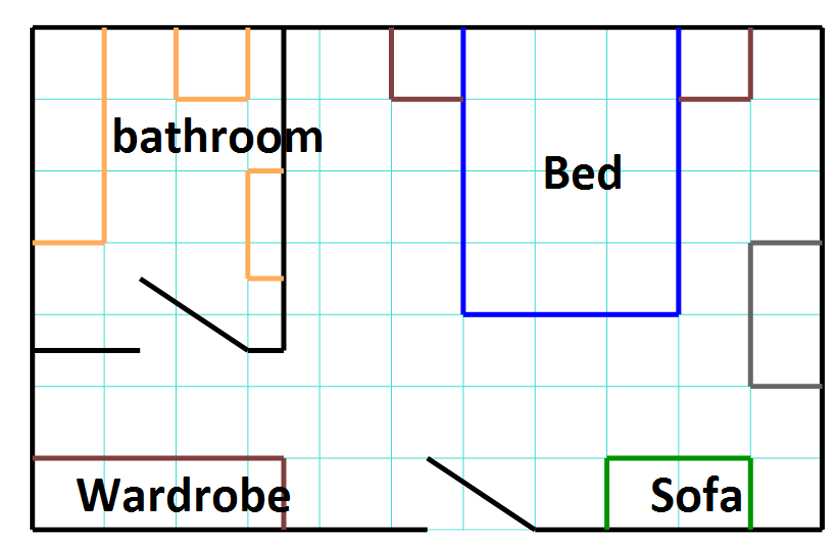
Below is a scale drawing of a hotel bedroom. If each square is 1cm x 1cm and the scale is 1:50, what is the area of the bathroom in m² to 1 d.p.?

Diagram

scaled bedroom ex

Solution

Work out the dimensions of the bathroom in the drawing in cm. It's 3.5cm x 4.5cm. The scale is 1:50 so that represents 175cm x 225cm = 39375cm² We're asked to give the answer in m². 1m² = 100cm x 100cm = 10000cm² So we need to divide by 10000. To 1 d.p. the bathroom's area is 3.9m²

Nets

Definition

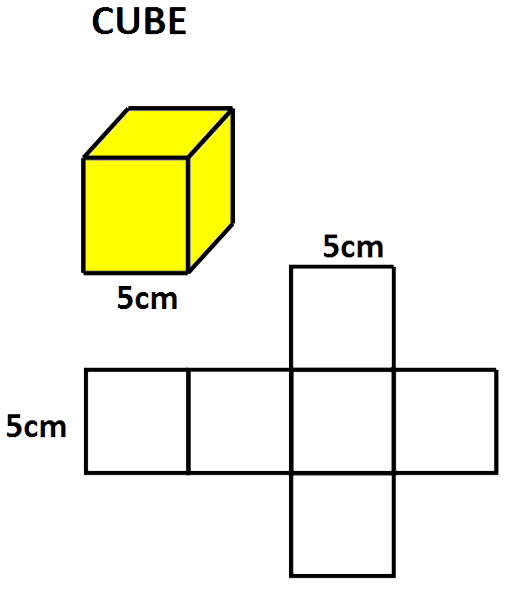
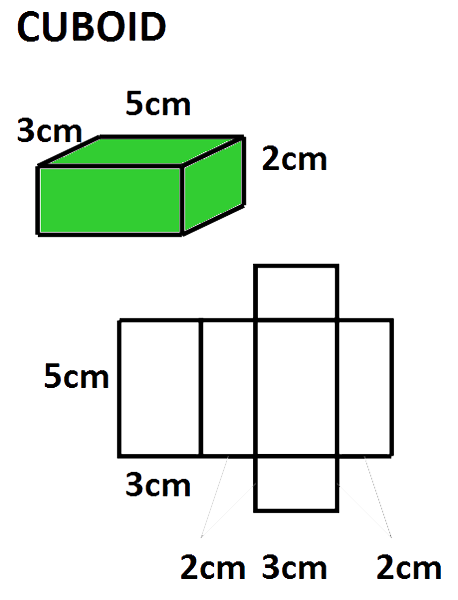
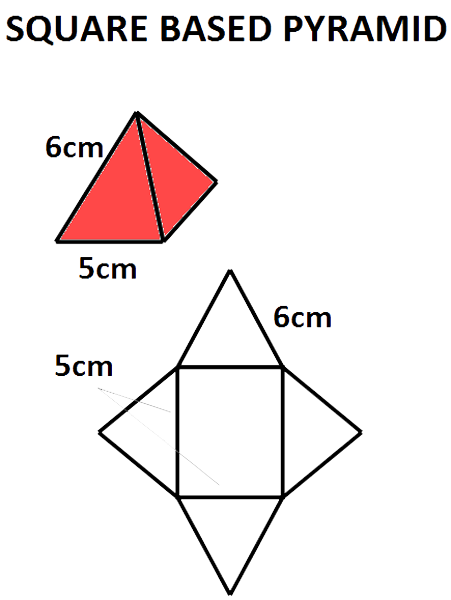
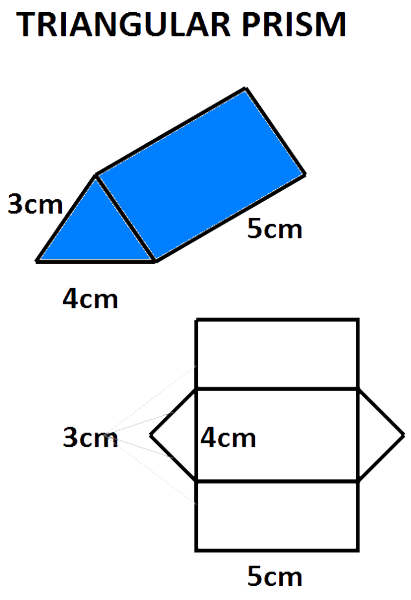
A Net is a 2 dimensional shape that can be folded to create a 3 dimensional shape. There are 4 basic nets that you should know.

Diagram

cube net def

Diagram

cuboid net def

Diagram

square based pyramid net def

Diagram

triangular prism net def

Tips/hints

Remember the Surface Area of Net = Surface Area of Solid

Example

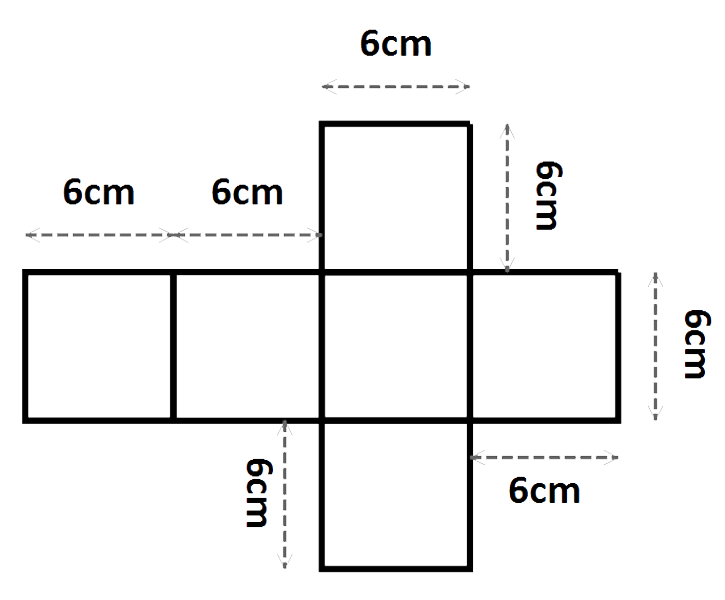
What solid shape does this net make and what is the surface area of the shape?

Diagram

nets ex

Solution

The net is that of a cube with sides 6cm

The surface area of the net is the same as that of the solid shape. Six squares of 6cm x 6cm make up the net so its surface area is: 6 x 6 x 6 = 216cm² = surface area of cube.

Test yourself on this topic

Try the free quiz with worked solutions.

Start quiz →

Get GCSE Geometry

Full notes, full question bank, offline.