


G GCSE Apps

GCSE Geometry

Circle Theorems

8 subtopics in this section

Angle in a semi-circle

Definition

The angle subtended at the circumference by a semi-circle is always a right angle.

Diagram
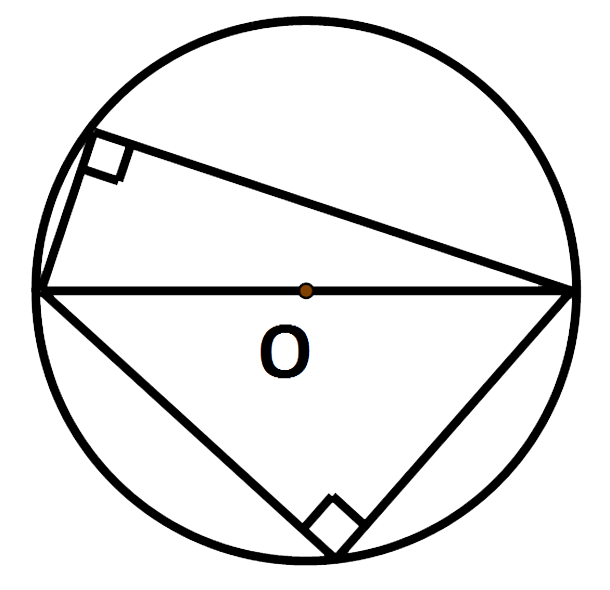
angle in a semicircle def

Proof

This is a special case of the angle at the centre being twice the angle at the circumference.

Diagram
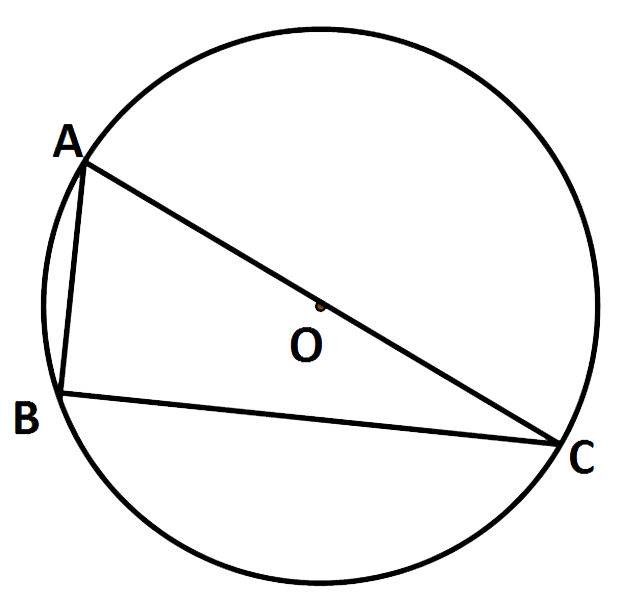
angle in a semicircle ex

Note

AC is a straight line running through O So, ∠AOC = 180° ∠ABC is the angle at the circumference subtended by the arc AC So, ∠ABC = 1/2 ∠AOC = 1/2 180° ie. it's a right angle.

Tips/hints

This theorem means that any triangle formed by a diameter and a point on the circumference will be a right angled triangle with the right angle opposite the diameter.

Example

The circle below has radius 25cm and AB is 14cm. Calculate the length of BC.

Diagram

angle in a semicircle ex

Solution

∠ABC = 90° (angle in a semi-circle). So, we can use Pythagoras' theorem in ABC AC = 2 x 25cm = 50cm So, 50² = 14² + BC² BC² = 2500 - 196 = 2304. BC = 48cm
Angle at centre is twice angle at circumference

Definition

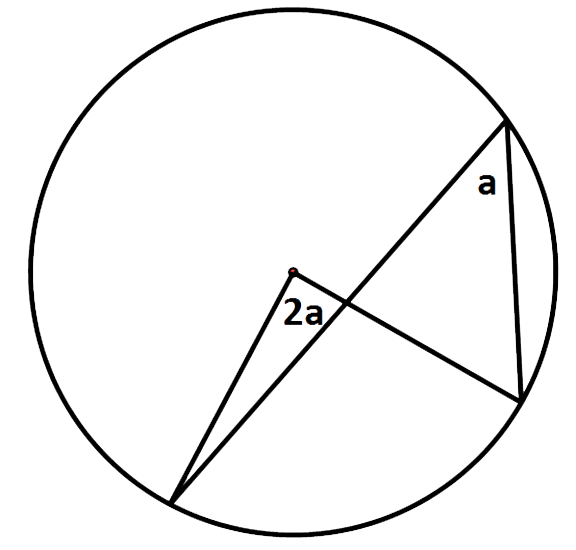
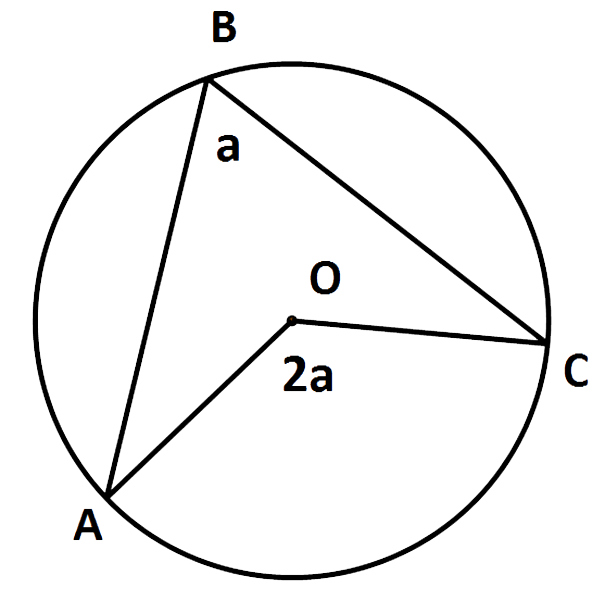
The Angle subtended at the Centre of a Circle by an arc is Twice the Angle subtended by the same arc at the Circumference.

Diagram

angle at centre theorem def

Proof

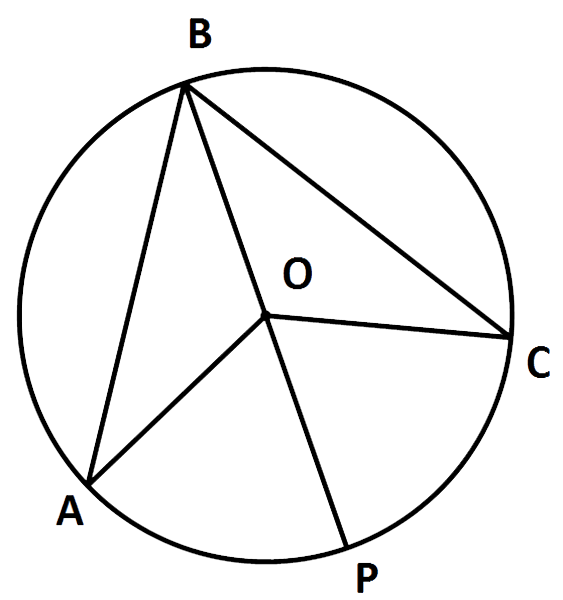
Consider the circle below.

Diagram

angle at centre theorem proof

Note

AO = BO = OC (all radii) So, triangles AOB and BOC are isosceles. Let ∠OAB = x so, ∠ABO = x Let ∠OBC = y, so ∠BCO = y Now, ∠AOP is an external angle to triangle OAB so, ∠AOP = ∠OAB + ∠OBA = 2x Similarly, ∠POC = 2y Now, ∠AOC = ∠AOP + ∠POC = 2x + 2y = 2(x + y) But, ∠ABC = ∠ABO + ∠OBC = x + y Which means, ∠AOC = 2 ∠ABC ie. the angle at the centre is twice the angle at the circumference.

Tips/hints

Look out for this as it isn't always easy to spot, especially if extra lines have been drawn or it's configured as below.

Diagram

tricky angle at centre

Example

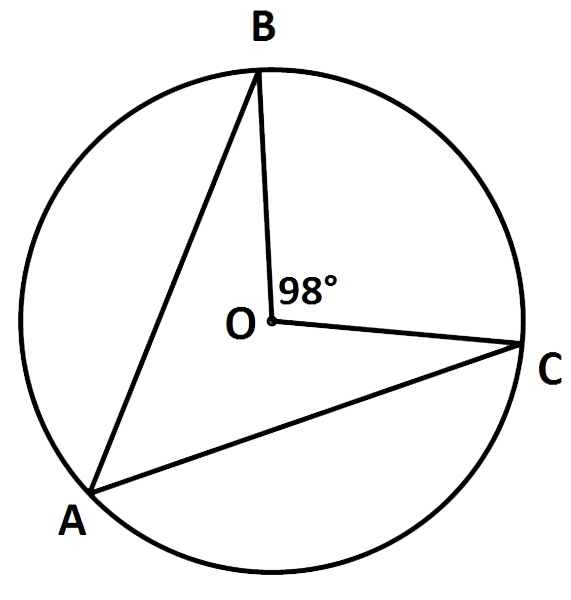
If O is the centre of the circle, what is the size of ∠CAB?

Diagram

angle at centre theorem ex

Solution

∠BOC is the angle at the centre so ∠CAB = 1/2 ∠BOC ie. ∠CAB = 49°

Cyclic quadrilaterals

Definition

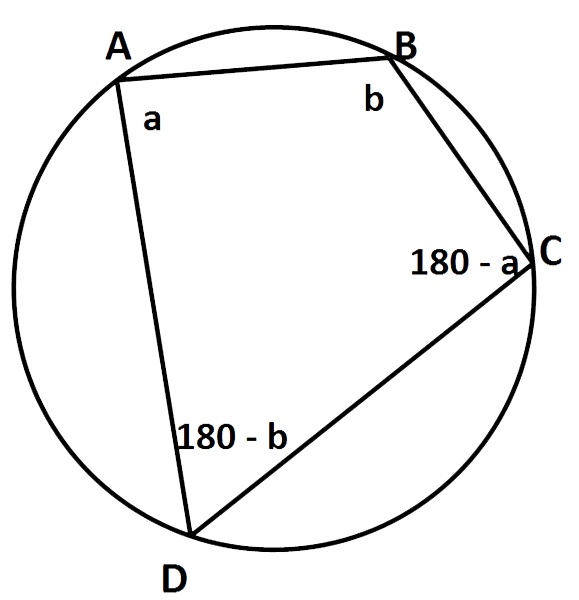
A Cyclic Quadrilateral lies within a circle and each of its 4 vertices are on the circumference. The sum of opposite angles in a Cyclic Quadrilateral is 180°

Diagram

cyclic quad def

Proof

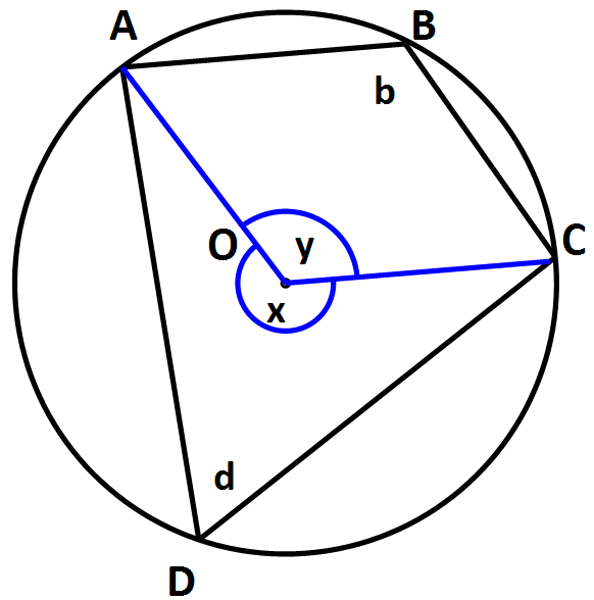
Let O be the centre of the circle and ABCD a cyclic quadrilateral in that circle.

Diagram

cyclic quad proof

Note

Now, the angle subtended at the centre of a circle is twice that subtended at the circumference by the same arc. So, y = 2d x = 2b But, x + y = 360° (angles around a point) So, 2d + 2b = 360° ie. b + d = 180° which is what we set out to prove.

Tips/hints

Make sure the quadrilateral you're looking at has ALL of its vertices on the circumference.

Example

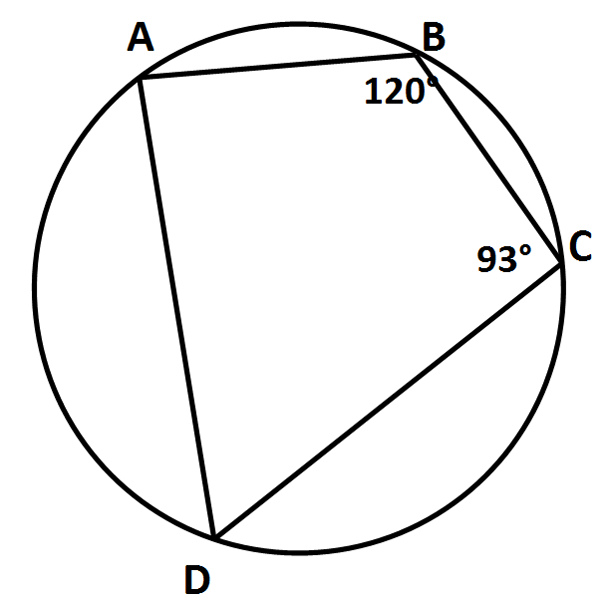
Work out the missing angles in the quadrilateral below

Diagram

cyclic quad ex

Solution

ABCD is a cyclic quadrilateral so its opposite angles add up to 180° ∠ADC = 180° - 120° = 60° ∠DAB = 180° - 93° = 87°

Angles in same segment are equal

Definition

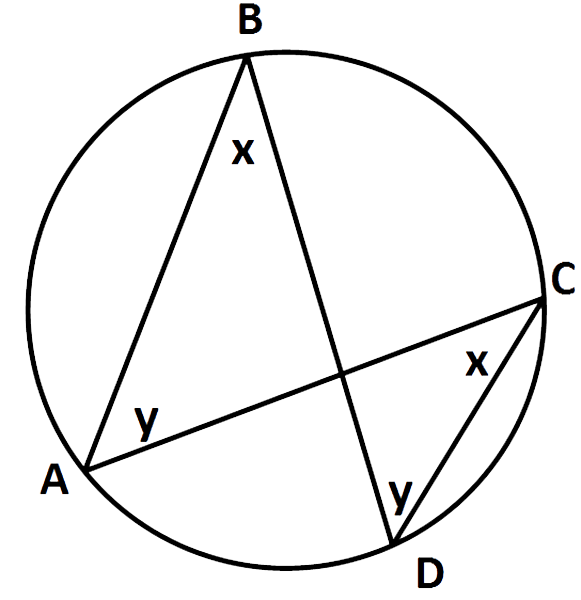
Any angles at the circumference subtended by the same arc of a circle are equal.

Diagram

angles in same segment def

Proof

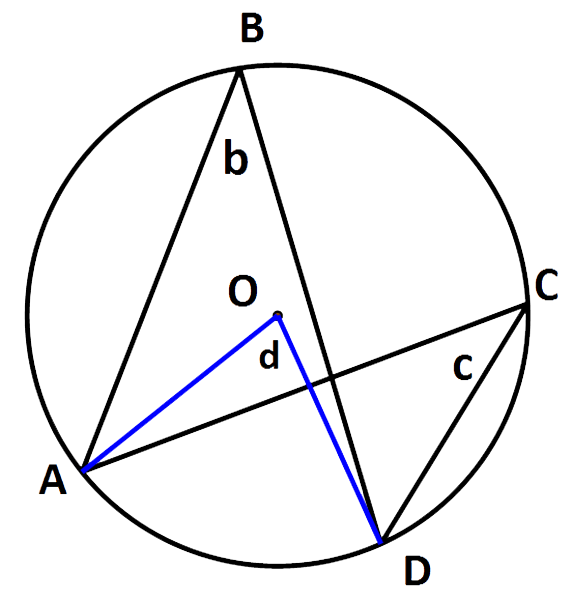
Let O be the centre of the circle.

Diagram

angles in same segment proof

Note

Let ∠AOD = d, ∠ABD = b, ∠ACD = c Now, an angle at the centre of a circle is twice that at the circumference subtended by the same arc. So here, d = 2b. But also, d = 2c So, 2b = 2c and b = c which is what we wanted to prove.

Tips/hints

These are usually quite straightforward to spot

Example

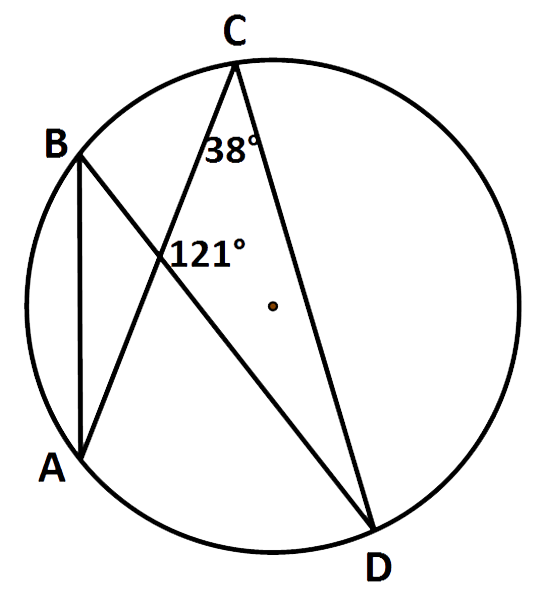
Find the size of ∠CAB

Diagram

angles in same segment ex

Solution

Angles in a triangle add up to 180° so ∠BDC = 180° - (121° + 38°) = 21°

∠CAB = ∠CDB (angles in same segment) So, ∠CAB = 21°

Tangents and chords

Definition

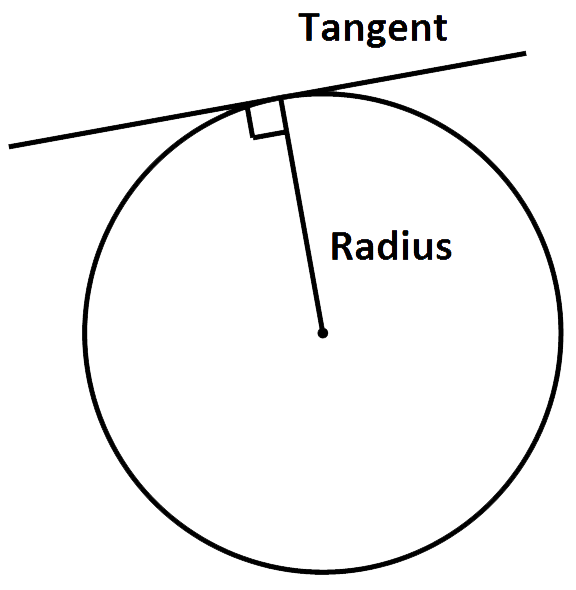
A Tangent is a line that just touches the circumference of a circle. A radius drawn to the Tangent meets it at right angles.

Diagram

tangent to circle def

Definition

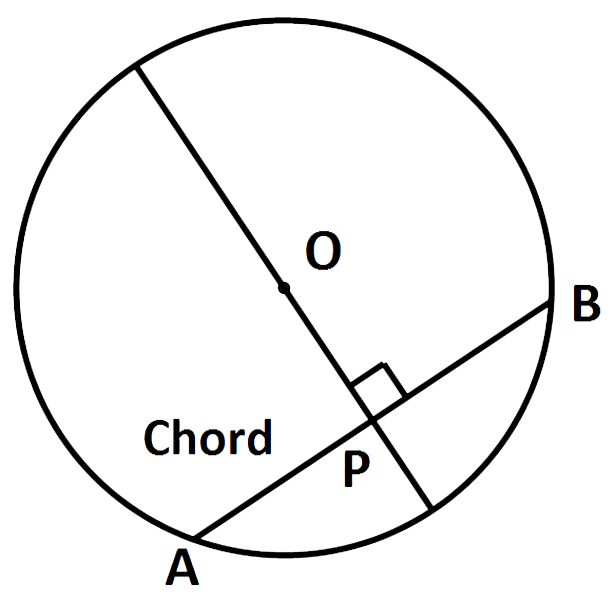
A Chord is a line that joins two points on the circumference of a circle. The perpendicular bisector of a Chord passes through the centre of the circle.

Diagram

chord def

Note

In the diagram above, AB is a chord, AP = BP and ∠APO = 90°

Method

Learn the two key facts about Tangents and Chords: A radius drawn to the Tangent meets it at right angles The perpendicular bisector of a Chord passes through the centre of the circle.

Example

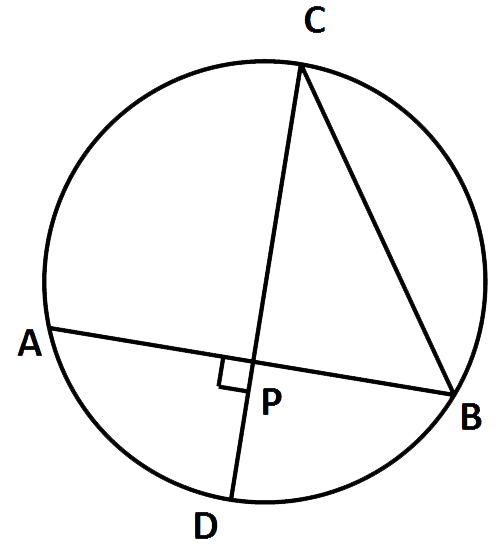
In the diagram below, AB is a chord in a circle radius 10cm. CD intersects AB at right angles at P. AB = 24cm and PD = 7cm. What is the area of the triangle PBC?

Diagram

tangents and chords ex

Solution

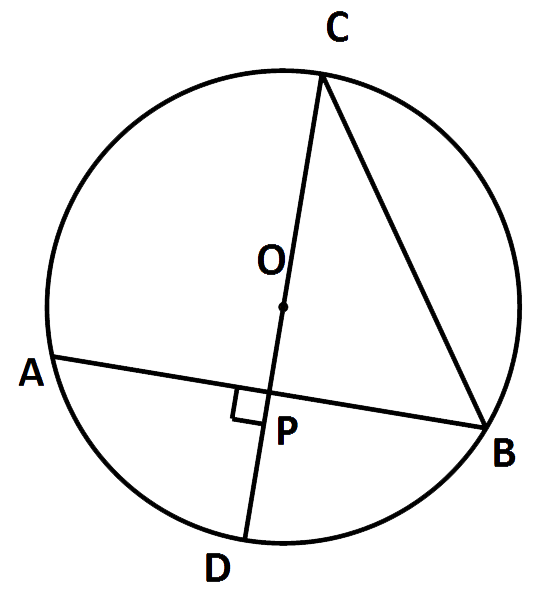
First, locate the centre of the circle. We're told CD bisects AB at right angles so, CD is a diameter. Let O be the centre.

Diagram

tangents and chords sol

Note

OD = 10cm (radius) PD = 7cm so PO = 3cm. Therefore, PC = 13cm. We know PB = 1/2 AB = 12cm

Triangle PBC is a right angled triangle (opposite angles) so the Area = 1/2 PB x PC = 1/2 (12 x 13) = 78 cm²

Alternate segment theorem

Definition

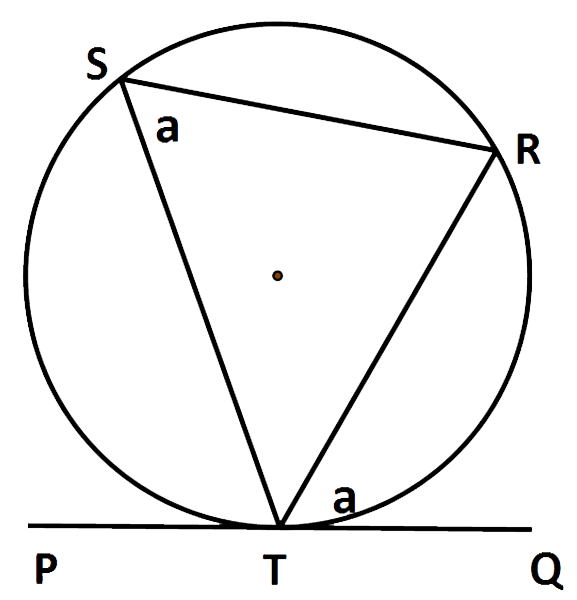
The theorem states: If a tangent to a circle and a chord in the circle meet, then the Angle between them is equal to the Angle in the Alternate Segment.

Diagram

alternate segment theorem def

Proof

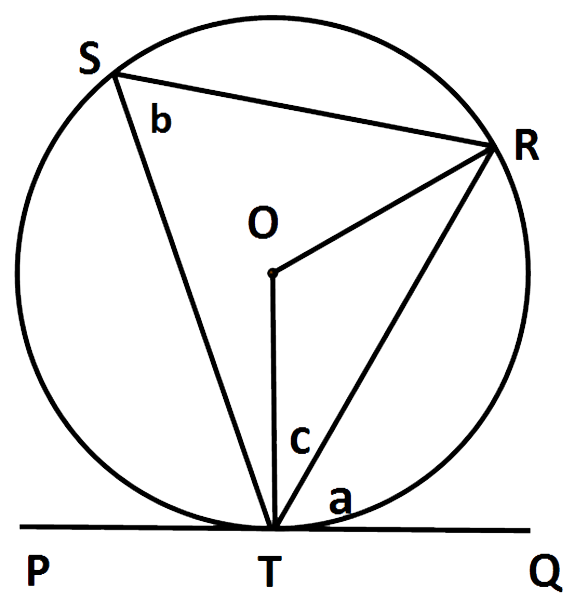
Consider the diagram below.

Diagram

alternate segment theorem proof

Note

PQ is a tangent meeting the circle at T. O is the centre of the circle so ∠OTQ = 90° So, a + c = 90° and a = 90° - c

OT and OR are radii so triangle OTR is isosceles so: ∠ORT = c ∠TOR = 180° - 2c

So, ∠TSR = 1/2(∠TOR) (angle at circumference is half angle at centre) ie. b = 1/2(180° - 2c) = 90° - c = a Which is what we set out to prove.

Method

These aren't easy to spot so try to remember to look for them whenever you see a tangent to a circle.

Example

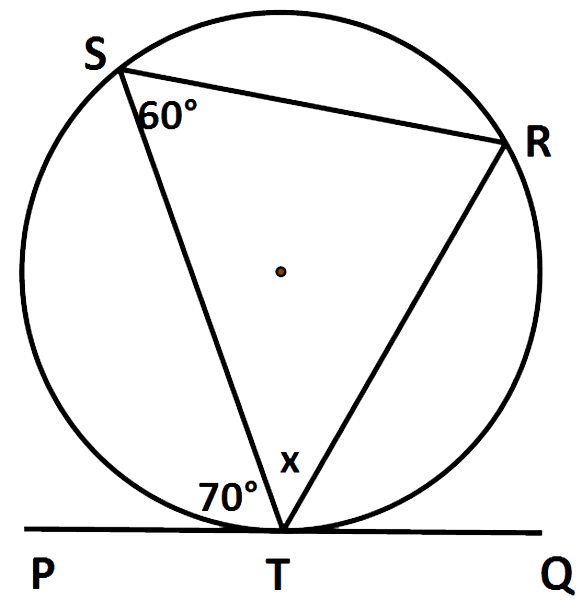
PQ is a tangent to the circle meeting it at T. Find the size of x.

Diagram

alternate segment theorem ex

Solution

By the alternate segment theorem, ∠RTQ = ∠RST = 60° Angles on a straight line add up to 180° So, x = 180° - (60° + 70°) = 50°

Circle geometry

Definition

There are a number of theorems and facts associated with Circles. These are covered in the modules in this topic.

Method

You need to be familiar with all the circle theorems. And don't forget you might have to apply your knowledge about other geometry topics eg. parallel lines or similar triangles.

Tips/hints

Remember to always give your reasoning. It's no good to say ∠ABC = ∠PQR without a reason why.

Example

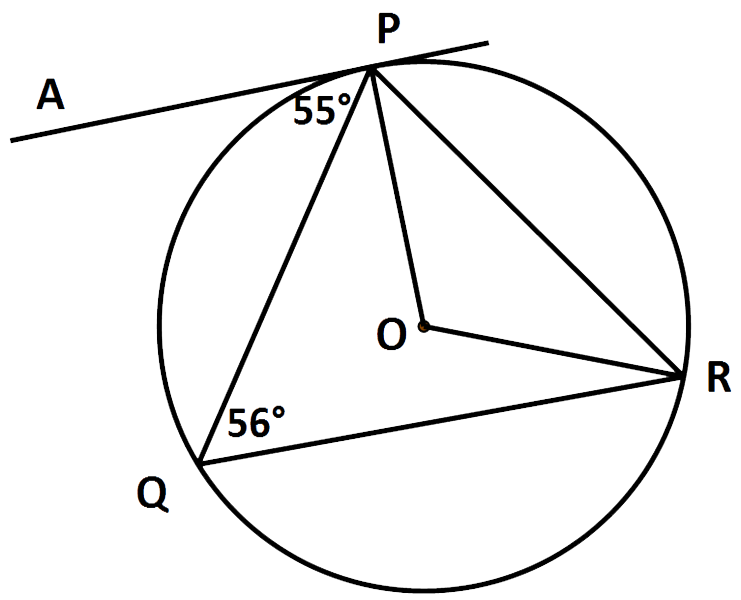
In the diagram below, O is the centre of the circle. AP is a tangent to the circle, ∠APQ = 55° and ∠PQR = 56°. What is the size of ∠ORQ?

Diagram

circle geometry ex

Solution

By the Alternate Segment Theorem, ∠PRQ = ∠APQ = 55°

Also, the Angle at the Centre of a Circle is Twice the Angle at the Circumference so, ∠POR = 2 x ∠PQR = 2 x 56° = 112°

Now, OP = OR because they are both radii. So, triangle OPR is isosceles and ∠OPR = ∠ORP ∠POR = 112° so ∠OPR = ∠ORP = 34°

Finally, ∠ORQ + ∠ORP = 55° so, ∠ORQ = 55° - 34° = 21°

Proof of Circle Theorems

Definition

Circle theorem proofs show WHY the theorems work, not just that they do. In the exam, you may be asked to prove a circle theorem or explain the reasoning behind one.

The key starting fact used in most proofs is that all radii of a circle are equal in length, which creates isosceles triangles.

Proof: Angle at Centre = 2 × Angle at Circumference

1. Draw two radii to the points on the circumference and one to the centre, creating two isosceles triangles.

2. Label the base angles of each isosceles triangle a and b (base angles are equal).

3. The angle at the circumference = a + b.

4. Using the exterior angle theorem, the angle at the centre = 2a + 2b = 2(a + b).

5. Therefore, the angle at the centre is twice the angle at the circumference.

Proof: Angle in a Semicircle = 90°

This follows directly from the angle at the centre theorem.

The diameter creates an angle of 180° at the centre (a straight line).

The angle at the circumference = 180° ÷ 2 = 90°.

Proof: Angles in Same Segment are Equal

Both angles at the circumference are subtended by the same arc.

Each angle is half the central angle subtended by that arc (from the angle at the centre theorem).

Since they are both half the same central angle, they must be equal.

Proof: Opposite Angles of Cyclic Quadrilateral = 180°

The two opposite angles are each subtended at the circumference by arcs that together make the full circle.

The central angles for these arcs add up to 360°.

Each circumference angle is half its central angle, so the two opposite angles sum to 360° ÷ 2 = 180°.

Tips/hints

The "angle at centre = twice angle at circumference" theorem is the foundation — most other proofs rely on it.

Always start proofs by identifying isosceles triangles formed by radii.

In the exam, show each step clearly and state which facts or theorems you are using at each stage.

Test yourself on this topic

Try the free quiz with worked solutions.

Start quiz →

Get GCSE Geometry

Full notes, full question bank, offline.