


G GCSE Apps

GCSE Algebra

Patterns and sequences (F)

6 subtopics in this section

Patterns in number

Definition

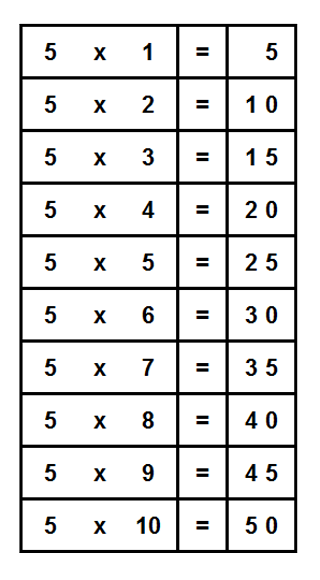
Mathematics is full of patterns, in fact, one of the objectives of maths is to find patterns and apply them generally. You'll already be aware of some number patterns such as the 5 times table

Diagram
5 times table

Note

See how the second digit of the result alternates between 5 and 0 And the first digit follows the pattern (0), 1,1,2,2,3,3,4,4 etc

Method

Basically you have to do some detective work and look for patterns. Can you see certain numbers occurring on a regular basis? Is there a link between a number and the one before it or after it? Once you've worked out the pattern, see if you can convert it into a general rule.

For example, with the 5 times table, for 5 x n, if n is odd the last digit is 5, otherwise it's 0 And the first digit is n ÷ 2 (ignoring the remainder)

Example

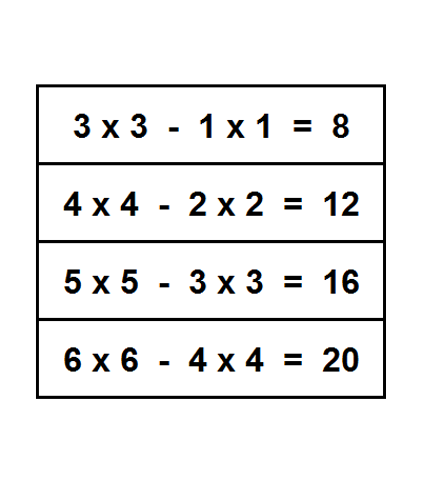
Look for the pattern in the table below and use it to calculate 101x101 - 99x99

Diagram
diff of squares 2 apart

Solution

The entries on the left are the differences between the squares of numbers that are two apart, the difference of the squares of n+2 and n

The results on the right are multiples of 4 and in fact are 4 x the average of the two numbers on the left ie. 4 x (n+1)

So, 101 x 101 - 99 x 99 = 4 x (100) = 400
Number sequences

Definition

Number sequences are strings of numbers in which each consecutive pair is related in the same way.

Often, each new term in a sequence is formed by adding the same amount onto the previous one.

There are some special sequences too such as the perfect squares.

Method

First, see if the numerical difference between each pair of terms is the same. If it is, then each new term can be formed by adding this difference on to the previous term.

If not, then look for another pattern, maybe perfect squares or all the numbers have a common factor.

Sometimes you'll be told how a sequence is formed. Take care to follow the steps to create new numbers in the sequence.

Example

Which term is missing from the sequence: 25, 22, 19, , 13, 10...?

Solution

First calculate the difference between two pairs of consecutive terms. 22 - 25 = -3, 19 - 22 = -3. So, each term is formed by subtracting 3 from the previous one. The missing term is therefore 19 - 3 = 16

The nth term of a sequence

Definition

A number sequence can usually have its pattern expressed in an algebraic format. Using this, we can calculate the nth term.

Method

This might sound complicated but is quite simple. For example, the nth term in the sequence of even numbers which starts 2, 4, 6, ...is given by 2n

This means we can easily work out the 40th even number (2 x 40 = 80) or the 523rd even number (2 x 523 = 1046)

Example

The nth term of a sequence is given by the formula 3n - 4 What is the 50th term in the sequence?

Solution

Plug 50 into the formula to get 3x50 - 4 = 146

Finding the nth term

Definition

When the difference between each pair of consecutive terms in a number sequence is the same, it's called an Arithmetic Sequence and the formula for the nth term will be in the format dn + c.

Method

In this type of questions, you'll be given a sequence and asked to work out a formula for its nth term.

Take the template formula dn + c Work out the common difference between each pair of terms; this is the value of d Now consider the first term in the sequence to work out c

Follow the example below to see this method in action. It's very straightforward.

Tips/hints

Don't forget - if each term is less than the last, the common difference will be negative.

Example

Find a formula for the nth term of the sequence which begins: -3, 1, 5, 9, ...

Solution

Our formula will be in the format dn + c The common difference in this sequence is 4 so the formula becomes 4n + c When n = 1 we have 4 + c = -3 so c = -7 So, our formula is 4n - 7 We can check this with the 3rd term say. Put n = 3 into the formula: 4 x 3 - 7 = 12 - 7 = 5 which is indeed the 3rd term.

Special sequences

Definition

There are lots of Special Sequences of numbers, odd numbers, even numbers, square numbers, prime numbers etc.

Method

Learn at least the first 10 terms of the special sequences listed above and also be on the look out for slight variations eg. the squares of even numbers.

Example

Express in words the sequence of numbers which starts: 2, 8, 18, 32, 50, 72, 98, ...

Solution

On first inspection that's quite an unusual sequence. Is there anything you notice that is common to all the numbers? They're all even. Try dividing them all by 2 and see if any pattern emerges. 1, 4, 9, 16, 25, 36, 49,... That looks more familiar. Those are the square numbers. So, expressing the sequence we were given in words we could say It's the sequence of the square numbers doubled.

Finding the nth term from given patterns

Definition

As well as numerical patterns, visual patterns can be described by an algebraic formula.

Method

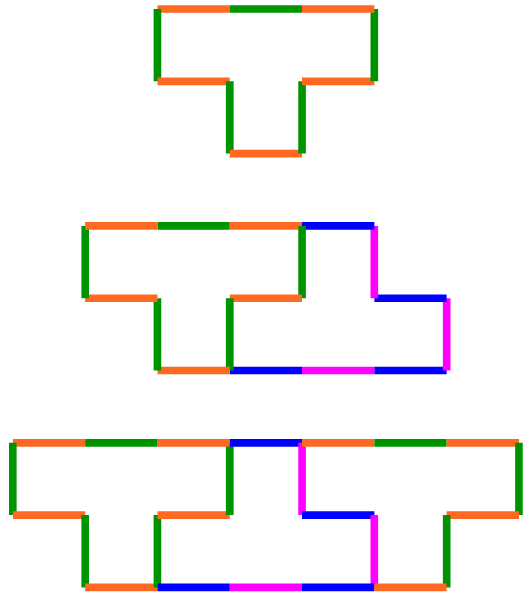
We'll use the standard formula for the nth term in an arithmetic sequence ie. dn + c Usually you'll be presented with a series of diagrams such as the one shown.

Diagram

T-tiles

Note

Count the elements in the initial diagram. See how many extra ones are required in the second. This will give you the common difference, d. Then put the number you counted in the initial diagram along with the common difference into the formula to find c

Example

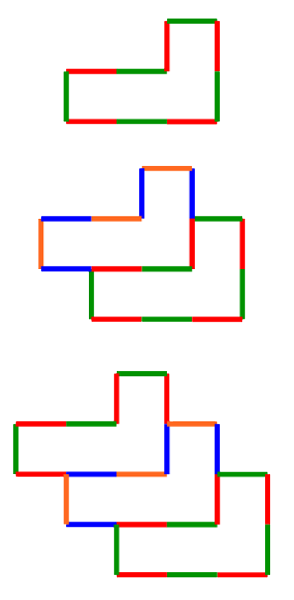
A series of L-shaped tiles has been made using coloured matchsticks. Find a formula for the number of matchsticks required when the pattern contains n tiles.

Diagram

step tiles

Solution

The initial pattern contains 10 matchsticks. The second pattern has 7 extra matchsticks. So, using the formula dn + c, d = 7 Put this into the formula with n = 1 to get 7 + c = 10 so c = 3 Check these values in the third diagram where n = 3 7 x 3 + 3 = 24. Count up the matchsticks. There's 24. But then what did you expect?

Test yourself on this topic

Try the free quiz with worked solutions.

Start quiz →

Get GCSE Algebra

Full notes, full question bank, offline.