

G GCSE Apps

GCSE Algebra

Inequalities (F and H)

5 subtopics in this section

Inequalities

Definition

An Inequality is like a regular equation except the equals sign, = , is replaced by one or more of the signs below. It indicates a range of values that a variable can take.

≥ means Greater Than or Equal To

≤ means Less Than or Equal To

> means Greater Than

< means Less Than

Method

Learn the signs and don't forget that two of them include equal values but two of them don't. Sometimes two will be used eg. -3 < x ≤ 2 In words, this means that x is greater than -3 and less than or equal to 2. So, x cannot equal -3 but can equal 2.

Example

How many different integer values can x take if -1 < x < 4?

Solution

x can't equal -1 or 4 so the integer values it can take are 0, 1, 2, 3 ie. there's 4 of them
Solving inequalities

Definition

Inequalities behave like equations though their solutions, rather than give specific values for an unknown, give a range of values (usually in the form of another inequality).

Method

As with equations, inequalities can be simplified by adding and subtracting amounts to both sides. Also, you can multiply and divide both sides by a positive number.

For example: solve the inequality 3x > 2 - x Add x to both sides to get 4x > 2 Divide both sides by 4 to get x > 0.5

However, and this is a BIG however, if you want to multiply or divide both sides of an inequality by a negative number, you have to change the direction of the inequality.

For example: solve the inequality 3 - 2x ≥ 5 Subtract 3 from both sides to get -2x ≥ 2 Now divide by -2 (ie. a negative number so the inequality has to be flipped) x ≤ -1

One other thing to look out for - square roots. You may be presented with the following: Solve the inequality x² < 16

Now, as with an equation, when we take a square root, we need to consider both the positive and negative roots. First look at the positive root, x < 4 So far so good. The negative root though flips the inequality so we get x > -4 These can be combined and written as -4 < x < 4

If the original inequality was the other way, ie. x² > 16, the solution would be: x > 4, x < -4

Example

Solve the inequality 4x - 3 > 1 - x

Solution

Add x to both sides to get 5x - 3 > 1 Now add 3 to both sides 5x > 4 Finally divide through by 5 so x > 0.8

Inequalities on number lines

Definition

An Inequality can be represented on a number line.

These representations are quite straightforward but there are a few symbols to learn.

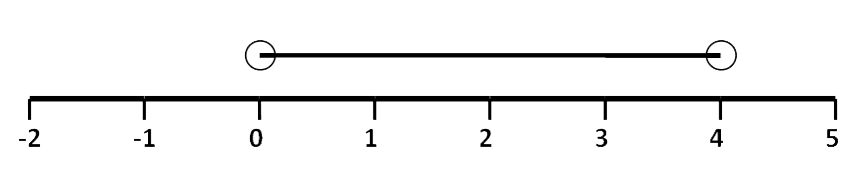
The line represents the range. A filled in circle indicates 'with equality' An open circle indicates 'no equality' An arrow indicates no upper/lower bound (depending on the direction it's pointing in)

Method

Work out the inequality from the line and the symbols taking care to include/exclude equality as appropriate.

Diagram

number line gt 0 lt 4

Note

The line runs from 0 to 4, this is the range of the inequality. The circles at either end are open so there's no equality with 0 or 4. This line represents the inequality 0 < x < 4

Example

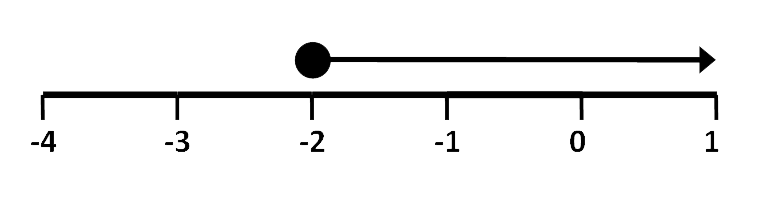
Which inequality is represented here?

Diagram

number line gte minus 2-note

Solution

The arrow at the right indicates there's no upper bound. The filled in circle over the -2 means that equality is included. So, the line represents -2 ≤ x

Graphical inequalities

Definition

Inequalities can be represented graphically and can include x and y For example x + y < 5

Method

(This module looks at just a single graph) First, work out the equation of the graph. A horizontal line has the equation: y = c A vertical line has the equation x = c where c is a constant in both instances.

Diagonal lines are trickier but you can use the notes in the module Find the Equation of a Line from Its Graph to see how to work out a line's equation.

Write the equation of the graph in the format ax + by = c (any of the constants could be 0) that is, with the variables on one side and the constant on the other. Now, take a point in the area you've been asked to consider and put its x, y coordinates into the left hand side of the graph's equation. Is the result bigger than or less than the right hand side of the equation? Whichever it is, put that inequality in place of the equals sign.

Now, if the graph is drawn with a dotted line, it means it's not included in the inequality so you already have your answer. If the graph is a solid line, then equality is included and you need to change the symbol to reflect that.

Example

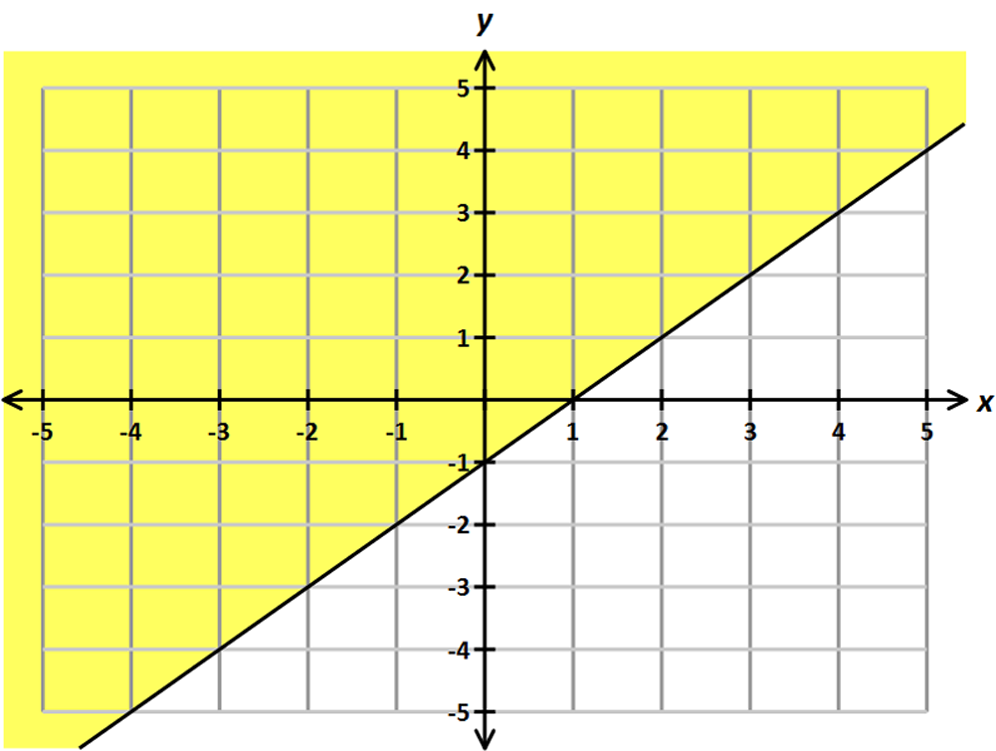
What inequality is represented by the yellow shaded area?

Diagram

y gte x - 1

Solution

First find the equation of the graph. It's a straight line so is of the form y = mx + c It goes through (0, -1) and (1, 0) so -1 = c and 0 = m + c So, the equation of the line is y = x - 1

Rearrange to get the variables on the same side so y - x = -1 Now take a point in the yellow area, (0, 1) say. Put these values into the left hand side of the equation. This gives 1 which is > than the right hand side ( -1 ) So, the inequality is y - x > -1 But we're not finished. The line of the graph is solid so equality is included. Therefore our answer is y - x ≥ -1

More than one inequality

Definition

It's possible to represent more than one inequality using graphs. The result is one or more shaded regions.

Method

Use the same method as outlined in the module Graphical Inequalities. Find the equations of each line and then take a point in the area you've been asked to consider and find out which way the inequality goes.

Your answer will be a list of the inequalities that satisfy the specified region.

Tips/hints

Don't forget to see if the graphs use dotted or solid lines.

Example

Which inequalities are represented by the shade area in the graph below?

Note

y lt 3 x lte 4 y gt minus x

Solution

Let's start with the easy lines. The blue one's equation is x = 4 The red one is y = 3 And the trickier green one passes through (0, 0) and has gradient -1 so its equation is y = -x which rearranged is y + x = 0

The point (1, 1) is in the shaded region so plug that into each equation to see which way the inequalities go. Don't forget, the blue line is solid so that includes equality. So, our final answer is: x ≤ 4, y < 3, y + x > 0

Test yourself on this topic

Try the free quiz with worked solutions.

Start quiz →

Get GCSE Algebra

Full notes, full question bank, offline.