


G GCSE Apps

GCSE Algebra

Expressions, equations etc (H)

24 subtopics in this section

Advanced Powers

Definition

These are the rules of working with powers, whether they're powers of the same number or of the same algebraic letter

To Multiply the terms, Add the powers

To Divide the terms, Subtract the powers

To find the Power of a Power, Multiply the powers

A Negative Power means 1 over the positive power

A Zero Power is ALWAYS 1

A Fractional Power means a Root

Tips/hints

Break complicated sums down into simpler parts if possible.

Example

Simplify the following:

Solution

Let's look first at the denominator. It's the power of a power so we multiply the powers (don't forget to do the operation to each term in the brackets).

Now rewrite the sum:
Identities

Definition

An Identity is an equality that is true no matter what value any variables take. A special sign is used to denote it: ≡

Method

Normally you can identify an identity because of the ≡ but if an = sign is used, expand and simplify the terms on either side. If they're the same, then it's an identity.

Example

Which of these could have the = replaced with ≡? (a) 3(b + 2) = 2(3 + b) (b) 4(x - 1) = 2x - 3 (c) -3(a - b) = 3b - 3a

Solution

Evaluate both sides of each one: (a) 3b + 6 = 6 + 2b NOT an identity (b) 4x - 4 = 2x - 3 NOT an identity (c) -3a + 3b = 3b - 3a Identity So, (c) can have the = replaced with ≡

Expansion, simplification and factorisation II

Definition

Expansion means multiplying out brackets Simplification means gathering like terms and combining them into one term Factorisation means finding factors and using brackets to simplify further.

Tips/hints

Expansion: Remember to multiply each term inside the bracket by what’s outside it.

Simplification: Don't forget that the order of the letters doesn't matter in an algebraic term: abc = bca = cab.

Factorisation: It's safest to factorise in steps. First find any numerical common factors. Once those have been factored out, then look for common factors made up of letters.

Example

Expand, simplify and factorise if possible 4p(3p - 4q) + 2q(8p - 3q)

Solution

Multiply out the brackets first 12p² - 16pq + 16pq - 6q² The pq terms in the middle cancel out so we have: 12p² - 6q² There's a common factor of 6 so take this out and the expression becomes: 6(2p² - q²)

Rearranging formulas II

Definition

A Formula is a means of working out an unknown variable by using information we have about other variables, When the variable that is unknown changes, we need to rearrange the formula to enable us to work it out.

Tips/hints

Formulas work like equations. Whatever you do one side of the equals sign, you must to do the other. Some formulas are quite complex with powers, roots etc. so care needs to be taken when rearranging.

Example

Rearrange the formula t = (4π/√s) + r to make s the subject

Solution

First, get the term involving s on its own on one side Subtract r from both sides (t - r) = (4π/√s) Now multiply through by √s √s(t - r) = 4π Now divide by (t - r) √s = 4π/(t - r) Finally, square both sides s = 16π²/(t - r)²

Quadratic expansion

Definition

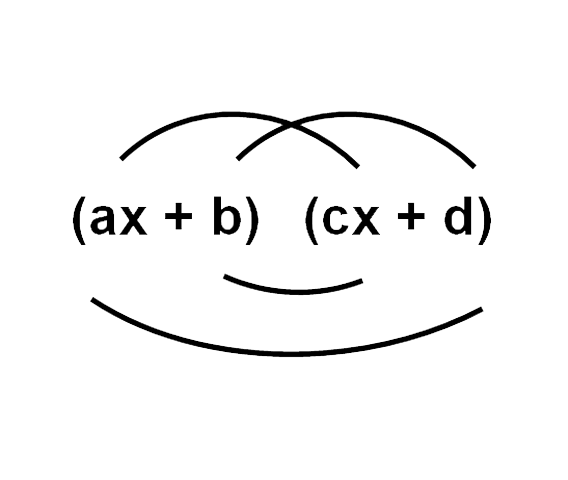
Quadratic Expansion is the expansion of brackets in the form (ax + b)(cx + d) where x is unknown and a, b, c, d are constants.

Method

It's time to draw a smiley face.

Diagram

quadratic expansion

Note

Both terms in the first bracket must be multiplied by both terms in the second.

The eyebrows give us acx² and bd and the smile and chin give adx and bcx

Putting this all together you get acx² + (ad + bc)x + bd You don't need to remember this, just the smiley face and remember to take care with any minus signs when multiplying.

Example

Expand (3x - 2)(2x + 1)

Solution

Use the smiley face to get: 6x² - 2 + 3x - 4x which simplifies to 6x² - x - 2

Squaring brackets

Definition

Squaring Brackets is simply Quadratic Expansion when both brackets contain the same expression.

Tips/hints

You might be asked the question in the form: Expand (ax + b)². If so, write it out as (ax + b)(ax + b) and use the smiley face method.

Example

Expand (3x - 2)²

Solution

Write it out as (3x - 2)(3x - 2) and use the smiley face to get: 9x² + 4 - 6x - 6x which simplifies to 9x² - 12x + 4

Difference of two squares

Definition

The Difference of Two Squares is One Thing Squared minus Another Thing Squared. Usually it's in the form (ax)² - b²

Method

It's worth learning how to factorise these expressions as one is quite likely to come up in the exam.

(ax)² - b² = (ax - b)(ax + b)

You can check this out by expanding the left hand side: (ax - b)(ax + b) = (a²x² - b² - abx + abx) = (ax)² - b²

Tips/hints

Don't forget to use the square roots of the x² coefficient and the constant when you factorise.

Example

Factorise 25x² - 4

Solution

The square root of 25 is 5 and the square root of 4 is 2 so, 25x² - 4 = (5x - 2)(5x + 2)

Solving quadratic equations by factorisation I

Definition

A Quadratic Equation is one where the highest power of the unknown is 2 that is, if the unknown is x, the equation will be of the form: ax² + bx + c = 0

In this module, the constant a is always 1

Method

You might need to rearrange the equation to get it into the standard format Eg. Solve 12 - x = x² can be rewritten as: x² + x - 12 = 0

Then, you just need to factorise it into two brackets (see the module Factorising a Quadratic with a Unit Coefficient of x²)

So, we'll have two brackets which, multiplied together make 0. That means one of them must be 0. Solve those for the answer. An example will make this all crystal clear!

Example

First factorise and then solve the equation: x² - 3x + 2 = 0

Solution

Because the signs in the equation go - +, the brackets will both contain - signs. So, it'll be in the format (x - p)(x - q) where pq = 2, p + q = 3 so, p = 1, q = 2 The equation becomes (x - 2)(x - 1) = 0 so, either x - 2 = 0 or x - 1 = 0 Therefore the solutions are: x = 1, x = 2 You can put these back into the original to check your answer. 2² - 3(2) + 2 = 4 - 6 + 2 = 0 so that's OK. 1² - 3(1) + 2 = 1 - 3 + 2 = 0 so that's OK as well.

Factorising a quadratic with a unit coefficient of x²

Definition

A Quadratic with a unit coefficient is of the form x² + bx + c = 0 where b, c are constants.

Depending on what values b,c are, it may possible to factorise the quadratic into the format (x + p)(x + q) where p, q are whole numbers

Method

Because b, c can be positive or negative, so can p, q so, it'll make life a whole lot easier if we treat all four, b, c, p, q as positive numbers and look at the possible signs that can go before them.

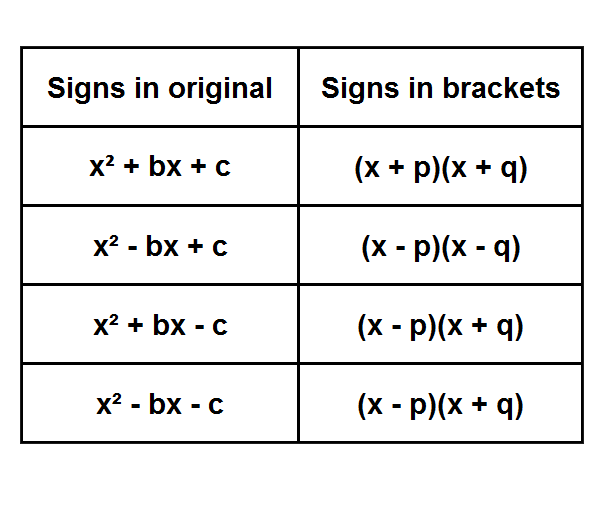
This table, shows how the signs work out.

Diagram

signs in a factored quad

Note

You don't have to learn the whole table, just remember: If the sign before c is a plus sign, then the signs in the brackets are both the same as the sign before b. Otherwise, if the sign before c is a minus sign, the signs are the brackets are different ie. one +, one -

Okay, so we know that each bracket starts with x and we know what sign follows each x. We now just need to work out p, q

We know that pq = c so write down the factor pairs of c Now it's a matter of trial and error to see which pair adds/subtracts to give b

Tips/hints

If there's no constant term in the expression ie. it's of the form x² + bx then it simply factorises to x(x + b)

Example

Factorise the expression: x² - 3x - 10

Solution

The sign before the constant is - so the signs in the brackets will be + and - So, the factorisation will be (x + p)(x - q) where p > 0, q > 0, pq = 10, p - q = -3

The factor pairs of 10 are 1 and 10, 2 and 5. 2 - 5 = -3 so that's the pair we want. Our answer then is x² - 3x - 10 = (x + 2)(x - 5) You can check this by expanding the expression on the right to make sure it matches the original one on the left.

Solving quadratics of the form ax² + bx + c = 0

Definition

A Quadratic Equation is one where the highest power of the unknown is 2 that is, if the unknown is x, the equation will be of the form: ax² + bx + c = 0

Method

More practice of these lovely things. Look at the previous notes on Solving Quadratics by Factorisation II and you'll sail through these

Example

Solve by factorising: 4x - x² = -12

Solution

First, rearranging to x² - 4x - 12 = 0 Now we can factorise to the form: (x - p)(x + q) where pq = 12, -p + q = -4 The values that multiply up to 12 are 1x12, 2x6, 3x4. The pair that has a difference of 4 is 2x6. By trial and error we get (x - 6)(x + 2) = 0 So, x = 6, x = -2 Put these back into the original equation to check the answer.

Solving quadratic equations by factorisation II

Definition

A Quadratic Equation is one where the highest power of the unknown is 2 that is, if the unknown is x, the equation will be of the form: ax² + bx + c = 0

Tips/hints

In this module we're looking at equations of the form ax² + bx + c = 0 Look at the notes on the modules Factorising a Quadratic with a Unit Coefficient of x² and Solving Quadratics by Factorisation 1 to familiarise yourself how to solve a quadratic by factorisation.

This time, we've an added complication in the factorisation as the coefficient of x² isn't 1.

So, the factorised form will be: (mx + p)(nx + q) With a = mn, c = pq and b = (mq + np)

So, this time not only do we have to work out p, q but there's also m, n. You see, I told you they were tricky.

You can work out the signs in the brackets in the same way as usual. Then, it's trial and error.

Write out the factor pairs for a and c and put each combination in the brackets to see which give the correct value of b

The Example below should help to show what to do.

Example

Solve the equation 2x² + 7x + 3 = 0

Solution

As only 1 and 2 divide into 2 and only 1 and 3 divide into 3, the factorisation has to be one of these combinations: (2x + 1)(x + 3) or (2x + 3)(x + 1) The first one gives +7x the second +5x when we expand so it's the first one we want.

Putting it back into the equation we get (2x + 1)(x + 3) = 0 so, 2x = -1, x = -3 ie. x = -1/2, x = -3 Check by putting these values back into the original equation.

Solving the general quadratic by the quadratic formula

Definition

A Quadratic Equation is one where the highest power of the unknown is 2 that is, if the unknown is x, the equation will be of the form: ax² + bx + c = 0

Method

Sometimes it's impossible to factorise a quadratic equation. In such cases, there's a formula that can be used. In fact it works for any quadratic.

The solutions of the quadratic equation ax² + bx + c = 0 are given by

So, all you have to do is put a, b, c into that to get the values of x which are the solutions to the equation.

However, it's very easy to mess up the signs. Don't forget the -b at the start and the -4ac in the square root. And don't forget to divide everything by 2a

Tips/hints

A big clue to knowing when to use the formula is if the question states 'Solve the quadratic equation to 2 d.p.'

Example

Solve the quadratic equation 3x² + 5x - 1 = 0 giving your answer to 1 d.p.

Solution

Put a = 3, b = 5, c = -1 into
This will give x = (-5 ± √37)/6
Evaluating it and rounding to 1 d.p. we get
x = 0.2, x = -1.8

Using the quadratic formula without a calculator

Definition

Quadratic Equations can be solved in many ways. Here we're using the quadratic formula to solve equations of the form: ax² + bx + c = 0

Method

In this module, although we're using the quadratic formula, we won't evaluate the contents of the square root. The answers will be left in surd form.

Example

Solve the equation: x² + 4x + 1 = 0 leaving your answer in surd form

Solution

Using the formula we get:
x = (-4 ± √(16-4)) / 2
ie. x = -2 ±(√12)/2
Now, √12 = √(2x2x3) = 2√3
So, x = -2 ± √3

Solving problems with quadratic equations

Definition

Solving problems with quadratics involves converting a practical problem into mathematical language and then solving the equation.

Method

Try and work out what the question's looking for and set up your equation carefully. If possible, check your solutions by substituting them back into the question.

Example

A rectangle's sides are x + 2, x - 2 cm long. Its area is 3x cm². What is the length of its longer side?

Solution

The area of a rectangle is the product of the lengths of its sides so: (x + 2)(x - 2) = 3x Expand this out to get x² - 4 = 3x Rearrange to x² - 3x - 4 = 0 This factorises to (x - 4)(x + 1) = 0 So, x = 4, x = -1

But, x + 2, x - 2 are positive (they're the sides of the rectangle) so x = -1 is not possible. So, x = 4 The question asks for the longest side so that is 4 + 2 = 6cm. As a check, put x = 4 back into the question. We get sides of 6cm and 2cm making the area 12cm² which is 3 x 4 which is correct.

Solving a quadratic equation by completing the square

Definition

Completing the Square is a method of solving quadratics that can't be factorised

Method

This method is quite neat but you need to follow the steps to be able to do it correctly.

If the equation isn't in the format x² + bx + c = 0 rearrange it so it is (this may involve dividing through by the coefficient of x²)

Now write (x + b/2)² Expand this to get x² + bx + b²/4 and compare it to the original to find out what we need to add or subtract to make it the same as the original.

The method doesn't works if you have to add a value, so let's assume you subtract K, K≥0

The equation can now be written (x + b/2)² - K = 0 Which becomes (x + b/2)² = K Take the square root of both sides to get: x + b/2 = ±√K so x = -b/2 ±√K

Look through the worked example to see it in practice.

Example

Solve the equation x² + 4x + 1 = 0 by completing the square. Leave your answer in surd form

Solution

Following the steps we get (x + 2)² Expand to get x² + 4x + 4 Compare this to the original x² + 4x + 1 To adjust, we need to subtract 3

The equation becomes (x + 2)² - 3 = 0 So, (x + 2)² = 3 Taking the square root of both sides, (x + 2) = ±√3 So, x = -2 ±√3

Quadratic equations with no solution

Definition

Not all Quadratic Equations can be solved. But there's an easy way to find out whether they can or not.

Method

Remember the quadratic formula? Well, this can be used to solve any quadratic equation but, it will only work if the expression in the square root sign ie. b² - 4ac is greater than or equal to 0. That's because we can't find the square root of a negative number.

So, a quadratic equation can be solved if and only if, b² - 4ac ≥ 0

The expression b² - 4ac is so important it even has its own name, it's the 'discriminant'

Example

What is the value of the discriminant of the quadratic equation: 4x² - 3x + 2. Can the equation be solved?

Solution

The discriminant is b² - 4ac Here it's (-3)² - 4(4)(2) = 9 - 32 = -23 ie. < 0 So, no, the equation cannot be solved.

Composite Functions

Definition

A composite function is formed when one function is applied to the result of another function. It is sometimes called a 'function of a function'.

The notation means 'apply g first, then apply f to the result'.

Similarly, means 'apply f first, then apply g to the result'.

Important: fg(x) is usually NOT the same as gf(x) — the order matters!

Method

To find a composite function:

1. Identify which function to apply first (the inner function, closest to x).

2. Substitute the inner function's expression into the outer function, replacing every x in the outer function.

3. Simplify the result.

To evaluate a composite function at a specific value, you can either find the composite expression first then substitute, or work from the inside out substituting numbers at each step.

Example

Given f(x) = 3x − 1 and g(x) = x + 4, find fg(x) and gf(x).

Solution

fg(x) = f(g(x)) = f(x + 4) = 3(x + 4) − 1 = 3x + 12 − 1 = 3x + 11

gf(x) = g(f(x)) = g(3x − 1) = (3x − 1) + 4 = 3x + 3

Notice that fg(x) = 3x + 11 and gf(x) = 3x + 3, confirming that the order of composition matters.

Example

Given f(x) = 2x − 1 and g(x) = x² + 3, solve gf(x) = 19.

Solution

First find gf(x):

gf(x) = g(2x − 1) = (2x − 1)² + 3 = 4x² − 4x + 1 + 3 = 4x² − 4x + 4

Set equal to 19: 4x² − 4x + 4 = 19

4x² − 4x − 15 = 0

Using the quadratic formula: x = (4 ± √256) ÷ 8 = (4 ± 16) ÷ 8

So x = 2.5 or x = −1.5

Key Point

ff(x) means applying the same function twice: ff(x) = f(f(x)). For example, if f(x) = 2x + 3, then ff(x) = f(2x + 3) = 2(2x + 3) + 3 = 4x + 9.

Inverse Functions

Definition

An inverse function reverses the effect of the original function. If f(x) maps x to y, then maps y back to x.

The notation f⁻¹(x) means the inverse of f. It does NOT mean 1/f(x).

A key property:

Method

To find the inverse of a function:

1. Write y = f(x)

2. Swap x and y

3. Rearrange to make y the subject

4. Replace y with f⁻¹(x)

Example

Find the inverse of f(x) = 3x − 7.

Solution

Write y = 3x − 7. Swap: x = 3y − 7. Rearrange: x + 7 = 3y, so y = (x + 7) ÷ 3.

Therefore f⁻¹(x) = (x + 7) ÷ 3.

Check: f(2) = 6 − 7 = −1 and f⁻¹(−1) = (−1 + 7) ÷ 3 = 2. ✓

Key Point

The graph of f⁻¹(x) is the reflection of f(x) in the line y = x.

Only one-to-one functions have inverses. For example, f(x) = x² does not have an inverse unless the domain is restricted (e.g. x ≥ 0).

Function Notation

Definition

A function is a rule that maps each input to exactly one output. We write f(x) to mean 'the function f applied to x'.

The x value is the input, and f(x) is the output.

The domain is the set of all allowed input values. The range is the set of all possible output values.

Method

To evaluate a function at a specific value, substitute that value for every x in the expression.

For example, if f(x) = x² + 3x, then f(4) = 4² + 3(4) = 16 + 12 = 28.

You can also substitute expressions: f(a + 1) = (a + 1)² + 3(a + 1).

Example

Given f(x) = 2x + 5, find f(3) and solve f(x) = 15.

Solution

f(3) = 2(3) + 5 = 11

For f(x) = 15: 2x + 5 = 15, so 2x = 10, giving x = 5.

Key Point

A function must be one-to-one or many-to-one. A one-to-many mapping (like x → ±√x) is NOT a function because each input gives more than one output.

Some functions have restricted domains. For example, f(x) = 1/(x − 2) cannot accept x = 2 because division by zero is undefined.

Algebraic Proof

Definition

An algebraic proof uses algebra to show that a mathematical statement is always true. Unlike checking a few examples, a proof demonstrates the result for ALL cases.

Method

Key representations:

• Even number: 2n

• Odd number: 2n + 1

• Consecutive integers: n, n + 1, n + 2, ...

• Consecutive even numbers: 2n, 2n + 2, 2n + 4

• Consecutive odd numbers: 2n + 1, 2n + 3, 2n + 5

To prove a statement, write the relevant quantities using algebra, then manipulate to show the required result.

Example

Prove that the sum of any three consecutive integers is always a multiple of 3.

Solution

Let the three consecutive integers be n, n + 1, n + 2.

Sum = n + (n + 1) + (n + 2) = 3n + 3 = 3(n + 1).

Since 3(n + 1) has a factor of 3 for all integer values of n, the sum is always a multiple of 3. ∎

Example

Prove that (n + 1)² − n² ≡ 2n + 1.

Solution

(n + 1)² − n² = n² + 2n + 1 − n² = 2n + 1. ∎

This also proves that the difference between consecutive perfect squares is always odd.

Expanding Triple Brackets

Definition

Expanding triple brackets means multiplying out an expression of the form (a + b)(c + d)(e + f). The result is typically a cubic expression.

Method

1. First expand any two of the three brackets (e.g. multiply the first two together).

2. Then multiply the result by the third bracket.

3. Collect like terms.

Example

Expand (x + 1)(x + 2)(x + 3).

Solution

Step 1: Expand (x + 1)(x + 2) = x² + 3x + 2

Step 2: Multiply by (x + 3):

(x² + 3x + 2)(x + 3)

= x³ + 3x² + 3x² + 9x + 2x + 6

= x³ + 6x² + 11x + 6

Key Point

A useful special case: (x + a)³ = x³ + 3ax² + 3a²x + a³. For example, (x + 1)³ = x³ + 3x² + 3x + 1.

Equation of a Circle

Definition

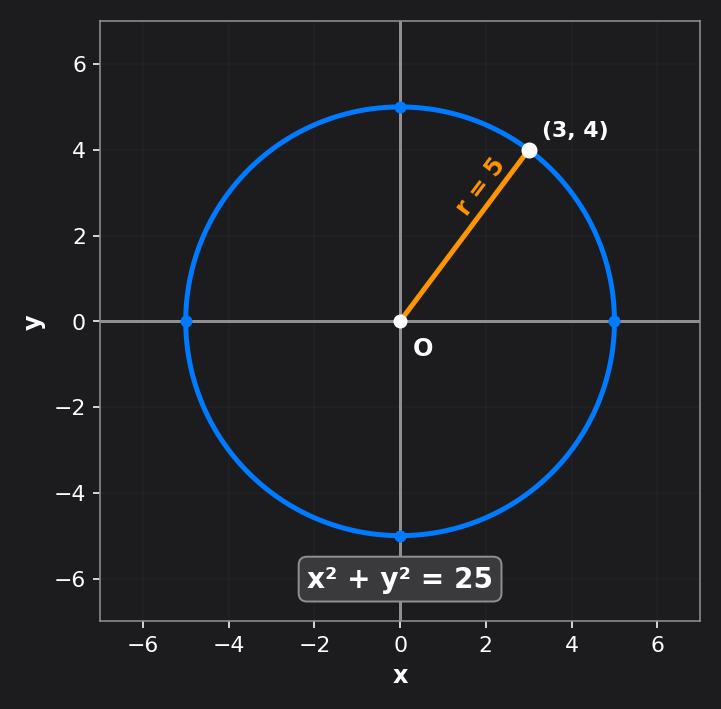
The equation of a circle centred at the origin with radius r is:

Any point (x, y) on the circle satisfies this equation.

Diagram

circle equation

Note

A circle centred at the origin with radius 5. The point (3, 4) lies on the circle since 3² + 4² = 25.

Method

To check if a point lies on a circle: substitute the coordinates into the equation and see if both sides are equal.

To find where a circle crosses an axis: set y = 0 (for the x-axis) or x = 0 (for the y-axis) and solve.

To find intersections with a line: substitute the equation of the line into the circle equation and solve the resulting quadratic.

Example

Does the point (3, 4) lie on the circle x² + y² = 25?

Solution

Substitute: 3² + 4² = 9 + 16 = 25. ✓

Yes, the point lies on the circle since 25 = 25.

Key Point

The tangent to a circle at any point is perpendicular to the radius at that point. So if the radius to (3, 4) has gradient 4/3, the tangent has gradient −3/4.

Gradient of a Curve

Definition

The gradient of a curve at a point is the gradient of the tangent line to the curve at that point. Unlike a straight line, the gradient of a curve changes at every point.

Diagram

gradient of curve

Note

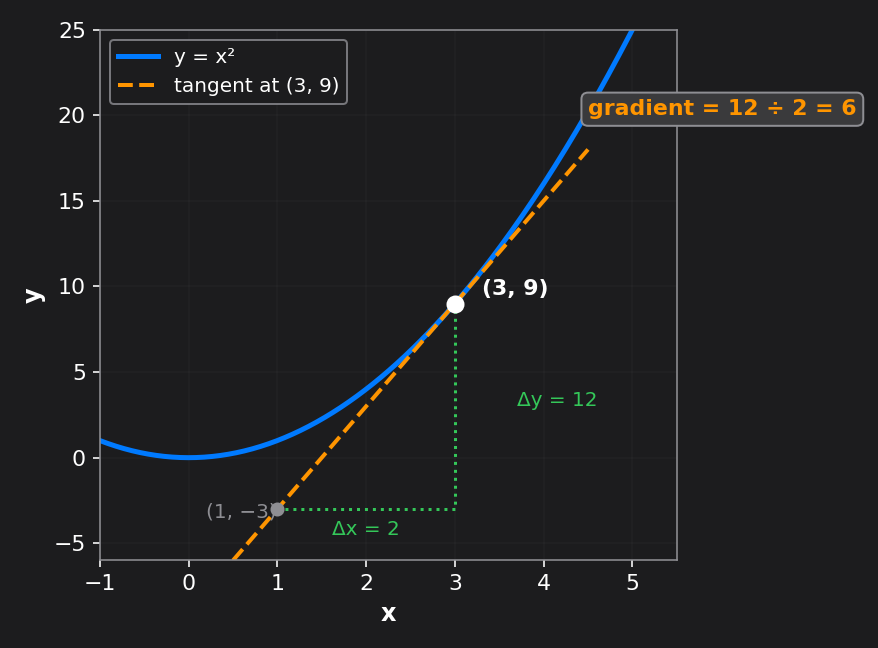
The gradient of y = x² at the point (3, 9) is found by drawing a tangent line and calculating its gradient: (9 − (−3)) ÷ (3 − 1) = 6.

Method

To estimate the gradient at a point on a curve:

1. Draw the tangent line at the point (a straight line that just touches the curve).

2. Pick two points on the tangent line that are easy to read.

3. Calculate the gradient: gradient = (change in y) ÷ (change in x).

Example

The tangent to y = x² at the point (3, 9) passes through (1, −3). Estimate the gradient at x = 3.

Solution

Gradient = (9 − (−3)) ÷ (3 − 1) = 12 ÷ 2 = 6.

So the gradient of y = x² at x = 3 is approximately 6.

Key Point

At a turning point (maximum or minimum), the gradient is zero — the tangent is horizontal.

In real-world contexts, the gradient of a distance–time graph gives velocity, and the gradient of a velocity–time graph gives acceleration.

Area under a Graph

Definition

The area under a graph can represent a real quantity. For example, the area under a velocity–time graph gives the distance travelled.

Method

For curves, we estimate the area using the trapezium rule:

where h is the width of each strip and y₀, y₁, ... yₙ are the y-values at equally spaced x-values.

More strips give a more accurate estimate.

Diagram

area under graph

Note

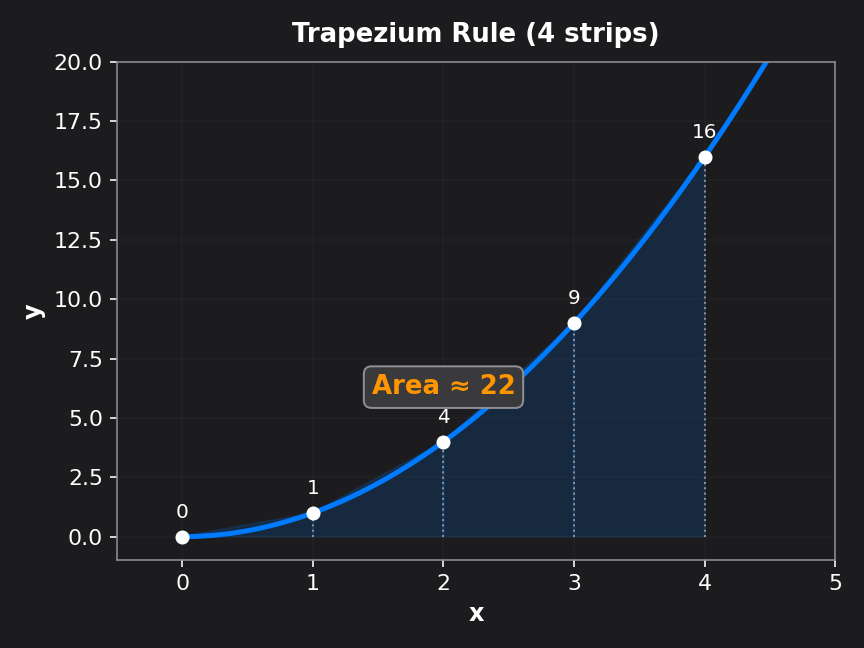
The trapezium rule estimates the area under y = x² using 4 strips from x = 0 to x = 4. The y-values at each strip boundary are used to form trapeziums.

Example

Use the trapezium rule with 4 strips to estimate the area under y = x² between x = 0 and x = 4.

Solution

h = (4 − 0) ÷ 4 = 1. The y-values are: y₀ = 0, y₁ = 1, y₂ = 4, y₃ = 9, y₄ = 16.

A ≈ 1/2 × [0 + 2(1 + 4 + 9) + 16] = 1/2 × [0 + 28 + 16] = 1/2 × 44 = 22

The estimated area is 22 square units.

Key Point

For a concave curve (curves downward like y = x²), the trapezium rule gives an overestimate. For a convex curve, it gives an underestimate.

Test yourself on this topic

Try the free quiz with worked solutions.

Start quiz →

Get GCSE Algebra

Full notes, full question bank, offline.