


G GCSE Apps

GCSE Algebra

Expressions, equations etc (F)

14 subtopics in this section

The language of algebra

Definition

The Language of Algebra is how we express a practical problem in mathematical terms. We use letters to denote unknown values.

Tips/hints

Look out for various terms which can be translated into mathematical signs Here are the signs and the words often used to replace them in a question: + 'More than' - 'Less than' x 'The product of', 'times' ÷ 'Divided by', 'split equally' = 'Is the same as'

Example

I am 2 years older than Kathryn. Find an expression for my age.

Solution

Let Kathryn's age be x. 'Older than' is like 'more than' so we use + My age is x + 2
Simplifying expressions I

Definition

Simplifying Expressions means collecting similar terms together to make the expressions easier to read.

Method

Look for like terms ie. the same letters. Be careful to keep the correct sign with each term. Also, group constant terms (ie. normal numbers) together.

Example

Collect like terms and simplify the expression: 3 - 4x + 5 + x

Solution

Collecting like terms we get 3 + 5 - 4x + x which becomes 8 - 3x

Simplifying expressions II

Definition

More complex algrebraic expressions can involve combinations of letters and powers of letters. Simplifying these also involves collecting like terms.

Method

When there's combinations of letters and powers of letters, 'like terms' must contain the same combinations and powers so, m²n is NOT a like term to mn².

Tips/hints

Don't forget though that the order of the letters in a term isn't important so, m²n is the same as nm²

Example

By first collecting like terms, simplify the expression: 2xy - y² + yx + 3x²y - xy

Solution

Collecting like terms we get: 2xy + yx - xy - y² + 3x²y = 2xy - y² + 3x²y (don't forget xy = yx)

Solving equations with brackets

Definition

Equations come in many forms. To solve those with brackets, first expand the brackets, then solve the equation in the normal way.

Tips/hints

Make sure you multiply any term outside a bracket with every term inside.

Example

Solve the equation: 2(x + 1) - 3(x - 3) = 0

Solution

Expand the brackets to get: 2x + 2 - (3x - 9) = 0 ie. 2x + 2 - 3x + 9 = 0 11 - x = 0 So, x = 11 Substitute back in to the original equation to check: 2(11 + 1) = 2(12) = 24 and 3(11-3) = 3(8) = 24 so our answer is correct

Multiplying expressions

Definition

Multiplying Expressions involves multiplying both numbers and letters.

Tips/hints

Take care to multiply both numbers and letters together and to make sure the write power is used if two expressions using the same letter are multiplied together.

Example

Multiply 4p(p - q)

Solution

Be careful to multiply each term in the bracket by the one outside. We get 4p² - 4pq

Equations with the variable on both sides I

Definition

Equations come in many forms. Sometimes the variable appears on both sides eg. 2x - 3 = x + 1

Method

When an equation has the variable on both sides, collect the terms using the variable on one side and constants on the other. Then you can solve the equation.

In order to collect terms on one side, add or subtract amounts from each side. For example: 4x - 3 = 2x + 1 To remove the 2x on the right hand side, subtract 2x from both sides of the equation. 4x - 3 - 2x = 2x + 1 - 2x So, 2x - 3 = 1. Similarly, remove the -3 from the left hand side by adding 3 to each side. 2x - 3 + 3 = 1 + 3 ie. 2x = 4 so x = 2

Tips/hints

Remember, what ever you add or subtract to/from one side of an equation, you must add or subtract to/from the other side.

Example

Solve the equation 5 - b = 3 + b

Solution

First, add b to both sides. 5 - b + b = 3 + b + b So, 5 = 3 + 2b Now subtract 3 from both sides So, 2 = 2b so b = 1

Formulae, expressions and equations

Definition

A Formula expresses a basic rule Eg. Area = πr² is the formula for the area of a circle.

An Expression is an arrangement of algebraic terms - it doesn't equate to anything Eg. 2mn + p is an expression

An Equation is algebraic expression that equals a number or another algebraic expression Eg. 3c - 4 = 7 - c

Tips/hints

If there's no equals sign, it's an Expression If there's an equals sign with a single letter or a word (eg. Area) on one side and an expression involving different letters on the other side, you can be pretty certain it's a Formula. If there's an equals sign and you can rearrange the terms to collect the variable on one side and a constant on the other, it's an Equation More advanced equations might be mistaken for formulas but at this level, these rules will apply.

Example

Decide whether these are formulas, expressions or equations (i) 4d = 1 - 2d (ii) 2(t - 1) + 2s(3p + q) (iii) A = 4πr²

Solution

(i) There's an equals sign so it's not an expression. There's just one variable, d and we can arrange it to get this on one side and a constant on the other so it's an equation.

(ii) There's no equals sign so it's an expression

(iii) There's an equals sign but we can't separate out a variable to be equal to just a constant so it's a formula.

Expansion, simplification and factorisation I

Definition

Expansion means multiplying out brackets Simplification means gathering like terms and combining them into one term Factorisation means finding factors and using brackets to simplify further.

Tips/hints

Expansion: Remember to multiply each term inside the bracket by what’s outside it.

Simplification: Don't forget that the order of the letters doesn't matter in an algebraic term: abc = bca = cab.

Factorisation: It's safest to factorise in steps. First find any numerical common factors. Once those have been factored out, then look for common factors made up of letters.

Example

Expand, simplify and factorise if possible the following expression: (3a - 2b)(2b - a) + b(4b - a)

Solution

First expand (multiply) out the brackets to get 6ab - 4b² - 3a² + 2ab + 4b² - ab

Simplify by gathering the like terms together: 6ab + 2ab - ab - 4b² + 4b² - 3a² = 7ab - 3a²

Now find common factors across the terms: a(7b - 3a)

Rearranging formulas I

Definition

A Formula is a means of working out an unknown variable by using information we have about other variables, When the variable that is unknown changes, we need to rearrange the formula to enable us to work it out.

Tips/hints

Formulas work like equations. Whatever you do one side of the equals sign, you must to do the other.

Example

Rearrange the formula P = 4t - s to make t the subject

Solution

We need to get t on its own on one side of the equals sign. Firstly, add s to both sides P + s = 4t Now divide by 4 and swap the sides to get: t = (P + s)/4

Solving linear equations

Definition

A linear equation is one which the variable appears only to the power 1 Eg. 3x = 2 4(b - 1) = 2(3 + b)

Method

Solving linear equations is straightforward. Collect all terms involving the variable on one side and all constants on the other.

Tips/hints

Don't forget, whatever you do to one side of an equation, you must do to the other.

Example

Solve the equation: c/5 = 4 + c

Solution

First, let's get rid of the fraction. To do this, multiply both sides by 5 c = 20 + 5c Now, subtract 5c from both sides to get -4c = 20 so, c = -5 Substitute this into the original equation to check the answer: c/5 = -5/5 = -1 4 + c = 4 - 5 = -1 so the answer is correct

Equations with the variable on both sides II

Definition

Equations with the variable on both sides can be quite complex, involving several expressions.

Tips/hints

The key is to take care in expanding brackets and simplifying. Also, it's a good habit to check your answer by substituting it back into the original question.

Example

Solve the equation 3(6 + a) = 4(1 - a)

Solution

First, expand the brackets to get 18 + 3a = 4 - 4a Now add 4a to each side 18 + 7a = 4 Now subtract 18 from each side 7a = -14 which makes a = -2 Substitute back into the original equation 3 ( 6 - 2 ) = 12 4 ( 1 - (-2) ) = 4 ( 3 ) = 12 So our answer is correct

Setting up equations

Definition

Setting Up Equations is the conversion of a practical problem into a mathematical one

Method

The key thing is to understand what information the question is providing and what it wants you to find. It's normally a good move to make the piece of information the question is asking for a variable such as x and take it from there.

Example

Last year your brother was twice as old as you are now. Next year he'll be 12. How old are you now?

Solution

They're asking for your age now so let that be x If your brother is 12 next year, then this year he's 11 and last year he was 10 We're told that last year he was twice as old as you are now so, 2x = 10 so x = 5 That is, you are now 5 years old.

Substitution

Definition

When we know the value of one or more variables in an expression or formula, we can Substitute these in to simplify the expression/formula or evaluate it

Method

This is quite straightforward. Just make sure you take care with the arithmetic.

Example

Find the value of x² + xy - y² when x = -1, y = 2

Solution

The expression becomes: (-1)² + (-1)(2) - 2² = 1 - 2 - 4 = -5

Iteration

Definition

Iteration is a method for finding approximate solutions to equations that are difficult to solve algebraically. You start with an estimate and repeatedly apply a formula to get closer and closer to the true answer.

An iterative formula has the general form:

where xn is the current value and xn+1 is the next (improved) value.

Method

To use iteration to solve an equation:

1. Rearrange the equation into the form x = f(x) to create an iterative formula.

2. Choose a starting value x0 (this is often given in the question).

3. Substitute x0 into the formula to find x1.

4. Substitute x1 into the formula to find x2, and so on.

5. Keep going until the values converge (settle down to a consistent answer to the required number of decimal places).

Key Point

An equation can often be rearranged into several different iterative formulas. Not all of them will converge — the question will usually tell you which rearrangement to use.

The solution is found to a given number of decimal places when two consecutive iterations round to the same value at that precision.

Diagram

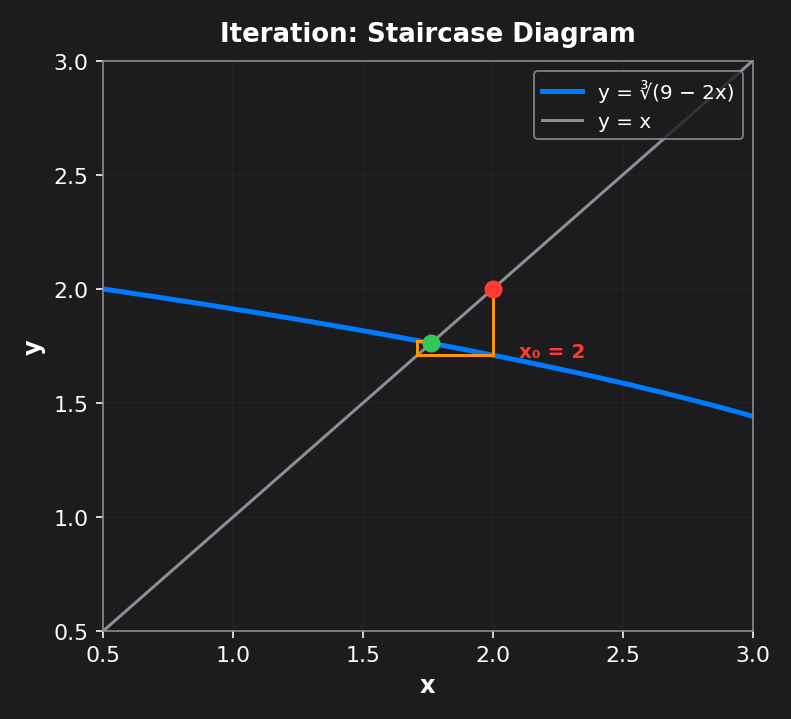
iteration staircase

Note

A staircase diagram showing iteration converging to a solution. Starting at x₀ = 2, each step applies the formula and moves closer to where y = f(x) meets y = x.

Example

The equation can be rearranged to x³ = 9 − 2x, giving the iterative formula:

Starting with x0 = 2, find the solution to 1 d.p.

Solution

x1 = ∛(9 − 2 × 2) = ∛5 = 1.7100

x2 = ∛(9 − 2 × 1.7100) = ∛5.5800 = 1.7737

x3 = ∛(9 − 2 × 1.7737) = ∛5.4526 = 1.7601

x2 and x3 both round to 1.8 to 1 d.p., so the solution is x = 1.8 (1 d.p.).

Example

Use the iterative formula with x0 = 2 to find a solution to correct to 1 d.p.

Solution

x1 = ∛(4 × 2 + 2) = ∛10 = 2.1544

x2 = ∛(4 × 2.1544 + 2) = ∛10.6176 = 2.1979

Both x1 and x2 round to 2.2, so the solution is x = 2.2 (1 d.p.).

Test yourself on this topic

Try the free quiz with worked solutions.

Start quiz →

Get GCSE Algebra

Full notes, full question bank, offline.