


G GCSE Apps

GCSE Algebra

Advanced expressions and equations (H)

6 subtopics in this section

Uses of graphs-solving linear simultaneous equations

Definition

In the same way that any (linear) equation of the form y = mx + c can be represented as a graph, so can any pair of linear simultaneous equations. Their solution is given by the point of intersection of the lines. If the lines don't intersect, then there is no solution to the equations.

Method

If you're asked to solve a pair of simultaneous equations graphically, draw the graphs in the usual way and find their point of intersection. The coordinates of this point give the solution to the equations.

Tips/hints

Always substitute your answer back into the equations in the original question to check it.

Example

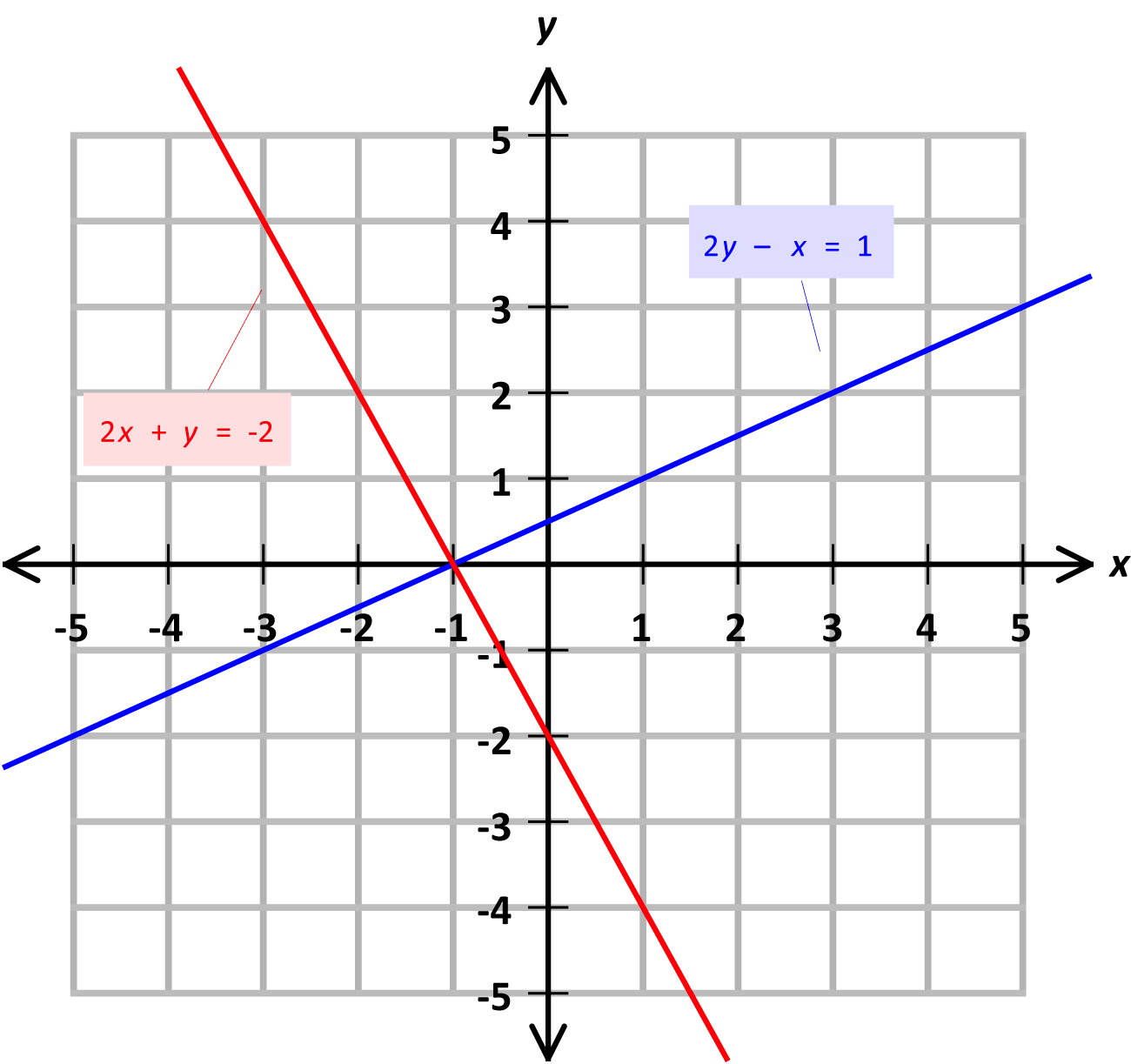
Using the graph, what is the solution for the pair of simultaneous equations: x = 2y - 1 2(x+1) = -y

Diagram
sim graph ex

Solution

The equations we're given don't seem to match the lines on the graph but, try rearranging them. You'll get: 2y - x = 1 (the equation of the blue line) 2x + y = -2 (the equation of the red line)

So, the graphs are the equations we've been given. The solution is the point of intersection ie. (-1, 0), x = -1, y = 0 Substitute these values into the equations in the question to check your answer.


Simultaneous equations

Definition

Simultaneous Equations are a set of equations in two or more variables. Your task is to find the values of the variables that satisfy all the equations. At this level, you'll only have to deal with two simultaneous equations and two variables.

Linear Simultaneous Equations will only involve single powers of the variables ie. x, y and not x², y² etc.

Method

The first step is to REARRANGE the equations to get the x, y terms on the left any constants on the right. The second step is to ELIMINATE one of the variables The third step is to SOLVE for the remaining variable The fourth step is to SUBSTITUTE this variable in and solve for the other variable The final step is to CHECK

The easiest way to see this is to follow the example below.

Solve the equations: 3x + y = 4 2y = 3 - x

First REARRANGE: 3x + y = 4 EQ 1 x + 2y = 3 EQ 2

Now we ELIMINATE one of the variables. To do this, we match up the coefficients of one of the variables in each equation. Let's match up the coefficients of y To do this, multiply EQ 1 by 2 and relabel it EQ 3 We now have: 6x + 2y = 8 EQ 3 x + 2y = 3 EQ 2 Now subtract EQ 2 from EQ 3 to get: 5x = 5

Next step is to SOLVE this for x So, x = 1

Next step, SUBSTITUTE that value back into one of the original equations, EQ 1, say to get 3 + y = 4 so y = 1

Now CHECK by putting both the values back into the other original equation, EQ 2 So 1 + 2 = 3 which is correct.

Example

Solve the simultaneous equations: x + y = 3 2(1 - y) = x

Solution

First, REARRANGE to get: x + y = 3 EQ 1 x + 2y = 2 EQ 2

Next ELIMINATE a variable. Subtract EQ 1 from EQ 2 to get y = -1 This has completed the next step, too.

Now SUBSTITUTE y = -1 into EQ 1 x - 1 = 3 so x = 4

Now CHECK by putting both values into EQ 2 2( 1 - (-1) ) = 2 ( 1 + 1 ) = 4 which is correct.

Setting up simultaneous equations

Definition

Often we're presented with a problem in words that we need to convert into a mathematical problem. When there are two unknown variables, we'll need to Set Up Simultaneous Equations and solve them

Method

Read the question carefully and decide what your variables are going to represent. Then, formulate a pair of equations using these variables. Solve in the usual way.

Example

Alex buys some vegetables at the market. Carrots cost £1 per kg and peas cost £2 per kg. In total, he spends £9 and has 7kg of carrots and peas to carry home How many kg of each vegetable does he buy?

Solution

Let x be the weight of carrots and y be the weight of peas.

The total weight is 7kg so x + y = 7 The cost of the carrots he buys will be 1x = x and the cost of the peas 2y The total cost is £9 so, x + 2y = 9

So, we have a pair of simultaneous equations: x + y = 7 x + 2y = 9 Solve these in the usual way to find x = 5, y = 2

Algebraic fractions

Definition

Algebraic Fractions are simply fractions that include algebraic expressions. They can be multiplied, divided, added and subtracted in the same way as numerical fractions. Also, they can be simplified by dividing numerator and denominator by a common factor.

Multiplication

Multiply the terms in the numerators together, and multiply the denominators together. Then cancel any common factors

Division

Turn the second fraction upside down and change the ÷ to multiply.

Addition

Find a common denominator (here the two denominators are multiplied together) and proceed as with numerical fractions.

Here the numerator can't be simplified any further

Subtraction

Find a common denominator (here the two denominators are multiplied together) and proceed as with numerical fractions.

Again, the numerator can't be simplified any further.

Tips/hints

Keep each step as simple as possible. There's lots of scope for error so check your work carefully

Example

Work out the following leaving your answers in their simplest terms. (i) (ii)

Solution

(i)

(ii) Make pq the common denominator to get:

Expand the brackets to get:

Which becomes:

Solving equations with algebraic fractions

Definition

Equations with Algebraic Fractions follow the same rules as normal equations.

Method

Usually the first step is to multiply everything by a suitable term to remove any denominators. Then simplify and solve like a normal equation.

Tips/hints

Multiplying out algebraic denominators often results in quadratic equations being formed so make sure you find all the solutions.

Example

Solve the equation for x > 0

Solution

Note: we're told x > 0 because otherwise the terms with x in the denominator would be undefined.

First, multiply by x² to remove the denominators. We get 6 = 5x - x² Rearrange to x² - 5x + 6 = 0 This factorises to (x - 3)(x - 2) = 0 making our solution x = 3, x = 2

Don't forget to check the solution in the original equation. Putting in x = 2 we get 6/4 = 1 1/2 for the left side and 5/2 - 1 = 1 1/2 for the right side which matches. And putting in x = 3 we get 6/9 = 2/3 on the left, 5/3 - 1 = 2/3 on the right, again, a match.

Linear and non-linear simultaneous equations

Definition

Simultaneous Equations are not always linear. Some equations may contain an x² term.

Method

These are solved in a slightly different way to a pair of linear equations. Again, break it down into steps to keep it simple.

First step REARRANGE the equation containing the x² term so that the equation is in the form y = ...

Now SUBSTITUTE this expression for y into the linear equation.

Rearrange this equation and SOLVE THE QUADRATIC for x

Put the value(s) for x into the rearranged original equation for FIND THE VALUE(S) for y

Finally CHECK the solution(s) (there's normally two) in the other original equation.

Follow the worked example below to see it in action.

Example

Solve the simultaneous equations: y - x² = 1 5x = 3 + y

Solution

REARRANGE the first equation and add labels to get: y = 1 + x² EQ 1 5x = 3 + y EQ 2

Substitute y = 1 + x² into EQ 2 5x = 3 + 1 + x²

Rearrange to get x² - 5x + 4 = 0 and factorise (x - 4)(x - 1) = 0 to SOLVE THE QUADRATIC So, x = 1, x = 4

Now FIND THE VALUES for y Put x = 1 into EQ 1 giving y = 2 Put x = 4 into EQ 1 giving y = 17

Now CHECK in EQ 2. First try x = 1, y = 2 5(1) = 5 = 3 + 2 so that's OK. Now try x = 4, y = 17 5(4) = 20 = 3 + 17 so that's OK too. So, our solutions are: x = 1, y = 2 and x = 4, y = 17

Test yourself on this topic

Try the free quiz with worked solutions.

Start quiz →

Get GCSE Algebra

Full notes, full question bank, offline.