


Probability Tree Diagrams: Step-by-Step for GCSE
How to draw and use tree diagrams for GCSE probability — with and without replacement, conditional probability, and 'at least one' tactics.
5 February 2026 · Webrich Software
Probability tree diagrams are one of the highest-yielding topics on Higher tier and a regular Foundation appearance. Get the method right and you can pick up 6–8 marks across the paper in a few minutes.
What a tree diagram does
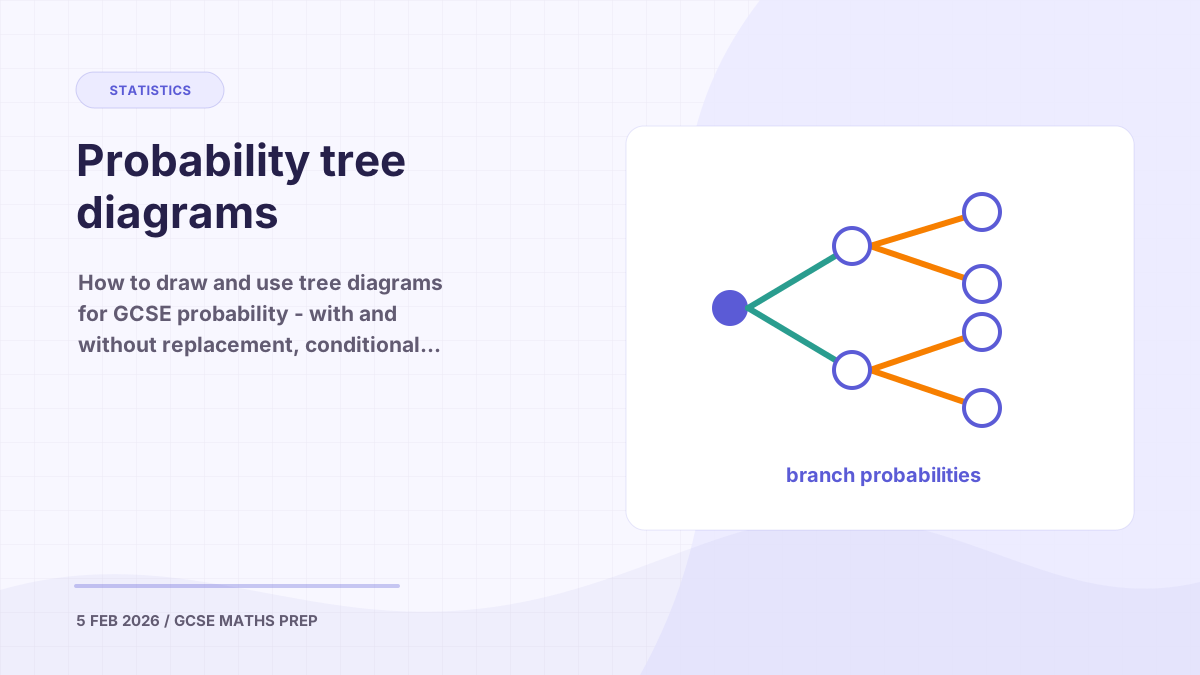
It maps every possible sequence of outcomes. Each branch shows the probability of that outcome happening given everything that’s happened so far. Multiply along a path to get the probability of that exact sequence. Add the probabilities of paths you want.
The general method
Tip: Always write probabilities on the branches, not the nodes. Examiners are looking at branch labels — that’s where the marks live.
- Draw branches for the first event. Label probabilities.
- Draw a fresh set of branches off each first-event node for the second event. Label.
- Repeat for as many events as the question has.
- To find P(outcome A) — multiply along the relevant path.
- To find P(any of several outcomes) — multiply along each, then add.
Worked example: with replacement
A bag has 6 red and 4 blue counters. You pick one, note it, replace it, then pick another. P(both red)?
Probabilities on each branch:
- P(red on pick 1) = 6/10 = 3/5
- P(red on pick 2 | replaced) = 6/10 = 3/5 (same — that’s what “replacement” means)
P(both red) = 3/5 × 3/5 = 9/25.
Worked example: without replacement
Same bag. Pick one, don’t replace, pick another. P(both red)?
After removing one red:
- 5 red and 4 blue remain → 9 total
- P(red on pick 2 | first was red) = 5/9
P(both red) = 6/10 × 5/9 = 30/90 = 1/3.
| Variant | Pick 1 | Pick 2 (after red) | P(both red) |
|---|---|---|---|
| With replacement | 6/10 | 6/10 | 9/25 |
| Without replacement | 6/10 | 5/9 | 1/3 |
Remember: The first pick is the same in both cases. Replacement only affects later picks.
The “at least one” shortcut
A bag has 5 red and 5 blue counters. You pick 3 with replacement. What is P(at least one red)?
The slow way: add P(exactly 1 red) + P(exactly 2 red) + P(exactly 3 red). Three calculations.
The fast way:
- P(at least one red) = 1 − P(no reds)
- P(no reds) = P(all blue) = (5/10)³ = 1/8
- Answer = 1 − 1/8 = 7/8
Always try the complement first. The question “at least one of X” almost always has a simpler “none of X” complement.
Conditional probability questions
Higher tier loves the structure: “Given that the first card was red, what’s the probability the second is also red?” That given is doing all the work — it tells you which branch you’re already standing on.
Did you know? “Given that” in maths means “we are restricted to the universe where this has happened.” It’s a denominator change, not a numerator one. The probability is P(event ∩ given) ÷ P(given).
Common errors
- Forgetting to subtract from the total when calculating “at least one.” This trips up everyone at some point.
- Replacing on the second branch by accident. If the question says “doesn’t replace,” update the denominator.
- Not adding all relevant paths. “P(one red, one blue, in any order)” means add P(red then blue) and P(blue then red).
- Forgetting to simplify, especially at the end of a 3-event tree where denominators get big (60, 120, 240…).
Drill them properly
Tree diagrams stick with practice, not reading. Try the dedicated topics in our Statistics quiz — probability is the largest of the four subject areas in the GCSE Statistics app, with subtopics specifically on tree diagrams, conditional probability and “at least one” questions.
Frequently asked questions
When should I use a tree diagram instead of just multiplying?
Use a tree diagram whenever there are two or more dependent or sequential events AND the question asks for a combined probability. For a single coin flip you don't need one. For 'three coin flips, what's the probability of exactly two heads?' you do — or at least you should sketch one mentally.
Do I need to simplify fractions in the final answer?
Always simplify unless the question explicitly says otherwise. 12/36 should be 1/3. Leaving an unsimplified answer rarely loses marks on its own, but it makes it harder for the examiner to see you got the right answer and easier for you to make arithmetic slips downstream.
What's the difference between 'with replacement' and 'without replacement'?
'With replacement' means after you take the first item, you put it back — so probabilities don't change for the next pick. 'Without replacement' means you keep it out — probabilities and denominators both change. The classic question: '5 red, 3 blue balls in a bag. Pick two without replacement, what's the probability both are red?' Answer: 5/8 × 4/7 = 20/56 = 5/14.
Related apps
Put it into practice
Free quizzes for every topic, or download the apps for the full experience.